.png)



D2C brands do not need the longest possible agency menu. They need the right marketing agency services, connected to the business problems that actually control growth: demand, conversion, margin, retention, and brand trust.
For ecommerce entrepreneurs, this distinction matters. A brand can spend heavily on paid social, launch beautiful creative, and still stall if the offer is unclear, the product page does not answer buyer objections, or retention is treated as an afterthought. The best agency support is not a collection of disconnected tactics. It is a growth system built around how your customers discover, evaluate, buy, and come back.
That is especially true for D2C brands in sports, fitness, wellness, apparel, nutrition, and CPG, where customers often need education, proof, identity, and confidence before they purchase. Below are the marketing agency services that matter most for D2C, plus how to tell whether an agency is delivering work that can compound over time.
Why D2C Brands Need a Different Agency Model
Traditional marketing often separates brand, performance, website, email, and analytics into different silos. D2C cannot afford that separation. Your ad creative affects landing page conversion. Your landing page affects CAC. Your retention flow affects how much you can spend to acquire customers. Your brand positioning affects whether shoppers see you as a commodity or a category leader.
This is why a strong D2C agency should think beyond campaign execution. OPTYO has written more about this broader agency standard in its guide on why a marketing agency needs more than marketing, and the same principle applies here: services only matter when they work together.
For a D2C brand, the question is not “Can this agency run ads?” It is “Can this agency help us understand what is preventing profitable growth, then build the right system to fix it?”
1. Brand Strategy and Positioning
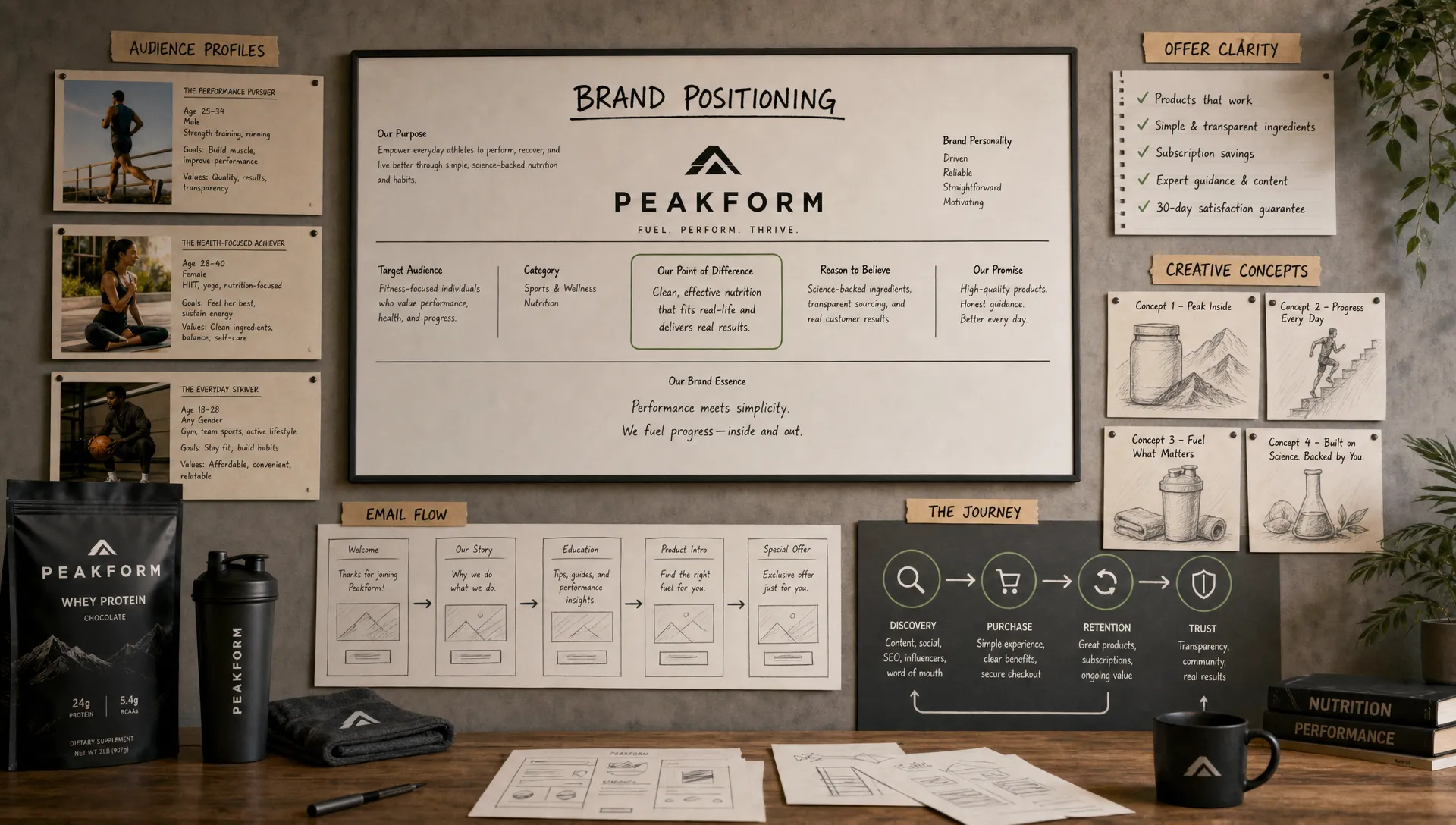
Before media spend scales, the brand has to be easy to understand and hard to ignore. Positioning is the foundation for nearly every other marketing agency service because it shapes your messaging, creative angles, landing pages, email flows, influencer briefs, and product storytelling.
For D2C, strong positioning answers a few practical questions:
- Who is this product specifically for?
- What problem does it solve better than the alternatives?
- Why should a shopper believe the claim?
- What emotional identity does the customer buy into?
- What makes the offer worth acting on now?
This is not abstract brand theory. It is conversion infrastructure. A running recovery brand, for example, needs to communicate different value to marathoners, CrossFit athletes, weekend runners, and physical therapy customers. A wellness CPG brand may need to decide whether it is selling performance, clean ingredients, convenience, taste, or lifestyle status.
Weak positioning shows up everywhere. Ads feel generic. Product pages over-explain features but under-sell outcomes. Email campaigns repeat discounts because the brand has no deeper story to tell. When evaluating an agency, ask how they will sharpen your positioning before they increase media pressure.
2. Performance Marketing Built Around Learning
Paid social and paid search are still critical D2C growth channels, but performance marketing has changed. Platform automation is stronger, attribution is less perfect, and creative fatigue can arrive quickly. The agency’s job is no longer just to push buttons inside ad accounts. The job is to build a learning engine.
That means every campaign should test a useful business question. Which audience pain point converts best? Which product benefit has the highest purchase intent? Which creative style produces profitable first orders? Which landing page best supports a specific offer? Which customer segment has the strongest payback window?
A good performance marketing service should include:
- Campaign structure aligned with business goals, not vanity metrics.
- Creative testing that produces insights, not just more ad variations.
- Budget allocation based on margin, inventory, seasonality, and cash flow.
- Full-funnel thinking across acquisition, retargeting, and retention.
- Clear readouts on what was learned and what changes next.
For D2C brands, ROAS alone is not enough. If a campaign drives cheap purchases from one-time discount seekers, it may look strong in-platform while weakening long-term economics. A better agency watches CAC, AOV, contribution margin, repeat purchase rate, payback period, and customer quality.
3. Creative Asset Production That Sells
Creative is now one of the biggest performance levers in D2C marketing. The difference between average and excellent creative can determine whether paid acquisition scales or stalls.
But “creative” should not mean random lifestyle photos, trend-chasing videos, or polished assets that do not answer buyer objections. D2C creative must sell. It has to communicate the problem, the promise, the proof, the product, and the reason to act, often in seconds.
For sports, fitness, and wellness brands, creative should often combine education and aspiration. Customers want to see how the product fits their routine, what result it supports, and why it belongs in their identity. A gym accessory brand may need product demos and performance proof. A supplement brand may need ingredient education and trust-building claims. An apparel brand may need fit, movement, durability, and community signals.
The best creative production service includes both volume and strategy. Volume matters because platforms need fresh inputs, but strategy matters because more assets are not automatically better. An agency should be able to map creative concepts to customer awareness stages, purchase objections, product benefits, and channel formats.
A simple test: if your agency cannot explain why each creative concept exists, what it is testing, and where it fits in the customer journey, the service may be production-heavy but strategy-light.
4. Ecommerce Development and Conversion Rate Optimization
A D2C website is not a brochure. It is a sales environment. Every part of the experience should help a shopper move from curiosity to confidence.
That is why ecommerce development and conversion rate optimization, often called CRO, are among the most important marketing agency services for D2C brands. Traffic only becomes valuable when the site can convert it profitably.
CRO is not just button colors or headline tweaks. It includes offer clarity, page speed, product education, merchandising, social proof, checkout friction, mobile usability, bundles, subscription logic, and post-click message match. Baymard Institute’s checkout usability research has long shown how checkout friction can cost ecommerce brands sales, but the same principle applies across the entire buying journey.
Think about a premium product category where visual quality, fit, customization, shipping, and trust all influence the purchase. A D2C home brand like BUYnBLUE’s modern designer lighting store has to help shoppers understand style, room fit, material quality, customization options, delivery expectations, and return confidence before they feel ready to buy. The same principle applies to D2C fitness equipment, wellness products, technical apparel, and premium CPG: the page has to remove uncertainty.
For D2C brands, high-impact CRO often focuses on a few core areas:
- Product pages that answer objections before the shopper leaves.
- Landing pages that match the promise made in the ad.
- Bundles and offers that improve AOV without confusing the buyer.
- Mobile-first design that makes product evaluation fast and clear.
- Checkout flows that reduce friction and reinforce trust.
If paid media is getting traffic but revenue is not following, the problem may not be the campaign. It may be the conversion environment.

5. Email Marketing and Customer Retention
Many D2C brands over-focus on acquisition because it is the most visible growth lever. But profitable growth often depends on retention. Email marketing helps turn first-time buyers into repeat customers, educate leads who are not ready to buy, and recover revenue that would otherwise be lost.
A strong email marketing service should cover both automated flows and campaign strategy. Automated flows create the foundation: welcome series, abandoned cart, browse abandonment, post-purchase education, replenishment reminders, winback flows, and review requests. Campaigns create momentum around launches, promotions, seasonal moments, community stories, and educational content.
For D2C brands, retention content should not be only promotional. Customers need reasons to stay engaged between purchases. Fitness brands can share training tips, product use cases, athlete stories, and recovery education. Wellness brands can educate around routines, ingredients, habit formation, and customer outcomes. CPG brands can build usage occasions, recipes, replenishment reminders, and bundle ideas.
The goal is not to send more emails. The goal is to increase customer value while strengthening the relationship with the brand. Done well, email can improve repeat purchase rate, LTV, margin, and cash flow, which then gives the brand more room to invest in acquisition.
6. Search Engine Optimization for Demand Capture
SEO is often overlooked by early D2C brands because paid media feels faster. But organic search can become one of the most valuable channels in the growth mix, especially when shoppers are actively comparing products, researching ingredients, looking for solutions, or searching for category education.
SEO for D2C should not be limited to blog posts. It should include technical SEO, product page optimization, collection page strategy, internal linking, content planning, and search-informed merchandising. The best opportunities often sit close to revenue: “best running recovery tools,” “protein powder for sensitive stomach,” “compression shorts for lifting,” or “electrolytes for endurance training.”
The content should match the buying journey. Top-of-funnel education builds category awareness. Middle-of-funnel guides help shoppers compare solutions. Bottom-of-funnel pages support high-intent searches and product evaluation.
If organic search is part of your growth plan, it helps to understand how a specialized partner approaches the channel. OPTYO’s article on how a search engine optimization agency grows D2C brands breaks down the role of SEO in ecommerce growth in more detail.
The key point is simple: SEO compounds when it is tied to product demand, not when it is treated as generic publishing.
7. KPI Reporting That Connects Marketing to the Business
Reporting is one of the most underrated marketing agency services. Many agencies provide dashboards. Fewer provide decision-making clarity.
D2C founders need reporting that connects marketing activity to business performance. That means looking beyond impressions, clicks, and platform ROAS. Useful reporting should explain what is happening, why it matters, and what the team should do next.
Important D2C metrics often include:
- Revenue by channel and campaign.
- CAC and blended CAC.
- MER, or marketing efficiency ratio.
- AOV and conversion rate.
- Contribution margin after ad spend.
- Repeat purchase rate and customer lifetime value.
- Email revenue, list growth, and flow performance.
- Creative fatigue and testing results.
The right KPI reporting helps founders make better tradeoffs. Should you increase spend, improve the offer, fix the landing page, push a bundle, pause a campaign, invest in retention, or expand SEO? Without clear reporting, teams guess. With clear reporting, marketing becomes a management system.
This is also where agency experience matters. A partner that understands ecommerce operations, cash flow, inventory, and margins can give better recommendations than one that only reads platform dashboards.
8. Growth Consulting and Prioritization
D2C teams are rarely short on ideas. They are short on focus. Growth consulting helps decide what to do first, what to delay, and what not to do at all.
This service is valuable because every marketing action has an opportunity cost. A founder might want to launch TikTok ads, redesign the website, test subscriptions, hire creators, build an ambassador program, improve SEO, create bundles, and launch a new product at the same time. Some of those ideas may be smart. Doing all of them at once can dilute resources and make results harder to interpret.
A strong growth consulting partner should help identify the current constraint. If awareness is low, the priority may be creative and acquisition. If traffic is strong but sales are weak, the priority may be CRO and offer strategy. If first purchases are healthy but repeat revenue is low, the priority may be email, product education, and replenishment. If paid media is profitable but capped, the priority may be channel expansion or SEO.
OPTYO’s guide on what a direct to consumer marketing agency should fix goes deeper into diagnosing these bottlenecks. The main takeaway is that the best service is the one that addresses the constraint holding growth back right now.
How to Choose Which Services Matter Most Right Now
Not every D2C brand needs the same agency support on day one. The right service mix depends on stage, budget, margins, team capabilities, and growth goals.
An early-stage brand may need positioning, creative testing, landing pages, and initial acquisition. A brand with product-market traction may need performance marketing, CRO, retention, and reporting. A more mature D2C company may need channel diversification, SEO, advanced segmentation, creative systems, and deeper strategic planning.
Instead of asking an agency for a standard package, ask for a diagnosis. A strong partner should be able to review your funnel and identify the highest-leverage opportunities across acquisition, conversion, retention, and measurement.
Good agency conversations should include questions like:
- What is currently limiting profitable growth?
- Which metrics show the clearest opportunity?
- What must be fixed before scaling spend?
- What can we test in the next 30 to 60 days?
- How will creative, media, website, and retention work together?
- How will results be reported in business terms?
If the answers are vague, the service offering may be too tactical. If the answers connect marketing work to revenue, margin, and customer behavior, you are closer to the kind of agency relationship D2C brands actually need.
Frequently Asked Questions
What marketing agency services are most important for D2C brands? The most important services are brand strategy, performance marketing, creative production, ecommerce development, conversion rate optimization, email marketing, SEO, KPI reporting, and growth consulting. The exact priority depends on the brand’s current bottleneck.
Should a D2C brand hire an agency for paid ads first? Not always. Paid ads can accelerate growth, but they work best when positioning, creative, product pages, and retention are strong enough to support profitable acquisition. If those foundations are weak, scaling ad spend can expose the problem faster.
How does CRO fit into D2C marketing? CRO improves the website experience so more visitors become customers. For D2C brands, CRO can include product page messaging, mobile usability, offers, bundles, reviews, checkout friction, and landing page alignment with ads.
Why is email marketing important for D2C? Email marketing improves retention, repeat purchases, customer education, and revenue from owned audiences. It helps reduce dependence on paid acquisition by increasing the value of each customer after the first purchase.
How should D2C brands evaluate agency reporting? Agency reporting should connect marketing activity to business outcomes. Look for clarity around CAC, MER, conversion rate, AOV, margin, retention, creative learnings, and the next decisions the data supports.
Build a D2C Growth System, Not Just a Marketing Checklist
The marketing agency services that matter most for D2C are the ones that work together. Strategy shapes creative. Creative fuels acquisition. Acquisition depends on conversion. Conversion improves when the offer is clear. Retention increases customer value. Reporting keeps the system honest.
If you are building a sports, fitness, wellness, ecommerce, or CPG brand, OPTYO helps connect performance marketing, creative, ecommerce optimization, email, SEO, reporting, and growth consulting into a focused growth system. Learn more about how OPTYO supports D2C brand growth.