.png)



For many direct to consumer brands, growth starts with a channel. A founder runs Meta ads, lands an influencer partnership, posts short-form videos, builds an email list, or launches a few SEO pages. Early wins can be real. But as acquisition costs rise and the easiest buyers are captured, single-channel growth starts to feel fragile.
That is where full-funnel thinking becomes essential.
A direct to consumer brand does not just need more traffic. It needs a connected system that creates demand, earns trust, converts efficiently, and brings customers back. When those pieces work in isolation, marketing becomes expensive and unpredictable. When they work together, each dollar spent has a better chance of turning into durable growth.
This matters especially for sports, fitness, wellness, CPG, and ecommerce brands. Customers are not just buying a product. They are buying a promised outcome: better performance, better recovery, better nutrition, better confidence, or a better daily routine. That kind of purchase requires education, credibility, timing, proof, and follow-through.
What full-funnel thinking actually means
Full-funnel thinking means making marketing decisions with the entire customer journey in mind, not just the next click or the next order.
In a direct to consumer model, the brand owns the customer relationship from first impression through repeat purchase. There is no retailer doing the merchandising for you, no in-store associate explaining the product, and no shelf placement creating passive discovery. Your marketing, website, creative, email, content, offer, and post-purchase experience have to do that work together.
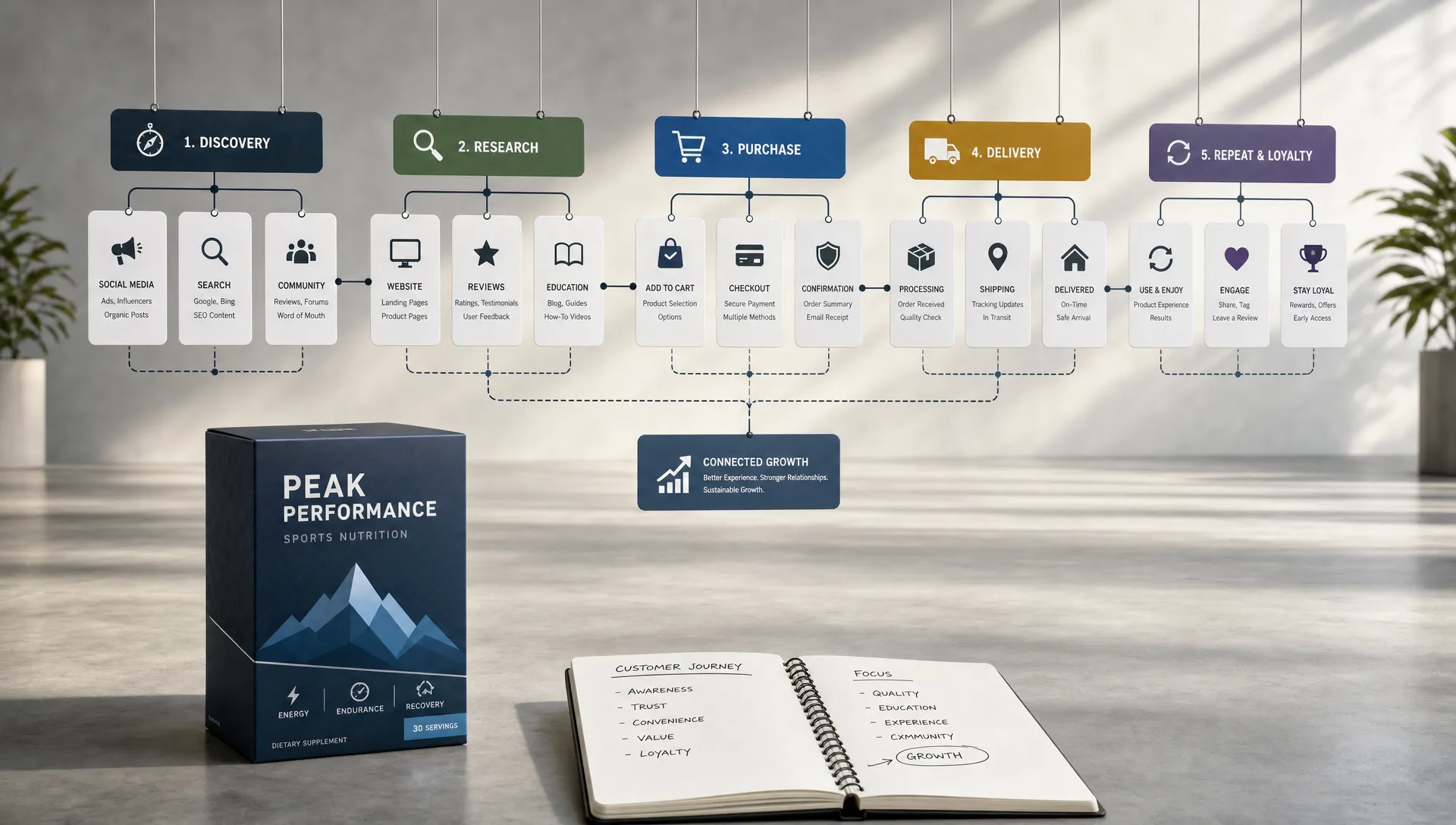
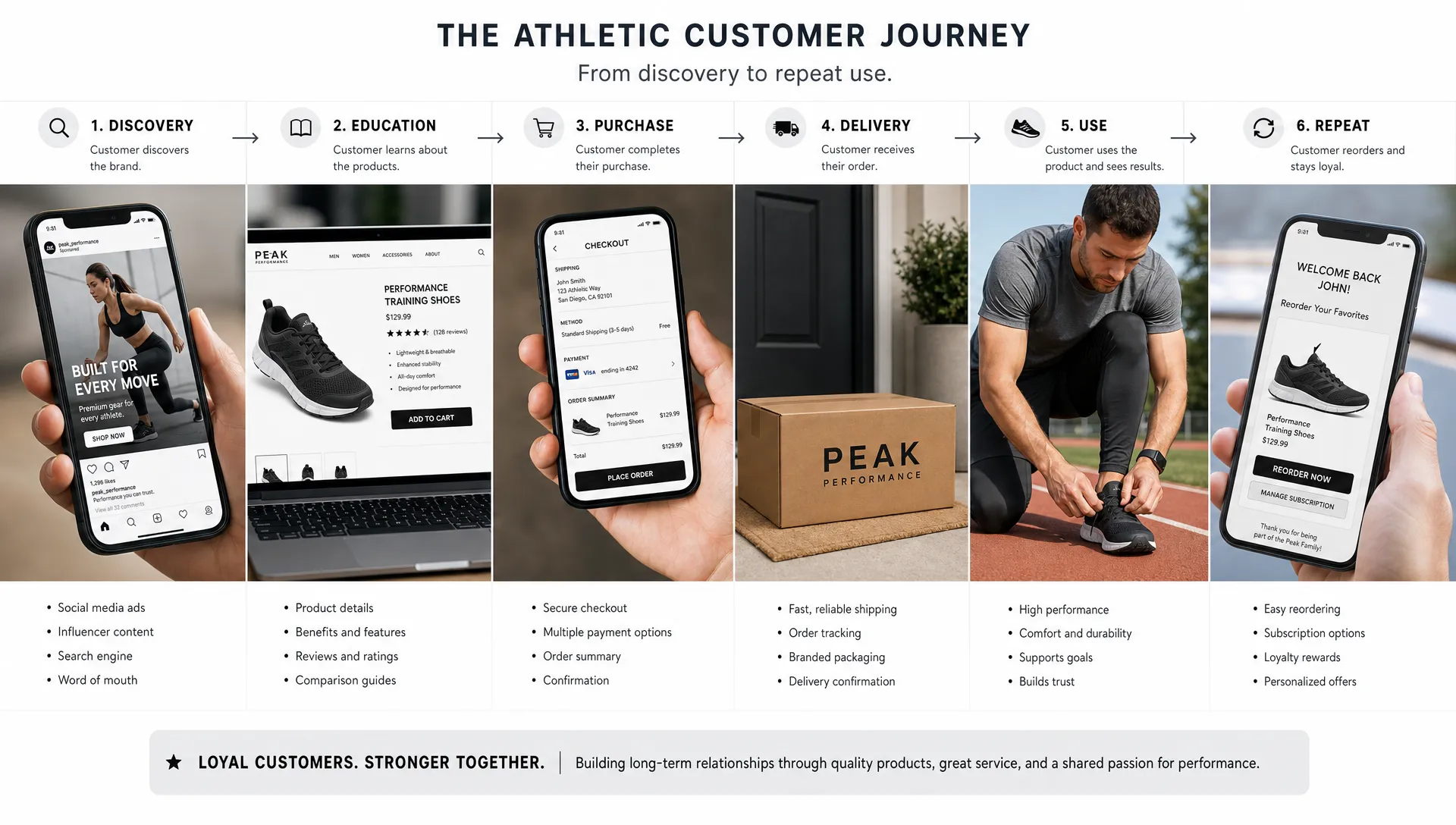
A full-funnel approach usually includes four connected stages:
- Demand creation: Reaching people who may not know your brand, but have a relevant problem, goal, identity, or aspiration.
- Consideration: Helping prospects understand why your product matters, how it works, who it is for, and why they should trust you.
- Conversion: Removing friction so interested shoppers can confidently buy.
- Retention: Turning customers into repeat buyers, advocates, subscribers, or community members.
The funnel is not perfectly linear. A runner might see a recovery drink on TikTok, search for reviews a week later, visit the product page twice, sign up for a discount, abandon cart, buy after an email, then come back 30 days later if the experience matched the promise. Full-funnel thinking respects that reality.
Why fragmented growth breaks DTC brands
The most common mistake direct to consumer brands make is treating every marketing function as a separate problem.
Paid media is judged only on ROAS. Creative is judged only on engagement. The website is judged only when conversion rate drops. Email is treated as a discount channel. SEO is pushed off until paid acquisition becomes too expensive. Retention is addressed only after churn becomes painful.
That fragmentation creates predictable symptoms:
- Ads generate traffic, but landing pages do not continue the same message.
- Creative gets refreshed, but it is not based on customer objections or purchase intent.
- Product pages explain features, but not outcomes, use cases, or proof.
- Email captures subscribers, but does not educate them before asking for a sale.
- Retargeting repeats the same offer instead of answering why someone hesitated.
- Retention campaigns promote products, but do not help customers get value from the first order.
When the funnel is disconnected, the brand pays for the same customer hesitation over and over again. CAC rises. Attribution gets murky. The team blames the channel, when the real issue is often the system around the channel.
A better question is not, “Which platform should we spend more on?” It is, “Where is the customer getting stuck, and what does that stage need?”
Demand creation starts with a sharper customer definition
Full-funnel thinking begins before an ad is launched. If the target customer is vague, every funnel stage becomes weaker.
A fitness apparel brand targeting “active women” will struggle to build compelling creative, landing pages, influencer briefs, and email flows. A brand targeting “women training for their first half marathon who need supportive, non-chafing gear for long runs” has a much clearer path. The second audience gives the brand a real customer context, which makes every channel sharper.
This is why the first step is often not media buying. It is customer definition. If your audience is too broad, OPTYO’s guide on how to define your target market for faster growth is a useful companion to this full-funnel approach.
Once the audience is clear, demand creation can move beyond generic awareness. The brand can build content and creative around specific motivations:
- The training goal the customer is chasing.
- The problem they have tried and failed to solve.
- The identity they want to express.
- The moment when the product becomes relevant.
- The objection that stops them from switching.
For sports, fitness, and wellness brands, this is especially powerful because purchases often connect to lifestyle and self-improvement. A supplement is not just a powder. Running gear is not just fabric. A recovery tool is not just hardware. The product is part of a routine, and demand creation should show the routine, the pain point, and the desired outcome.
Community listening can also strengthen demand creation. Founders and marketers can study customer language in Reddit threads, niche forums, review sections, and creator comments to find recurring questions and frustrations. Some teams use lead-discovery and engagement tools like Redditor AI to identify relevant conversations where purchase intent or problem awareness is already present.
Consideration is where trust gets built
Many direct to consumer brands are decent at getting attention and weaker at turning attention into trust.
That gap is expensive. A prospect may like the ad, understand the product, and still hesitate because they do not yet believe the claim. This is common in wellness and performance categories, where customers are skeptical of exaggerated benefits. It is also common in apparel and equipment categories, where fit, durability, sizing, and real-world use matter.
Consideration assets help answer the questions people ask before they buy. These can include product education, comparison pages, reviews, user-generated content, founder stories, expert input, ingredient explanations, sizing guides, routines, use-case pages, quizzes, buying guides, and FAQ sections.
The best consideration content does not sound like a hard sell. It helps the customer make a confident decision.
For example, a direct to consumer hydration brand might need more than a “Shop Now” landing page. It may need to explain when to use the product, how it differs from standard sports drinks, what type of athlete benefits most, how it tastes, how often to reorder, and what customers notice after consistent use. Each answer lowers perceived risk.
This is also where SEO can support the funnel. Search content captures prospects who are actively researching problems, comparisons, and solutions. A shopper searching “best recovery drink after long runs” is not in the same mindset as someone passively scrolling. Full-funnel brands build content for both.
Conversion is a system, not a button
Bottom-of-funnel performance is often misunderstood. Brands obsess over the call-to-action button, discount code, or checkout color, but conversion is shaped by the entire pre-purchase experience.
A high-converting ecommerce experience aligns the ad promise, landing page, product page, offer, checkout, and follow-up. If any part feels inconsistent, unclear, or risky, conversion suffers.
For direct to consumer brands, the most important conversion questions are practical:
- Does the product page immediately confirm that the shopper is in the right place?
- Does the page explain the outcome, not just the product features?
- Is proof visible near the point of decision?
- Are shipping, returns, guarantees, subscriptions, or bundles easy to understand?
- Does the offer increase confidence without training customers to wait for discounts?
- Does abandoned cart messaging address the likely reason for hesitation?
Conversion rate optimization is not just testing random page elements. It is the process of identifying friction, prioritizing fixes, and learning what actually moves qualified visitors toward purchase.
A good test might compare two product page narratives: one centered on technical specs, another centered on a specific use case. Another test might compare a bundle offer against a first-order trial. Another might improve the order of proof, moving reviews, certifications, or athlete testimonials closer to the purchase decision.
The point is not to chase small wins in isolation. The point is to make the buying path match the customer’s decision process.
Retention is where growth becomes more profitable
Many DTC brands underinvest in retention because acquisition feels more urgent. But if every month depends on buying a new customer from scratch, the business becomes vulnerable to rising CPMs, creative fatigue, platform changes, and seasonal volatility.
Retention does not begin after the second purchase. It begins immediately after the first purchase.
The post-purchase experience should help the customer get value quickly. For a wellness brand, that might mean usage instructions, expectation-setting, routine-building emails, and reminders based on replenishment timing. For a fitness product, it might mean training tips, setup guidance, care instructions, or community content. For apparel, it might mean styling, performance care, or recommendations based on the first item purchased.
Retention also gives acquisition better economics. If repeat purchase rate, average order value, and customer lifetime value improve, the brand can afford to acquire customers more aggressively while still protecting margin.
This is where full-funnel thinking changes the conversation. Instead of asking paid media to carry the entire business, the brand builds a system where acquisition, conversion, and retention reinforce each other.
The metrics need to match the funnel stage
Full-funnel thinking also requires better measurement. A common mistake is forcing every channel and campaign to prove itself through the same bottom-of-funnel metric.
ROAS and CAC matter, but they do not tell the whole story. A top-of-funnel campaign may create future demand that later converts through search, email, or direct traffic. A blog post may not drive immediate revenue, but it can reduce hesitation for shoppers comparing products. A post-purchase email may not acquire new customers, but it can increase LTV and improve payback over time.
A healthier measurement system looks at stage-specific indicators:
- Demand creation: Reach quality, engaged traffic, video hold rates, branded search lift, new visitor growth, and creative learnings.
- Consideration: Email capture rate, product page engagement, quiz completion, comparison page visits, review engagement, and returning visitor rate.
- Conversion: Conversion rate, CAC, AOV, checkout completion, cart abandonment, contribution margin, and first-order profitability.
- Retention: Repeat purchase rate, time to second order, subscription retention, LTV, refund rate, customer support themes, and referral activity.
The most useful view is often blended. Ecommerce leaders should understand platform-level performance, but they should also monitor total revenue, total spend, contribution margin, cohort behavior, and repeat purchase patterns. A campaign that looks average on day seven may be highly valuable if it attracts customers with stronger repeat behavior.
How to build a full-funnel operating system
Full-funnel thinking becomes valuable when it changes how the team works. It should not live in a strategy deck. It should shape weekly decisions.
A practical operating system can start with a few steps:
- Map the customer journey: Write down what the customer believes, doubts, needs, and does at each stage from discovery to repeat purchase.
- Find the biggest bottleneck: Look for the stage where momentum breaks, such as low product page conversion, weak email capture, high cart abandonment, or poor second-order rate.
- Align channels to jobs: Decide whether each channel is meant to create demand, capture demand, convert shoppers, retain customers, or support multiple stages.
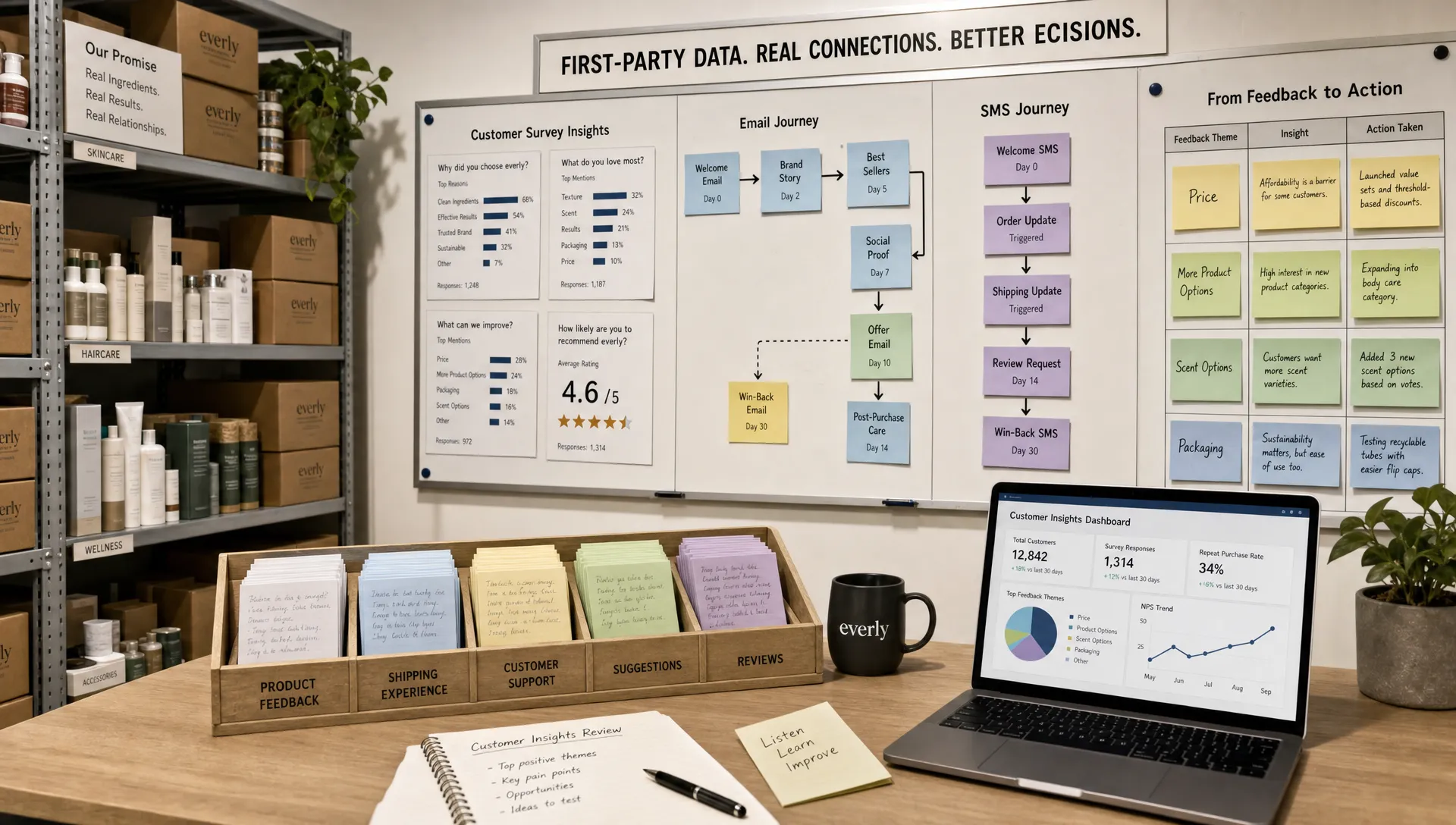
- Build creative around objections: Use customer reviews, support tickets, sales calls, comments, and competitor research to develop message angles that answer real concerns.
- Connect paid media and onsite testing: Make sure ad concepts have matching landing pages, product page narratives, and email follow-ups.
- Review learning, not just reporting: Each week, identify what the funnel taught you about the customer and what will change because of it.
This turns marketing into a feedback loop. Paid media reveals which messages earn attention. Website behavior reveals where shoppers hesitate. Email performance reveals which education points drive action. Retention data reveals whether the original promise matched the customer experience.
When those learnings are shared across the team, the funnel gets smarter.
Why full-funnel thinking is a competitive advantage
The direct to consumer space is more mature than it used to be. Winning brands are not simply better at running ads. They are better at connecting brand, performance, ecommerce, creative, and retention into one growth engine.
That is a meaningful advantage because most competitors still optimize in pieces. They launch ads without fixing the landing page. They redesign the site without updating the offer. They grow email volume without improving segmentation. They invest in awareness without building enough trust assets to capture demand later.
A full-funnel brand compounds learning. Every campaign teaches the team something about the customer. Every conversion test improves the next media push. Every retention insight informs acquisition messaging. Every customer objection becomes new creative, content, or product page copy.
If you are evaluating outside support, it is worth understanding what a direct to consumer marketing agency should fix beyond simply launching more campaigns. The best partners help identify the constraint that is actually limiting growth.
For emerging brands, this can be the difference between temporary spikes and scalable momentum.
Frequently Asked Questions
Is full-funnel thinking only for large direct to consumer brands? No. Smaller brands often need it even more because they have less room for wasted spend. A lean full-funnel system helps founders prioritize the highest-impact fixes instead of chasing every channel at once.
Which funnel stage should a DTC brand fix first? Start with the biggest constraint. If traffic is low, demand creation may be the priority. If traffic is strong but sales are weak, focus on conversion and trust. If acquisition works but profitability is poor, retention and LTV may be the most important levers.
Does full-funnel thinking mean using every marketing channel? No. It means every active channel has a clear role. A brand may only use paid social, email, SEO, and influencer partnerships, but those channels should still connect across awareness, consideration, conversion, and retention.
How does full-funnel thinking improve paid media? It gives paid media better inputs and better support. Ads perform better when the audience is clear, creative answers real objections, landing pages match the message, and retention improves the economics of acquiring each customer.
How often should ecommerce brands review the funnel? Most brands should review key funnel metrics weekly and deeper cohort or retention data monthly. The goal is to spot bottlenecks early and turn customer behavior into better creative, site improvements, offers, and lifecycle campaigns.
Build a funnel that compounds
Direct to consumer growth is no longer about isolated wins. It is about building a connected system where awareness creates qualified demand, education builds trust, conversion paths remove friction, and retention improves profitability.
If your sports, fitness, wellness, or ecommerce brand is generating interest but not enough scalable growth, OPTYO can help connect performance marketing, creative, ecommerce development, CRO, email, SEO, KPI reporting, and brand strategy into a more cohesive growth engine.