.png)




Efficiency in ecommerce is not just about moving faster. It is about reducing the waste that appears when paid media, creative, website development, retention, reporting and brand strategy all operate in separate lanes. For many founders, an integrated marketing agency can improve efficiency because it connects those lanes into one growth system, where every decision is tied to customer behavior and business economics.
That matters more in 2026 because acquisition costs remain volatile, privacy changes make attribution less simple and customers expect more consistent experiences across every touchpoint. A fitness, wellness or sports brand cannot afford to have its ad account saying one thing, its landing page saying another and its email flows ignoring what actually converted the customer in the first place.
What an integrated marketing agency changes inside ecommerce growth
Most ecommerce teams do not suffer from a lack of effort. They suffer from too many disconnected efforts. A paid social team launches new campaigns, a designer creates assets, a developer updates product pages, an email marketer builds automations and the founder tries to interpret results from several different reports. Each function may be competent, but the system still leaks time, money and attention.
An integrated marketing agency changes the operating model by making strategy, execution and measurement work from the same source of truth. Instead of asking whether Meta ads, SEO, email or conversion rate optimization is working in isolation, the better question becomes whether the full customer journey is becoming more profitable.
This is especially useful for ecommerce brands that have product-market traction but feel stuck between founder-led growth and a more mature marketing organization. Integration gives the brand a way to scale without hiring a full in-house team too early or coordinating a patchwork of freelancers and niche vendors.
The hidden inefficiencies that slow ecommerce teams
Ecommerce inefficiency is not always obvious. It rarely looks like total failure. More often, it looks like small frictions that compound over time, such as delayed creative production, landing pages that do not match the ad promise, email campaigns that ignore acquisition insights or reports that explain what happened without clarifying what to do next.
When an integrated marketing agency owns the connection between these moving parts, the brand can diagnose friction faster. The same customer insights that shape ad hooks can inform product page copy, email segmentation and SEO content. That creates a tighter feedback loop and reduces the cost of learning.
| Inefficiency | What it looks like | How integration improves it |
|---|---|---|
| Siloed channel decisions | Paid media, email and website changes happen separately | Teams align around shared KPIs and customer journey insights |
| Creative bottlenecks | Ads fatigue before new concepts are ready | Creative testing is planned as part of the growth calendar |
| Weak handoff from ad to site | Customers click but do not convert | Landing pages reflect the same promise and audience intent as the ad |
| Fragmented reporting | Each vendor reports channel wins without business context | Metrics are interpreted through profitability, retention and revenue quality |
| Slow iteration | Every change requires separate coordination | Strategy, creative, media and CRO decisions move together |
Why integrated teams make faster, better decisions
Speed alone can be dangerous in ecommerce. A team can launch more ads, send more emails and publish more landing pages while still burning cash. Efficiency improves when speed is paired with cleaner decision-making.
For ecommerce founders, the value of an integrated marketing agency is that it reduces the distance between insight and action. If an ad angle drives strong click-through but weak conversion, the answer might not be to kill the campaign. The site may need stronger proof, the offer may need refinement or the audience may need a more specific landing page. A disconnected vendor setup often turns that into a long debate. An integrated team can test the next move faster.
Strategy turns activity into a system
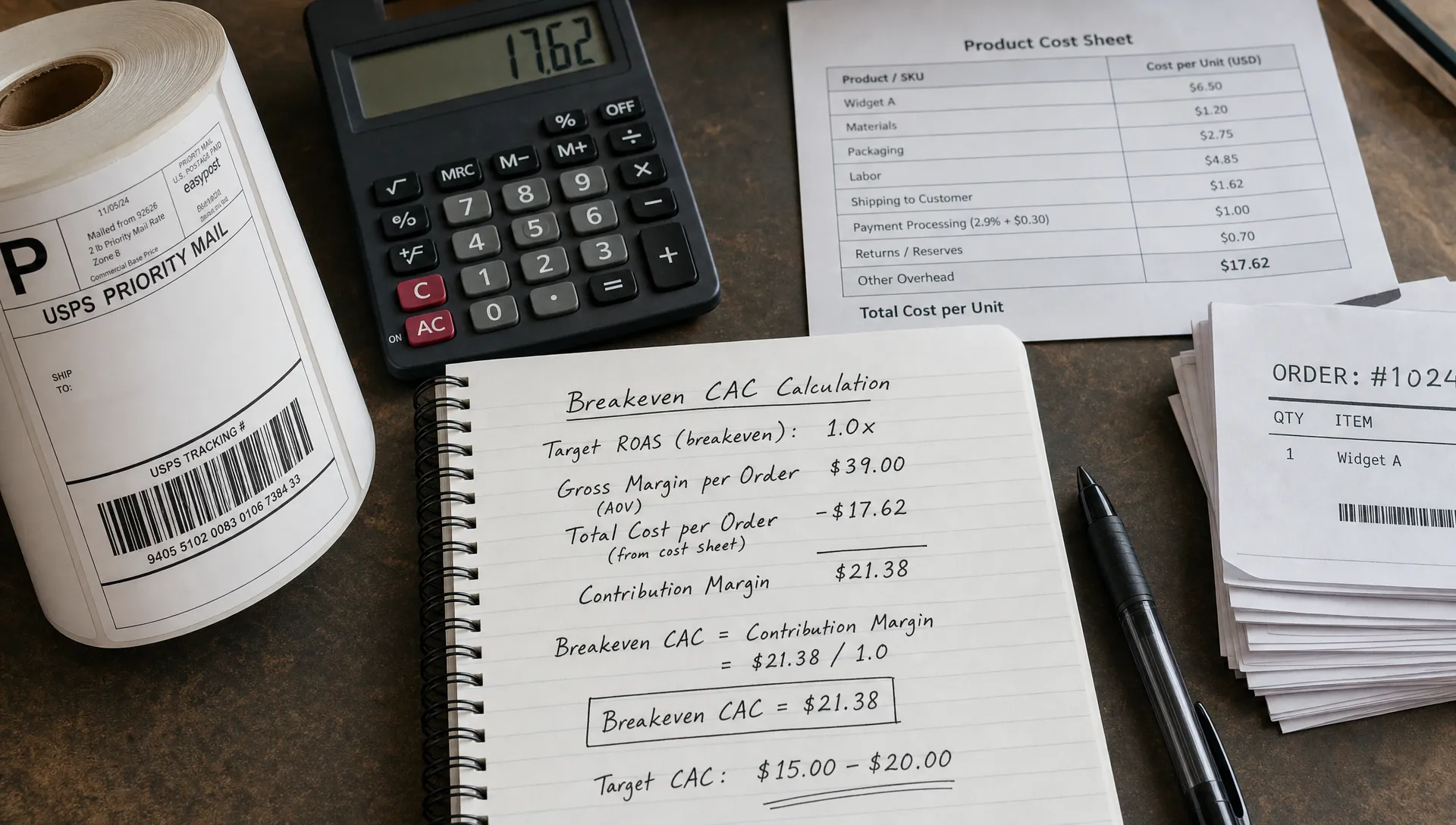
A strong ecommerce strategy starts with the economics of the business. Average order value, gross margin, repeat purchase rate, contribution margin and inventory realities all influence how aggressively a brand should acquire customers. Marketing is less efficient when those numbers sit outside the planning process.
This is why performance marketing and brand strategy need to inform each other. If you want a deeper look at the profitability side, OPTYO has also covered how performance marketing for ecommerce improves profitability through better targeting, creative testing, CRO and retention.
Creative becomes a performance asset
Creative is often treated as a deliverable, but in ecommerce it should operate like a testing engine. Hooks, product education, founder stories, use cases, user-generated content, comparison angles and offer messaging all reveal what customers care about.
Other industries show the same pattern. Real estate agents, for example, lose time when content production is too hard to repeat, which is why resources on marketing tools that simplify video production are useful beyond real estate. The point for ecommerce is similar: creative systems become more valuable when they remove friction from repeated publishing and testing.
Where efficiency gains show up first
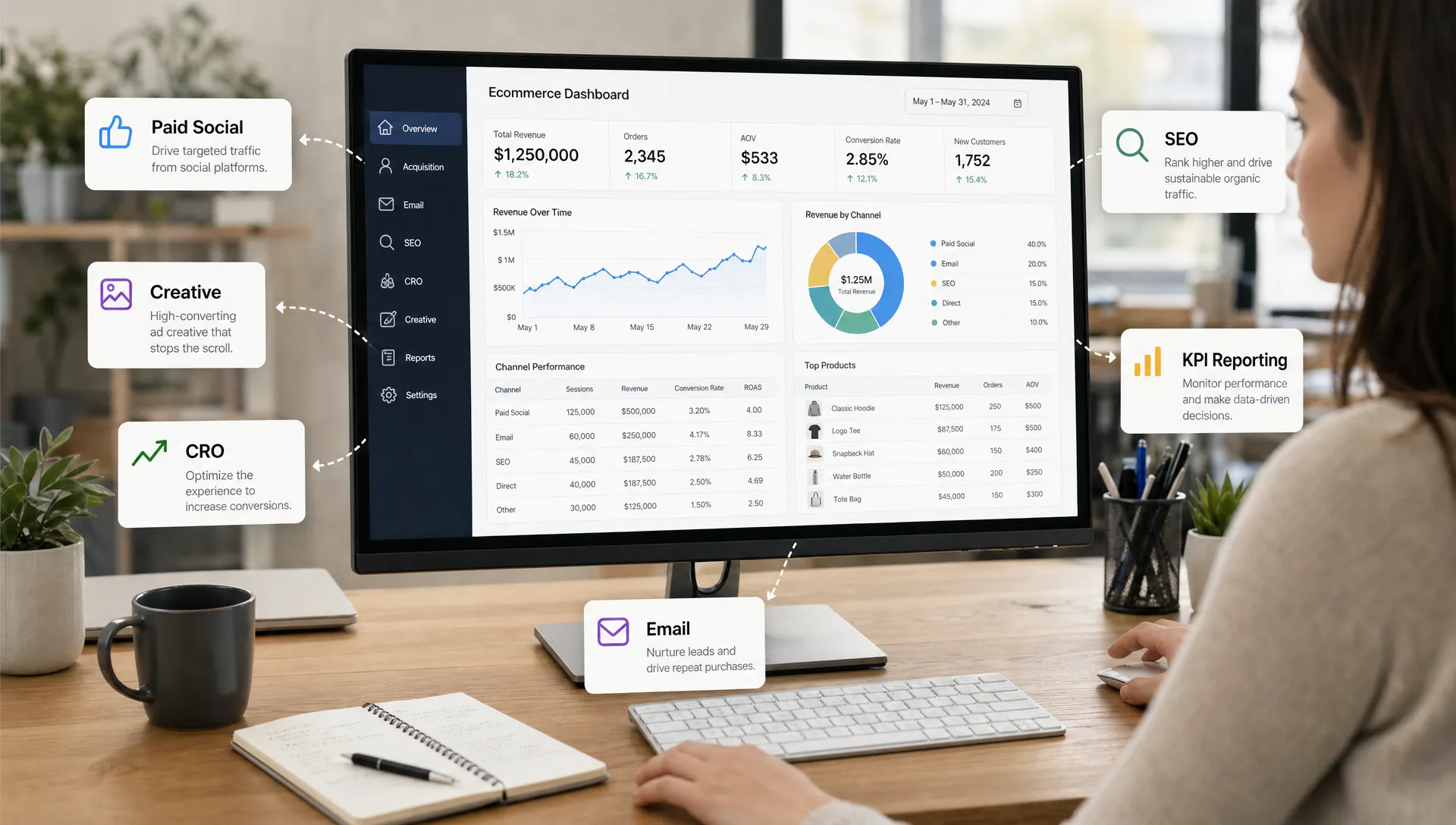
The first gains often appear where ecommerce teams feel the most pressure: paid acquisition, website conversion and retention. These are also the areas where fragmented work creates the most waste.
A mature integrated marketing agency will look at acquisition quality, not just acquisition volume. If a paid campaign brings in low-margin first-time buyers who never return, the top-line revenue can look good while the business becomes less healthy. If another campaign brings fewer buyers but better repeat purchase behavior, that may be the more efficient path to scale.
Paid acquisition becomes more disciplined
Paid social and search are still powerful for ecommerce, but they need constant creative renewal and tighter financial discipline. Integration helps because media buyers are not working from ad platform metrics alone. They can see whether customers convert on-site, which products create better bundles and which audiences respond to specific proof points.
For a sports nutrition brand, that might mean distinguishing between customers who buy for performance, recovery or weight management. For an apparel brand, it may mean building different journeys for first-time buyers, returning customers and wholesale-adjacent audiences. The media spend becomes more efficient because the message and destination match the customer segment.
Website and CRO stop being afterthoughts
Conversion rate optimization is often treated as something to fix after traffic becomes expensive. In reality, CRO should be part of the acquisition strategy from the beginning. If customers are leaving because the product page lacks sizing clarity, social proof, subscription logic or shipping reassurance, buying more traffic only amplifies the leak.
An integrated setup can connect ad feedback directly to site improvements. If customers respond to a specific benefit in ads, that benefit should be visible on the product page. If email subscribers repeatedly click on educational content before purchasing, that insight can shape landing page structure and product merchandising.
Email turns acquisition into lifetime value
Email marketing is one of the most underused efficiency levers in ecommerce because it can improve the value of traffic a brand already paid for. Welcome flows, post-purchase education, replenishment reminders, winback campaigns and segmentation can all support profitability without relying entirely on new customer acquisition.
The key is making email part of the broader growth system. OPTYO explains this connection in more detail in its article on how email and marketing work better together, including why retention should not be separated from acquisition strategy.
Integrated agency vs specialist vendors
Specialists can be useful, especially when a brand has a narrow technical problem. The challenge is that ecommerce growth rarely breaks in one isolated place. A paid media issue may be a creative issue. A creative issue may be a positioning issue. A conversion issue may be an offer issue. A retention issue may begin with the wrong acquisition audience.
The right integrated marketing agency does not replace expertise with generalism. It brings specialists into one coordinated operating system so the brand does not have to serve as the connective tissue between every discipline.
| Partner model | Best fit | Main efficiency risk |
|---|---|---|
| Multiple niche freelancers | Early-stage brands with simple needs and founder oversight | Founder becomes the project manager across every function |
| Single-channel specialist agency | Brands with one clear bottleneck, such as paid search or email | Channel gains may not translate into full-funnel improvement |
| In-house team | Larger brands with budget, management capacity and stable processes | Hiring takes time and can create fixed overhead before systems mature |
| Integrated agency partner | Growing ecommerce brands that need strategy plus execution across functions | Requires clear priorities and strong communication on business goals |
How to know if your brand is ready
Not every ecommerce brand needs a fully integrated partner on day one. A founder testing the first product can often move faster with simple tools, lean creative and direct customer conversations. The need for integration grows once complexity starts to slow decisions.
You may be ready when several of these signs are present:
- You have traction but growth has become inconsistent or expensive.
- You are coordinating multiple vendors and still making the final strategic calls yourself.
- Your creative testing is reactive instead of planned.
- Your website conversion rate does not support the amount you spend on traffic.
- Your email revenue exists but is not connected to acquisition insights.
- Your reports show channel metrics but do not explain profitability clearly.
An integrated marketing agency should be able to help you prioritize the highest-leverage constraint first. That might be improving landing pages before scaling ads, building a stronger retention engine before entering new channels or clarifying brand positioning before producing another batch of creative.
What to look for in an integrated partner
Efficiency does not come from bundling services under one invoice. It comes from the quality of coordination. Before hiring an agency, ask how strategy flows into execution, how learnings are documented and how teams decide what to test next.
Strong partners should be comfortable discussing business fundamentals, not just campaign management. For ecommerce, that means understanding margins, inventory constraints, purchase frequency, offer design, subscription potential and customer lifetime value. A beautiful ad campaign is not efficient if it sells the wrong product mix or attracts customers who never buy again.
You should also look for a partner that respects brand building and performance measurement at the same time. Performance without brand can become a race to discounting. Brand without performance can become expensive guesswork. The efficiency comes from connecting both.
Frequently Asked Questions
What does an integrated marketing agency do for ecommerce brands? An integrated partner coordinates strategy, paid media, creative, website optimization, email, SEO, reporting and growth consulting so the brand can make decisions from one connected view of the customer journey.
Is an integrated agency better than hiring channel specialists? It depends on the problem. Channel specialists can be effective for narrow needs, but integrated support is usually more efficient when the bottleneck crosses creative, acquisition, conversion and retention.
How does integration improve marketing ROI? Integration improves ROI by reducing wasted spend, aligning messaging across touchpoints, speeding up testing and connecting marketing decisions to profitability rather than isolated channel metrics.
When should an ecommerce founder consider an integrated partner? Consider one when vendor coordination is slowing execution, customer acquisition costs are rising, creative output feels inconsistent or your reporting does not clearly show which actions improve profitable growth.
Build a more efficient ecommerce growth engine
If your growth team is working hard but the pieces are not compounding, an integrated marketing agency can help turn scattered activity into a clearer operating system. For sports, fitness and wellness brands, that often means connecting performance marketing, ecommerce development, CRO, email, creative, SEO, KPI reporting and growth consulting around one goal: more efficient growth.
OPTYO works with ecommerce entrepreneurs and emerging brands that need both strategic direction and execution support. If your next stage of growth requires tighter alignment across acquisition, conversion and retention, building an integrated system is a practical place to start.