.png)



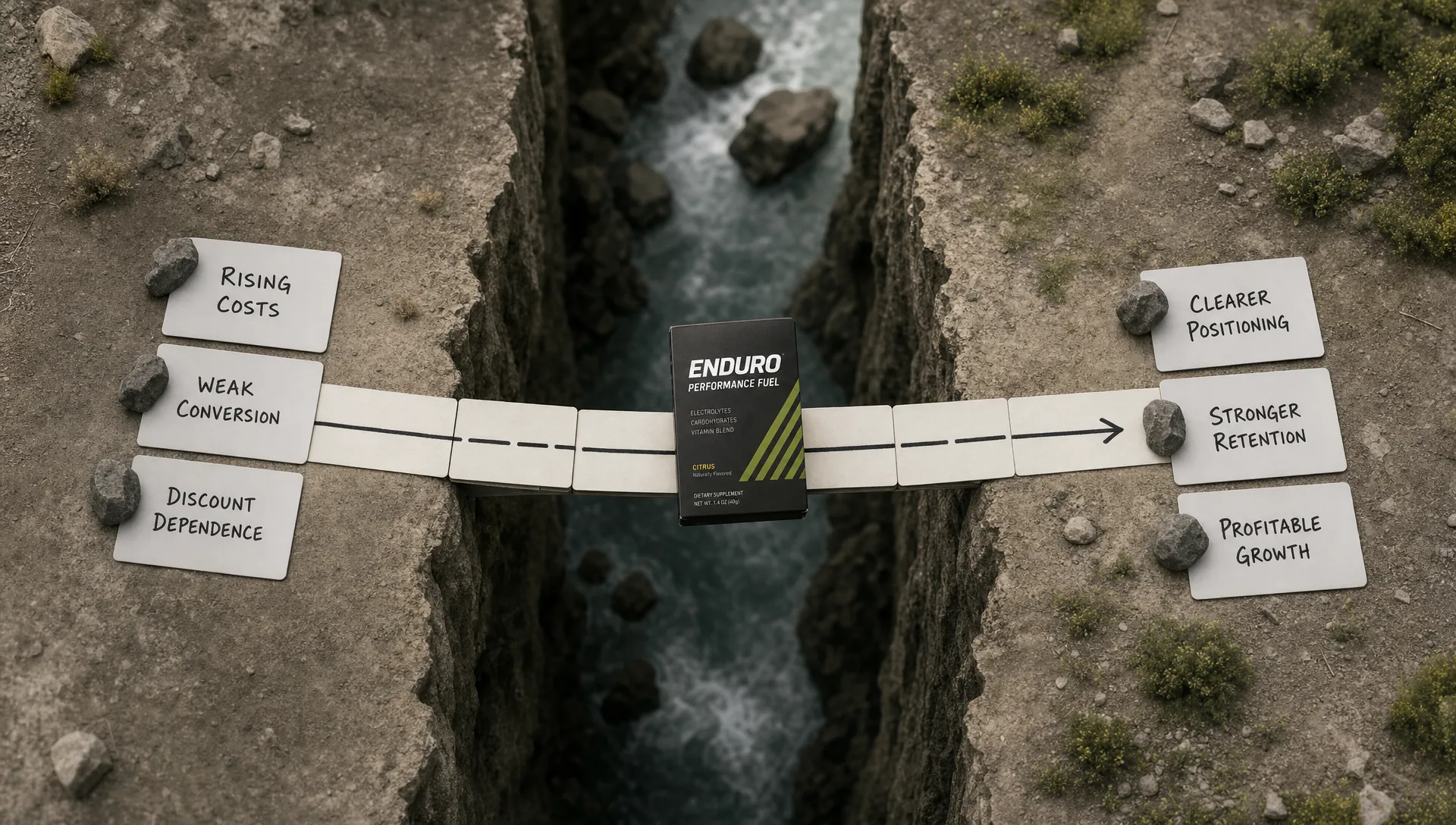
Growth is rarely linear. A brand can have real customers, positive product feedback, and promising revenue, yet still feel stuck when the next stage requires sharper decisions. Ad costs rise. Conversion rates fluctuate. Email revenue looks inconsistent. The founder is juggling creative, operations, product, and customer support, while trying to make sense of the marketing numbers.
That is usually when marketing consulting starts to make sense. Not because every growing brand needs outside advice, but because there are moments when the cost of guessing becomes higher than the cost of getting a clearer plan.
For ecommerce entrepreneurs, especially in sports, fitness, wellness, and CPG, the question is not simply whether to hire help. The better question is whether your current growth problems are strategic, operational, or executional. Marketing consulting is most valuable when the issue is not a lack of activity, but a lack of clarity about which activities matter most.
What marketing consulting actually does
Good marketing consulting is not a generic audit, a motivational strategy deck, or a list of tactics copied from another brand. At its best, it translates messy business signals into better decisions.
A consultant or strategic growth partner should look at how your brand makes money, who your most valuable customers are, what your acquisition channels are doing, how your creative is performing, where your website leaks revenue, and whether your retention strategy supports profitable scale. The work should connect marketing activity to business outcomes.
For a growing ecommerce brand, that often means answering questions like these:
- Which products, offers, or bundles deserve more media spend?
- Is the brand message clear enough for cold audiences?
- Are paid social campaigns underperforming because of media buying, creative, landing pages, or margins?
- Is the website converting qualified traffic efficiently?
- Is the brand too dependent on new customer acquisition?
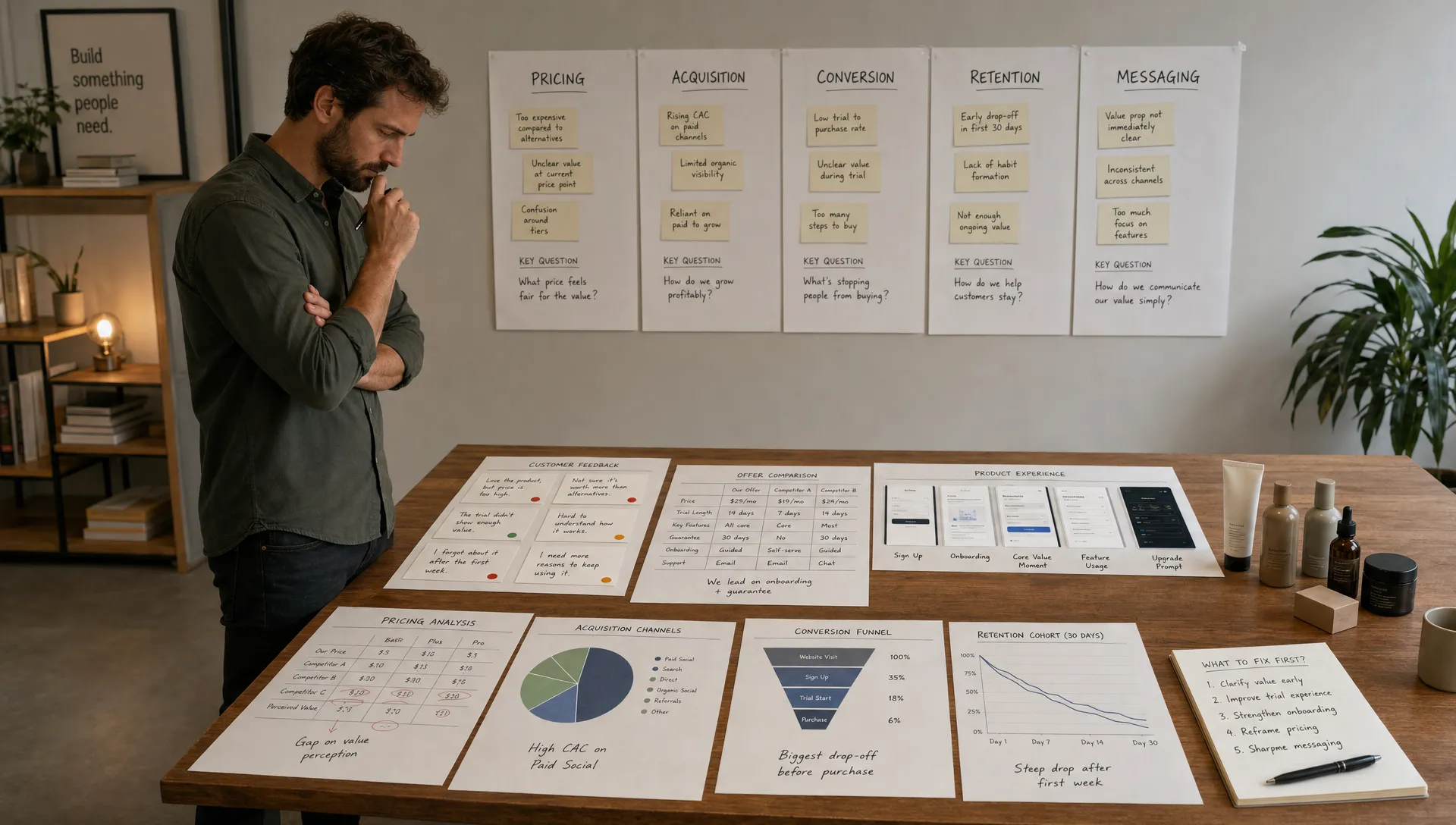
- What should be fixed first, and what can wait?
This is where marketing consulting differs from simply hiring someone to run ads or redesign a website. Execution matters, but execution without diagnosis can create more noise. A consultant helps define the growth system before the brand spends more money pushing traffic through it.
When marketing consulting makes the most sense
Marketing consulting is not only for brands in trouble. In many cases, it is more useful when a brand already has traction and needs to avoid wasting that momentum.
Your growth has plateaued, but the reason is unclear
A plateau is not always a demand problem. Sometimes traffic is healthy, but conversion rate has slipped. Sometimes conversion looks fine, but average order value is too low. Sometimes new customer acquisition works, but repeat purchase behavior cannot support the cost of acquisition.
For founders, this is frustrating because the brand can look busy from the outside while the numbers feel harder to improve. More campaigns, more posts, and more discounts may create temporary movement, but they do not necessarily reveal the underlying constraint.
Marketing consulting makes sense when you need a structured diagnosis. The right partner should separate symptoms from causes, then identify which levers are most likely to change the growth curve.
If your company operates in a category where identity, community, and performance all matter, such as sports or fitness, this diagnosis-first approach overlaps with what to expect from a sports marketing consultancy. The goal is not more marketing for its own sake. The goal is smarter allocation of budget, creative energy, and team focus.
Paid acquisition is getting more expensive
Many ecommerce brands start by finding one or two acquisition channels that work. A Meta campaign gains traction. Google Shopping captures intent. Influencer content creates social proof. Then the brand raises spend, and the economics begin to weaken.
This does not always mean the channel is broken. It may mean the creative testing system is too narrow, the offer is not strong enough for colder audiences, or the landing page does not match the ad promise. It may also mean the brand is scaling into customer segments with lower intent or lower lifetime value.
A marketing consultant can help evaluate the full acquisition chain instead of blaming one metric. Cost per click, click-through rate, conversion rate, contribution margin, payback period, and retention all need to be interpreted together. Rising CAC is a business problem, not just a media buying problem.
Your brand story is not converting into demand
Sports, fitness, wellness, and lifestyle brands often have strong missions. They may help customers perform better, recover faster, feel healthier, or build confidence. But a compelling mission does not automatically become a compelling purchase reason.
Positioning needs to answer the customer’s practical questions. Why this product? Why now? Why should I trust it? What outcome can I expect? What makes the brand credible?
For wellness brands, trust is especially important because customers are often evaluating quality, safety, credibility, and personal fit before they buy. A service-led brand such as Lumina Skin Sanctuary shows how personalized treatments, clean skincare products, testimonials, and experience cues can build confidence before a customer books or purchases. Ecommerce brands face the same trust equation at scale, but they have to solve it through product pages, creative, reviews, education, and retention flows.
Marketing consulting makes sense when your brand has real value, but the market is not understanding it quickly enough.
Founder-led marketing has reached its limit
In the early stage, founders often are the marketing engine. They know the customer, write the best copy, approve every creative, answer every comment, and make every campaign decision. That intensity can be an advantage, but it does not scale forever.
At some point, the founder becomes the bottleneck. The team waits for direction. Agencies execute isolated tasks. Creative ideas get approved based on instinct instead of a testing system. Reporting exists, but decisions are still made reactively.
Marketing consulting can help turn founder intuition into an operating framework. That might include clearer positioning, campaign priorities, channel roles, creative testing standards, KPI ownership, and a cadence for reviewing performance. The goal is not to remove the founder’s voice. It is to make the growth process less dependent on the founder being involved in every detail.
You are entering a new stage of growth
Marketing that works at one stage can become insufficient at the next. A brand moving from early D2C traction to broader scale may need stronger retention, more disciplined creative production, improved ecommerce infrastructure, or a clearer mix between paid media, SEO, email, wholesale, retail, and community.
A brand preparing for fundraising, retail expansion, or a larger product launch may also need a more credible growth story. Investors, buyers, and partners do not only look at revenue. They look at customer acquisition efficiency, margin structure, repeat purchase behavior, market positioning, and the team’s ability to keep learning.
Consulting is useful when the next stage requires a better growth architecture, not just more activity.
When marketing consulting may not be the right move
There are also times when marketing consulting is premature or misaligned.
If your product has not yet earned consistent customer demand, consulting cannot replace product-market fit. A consultant can help refine positioning, test offers, and identify audience segments, but they cannot manufacture demand for a product customers do not want.
If the company is unwilling to act on hard findings, consulting will also underperform. A good engagement may reveal uncomfortable truths: margins are too thin, the offer is confusing, the website experience needs work, or the current creative strategy is not distinct enough. If the team only wants validation, not direction, the value will be limited.
It may also be the wrong move if you only need a clearly defined executional task. If you already know you need Klaviyo flows built, a landing page designed, or ads launched from an existing strategy, you may need a specialist or agency rather than a consultant. Strategy support is most valuable when the question itself needs refinement.
What a strong consulting engagement should produce
The output of marketing consulting should not be a long presentation that sits untouched in a folder. It should create decisions, priorities, and a practical path forward.
A useful engagement often clarifies:
- The core growth constraint holding the brand back right now
- The highest-priority customer segments and purchase motivations
- The role of each marketing channel in the funnel
- The offers, messages, and creative angles worth testing first
- The website or ecommerce friction points that limit conversion
- The KPIs that should guide weekly, monthly, and quarterly decisions
The consultant should help the team understand tradeoffs. For example, pushing for more new customers may not be the best move if retention is weak. Redesigning a homepage may not matter if product pages drive most paid traffic. Increasing ad spend may be risky if creative fatigue is already high.
This is why the best consulting is connected to business economics. If you want a deeper breakdown of how strategy should connect audience, positioning, funnel design, and measurement, OPTYO’s guide on how a marketing strategy agency builds smarter growth covers that system in more detail.

Marketing consulting vs. agency execution vs. in-house hiring
One reason founders hesitate is that the options can blur together. Should you hire a consultant, an agency, a fractional CMO, or a full-time marketer?
A consultant is most useful when the brand needs clarity, prioritization, and strategic direction. They help define the problem, shape the plan, and guide decisions. An agency is most useful when the brand needs ongoing execution across paid media, creative, SEO, email, CRO, or ecommerce development. An in-house hire is most useful when the brand needs day-to-day ownership and institutional knowledge inside the company.
In practice, growing brands often need a blend. A consultant may help build the roadmap, an agency may execute key workstreams, and an internal team member may coordinate daily operations. Some partners combine strategic consulting with execution, which can reduce the gap between recommendations and implementation.
The important thing is to match the support model to the actual constraint. If the issue is unclear positioning, hiring more media buyers will not fix it. If the strategy is clear but execution is slow, more consulting may not be enough. If the founder is the bottleneck, the brand may need both strategic guidance and operating support.
For emerging brands, this is the broader standard to look for in any growth partner. Strategy, creative, performance, conversion, retention, and reporting should work together, as explained in OPTYO’s article on what a growth agency should deliver for emerging brands.
How to evaluate a marketing consulting partner
The right consultant should make your business feel more understandable, not more complicated. During early conversations, pay attention to the questions they ask. Strong consultants will want to understand your margins, channel mix, customer behavior, operational constraints, product roadmap, and growth goals before prescribing tactics.
Category familiarity also matters. Sports, fitness, and wellness brands often sell more than a functional product. They sell aspiration, identity, trust, routine, performance, or transformation. A partner who understands those dynamics can evaluate messaging and creative with more nuance.
Look for a consultant who can connect brand and performance. Brand without measurement can become vague. Performance without brand can become short-term and expensive. Growing brands need both: a distinct reason to exist and a measurable system for converting attention into revenue.
Clarity on scope is equally important. A good engagement should define what will be analyzed, what deliverables will be produced, how decisions will be made, and what the team is expected to implement. If everything sounds open-ended, the project can drift.
Finally, choose someone willing to challenge assumptions. The most valuable insight may not be the one you expected. A strong consultant should be able to say when the issue is not the ad account, not the algorithm, and not the latest tactic, but the offer, economics, message, or customer experience.
How to prepare before hiring marketing consulting support
Before bringing in outside help, gather the information that will make the engagement more productive. You do not need perfect dashboards, but you should have access to core data: revenue by product, gross margin, traffic sources, conversion rate, average order value, repeat purchase behavior, email performance, paid media results, and customer feedback.
You should also define the decision you are trying to make. Are you trying to scale ad spend? Improve conversion? Reposition the brand? Prepare for a launch? Increase repeat purchase? Enter a new channel? A focused question helps a consultant move faster.
Be honest about constraints. If inventory is limited, margins are tight, creative production is slow, or the team has limited implementation capacity, those realities should shape the strategy. Good consulting does not ignore constraints. It uses them to create a sharper plan.
Most importantly, be prepared to prioritize. A growing brand can usually identify dozens of possible improvements. The value of consulting is not in finding more things to do. It is in identifying the few moves most likely to matter now.
Frequently Asked Questions
What is marketing consulting for ecommerce brands? Marketing consulting helps ecommerce brands diagnose growth problems, clarify strategy, prioritize marketing initiatives, and connect channels like paid social, SEO, email, creative, CRO, and retention to business goals.
How do I know if my brand is ready for marketing consulting? Your brand is likely ready if you have traction, customer data, and active marketing efforts, but you are unsure which growth levers deserve focus. It is especially useful when performance has plateaued or your team is making decisions reactively.
Is marketing consulting better than hiring an agency? Neither is automatically better. Consulting is best for strategic clarity and prioritization. An agency is best for execution. Many growing brands need both, especially when strategy and implementation must stay closely connected.
How long should a consulting engagement last? It depends on the scope. Some brands need a focused diagnostic sprint, while others need ongoing strategic guidance through a launch, channel expansion, or scaling phase. The timeline should match the decisions the brand needs to make.
What should a founder expect to change after consulting? A founder should expect clearer priorities, better KPI alignment, sharper messaging, more disciplined testing, and a stronger understanding of what is actually limiting growth. The best outcome is not more activity. It is better decision-making.
Ready to make growth less reactive?
Marketing consulting makes sense when your brand has momentum, but the path forward needs more clarity. For sports, fitness, wellness, D2C, and CPG brands, that clarity can shape everything from creative testing and paid acquisition to ecommerce conversion, retention, and brand positioning.
If your team is trying to scale without guessing, OPTYO can help connect strategy, performance marketing, creative, ecommerce development, CRO, email, SEO, KPI reporting, and growth consulting into a more focused growth system.