.png)



Most ecommerce founders do not have a growth problem because they lack effort. They have a growth problem because too many decisions are being made in isolation: a Meta campaign here, a landing page change there, a discount email when sales slow down, and a new creative sprint whenever performance dips.
A marketing strategy agency exists to turn those scattered moves into a connected growth system. The goal is not to do more marketing for the sake of activity. The goal is to make better decisions about where to compete, who to target, what to say, which channels to prioritize, and how to measure progress without confusing noise for momentum.
For sports, fitness, and wellness brands, that clarity matters even more. These categories are crowded, emotionally driven, and often highly competitive on paid media. Customers compare products quickly, expect proof, and need to believe the brand before they commit. Smarter growth comes from aligning brand, performance, creative, website experience, and retention around one coherent strategy.
Smarter growth starts with a better diagnosis
Many brands come to an agency asking for more traffic, better ads, or a higher conversion rate. Those goals are valid, but they are usually symptoms of a deeper question: what is actually limiting growth right now?
A strong strategy process begins by identifying the constraint. For one brand, the issue may be unclear positioning. For another, it may be weak landing pages, low repeat purchase, poor creative testing, or unit economics that make scaling paid acquisition unrealistic. Without that diagnosis, the brand risks spending more money to amplify a broken system.
A marketing strategy agency should look at the full business context before recommending tactics. That includes product margins, average order value, customer acquisition cost, repeat purchase behavior, inventory constraints, offer structure, seasonality, competitive positioning, and channel performance. In other words, strategy is not a slide deck. It is a decision-making framework that helps a founder understand what to fix first.
This is especially important for entrepreneurs who are close to the business. Founders often have deep product knowledge, but that closeness can make it harder to see where customers are confused, where messaging is too broad, or where resources are being spread too thin. An outside strategy partner brings objectivity and a structured way to prioritize.
What a marketing strategy agency actually connects
The best growth strategies do not separate brand from performance. Brand creates meaning, differentiation, and trust. Performance marketing turns that demand into measurable acquisition. Creative translates the strategy into assets people actually notice. Conversion rate optimization removes friction. Email and retention increase customer value. SEO compounds visibility over time.
When these pieces operate separately, growth becomes inconsistent. Ads may drive traffic to a page that does not reinforce the same promise. Email may push discounts that weaken premium positioning. Content may attract readers who are not likely buyers. A good agency connects the system so every part of the funnel supports the same commercial objective.
For an ecommerce fitness brand, that might mean aligning paid social creative with product education, sending traffic to a comparison-focused landing page, improving product page proof, and building post-purchase emails that increase repeat purchases. For a wellness brand, it might mean clarifying the customer problem, simplifying educational content, and building trust through founder story, ingredients, reviews, and usage guidance.
If you are still working through the fundamentals, OPTYO has also outlined how to approach a marketing strategy that actually scales from the business model upward.
Step 1: Build around business economics, not channel trends
A common mistake is choosing channels based on what is popular instead of what the business can support. TikTok, Meta, Google, influencers, SEO, retail media, affiliates, and email can all work, but they do not work equally well for every brand at every stage.
A strategy agency should first evaluate the economic reality of the brand. If margins are tight and the product has low repeat purchase, paid acquisition will need a very different approach than a premium product with strong lifetime value. If the average order value is low, bundles or subscriptions may need to be part of the growth plan. If the product is highly educational, search and content may play a bigger role in customer acquisition.
The point is not to avoid experimentation. It is to experiment within a realistic growth model. Smart strategy answers questions like:
- Which customer segments can we profitably acquire?
- What acquisition cost can the business tolerate?
- Which offers improve conversion without destroying margin?
- How quickly do we need payback from new customers?
- Which channels create short-term revenue, and which build long-term demand?
This prevents the brand from chasing vanity metrics. A campaign with cheap clicks is not necessarily good if those visitors do not buy. A high return on ad spend can still be misleading if scale is tiny or if attribution is overstated. Smarter growth requires metrics that connect marketing activity to business outcomes.
Step 2: Clarify who the brand is really for
Growth gets easier when the brand knows exactly who it is trying to win. Too many ecommerce companies define their audience as “anyone who wants to be healthier” or “people who work out.” Those categories are too broad to guide messaging, creative, or channel decisions.
A marketing strategy agency helps narrow the focus. That does not mean the brand can only sell to one type of customer forever. It means the growth strategy starts with the segment most likely to convert, advocate, and come back. In sports, fitness, and wellness, the difference between customer segments can be significant. A competitive athlete, a busy parent returning to training, a boutique fitness enthusiast, and a longevity-focused wellness buyer may all care about health, but they buy for different reasons.
Audience clarity shapes the entire funnel. It determines the emotional hook in ads, the objections addressed on product pages, the proof points highlighted in content, and the retention messages sent after purchase. If this step is weak, everything downstream becomes less efficient.
For founders refining this part of the strategy, learning how to define your target market for faster growth can help turn broad assumptions into sharper customer segments.
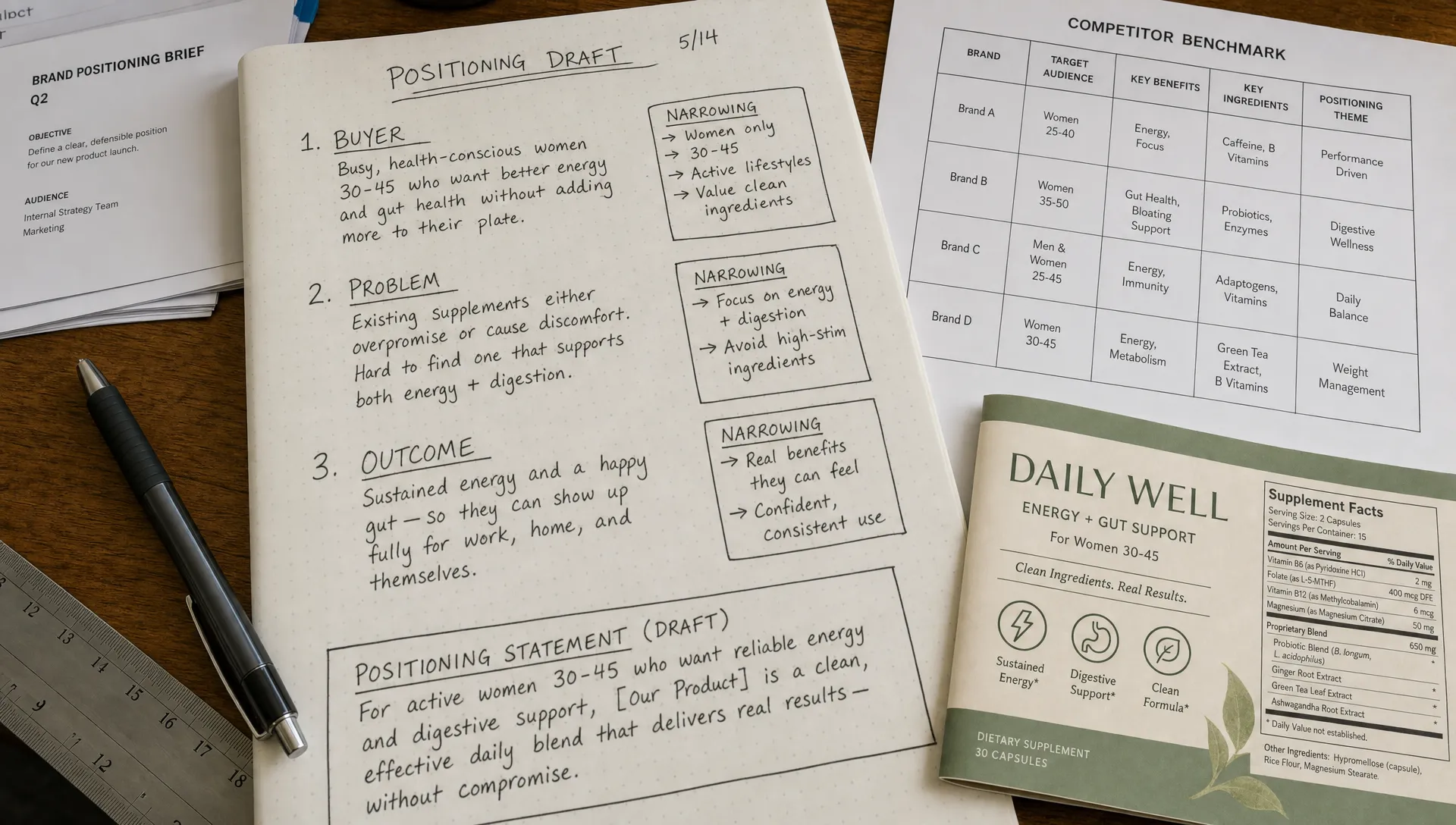
Step 3: Position the brand around a credible advantage
Positioning is where strategy becomes competitive. It answers why a customer should choose this brand instead of the alternatives. That answer cannot be generic. “High quality,” “better ingredients,” “premium design,” and “built for performance” are not enough unless the brand can make them specific and believable.
A strategy agency looks for the intersection between what the customer values, what the brand can credibly own, and what competitors are not already saying effectively. Sometimes that advantage is product performance. Sometimes it is convenience, identity, expertise, community, education, or a new category mechanism.
This is particularly important in wellness, where products often require customer education before purchase. For example, an innovative brand like Air Tea Company introduces a different way to experience herbal wellness through warm-air vaporization, which means its growth strategy must do more than promote a product. It has to explain the category, build trust, and make the new behavior feel understandable.
That same principle applies across sports and fitness. If customers do not immediately understand what makes the product different, the brand needs sharper messaging, stronger proof, and creative that demonstrates the value quickly.
Step 4: Turn positioning into a testing roadmap
Strategy should not stay abstract. Once the brand has a clear position, the agency should translate it into a testing roadmap. This is where many brands lose discipline. They test random ad concepts, change too many variables at once, and make decisions based on short-term fluctuations.
A smarter approach groups creative tests around strategic hypotheses. The agency might test different customer motivations, such as performance, recovery, confidence, convenience, or long-term health. It might compare founder-led storytelling against product demonstrations, social proof, educational content, or problem-solution messaging. Each test should teach the brand something useful, even if the individual asset does not become a winner.
Creative testing is not just about finding one high-performing ad. It is about building a library of insights that improves the whole growth system. Winning ad angles can inform landing pages. Customer objections from comments can inform email flows. High-performing hooks can become SEO article topics or product page headlines.

Step 5: Design the funnel as one connected experience
Customers rarely buy after one touchpoint. They may see an ad, visit the site, read reviews, compare alternatives, leave, receive an email, search the brand later, and then purchase. If each touchpoint tells a different story, the customer experience feels fragmented.
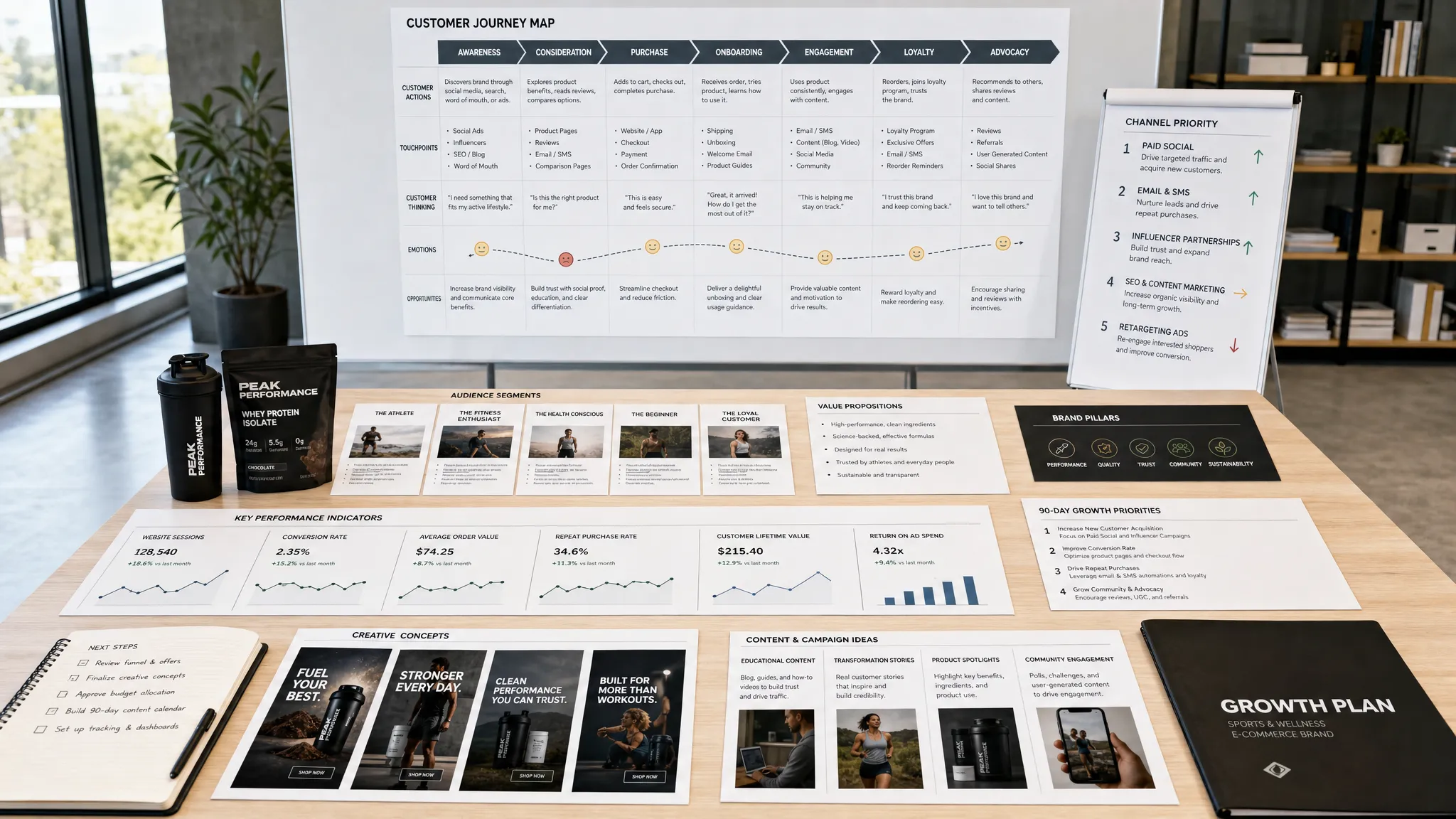
A marketing strategy agency builds smarter growth by mapping the full customer journey. The goal is to make every step answer the next question in the buyer’s mind. At the awareness stage, the customer needs to understand the problem and why the product matters. At the consideration stage, they need proof, comparison, and clarity. At the conversion stage, they need confidence, urgency, and a frictionless path to purchase. After purchase, they need guidance, support, and reasons to return.
This is where ecommerce strategy becomes practical. Product pages may need stronger hierarchy. Landing pages may need clearer proof. Offers may need to be easier to understand. Email flows may need better segmentation. Paid media may need to send different audiences to different pages instead of forcing everyone through the same path.
If revenue is growing but the system feels inefficient, it may be useful to examine how an ecommerce marketing agency can scale revenue by improving acquisition, conversion, and retention together.
Step 6: Use measurement to make decisions, not just reports
Reporting is only valuable if it changes behavior. A strategy agency should create a measurement system that helps the brand decide what to keep, what to stop, and what to improve.
That requires a balanced view of performance. Platform-level metrics can be useful, but they are not the whole truth. Meta, Google, Klaviyo, Shopify, and analytics tools may all tell slightly different stories. Smarter strategy looks at both channel-specific data and blended business metrics.
A useful reporting rhythm often includes revenue, contribution margin, customer acquisition cost, conversion rate, average order value, repeat purchase rate, email revenue, creative performance, and landing page performance. The exact KPIs depend on the business model, but the principle is the same: the agency should connect marketing activity to commercial outcomes.
Good reporting also separates leading indicators from lagging indicators. Creative thumb-stop rate, click-through rate, landing page engagement, and email opt-in rate can show whether the strategy is gaining traction before revenue fully reflects it. Repeat purchase and lifetime value take longer to measure, but they often determine whether the growth model is sustainable.
Step 7: Prioritize the next best move
The smartest agencies do not try to fix everything at once. They identify the next highest-leverage move. That could be rebuilding the landing page, restructuring paid social campaigns, improving email flows, clarifying the offer, developing new creative, or investing in SEO.
Prioritization matters because entrepreneurs have limited time, capital, and attention. A founder might be tempted to launch five channels at once, but if the brand has not yet proven its core message and funnel, that can create more confusion than growth. A strong strategy partner helps sequence the work.
For an early-stage brand, the priority may be validating the audience and offer. For a growing brand, it may be scaling creative production and improving conversion rate. For a more mature brand, it may be expanding into new channels, improving retention, or building a stronger organic search foundation.
Smarter growth is not about doing the most. It is about doing the right work in the right order.
Why entrepreneurs benefit from a strategic partner
Entrepreneurs often move fast out of necessity. That speed is a strength, but it can also create reactive marketing habits. A strategy agency adds structure without slowing the business down. It helps founders make decisions based on evidence, not only urgency.
The right partner also brings cross-functional perspective. Paid media specialists may see one part of the problem. Designers may see another. Developers, email marketers, SEO strategists, and brand consultants all contribute different insights. A strategy-led agency pulls those perspectives together so the brand is not optimizing one piece at the expense of the whole system.
This is where OPTYO’s focus on sports, fitness, and wellness brands is relevant. These categories require both performance discipline and brand sensitivity. Customers need to feel motivated, trust the product, and believe the promise. At the same time, founders need measurable acquisition, conversion, retention, and reporting that supports better decisions.
Signs your brand may need a marketing strategy agency
Not every company needs outside strategy at the same moment. But there are clear signals that a brand has outgrown purely tactical marketing.
- Sales are inconsistent, and the team cannot clearly explain why performance rises or falls.
- Paid media works at small budgets but becomes inefficient when spend increases.
- Creative output is high, but the team is not learning enough from tests.
- Website traffic is growing, but conversion rate remains weak.
- Email revenue depends too heavily on discounts and promotions.
- The brand has multiple customer segments but no clear messaging hierarchy.
- Reporting exists, but it does not lead to confident decisions.
If several of these apply, the issue may not be effort. It may be the absence of a unified growth strategy.
How to choose the right strategy partner
Choosing an agency should not come down to who promises the fastest results. Growth is the outcome of a system, and the agency should be able to explain how it will evaluate that system.
Look for a partner that asks about margins, customer behavior, positioning, creative, conversion, retention, and operational constraints before pitching tactics. A strong agency should be comfortable discussing both brand and numbers. It should also be honest about tradeoffs. Not every channel is worth pursuing immediately, and not every growth goal is realistic without changes to the offer, funnel, or economics.
You should also look for a clear operating cadence. Strategy without execution becomes theory. Execution without strategy becomes busywork. The right partner connects planning, testing, reporting, and iteration into a repeatable rhythm.
If you are comparing options, this guide on what to look for in a performance marketing agency can help you evaluate whether a partner is equipped to support sustainable growth.
Frequently Asked Questions
What does a marketing strategy agency do? A marketing strategy agency helps a brand define its growth direction, target audience, positioning, channel priorities, messaging, funnel structure, and measurement system. The goal is to align marketing decisions with business outcomes.
How is a marketing strategy agency different from a performance marketing agency? A performance marketing agency often focuses on measurable acquisition channels like paid social, paid search, and conversion campaigns. A marketing strategy agency takes a broader view, connecting brand, audience, offer, creative, website experience, retention, and reporting. Some agencies, including OPTYO, combine strategic and performance capabilities.
When should an ecommerce brand hire a marketing strategy agency? An ecommerce brand should consider hiring a strategy agency when growth feels inconsistent, paid media is hard to scale, messaging lacks clarity, conversion rates are weak, or the team needs a clearer plan for prioritizing channels and resources.
Can a strategy agency help a small brand, or is it only for larger companies? A strategy agency can help smaller brands if there is enough traction to analyze and enough ambition to act on the plan. Early-stage brands often benefit from sharper positioning, clearer customer definition, and better funnel foundations before spending heavily on acquisition.
What should founders expect from a strategic growth process? Founders should expect discovery, data review, customer and competitor analysis, positioning work, channel planning, creative direction, KPI definition, and a prioritized roadmap. The best process leads to action, not just documentation.
Build growth with more clarity and less guesswork
Smarter growth does not come from chasing every new tactic. It comes from building a system where positioning, creative, acquisition, conversion, retention, and measurement all work together.
OPTYO helps sports, fitness, and wellness brands connect strategy with execution across performance marketing, ecommerce development, conversion rate optimization, email marketing, creative production, SEO, growth consulting, and KPI reporting.
If your brand is ready to move from scattered tactics to a more disciplined growth system, start with OPTYO and build a strategy designed to scale with confidence.