.png)



A scalable marketing strategy is not a bigger ad budget. It is a system that keeps working when your brand has more customers, more channels, more creative, more inventory pressure, and more competition.
For sports, fitness, and wellness brands, this matters early. A product can win attention quickly through paid social, creators, gyms, coaches, events, or Amazon. But attention alone does not create a durable business. If the strategy is built only around one winning ad, one influencer post, or one seasonal promotion, growth becomes fragile.
A marketing strategy that actually scales answers four questions clearly:
- Who are we built for?
- Why should they choose us now?
- How do we acquire customers profitably?
- How do we turn first purchases into repeat revenue and brand loyalty?
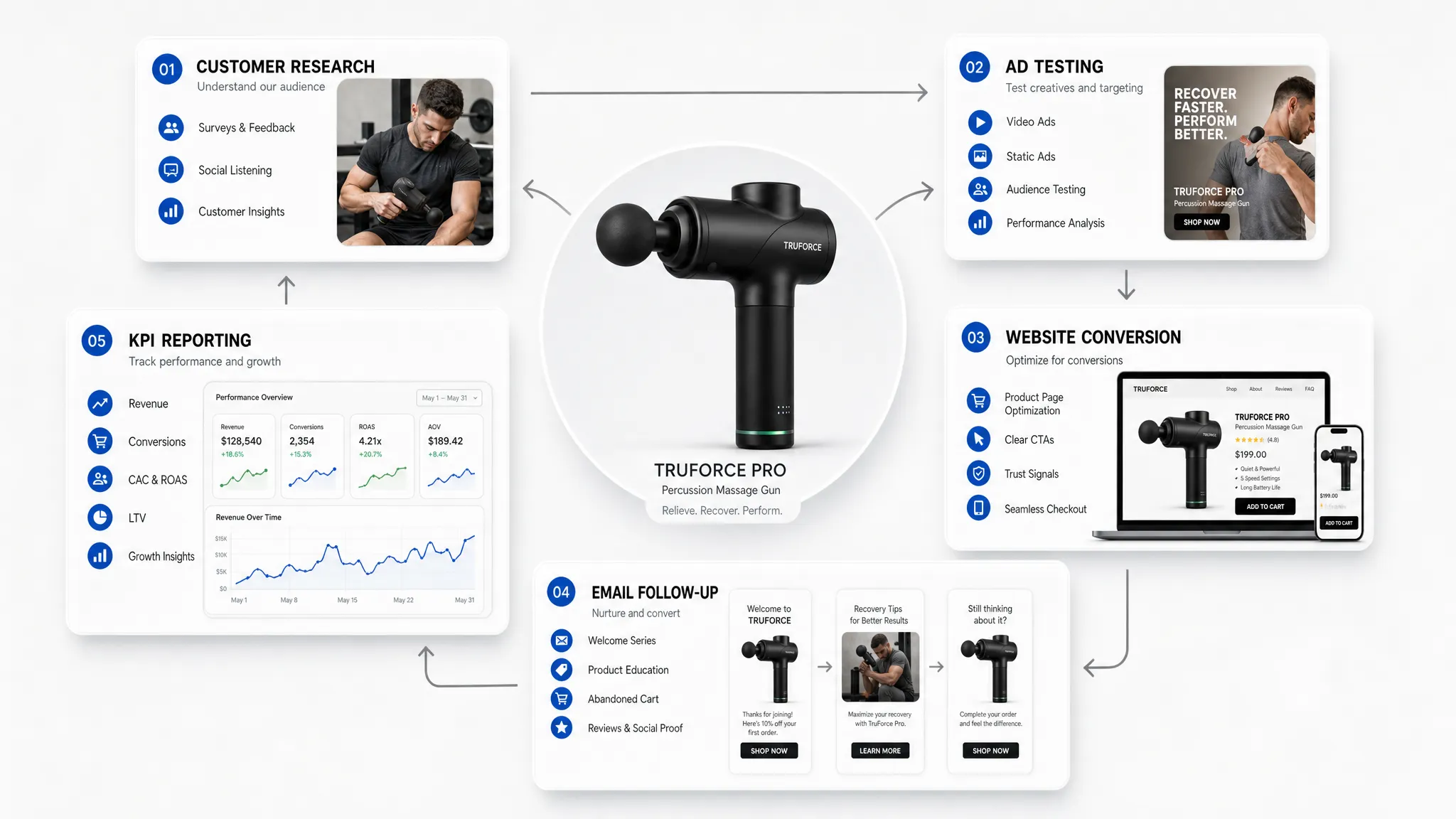
The goal is not to do every marketing tactic. The goal is to build a repeatable growth engine where positioning, creative, media, conversion, retention, and reporting reinforce each other.
What scaling really means in marketing
Scaling means your marketing can increase volume without destroying efficiency, brand trust, or operational capacity. A campaign that performs at $200 per day but collapses at $2,000 per day is not scalable yet. A channel that drives orders but brings customers who never purchase again may look good in-platform while weakening the business.
For a D2C or CPG brand, scale should be judged by business performance, not just ad account performance. Return on ad spend matters, but so do contribution margin, repeat purchase rate, average order value, inventory availability, refund rates, and payback period.
This is especially true in fitness and wellness, where buyers often need education before purchasing. Someone shopping for equipment, supplements, recovery tools, activewear, or functional foods may compare ingredients, reviews, certifications, shipping options, use cases, and brand credibility before converting. Your strategy needs to support the whole decision, not only the click.
Start with business economics, not channels
Many brands start with the wrong question: Which channel should we use? A better first question is: What can we afford to pay for a customer and still grow profitably?
Before scaling spend, define the economic guardrails of your business. This prevents your team from celebrating vanity metrics while cash flow suffers.
Key numbers to clarify include:
- Gross margin after product cost, shipping, payment fees, and typical discounts
- Average order value by product, bundle, and customer segment
- First-order profitability or acceptable first-order loss
- Customer acquisition cost by channel and campaign type
- Repeat purchase rate and expected customer lifetime value
- Inventory constraints, fulfillment capacity, and seasonality
- Payback period, especially if you are funding growth from cash flow
These numbers shape the entire marketing strategy. A protein snack brand with strong repeat purchase potential can tolerate a different acquisition model than a premium home gym equipment brand with a longer buying cycle and fewer repeat purchases. A wellness brand with subscriptions needs a different message than a one-time performance product.
When the economics are clear, marketing decisions become sharper. You know when to increase spend, when to improve conversion rate, when to raise AOV with bundles, and when to focus on retention before adding more traffic.
Define the customer with more precision than demographics
A scalable strategy needs a specific customer definition. Broad demographics like active adults, women 25 to 45, or people who care about fitness are too vague to guide creative, offers, landing pages, or channel decisions.
Better customer definitions focus on the job the product performs in someone’s life. A recovery product might serve marathoners trying to train without soreness, parents returning to fitness after years away, or coaches buying for athletes. Each customer has different motivations, objections, proof requirements, and content preferences.
For sports and wellness brands, useful customer research often comes from:
- Customer reviews and support tickets
- Post-purchase surveys
- Social comments and community discussions
- Competitor reviews
- Creator feedback
- Sales conversations with retailers, gyms, coaches, or practitioners
Look for the exact words customers use. Do they talk about energy, confidence, pain, convenience, strength, longevity, performance, or identity? Those words should influence your messaging.
Your positioning should make three things obvious: who the product is for, what outcome it helps create, and why your brand is credible. If your product makes health, wellness, or performance claims, keep the claims accurate and supported. The FTC Health Products Compliance Guidance is a useful reference for brands that market wellness-related products.
Build the funnel around how people actually buy
Customers rarely move in a straight line from seeing an ad to purchasing. They compare options, read reviews, check social proof, visit your site multiple times, abandon carts, ask friends, search Google, and return later.
Google’s research on the messy middle of the purchase journey highlights how consumers loop between exploration and evaluation before deciding. That is exactly why scalable marketing cannot rely on one touchpoint.
A strong funnel covers the full buying process.
At the awareness stage, your goal is to create demand. This is where paid social, creator content, SEO, short-form video, partnerships, and PR can introduce the problem and make your brand memorable.
At the consideration stage, your goal is to build trust. Product education, comparisons, reviews, testimonials, expert content, email sequences, and landing pages help shoppers understand why your solution is worth choosing.
At the conversion stage, your goal is to remove friction. Clear offers, fast pages, strong product detail pages, simple checkout, risk reducers, bundles, and remarketing all matter.
At the retention stage, your goal is to increase customer value. Email marketing, replenishment reminders, loyalty programs, product education, community, subscriptions, and post-purchase content can turn a transaction into a relationship.
If one stage is weak, scale becomes expensive. Paid traffic will expose the weakness faster.
Choose channels based on role, not hype
A common scaling mistake is treating every channel as if it should produce the same outcome. Paid social, search, SEO, email, influencers, and marketplaces each play a different role.
Paid social is often best for demand creation and creative testing. Platforms like Meta and TikTok can help brands identify which angles, offers, and product demonstrations resonate. But paid social needs constant creative development because fatigue is real.
Search captures existing demand. Google Search and Shopping can work well when people already know what they are looking for, such as adjustable dumbbells, clean protein bars, running recovery tools, or electrolyte powder. Search is usually closer to purchase intent, but it may not create enough new demand on its own.
SEO compounds over time. Educational content, comparison pages, buying guides, and optimized product pages can reduce overdependence on paid media. For fitness and wellness brands, SEO is also useful for answering questions buyers ask before they trust a product.
Email and SMS support conversion and retention. They help recover abandoned carts, educate new subscribers, drive repeat purchases, and improve the payback period on acquisition spend.
Creators and affiliates can add trust. In sports and fitness, credible use matters. A coach, athlete, trainer, dietitian, physical therapist, or enthusiast can sometimes communicate product value more naturally than a polished brand ad.
The scalable move is not to be everywhere. It is to assign each channel a job, measure it appropriately, and expand when the core system is stable.
Treat creative as a growth engine
Creative is not just the packaging around the strategy. In modern performance marketing, creative often is the strategy in motion.
Your ads, videos, product images, landing page copy, hooks, testimonials, and emails are how customers experience your positioning. If the creative is generic, your media buying has limited room to improve.
A scalable creative system tests different customer angles, not random design variations. For example, a fitness equipment brand might test performance improvement, space saving, durability, coach endorsement, home convenience, and cost compared with a gym membership. A wellness CPG brand might test taste, ingredients, routine, energy, clean label, convenience, or subscription value.
Good creative testing usually includes:
- A clear hypothesis for each concept
- Multiple hooks tied to different customer motivations
- Product demonstrations that show real use cases
- Objection-handling content, such as price, quality, taste, fit, or setup
- Social proof from reviews, experts, creators, or customers
- A process for turning winning ads into landing page and email insights
Do not only ask which ad won. Ask why it won. The answer should improve your product page, email flows, SEO content, and future campaigns.
Improve conversion before pouring on spend
If your site does not convert, scaling traffic will magnify the leak. Conversion rate optimization is one of the highest-leverage parts of a marketing strategy because it improves the value of every channel.
For eCommerce brands, the product page is often the most important conversion asset. It should quickly explain what the product is, who it is for, why it is different, how it works, what proof supports it, and what the customer should do next.
Strong conversion assets often include clear product photography, benefit-led copy, reviews, FAQs, shipping and return information, bundle options, comparison points, mobile-friendly design, and a checkout process with minimal friction. For sports, fitness, and wellness products, usage education is especially important. Customers want to imagine how the product fits into training, nutrition, recovery, or daily routine.
Landing pages can also help when one product serves different segments. A runner, a CrossFit athlete, and a busy parent may all buy the same recovery tool, but the most persuasive page for each person may emphasize different outcomes.
Before increasing media spend, review whether your site gives each segment a persuasive path to purchase.
Build retention into the strategy from day one
A brand that only knows how to acquire first-time customers is always under pressure. Acquisition costs fluctuate. Algorithms change. Competitors copy offers. Retention gives the business more resilience.
This is where email marketing, post-purchase education, subscriptions, replenishment, loyalty, and community become strategic rather than tactical.
For consumable CPG products, retention may come from replenishment reminders, subscription offers, flavor launches, bundles, and routine-building content. For equipment or apparel, retention may come from accessories, complementary products, training programs, seasonal releases, and community engagement.
Personalization matters here. McKinsey has reported that companies that excel at personalization generate 40 percent more revenue from personalization activities than average players. You do not need an overly complex system to begin. Start by segmenting customers based on what they bought, when they bought, how often they buy, and what they engaged with.
Retention also improves acquisition. When you know which customer segments repeat, you can prioritize campaigns that attract more of those people.
Measure the business, not just the platform dashboard
Platform reporting is useful, but it is incomplete. Meta, Google, TikTok, email platforms, and affiliate tools each see part of the picture. A scalable marketing strategy needs a reporting system that connects channel performance to business outcomes.
Your KPI reporting should include metrics that show both growth and quality of growth.
Important metrics include:
- Revenue and contribution margin
- Blended customer acquisition cost
- Marketing efficiency ratio
- New customer revenue versus returning customer revenue
- Average order value and bundle attach rate
- Conversion rate by landing page and device
- Email revenue and flow performance
- Repeat purchase rate and time to second order
- Creative performance by angle, format, and audience
The goal is not to create a bloated dashboard. The goal is to make better decisions. If blended CAC is rising but repeat purchase quality is improving, the right decision may be different than if CAC is rising and retention is weak. If paid social is creating demand that search later captures, last-click reporting may undervalue the top-of-funnel work.
A healthy reporting rhythm keeps the team focused on what matters and prevents emotional decision-making after one good or bad day in the ad account.
Create a cadence for testing and scaling
Scalable marketing is built through cadence. The brands that grow consistently tend to have a repeatable operating rhythm for research, creative, testing, optimization, and reporting.
A simple cadence might look like this:
- Weekly performance review to identify what changed and what needs action
- Weekly creative review to analyze winning and losing messages
- Biweekly landing page or offer tests based on customer behavior
- Monthly budget review by channel, product, and margin profile
- Quarterly strategy review to reassess positioning, customer segments, and channel expansion
This rhythm helps prevent two common problems: moving too slowly when there is a clear opportunity and making random changes when performance becomes noisy.
As you scale, document what you learn. Winning hooks, audience insights, objections, offer tests, landing page results, and customer feedback should become a shared growth library. That knowledge makes future campaigns faster and smarter.
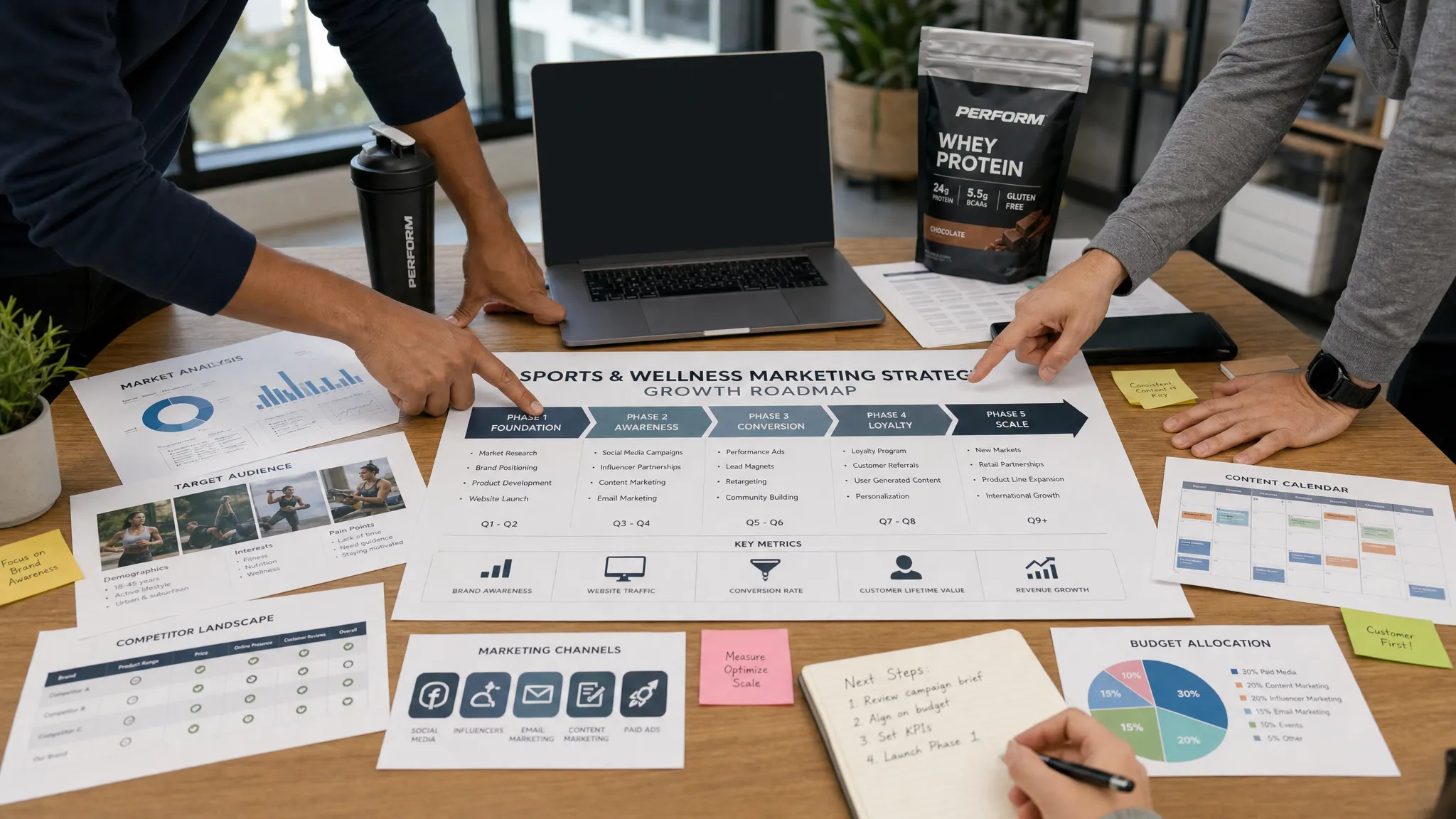
A practical 90-day roadmap for building a scalable marketing strategy
If your current marketing feels scattered, start with a 90-day reset. You do not need to rebuild everything at once.
- Days 1 to 30, diagnose the foundation: Clarify unit economics, review customer data, audit your website, analyze channel performance, study reviews, and define the highest-value customer segments. The output should be a clear strategy brief that explains who you are targeting, what message matters, and what constraints affect scale.
- Days 31 to 60, build the testing system: Launch structured creative tests, improve key landing pages, refine product page messaging, set up or improve essential email flows, and clean up KPI reporting. The output should be a repeatable process for learning what drives profitable acquisition and conversion.
- Days 61 to 90, scale what is working: Shift budget toward proven messages, expand winning creative formats, improve offers or bundles, strengthen retention campaigns, and decide which channel deserves the next investment. The output should be a growth plan based on evidence, not guesses.
This roadmap works because it balances strategy with execution. You are not pausing growth to write a document. You are building a system while learning from the market.
Common mistakes that stop a marketing strategy from scaling
The first mistake is scaling spend before validating the offer, message, and conversion path. More traffic will not fix unclear positioning.
The second mistake is optimizing only for platform ROAS. A campaign can look efficient while attracting low-value customers, overusing discounts, or hiding weak retention.
The third mistake is underinvesting in creative. If you do not have a consistent pipeline of new concepts, your paid media will eventually plateau.
The fourth mistake is separating brand and performance too much. Brand strategy gives performance marketing a reason to work. Performance data gives brand strategy real market feedback.
The fifth mistake is ignoring post-purchase experience. The customer’s first 30 days after buying can determine whether they reorder, review, refer, or disappear.
When to bring in a growth partner
A founder-led team can build a strong foundation internally, but scaling often requires specialized execution across paid media, creative, conversion rate optimization, email, SEO, reporting, and brand strategy. The challenge is not knowing that these pieces matter. The challenge is making them work together.
That is where a focused partner can help. OPTYO works with sports, fitness, and wellness brands on performance marketing, eCommerce development, conversion rate optimization, email marketing, creative asset production, growth consulting, paid social advertising, SEO, KPI reporting, and brand strategy consulting.
For an example of how integrated execution can support growth, see OPTYO’s MX Select case study, which highlights the role of data-driven advertising, landing page optimization, email automation, and budget testing for a premium fitness equipment brand.
Frequently Asked Questions
What is a scalable marketing strategy? A scalable marketing strategy is a repeatable system for acquiring, converting, and retaining customers as spend and demand increase. It connects positioning, channel strategy, creative testing, conversion optimization, retention, and reporting to business economics.
How do I know if my marketing strategy is ready to scale? Your strategy is closer to scale when you understand your customer acquisition cost, margins, conversion rate, repeat purchase behavior, winning messages, and channel roles. If performance depends on one ad, one promotion, or one channel, the system is probably not ready yet.
Which marketing channel should a fitness or wellness brand scale first? It depends on demand, margin, product type, and buying behavior. Paid social is often useful for demand creation and creative testing, search can capture existing intent, SEO builds long-term visibility, and email improves conversion and retention. The best first channel is the one that matches your customer journey and economics.
How often should a brand update its marketing strategy? The core positioning should not change every week, but the execution should be reviewed constantly. Weekly performance and creative reviews, monthly budget reviews, and quarterly strategy reviews give most growing brands a healthy rhythm.
Why do marketing strategies stop working as brands grow? Strategies often break because the audience broadens, creative fatigues, acquisition costs rise, inventory constraints appear, or weak retention becomes more visible. Scaling requires stronger systems, not just more spend.
Build a marketing strategy designed for real growth
If your brand has momentum but your marketing feels inconsistent, the next stage is not more random tactics. It is a clearer system for growth.
OPTYO helps sports, fitness, and wellness brands connect strategy with execution across paid media, creative, eCommerce, CRO, email, SEO, reporting, and growth consulting. If you are ready to build a marketing strategy that can actually scale, connect with OPTYO and start turning growth into a repeatable engine.