.png)




Revenue growth is exciting, but it can also hide problems. A brand can double sales and still end the quarter with weaker cash flow, worse margins, and a larger dependency on paid acquisition. That is why the strongest business strategies for growth are not built around “more” alone. They are built around better economics.
For ecommerce founders, especially in sports, fitness, and wellness, profitable growth comes from aligning product, pricing, marketing, retention, operations, and cash management. The goal is not to slow down ambition. The goal is to make each stage of growth more durable, so every new customer, order, and channel contributes to a healthier business.
Profitable growth starts with better questions
Many founders ask, “How do we get more customers?” That question matters, but it is incomplete. A profitability-first growth strategy starts with questions like:
- Which customers are most valuable after fulfillment, returns, discounts, and support costs?
- Which products create the strongest contribution margin?
- Which channels bring customers who buy again, not just customers who buy once?
- Where are we leaking profit inside the website, offer, operations, or post-purchase experience?
- How much cash can we afford to invest before a customer pays back?
These questions shift the business from chasing volume to engineering margin. That shift is critical in 2026, when acquisition costs remain competitive, consumers compare more options before buying, and founders are expected to show a clearer path to profitability.
1. Build around contribution margin, not top-line revenue
Gross revenue tells you how much money came in. Contribution margin tells you how much money is left after the variable costs tied to each sale. For ecommerce brands, those costs often include product cost, packaging, shipping, payment processing, fulfillment, returns, discounts, and channel fees.
A brand with $100 average order value and weak margins may be less healthy than a brand with a $65 average order value and a much stronger contribution margin. That is why contribution margin should guide decisions about pricing, bundles, promotions, customer acquisition, and inventory.
Start by reviewing margin at the SKU level. Some products may look like bestsellers but underperform after shipping, discounting, or high return rates. Others may have lower volume but create better cash efficiency. Once you know which products carry the business economically, you can prioritize them in ads, merchandising, email campaigns, and bundles.
This is also where financial discipline matters. If your internal numbers are messy, growth decisions become guesswork. Founders who need help keeping tax, bookkeeping, and financial reporting organized can benefit from working with qualified providers of expert tax and accounting services, especially when growth creates more complexity across cash flow, inventory, and compliance.
2. Choose where to grow before choosing how to grow
Not every customer segment deserves the same level of investment. A sports nutrition brand may sell to elite athletes, weekend warriors, busy parents, coaches, and gym owners. A fitness apparel brand may attract casual buyers, performance-focused customers, creators, and team buyers. Each segment can have different motivations, price sensitivity, retention potential, and acquisition costs.
Profitable growth depends on identifying the segments that create the best long-term economics. The “best” customer is not always the cheapest to acquire. It may be the customer who buys bundles, replenishes frequently, refers friends, leaves reviews, and responds well to education.
A practical way to evaluate segments is to compare customer behavior across first order value, repeat purchase rate, refund rate, product preference, and time to second purchase. If a group of customers consistently spends more and needs fewer discounts to convert, that segment should influence your positioning, creative strategy, and offer architecture.
This is where many brands benefit from a sharper growth roadmap. If you need a broader framework, OPTYO’s guide on how to build a growth strategy for an ecommerce brand walks through the key pieces of an ecommerce growth system.
3. Improve the offer before increasing traffic
Traffic does not fix a weak offer. It usually makes the weakness more expensive.
Before scaling spend, look at what customers are actually being asked to buy. Strong offers make the value feel obvious, reduce hesitation, and increase order profitability. That does not always mean discounting. In fact, overusing discounts can train customers to wait, compress margins, and make paid acquisition harder to sustain.
Better offer strategies may include:
- Bundles that increase average order value while helping customers choose faster
- Starter kits that reduce confusion for first-time buyers
- Subscribe-and-save options for products with natural replenishment cycles
- Limited product drops that create urgency without permanent discounting
- Free shipping thresholds that protect margin and encourage larger carts
- Premium versions or add-ons that lift contribution margin
For sports, fitness, and wellness brands, the offer should also connect to a clear outcome. Customers are not only buying protein, footwear, supplements, equipment, or recovery products. They are buying a better workout, more confidence, consistency, convenience, identity, or performance.
When the offer speaks to that outcome clearly, conversion improves without requiring deeper discounts.
4. Make conversion rate optimization a growth strategy, not a website task
Conversion rate optimization is often treated as a design project. In reality, it is one of the most important business strategies for growth because it improves the return on every visitor you already have.
If your site converts at 2 percent and you move to 3 percent, you can generate 50 percent more orders from the same traffic. That can improve CAC efficiency, email capture, inventory velocity, and cash flow. The impact compounds when paired with better average order value and repeat purchase behavior.
High-impact ecommerce CRO areas include product pages, landing pages, collection pages, cart experience, checkout, mobile speed, and post-click message match. The most profitable tests usually reduce friction or make value easier to understand.
Look for answers to questions like:
- Does the landing page match the promise made in the ad or email?
- Can customers understand the product benefit within seconds?
- Are reviews, testimonials, certifications, or guarantees visible near decision points?
- Is shipping, return, and sizing information easy to find?
- Does the cart encourage profitable add-ons without distracting from checkout?
CRO is especially powerful when paired with performance marketing. If you want to connect paid acquisition with stronger economics, OPTYO’s article on how performance marketing for ecommerce improves profitability goes deeper into that relationship.
5. Use retention to make acquisition more affordable
A business that depends entirely on first purchases will always feel pressure from acquisition costs. Retention changes the math. When customers buy again, the original acquisition cost is spread across more revenue and margin.
Retention is not just an email sequence. It is the customer’s entire experience after the first purchase. Product quality, delivery speed, packaging, education, support, community, and follow-up communication all influence whether someone returns.
For ecommerce brands, strong retention systems often include welcome flows, product education, replenishment reminders, post-purchase surveys, loyalty programs, referral incentives, and segmented campaigns based on purchase behavior. But the foundation is relevance. A customer who bought running gear should not receive the same follow-up as someone who bought recovery tools or supplements.
Retention also improves acquisition strategy. When you know which first purchases lead to stronger lifetime value, you can spend more confidently to acquire those customers. This prevents the common mistake of optimizing campaigns only for the cheapest first sale.
6. Scale paid media with a margin-based testing system
Paid media can accelerate growth, but only when the testing system is disciplined. Too many brands scale campaigns based on platform-reported ROAS without understanding whether those sales are profitable after discounts, fulfillment, returns, and customer support.
A margin-based paid media system starts with clear guardrails. Know your allowable CAC, target payback window, contribution margin by product, and acceptable test budget. Then use creative, audience, offer, and landing page testing to find combinations that can scale without damaging cash flow.
Creative testing is especially important for sports, fitness, and wellness brands because buyers respond to emotion, identity, proof, and transformation. A strong ad does not merely show the product. It communicates who the product is for, what problem it solves, and why the customer should care now.
Instead of testing random ad concepts, organize creative around angles such as performance improvement, convenience, community, problem-solution, comparison, founder story, athlete or creator use case, and social proof. This makes testing easier to interpret and helps your team learn faster.
If your current challenge is expansion without overspending, the OPTYO guide on how to help your business grow without burning cash is a useful companion to this profitability-first approach.
7. Build owned and organic channels to reduce dependency
Paid acquisition can be powerful, but relying on it too heavily creates risk. Costs rise, platform algorithms change, tracking becomes less precise, and competitors can bid aggressively for the same audience. Owned and organic channels help reduce that dependency over time.
The most valuable owned channels for ecommerce brands are usually email, SMS, community, content, and customer referral systems. Organic channels can include SEO, creator partnerships, athlete relationships, educational content, and social platforms where your audience already spends time.
The profitability benefit is simple: owned and organic channels can keep customers engaged without paying for every interaction. They also help customers understand your brand before they buy, which can improve conversion when they eventually arrive on your site.
For example, a recovery brand could publish educational content around training soreness, mobility routines, and recovery habits. A sports apparel company could build content around fit, performance, material selection, and training lifestyles. A wellness brand could create email education that helps customers use the product consistently, which increases satisfaction and repeat purchase potential.
The key is consistency. Organic growth rarely produces instant results, but it creates an asset that compounds.
8. Protect cash flow as aggressively as you pursue revenue
Profitability on paper does not always mean healthy cash flow. Inventory-heavy ecommerce brands can run into trouble when cash is tied up in stock, paid ads, delayed payouts, or future production runs.
A profitable growth strategy should include cash flow planning before major campaigns, product launches, seasonal pushes, and retail expansion. This is especially important for CPG, fitness equipment, apparel, and supplement brands, where inventory timing can make or break a quarter.
Founders should watch cash conversion cycles, inventory turnover, payment terms, minimum order quantities, and the timing between ad spend and customer payback. A campaign may be profitable over 90 days but still create short-term cash pressure if the brand spends heavily upfront and waits too long for repeat purchases.
To reduce risk, model conservative, expected, and aggressive scenarios before scaling. This helps you decide how much inventory to buy, how much media budget to allocate, and what level of discounting you can afford.
9. Run the business on fewer, better KPIs
A dashboard with too many metrics can create confusion. A profitability-focused growth strategy needs a small set of KPIs that connect marketing activity to business health.
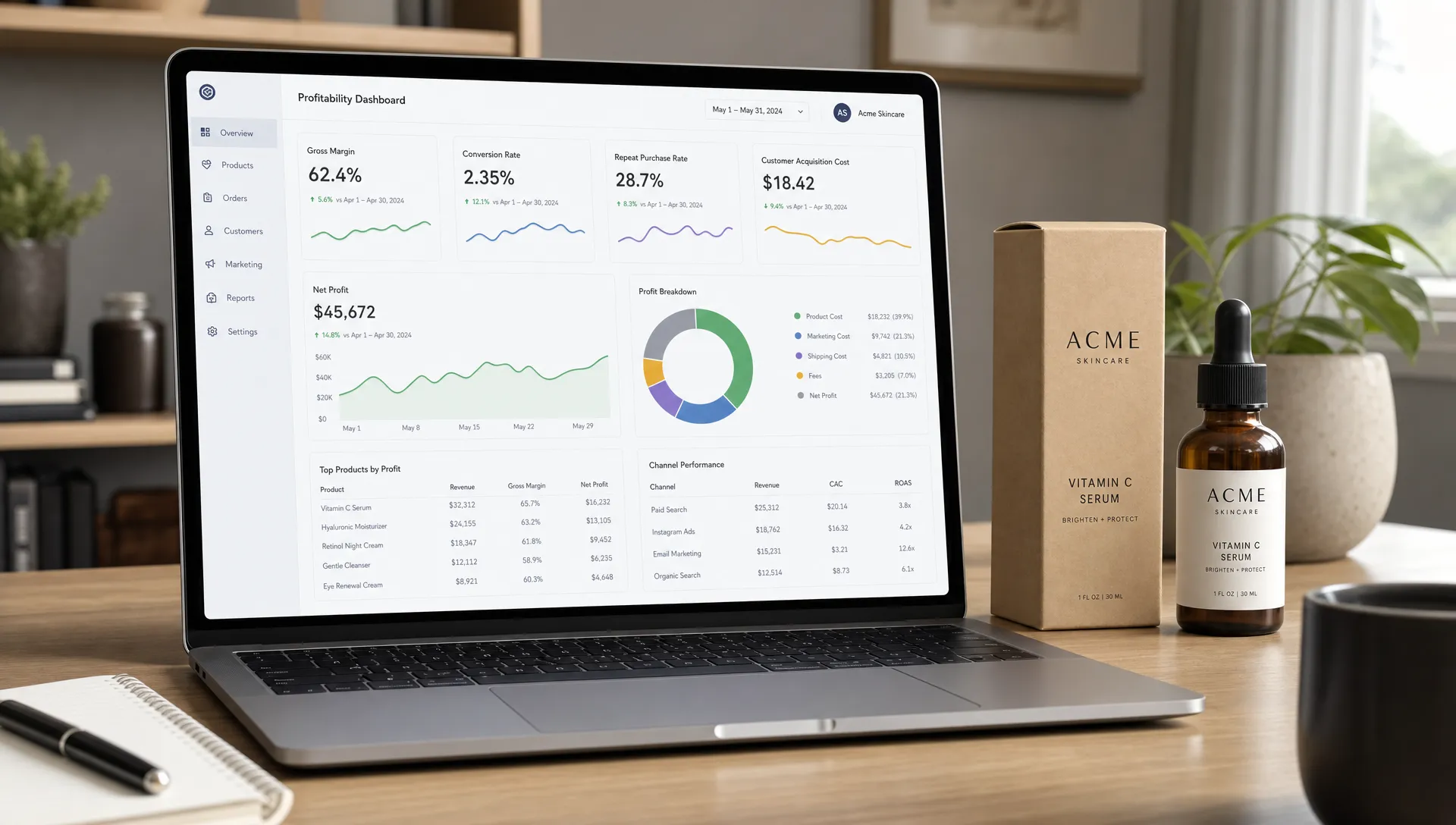
Useful metrics include contribution margin, CAC, MER, first-order profitability, repeat purchase rate, average order value, conversion rate, refund rate, inventory turnover, payback period, and revenue by cohort. The exact mix depends on your business model, but the principle is the same: every metric should help you make a decision.
A founder does not need to review every metric every day. Instead, create a weekly rhythm for performance, a monthly rhythm for strategic decisions, and a quarterly rhythm for bigger bets. This keeps the team focused on what matters and prevents overreacting to short-term fluctuations.
Good KPI reporting also improves accountability. Marketing, creative, operations, and finance should not operate in silos. If paid media is scaling but fulfillment costs are rising, the team needs to see the full picture. If conversion is improving but refund rates are increasing, the business may have a product expectation problem rather than a marketing win.
Turning strategy into an operating rhythm
The best business strategies for growth become part of how the company operates. They are not one-time planning documents. They are systems for making better decisions every week.
A simple 90-day profitability plan could look like this:
- Days 1 to 30: Audit unit economics, customer segments, product margins, traffic sources, conversion leaks, and retention performance.
- Days 31 to 60: Test offer improvements, product page updates, email flows, creative angles, and paid media guardrails.
- Days 61 to 90: Scale the winners, cut underperforming spend, refine inventory planning, and set the next round of growth priorities.
This rhythm keeps growth practical. It also helps founders avoid the trap of chasing every new channel, trend, or tactic before fixing the economics underneath the business.
Frequently Asked Questions
What is the most profitable growth strategy for an ecommerce brand? The most profitable strategy is usually the one that improves contribution margin and customer lifetime value at the same time. For many brands, that means improving offers, conversion rate, retention, and paid media efficiency before aggressively increasing traffic.
How can a business grow without lowering prices? A business can grow without lowering prices by improving positioning, creating stronger bundles, adding premium options, increasing perceived value, improving product education, and using customer proof to reduce buying hesitation.
Why is retention important for profitability? Retention spreads acquisition costs across multiple purchases. When customers buy again, the business earns more revenue and margin without paying the full cost of acquiring a brand-new customer each time.
Which KPIs matter most for profitable growth? The most useful KPIs include contribution margin, CAC, MER, conversion rate, average order value, repeat purchase rate, payback period, refund rate, and inventory turnover. These metrics connect growth activity to financial health.
Should startups focus on growth or profitability first? Startups need both, but the order matters. A brand should understand its unit economics and path to profitability before scaling aggressively. Otherwise, growth can amplify losses instead of creating a stronger business.
Build growth that strengthens the business
Profitable growth is not about being conservative. It is about being precise. When your margins, offers, conversion funnel, retention system, paid media, and cash flow are aligned, growth becomes easier to sustain.
OPTYO helps sports, fitness, wellness, D2C, and CPG brands connect performance marketing with the business fundamentals that drive profit. If you want a clearer strategy for scaling without wasting spend, explore how OPTYO can help turn growth into a more profitable system.