.png)




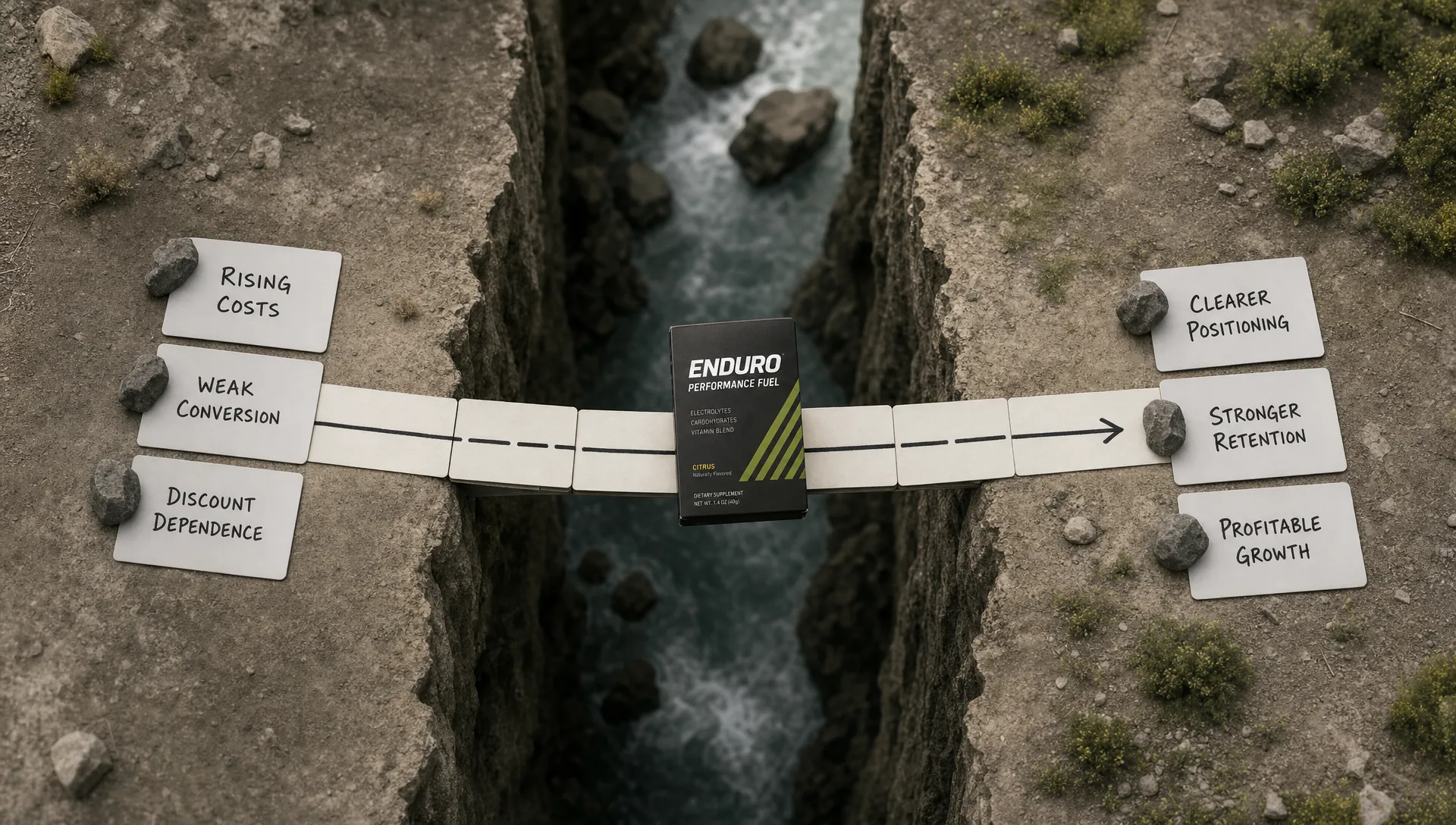
Expansion is exciting because it creates a bigger story for the business. A new region, retail channel, product line or customer segment can make growth feel inevitable. But for ecommerce, D2C and CPG brands, expansion also magnifies every weakness in positioning, margins, operations and acquisition costs.
That is why calculating market potential before expanding matters. It turns a broad opportunity into a practical decision: is this market big enough, reachable enough and profitable enough to justify the next move?
For sports, fitness and wellness brands, the answer is rarely found in one big industry report. A national trend might say recovery, hydration, mobility or women’s strength training is growing, but your business needs a more specific answer. How many customers can you realistically reach? How often will they buy? What will it cost to acquire them? How much profit remains after fulfillment, discounts, retail margins and launch costs?
The goal is not to predict the future perfectly. The goal is to avoid expanding on vibes.
What market potential really means
Market potential is the maximum revenue or profit your brand could realistically capture in a defined market over a defined period. The phrase “defined market” is doing a lot of work here.
For one brand, the market might be “runners in Texas who buy electrolyte products online.” For another, it might be “independent gyms that could stock a recovery beverage in the Northeast.” For a wellness ecommerce brand, it might be “urban professionals seeking at-home mobility tools after physical therapy.”
A useful market potential calculation should answer three questions:
- How many qualified buyers exist in this expansion market?
- How much can those buyers spend in your category over a realistic buying period?
- What portion can your brand reasonably capture after accounting for competition, distribution, marketing and operational limits?
That final question is where many expansion plans fall apart. A market can be large but still unattractive if your brand cannot reach customers profitably or serve them well.
Start with the expansion hypothesis
Before you calculate anything, define exactly what kind of expansion you are evaluating. “We want to grow in the wellness market” is too vague to model. “We want to test a new D2C recovery bundle for desk workers in major U.S. cities” is specific enough to measure.
Your expansion hypothesis should include the customer, the offer, the channel, the geography if relevant and the reason you believe demand exists. If any of those pieces are unclear, pause and sharpen them before building a spreadsheet.
For ecommerce founders, this step overlaps with target market definition. If you have not clearly separated your primary customer from adjacent audiences, revisit the fundamentals in OPTYO’s guide on how to define your target market for faster growth. Market size only matters after you know whose market you are sizing.
Here are examples of expansion hypotheses that are specific enough to test:
- A hydration brand wants to expand from endurance athletes into functional fitness customers through paid social and gym partnerships.
- A protein snack company wants to enter specialty retail in the Southwest with a smaller pack size and higher velocity merchandising.
- A mobility equipment brand wants to target office workers with a new bundle, search-driven content and corporate wellness partnerships.
- A supplement brand wants to launch in Canada through ecommerce before pursuing wholesale distribution.
Each of these requires a different market potential calculation because the buyer, channel economics and purchase behavior are different.
Use TAM, SAM and SOM without getting lost in theory
TAM, SAM and SOM are common market sizing terms, but they are only useful if you make them operational.
| Metric | What it means | Practical question |
|---|---|---|
| TAM | Total addressable market | How big is the broad category if every relevant buyer bought? |
| SAM | Serviceable available market | How much of that category can your business actually serve with its product, pricing, geography and channel? |
| SOM | Serviceable obtainable market | What share can you realistically win in the next 12 to 36 months? |
For expansion decisions, SOM is usually the most important number. TAM helps you understand the ceiling, but SOM helps you decide whether to spend.
A simple ecommerce formula is:
Potential customers x purchase frequency x average order value = annual revenue potential
For subscription products, the formula shifts slightly:
Potential customers x monthly ARPU x 12 = annual recurring revenue potential
For CPG wholesale, use a retail velocity model:
Number of stores x units sold per store per week x wholesale price x 52 = annual wholesale revenue potential
These formulas are simple on purpose. The hard part is not the math. The hard part is choosing assumptions that reflect reality.
Build a bottom-up model first
Top-down market sizing starts with a large category number, then narrows it down. It can be useful for investor decks, but it often overstates what a young brand can capture.
Bottom-up sizing starts with customer behavior, channel capacity and conversion assumptions. For expansion planning, it is usually more reliable.
Imagine a hydration powder brand evaluating a new customer segment: functional fitness athletes in a specific region. A bottom-up model might look like this:
| Assumption | Example input | Why it matters |
|---|---|---|
| Qualified audience | 120,000 potential buyers | People who match the buyer profile, not the whole fitness population |
| Reachable share | 40 percent | Portion the brand can reach through ads, partnerships, email capture or retail access |
| First-year conversion | 3 percent | Share of reachable buyers expected to purchase in year one |
| Average order value | $48 | Revenue per ecommerce order |
| Orders per customer | 2.2 per year | Repeat purchase behavior |
| Gross margin | 62 percent | Margin after product costs, not after all marketing costs |
| Estimated CAC | $32 | Cost to acquire each first-time customer |
Using those assumptions, the first-year obtainable revenue would be:
48,000 reachable buyers x 3 percent conversion x $48 AOV x 2.2 orders = $152,064
Gross profit before acquisition costs would be:
$152,064 x 62 percent = $94,280
If acquiring 1,440 first-time buyers costs $32 each, acquisition spend equals $46,080. That leaves roughly $48,200 before fixed launch costs like creative production, packaging changes, retail setup, sampling, new landing pages, legal review or agency support.
If the launch requires $75,000 in fixed costs, the opportunity may not clear the bar yet. If the launch requires $25,000 and builds a repeatable segment, it may be worth a controlled test.
This is the difference between a market that sounds big and a market that is economically useful.
Adjust for serviceability, not just demand
Demand alone does not make a market attractive. You also need to know whether your business can serve that demand without destroying the customer experience or margin.
For ecommerce, serviceability includes shipping speed, inventory planning, returns, customer support, tax complexity, channel restrictions and localized expectations. For CPG, it also includes broker relationships, distributor requirements, retail margins, slotting fees if applicable, shelf life and store-level velocity.
In sports and wellness, trust and accessibility can also shape serviceability. A local health provider, for example, needs to signal location convenience, accepted services, insurance access and treatment credibility. You can see this in how a Manhattan care provider like Move Well MD presents pain relief services, care options and clinic locations for patients evaluating local care. Product brands are different from clinics, but the principle is the same: a market is only serviceable when customers can understand, access and trust the offer.
For a D2C brand, that might mean localized landing pages, shipping thresholds that make sense for the region, customer reviews from similar users or educational content that addresses the specific use case.

Validate demand signals before trusting the spreadsheet
A spreadsheet can make weak assumptions look precise. Before expanding, compare your model with real-world demand signals.
Search behavior is one signal. If buyers are actively searching for your product category, pain point or comparison terms, that suggests existing intent. Social listening is another signal, especially in fitness communities where customers discuss routines, gear, supplements, recovery tools and frustrations in detail.
Your own data is often the best starting point. Look at where existing customers live, which products repeat best, which customer segments have the strongest contribution margin and which campaigns attract buyers who come back. Expansion should build from proven demand patterns, not distract from them.
Retail and wholesale conversations can also reveal market potential. If specialty retailers, gyms, clinics, studios or coaches already hear customers asking for a solution like yours, that is useful qualitative evidence. It is not enough by itself, but it can support a pilot.
Strong demand signals include:
- Existing customers organically buying from the expansion region or segment
- Search demand around the problem, product type or use case
- High engagement from paid creative aimed at the new audience
- Repeat purchases from a small test cohort
- Retailers, gyms or partners asking about the category
- Competitors selling successfully without fully owning the positioning
Weak signals include likes without purchases, survey interest without deposits, retailer compliments without purchase orders and category hype that does not connect to your exact offer.
Convert market potential into a go or no-go scorecard
Once you have your market size, revenue model and demand signals, create a scorecard. This prevents the loudest opinion in the room from driving the decision.
| Factor | What to evaluate | Strong signal |
|---|---|---|
| Audience fit | Does the market match your best customers? | Similar needs, use cases and buying triggers |
| Revenue potential | Is the obtainable market large enough? | SOM supports meaningful revenue within 12 to 36 months |
| Margin quality | Does profit remain after channel costs? | Contribution margin supports reinvestment |
| Acquisition feasibility | Can you reach buyers efficiently? | CAC is near or below your acceptable payback target |
| Retention potential | Will customers buy again? | Clear repeat purchase, subscription or replenishment behavior |
| Operational readiness | Can you fulfill and support demand? | Inventory, shipping and service processes can handle volume |
| Competitive opening | Is there a reason customers would switch? | Clear differentiation beyond price |
You can score each category from 1 to 5, then set a minimum threshold before greenlighting expansion. The score is less important than the discussion it forces. If market potential is strong but margins are weak, your next move might be offer redesign rather than launch. If demand is clear but acquisition is expensive, you may need partnerships, SEO or retail distribution instead of paid social alone.
Pressure-test unit economics before scaling
A market with impressive revenue potential can still be a bad expansion if the economics do not work. Before scaling, model contribution profit at the order level and customer level.
At minimum, calculate:
- Average order value
- Gross margin
- Fulfillment and shipping costs
- Discounts and promotional costs
- Payment processing fees
- Return or refund rate
- Customer acquisition cost
- Repeat purchase rate
- Payback period
The most important question is not “Can we generate sales?” It is “Can we generate profitable customers at a volume that justifies the expansion?”
This is where many brands should slow down. If your current market is not profitable, a new market may only give you a larger version of the same problem. OPTYO’s article on growing without burning cash explains why margin discipline, retention and controlled testing matter before adding more spend.
A clean expansion model should include fixed launch costs as well. Creative production, new packaging, market research, retail setup, landing page development, influencer seeding, sampling and inventory buys can all turn a promising contribution margin into a cash drain if they are not modeled upfront.
A useful break-even formula is:
Fixed expansion costs / contribution profit per customer = customers needed to break even
If the number of break-even customers is higher than your realistic year-one customer capture, the expansion needs a smaller pilot, better economics or a different channel.
Run a market potential pilot before committing fully
The best expansion plan usually includes a small test designed to validate the riskiest assumptions. If demand is uncertain, test messaging and conversion. If acquisition cost is uncertain, test paid channels. If repeat purchase is uncertain, test a cohort before expanding inventory. If retail velocity is uncertain, test a limited number of doors before pursuing a regional rollout.
A good pilot has a clear time frame, budget, success metric and decision rule. For example, a wellness brand might run a six-week landing page and paid media test for a new customer segment. The goal is not just revenue. The goal is to learn whether conversion rate, CAC and customer feedback support a larger launch.
For CPG, a pilot might involve a small retail cluster with stores that match the target customer. The brand can measure sell-through, reorder rate, merchandising quality and sampling effectiveness. If units move only when heavily discounted, the market potential is weaker than the top-line sales suggest.
Your pilot should connect to a broader launch system. If you need help organizing positioning, offer, channels and proof points, OPTYO’s guide to building a go-to-market strategy for products customers actually want is a useful next step.
Common mistakes when calculating market potential
The first mistake is confusing category size with brand opportunity. A billion-dollar category does not mean your brand can win a meaningful share, especially if distribution, trust or CAC are against you.
The second mistake is ignoring channel economics. A product that works D2C may not work in wholesale after retail margins, distributor fees and promotional allowances. The reverse is also true: a product with strong retail velocity may struggle online if it has low AOV or high shipping costs.
The third mistake is using one conversion assumption across every market. A loyal niche audience may convert at a healthy rate, while a broader audience needs more education and proof. Expansion usually lowers conversion at first because the brand is moving away from its strongest early adopters.
The fourth mistake is treating competitors as proof that the market is attractive. Competitors prove demand exists, but they do not prove you can acquire customers profitably. Look for gaps in positioning, product format, price architecture, distribution or customer experience.
The fifth mistake is skipping retention. Market potential is much stronger when customers repeat. In sports, fitness and wellness, replenishable products like supplements, beverages, snacks and personal care can support higher lifetime value. Durable products need a different model, often built around accessories, bundles, content, community or additional use cases.
A simple framework for deciding whether to expand
After you calculate market potential, summarize the decision in plain English. A founder, operator or marketing lead should be able to read the conclusion quickly and understand the tradeoff.
Use this structure:
The market: Define the customer, geography, channel or product category.
The opportunity: State TAM, SAM and realistic SOM in revenue terms.
The economics: Show expected contribution margin, CAC, payback and fixed costs.
The evidence: Summarize demand signals from customers, search, paid tests, retail conversations or first-party data.
The risk: Identify the assumption most likely to break the model.
The next move: Recommend no action, more research, a limited pilot or a full expansion.
If you cannot fill out these six pieces clearly, the expansion plan is not ready. That does not mean the opportunity is bad. It means the business needs more evidence before committing resources.
Frequently Asked Questions
What is the easiest way to calculate market potential? Start with a bottom-up formula: potential customers x purchase frequency x average order value. Then adjust for the share you can realistically reach, convert and serve profitably.
What is the difference between market size and market potential? Market size describes the total value of a category or audience. Market potential estimates what your brand could realistically capture in that market based on reach, conversion, economics and operational limits.
How do I calculate market potential for a CPG retail expansion? Use a store velocity model: number of stores x units sold per store per week x wholesale price x 52. Then subtract channel costs, promotional costs, broker or distributor costs if relevant and fixed launch expenses.
How much market potential is enough before expanding? There is no universal threshold. The opportunity should be large enough to cover fixed launch costs, support profitable customer acquisition and create meaningful growth without distracting from stronger existing markets.
Should I expand if competitors are already in the market? Competitors can validate demand, but they also raise acquisition and differentiation challenges. Expand only if you have a clear reason customers will choose you and a channel strategy that can reach them profitably.
Turn market potential into a smarter growth decision
Calculating market potential is not just a finance exercise. It is a strategy filter that helps you decide where to focus, what to test and how much risk to take.
For sports, fitness and wellness brands, the best expansion opportunities usually sit at the intersection of strong customer demand, clear differentiation, healthy margins and realistic channel access. If one of those pieces is missing, fix it before scaling.
OPTYO helps D2C and CPG brands connect market strategy with performance marketing, creative, ecommerce optimization and growth consulting. If you are evaluating a new market, product line or channel, the right model can help you expand with confidence instead of guesswork.