.png)



A product customers actually want is not created by louder ads, bigger launch discounts or a prettier homepage. Those can help a strong offer travel faster, but they cannot manufacture demand where demand does not exist.
For ecommerce entrepreneurs, especially in sports, fitness and wellness, the hard part is not simply getting attention. It is earning a specific kind of attention from people who are already motivated to solve a problem, improve a habit or reach a goal. A go-to-market strategy should turn that motivation into a clear path from discovery to purchase.
That means the best strategy go to market work starts before media buying, influencer seeding or email flows. It starts with one question: what evidence do we have that this customer wants this product badly enough to act now?
Why many product launches miss the real issue
Founders often treat go-to-market as a launch checklist. Build the site, make the content, set up paid social, brief creators, send emails and watch the numbers. Those steps matter, but they are execution. They do not answer whether the market understands the product, trusts the promise and sees enough urgency to buy.
CB Insights has reported that no market need was the most cited reason in its analysis of startup failures. The lesson for ecommerce brands is direct: a launch does not fail only because the ads underperformed. It often fails because the product was aimed at a vague buyer, the promise was too broad or the offer did not beat the customer’s current alternative.
A customer’s current alternative may not be a competing product. It could be doing nothing, using a cheaper supplement, following a free workout plan, wearing old gear one more season or relying on advice from a coach. Your go-to-market strategy must explain why switching is worth the effort.
Start with demand signals, not opinions
Customer desire is easy to overestimate when feedback comes from friends, followers or people who like the founder. Real demand has friction attached to it. People search, compare, ask specific questions, save money, join waitlists, attend demos, request samples or buy despite imperfect conditions.
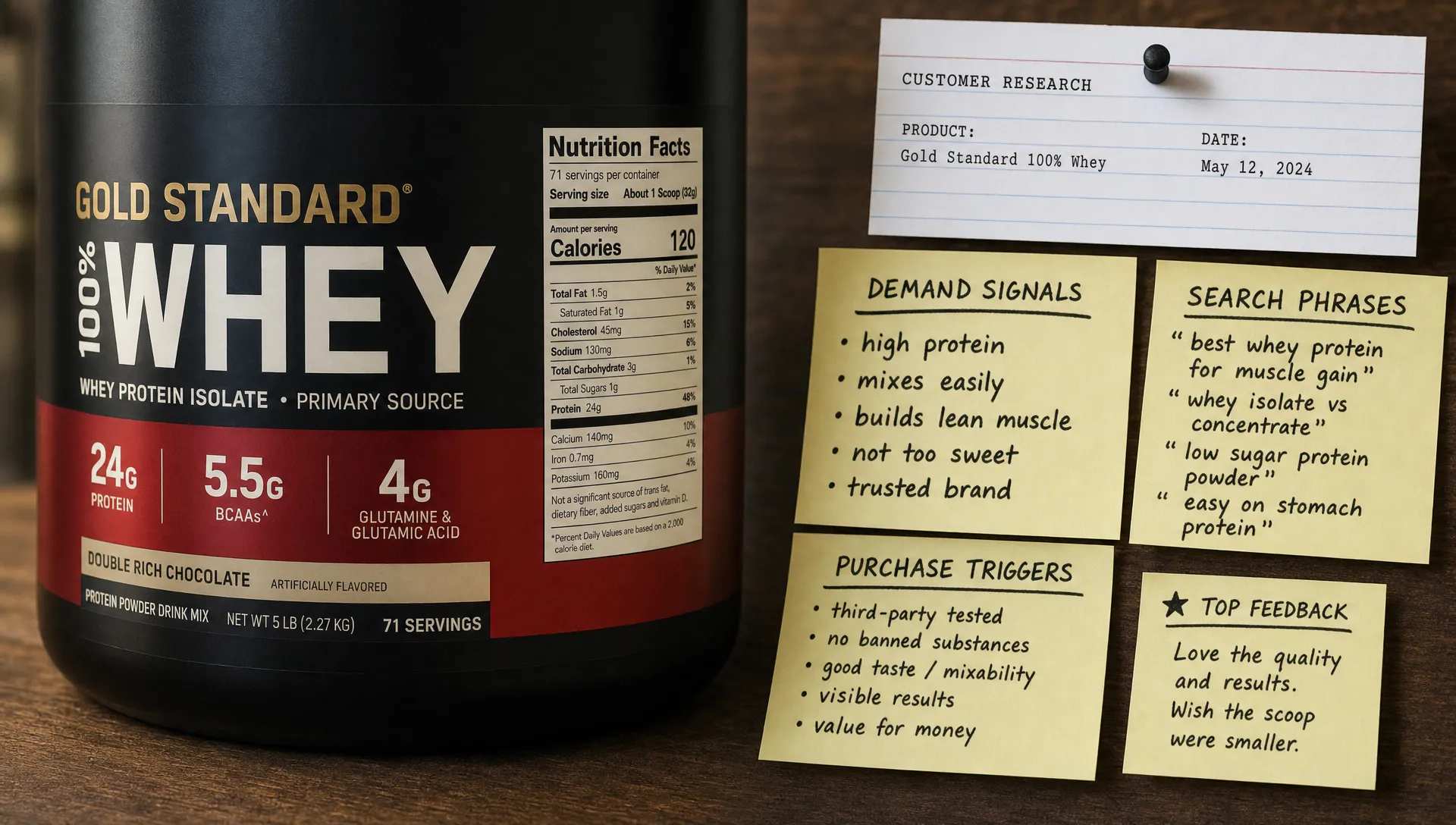
Before you plan the launch calendar, collect evidence across five areas:
- Problem intensity: The customer can describe the pain, goal or frustration without being coached.
- Current behavior: They already spend time or money trying to solve it.
- Purchase trigger: A specific moment makes them more likely to act, such as a race date, injury recovery, new training cycle, weight goal or lifestyle change.
- Switching barrier: You know what keeps them from trying something new, including price, trust, taste, fit, shipping, complexity or social proof.
- Language fit: Customers use phrases your brand can repeat in ads, product pages and email subject lines.
A fitness apparel brand might learn that its audience is not looking for general comfort. They want shorts that do not ride up during long runs in humid weather. A hydration brand might find that customers care less about vague performance benefits and more about avoiding stomach discomfort during endurance sessions. A wellness snack brand might discover that its strongest use case is not healthy snacking broadly, but a high-protein option that feels satisfying after evening workouts.
These distinctions shape everything that follows.
Define the smallest market you can win first
A product for everyone usually launches to no one. The sharper move is to define the smallest market where your product has a believable advantage and your brand can create momentum.
This is especially important in sports, fitness and wellness because identity drives buying behavior. A recreational pickleball player, competitive CrossFit athlete, marathon beginner, postpartum fitness customer and weekend hiker may all buy performance products, but they do not buy for the same reasons. Their goals, objections, communities and proof points differ.
A useful first market has three traits. It is specific enough to target, painful enough to motivate action and reachable through identifiable channels. If you cannot describe where the customer learns, shops, trains, competes or asks for recommendations, the segment is probably still too broad.
For a deeper breakdown of segmentation, OPTYO’s guide on how to define your target market for faster growth shows how ecommerce brands can move from broad personas to a more useful customer focus.
Once the first market is clear, the go-to-market strategy becomes less abstract. You can choose the right message, proof, offer, channel mix and launch sequence around a real buyer instead of a demographic profile.
Build the offer around the customer’s desired progress
Customers do not buy products only for their features. They buy progress. The product is the mechanism, but the offer is the full promise that helps them believe progress is possible.
A strong offer answers four questions quickly:
- What does this help me do? The desired outcome should be obvious.
- Why should I believe it? The brand needs proof, such as formulation details, athlete testing, customer reviews, expert credibility or clear product demonstrations.
- Why is this better for me? The difference should connect to the customer’s use case, not just the founder’s preference.
- Why should I act now? The trigger can be seasonality, limited access, an event, a goal timeline, a bundle or a launch incentive.
This is where many ecommerce brands weaken their own GTM. They lead with product details before establishing why the product matters. A recovery tool with five technical specs still needs a simple promise for the customer who wants to train tomorrow without feeling wrecked. A functional beverage with premium ingredients still needs to make the buying moment clear: pre-workout, post-run, afternoon energy, travel, focus or replacement for another habit.
The product page, ad creative and email flows should all reinforce the same core idea. If every asset tells a different story, the customer has to do the work of figuring out why the product exists.
Validate before scaling spend
A go-to-market strategy for products customers actually want should include small tests before major investment. Validation does not mean asking people if they like the idea. Most people are polite, optimistic or too detached from the buying moment to give useful answers.
Better validation asks for a meaningful action.
You might test a landing page with a waitlist, run paid creative against two positioning angles, offer a limited preorder, seed product to a narrow group of high-fit users or run a pop-up activation where people can sample and buy on the spot. For sports and wellness brands, event-led validation can be especially useful because customers are already in a high-intent environment. A brand launching around races, fitness classes or community experiences can reduce purchase friction by using tools such as a next-gen event ticketing platform to manage signups, ticket tiers and checkout without forcing unnecessary buyer registration.
The key is to separate curiosity from purchase intent. A strong click-through rate may show that the creative is interesting, but it does not prove the offer is compelling. A waitlist may show interest, but conversion from waitlist to purchase shows much more. Sampling may create positive comments, but repeat orders reveal whether the product fits into the customer’s routine.
Validation should shape the strategy, not simply confirm the founder’s original plan. If customers keep asking the same question, address it on the product page. If one use case converts better than the others, make it the lead message. If a price objection appears repeatedly, test bundles, sizing or value framing before cutting price.
Position the product so customers can repeat it
Positioning is not a tagline. It is the mental shortcut that helps customers understand what the product is, who it is for and why it matters.
A simple positioning draft can follow this structure:
For a specific customer who wants a specific outcome, this product helps create that outcome through a specific mechanism, with proof that reduces doubt.
For example, a generic claim like premium protein for active lifestyles is too broad. A stronger version might be built around busy strength athletes who need a high-protein breakfast that is quick, tastes good and fits their macros. The second version gives creative teams, media buyers, email marketers and product page designers something concrete to work with.
Positioning should also be repeatable by customers. If a buyer cannot explain the product to a friend in one sentence, the market will struggle to spread the idea for you.
Brand still matters here. Distinctive visuals, voice and storytelling create memory, but they work best when attached to a sharp buying reason. OPTYO’s article on marketing and branding strategies that build demand covers how ecommerce brands can connect positioning, creative and channel strategy without reducing brand to aesthetics.
Choose launch channels based on how the customer buys
Channel strategy should follow customer behavior. Too many founders pick channels based on what other brands are doing, then wonder why their launch feels scattered.
A D2C wellness brand with a high-education product may need search, long-form landing pages, creator explainers and email nurture. A fitness apparel brand with a visually obvious product may lean harder into paid social, short-form video, athlete creators and community content. A sports equipment brand may need demos, comparison content, retail partnerships or coach advocacy before paid ads can convert efficiently.
The right channel mix usually includes a blend of demand capture, demand creation and trust building. Search captures people already looking. Paid social and creators create new awareness. Email, SMS and retargeting help turn interest into revenue. Events, ambassadors, coaches and communities build credibility in places where performance claims face skepticism.
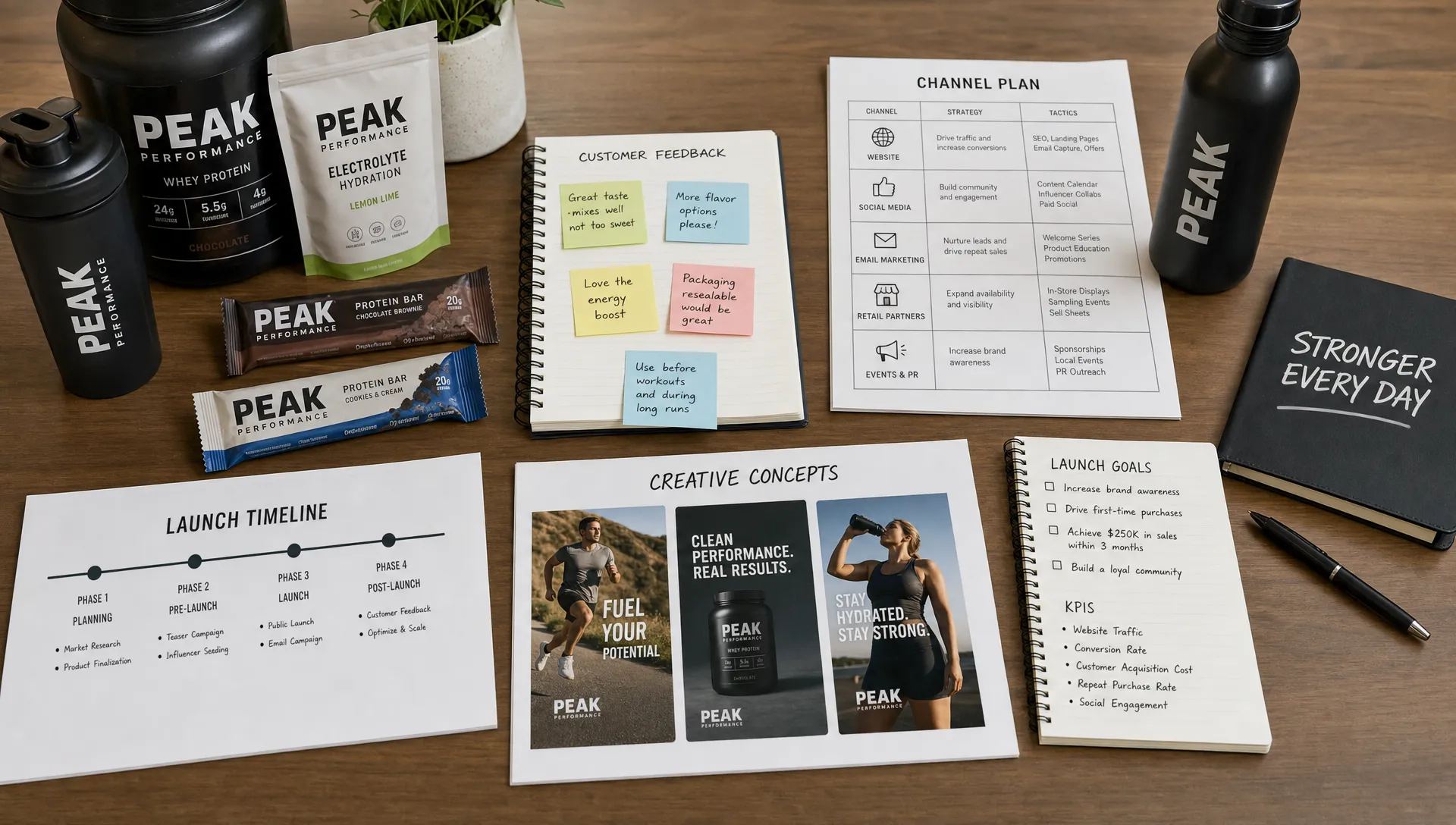
Avoid treating every channel as a separate campaign. If the launch promise is clear, each channel should express the same idea in a format native to that environment. A TikTok hook, Meta ad, product page headline, creator brief and abandoned cart email can all speak to the same customer problem without copying the same sentence.
For founders who need the full launch architecture, OPTYO’s guide to build a go-to-market strategy for D2C brands expands on market selection, offer design and launch channel planning.
Make the launch a learning system
The goal of launch is not only first-week revenue. It is to learn which customers respond, which messages convert, which objections block purchase and which channels deserve more capital.
A practical launch system has three phases.
Before launch: Build the audience, test the message, collect objections, create launch assets and define success metrics. The strongest pre-launch work often comes from customer conversations, creator feedback, product sampling and landing page tests.
During launch: Watch conversion behavior closely. Track which traffic sources produce buyers, not just visitors. Monitor comments, emails, customer service questions and checkout drop-off. If the same objection appears repeatedly, update the product page and creative quickly.
After launch: Measure repeat behavior, reviews, usage, refund reasons and post-purchase survey responses. Early customers are not only revenue. They are the best source of insight for version two of the offer and creative.
This approach keeps the team from making decisions based on isolated metrics. A launch with modest first-week revenue but strong repeat purchase, excellent reviews and low refund rates may be a better foundation than a flashy launch built on discounts and low-quality traffic.
Metrics that show whether customers actually want it
Vanity metrics can make a launch look healthier than it is. Followers, impressions and engagement matter only when they connect to buying behavior or future demand.
A better GTM scorecard focuses on customer intent and business quality. Track conversion rate by audience segment, customer acquisition cost, contribution margin, email signup to purchase rate, product page scroll depth, add-to-cart rate, checkout completion, repeat purchase, review quality and refund reasons.
For consumable products, repeat purchase and subscription behavior can reveal whether the product becomes part of the customer’s routine. For apparel and gear, reviews, sizing issues, return rates and user-generated content can reveal whether expectations matched reality. For premium products, time to purchase and content engagement can show how much education the buyer needs.
The point is not to chase perfect benchmarks. The point is to identify where desire is strong and where friction is still too high. If people click but do not add to cart, the promise may be interesting but the product page may lack proof. If people add to cart but abandon checkout, pricing, shipping or urgency may be the issue. If people buy once but do not come back, the product experience or post-purchase education may need work.
Common GTM mistakes to avoid
The same patterns appear across many ecommerce launches. They are fixable, but only if the team is willing to make the strategy more specific.
One common mistake is targeting a broad lifestyle instead of a buying situation. Active people is not a market. Parents training for their first half marathon with limited morning time is closer to one.
Another mistake is using discounts to solve a positioning problem. If customers do not understand why the product matters, a discount may create a temporary sale without increasing belief.
Brands also rush into paid media before the product page can convert. Paid traffic magnifies what already exists. If the offer is unclear, proof is weak or the checkout experience is clunky, spend will expose those issues quickly.
Finally, many teams treat the launch as a single event instead of a sequence. Products customers want often become obvious through iteration. The first version of the message is rarely the strongest one. The team that learns fastest usually earns the advantage.
Frequently Asked Questions
What is a go-to-market strategy? A go-to-market strategy is the plan for bringing a product to a specific customer segment through the right positioning, offer, channels and sales path. For ecommerce brands, it connects customer insight to launch execution.
How do I know if customers actually want my product? Look for behavior, not compliments. Strong signals include preorders, waitlist conversions, repeat purchases, high-intent search demand, product page engagement, referrals and customers describing the problem in their own words.
Should a new ecommerce brand launch on every channel? No. A focused launch usually performs better. Choose channels based on where your target customer discovers products, compares options and makes buying decisions.
What is the difference between product-market fit and go-to-market strategy? Product-market fit means the product satisfies a real market need. Go-to-market strategy is how you reach, persuade and convert that market. The two are connected because GTM tests often reveal whether the fit is strong enough.
How long should a go-to-market plan take to build? The timeline depends on product complexity, category education and available customer data. Many ecommerce teams can create a strong first version in a few weeks, then refine it through validation tests and launch performance.
Build a go-to-market strategy around real demand
A product customers want is easier to market, but it still needs disciplined execution. The strategy should clarify who the product is for, what progress it helps them make, why they should believe it and where the buying moment happens.
For sports, fitness and wellness brands, that means connecting customer insight with performance marketing, ecommerce experience, creative and retention. If your team is preparing to launch a new product or reposition an existing one, OPTYO can help turn customer demand into a focused growth system that is built to scale.