.png)


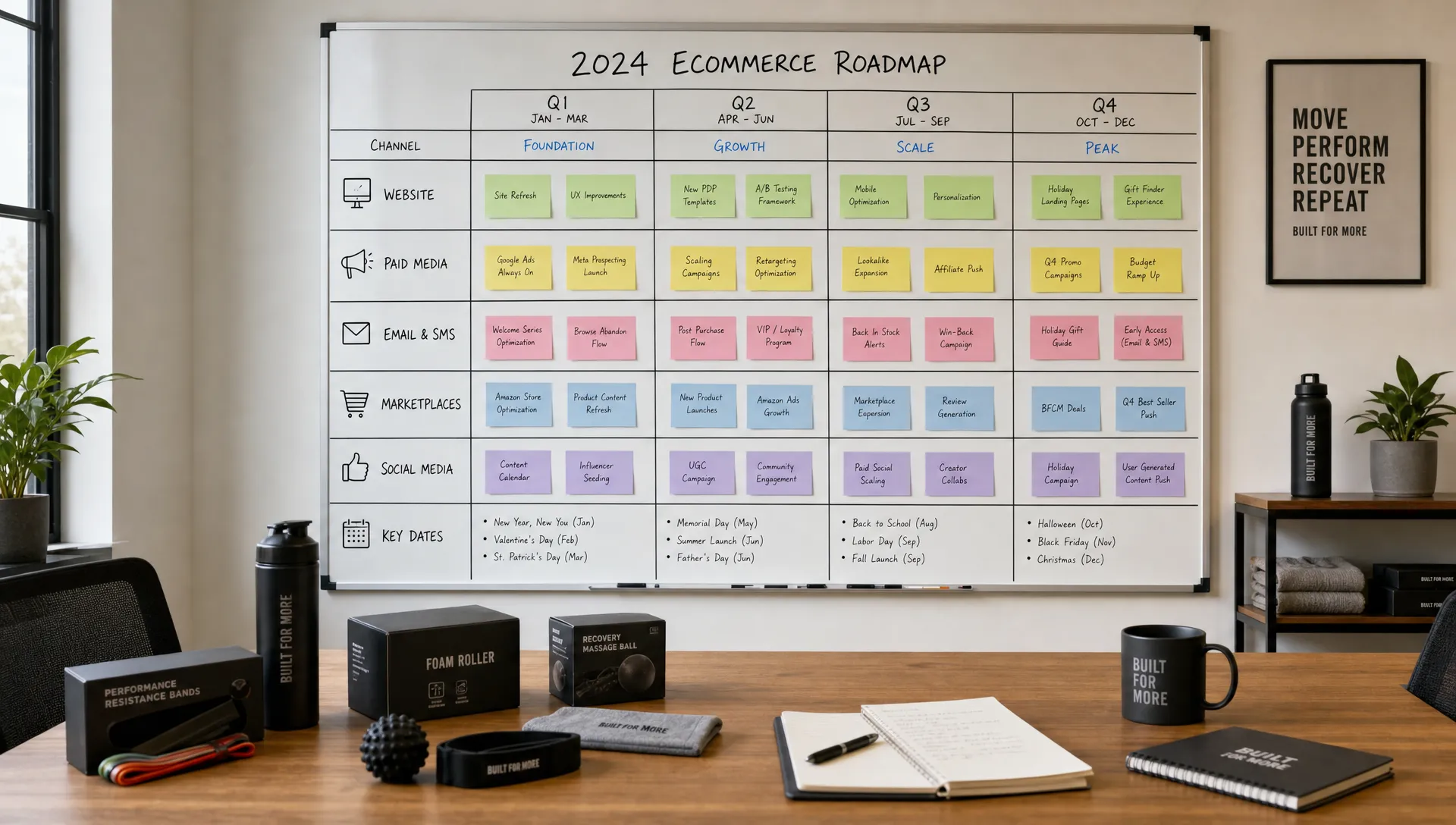

Most ecommerce marketing plans look good in a deck and fall apart in the calendar. The audience is too broad, the goals are too abstract, the channel mix is a wish list and nobody knows what to do on Monday morning.
A strong marketing plan and strategy should work differently. It should help a founder, growth lead, creative team, media buyer, email marketer and ecommerce manager make the same set of tradeoffs without needing a meeting for every decision.
For sports, fitness and wellness brands, this matters even more. Customers are buying identity, performance, health outcomes, community and trust, not just products. If your team cannot translate that into campaigns, landing pages, creative tests and retention flows, your strategy stays theoretical.
This guide breaks down how to create a marketing plan and strategy that is clear enough to execute, flexible enough to improve and practical enough for lean ecommerce teams.
Start by separating strategy from the plan
Strategy and planning are often mixed together, which is why teams end up with long documents that do not guide action.
Your marketing strategy defines the choices that shape growth. It answers questions like who you serve, why they should believe you, where demand will come from and what you will not chase. Your marketing plan turns those choices into campaigns, budgets, timelines, owners, assets and metrics.
A simple way to frame it is this: strategy creates focus, planning creates motion.
If the strategy says your fitness brand is built for competitive recreational athletes who want joint-friendly training, the plan should show how that idea becomes paid social creative, search campaigns, product page messaging, email sequences, influencer briefs and content topics.
OPTYO has covered the broader foundation of how to build a marketing strategy that scales. This article focuses on the next layer: making that strategy executable across the team.
Define one business outcome before choosing tactics
A plan becomes messy when every tactic is treated as equally important. Before choosing channels or campaigns, define the business outcome you need the marketing function to create.
For an ecommerce brand, that outcome is usually tied to one of five priorities:
- Acquire profitable new customers
- Increase conversion rate from existing traffic
- Raise average order value
- Grow repeat purchase and retention
- Improve launch performance for a new product or market
Each priority creates a different plan. A brand trying to improve conversion rate should focus on product pages, offer testing, merchandising, reviews, guarantees and landing page clarity. A brand trying to acquire new customers may need a stronger creative testing system, clearer audience segmentation and a budget model that shows how much it can spend to win a buyer.
Do not start with a goal like grow revenue. Start with the constraint behind the goal. If revenue is flat because paid acquisition is inefficient, the plan should not look the same as a plan for a brand with strong acquisition but weak repeat purchase.
Turn the outcome into numbers your team can use. For example, if the quarterly target is $750,000 in revenue, break it into expected orders, average order value, returning customer revenue, paid media spend, email contribution and target customer acquisition cost. The point is not to predict perfectly. The point is to make tradeoffs visible.
Build the plan around the customer moment
Most ecommerce teams define their audience too broadly. Men 25 to 45 who like fitness is not an audience definition that helps a creative team write ads or helps a retention team build emails.
An executable strategy defines the customer by the moment that triggers action. A running supplement brand might target marathon trainees who are struggling with late-race energy crashes. A recovery product might target strength athletes who feel soreness is disrupting consistency. A wellness brand might target busy parents who want a simple nightly routine that does not feel clinical.
Your customer brief should include:
- The trigger that makes the customer start looking
- The pain or desire they are trying to solve
- The current alternatives they compare against
- The objections that stop them from buying
- The proof they need before they trust you
- The language they already use to describe the problem
This brief should be short enough to use. If the team cannot remember it, they will not execute it.
For D2C brands preparing a launch or entering a new segment, this customer moment work should connect directly to the launch path. A focused go-to-market strategy for D2C brands can help prevent the common mistake of launching with too many audiences, too many messages and no clear first beachhead.
Make positioning actionable, not decorative
Positioning is not just a sentence on a brand slide. It should tell the team what to emphasize, what to avoid and what proof must show up in-market.
A strong positioning statement for internal use can be simple: For a specific customer, our product helps solve a specific problem better than alternatives because of a specific mechanism, proof point or belief.
That structure gives every function something to work with. Paid social can test the problem and proof. Email can educate around the mechanism. Product pages can make comparisons clearer. SEO can target the questions customers ask before purchase. Creative can stop producing generic lifestyle assets and start producing assets that answer actual doubts.
For high-consideration ecommerce categories, trust signals often matter as much as product desirability. A premium retailer of certified pre-owned luxury watches gives a useful example of how authentication, warranty language, shipping assurance and concierge support can reduce perceived risk. Sports, fitness and wellness brands can apply the same principle in their own category through ingredient transparency, athlete validation, clinical context when appropriate, material quality, return policies and customer results.
The more expensive, technical or personal the product, the more your plan needs to include trust-building assets. If the product affects the body, performance or health routines, the buyer needs more than a discount.
Assign a job to every channel
Channel planning goes wrong when a team lists every available platform and calls it a strategy. Paid social, Google Search, SEO, email, SMS, affiliates, creators and Amazon do not all play the same role.
Assign each channel a job before assigning budget.
Paid social is often best for demand creation, message testing and prospecting. Paid search captures existing intent and protects branded demand. SEO builds compounding visibility around education, comparison and problem-aware searches. Email and SMS convert interest, recover abandoned carts, deepen education and drive repeat purchase. Creators can build credibility, generate raw creative and introduce the brand through trusted voices.
This role clarity prevents bad decisions. If paid social is responsible for creating demand, do not judge every campaign only by same-day return on ad spend. If SEO is responsible for compounding discovery, do not expect it to act like a flash sale. If email is responsible for retention and conversion assistance, judge it on flow performance, list health, revenue contribution and repeat behavior, not just campaign spikes.
For brands that need a stronger relationship between brand and performance, OPTYO has also written about marketing and branding strategies that build demand. That connection is what keeps teams from treating brand as decoration and performance as pure bidding.
Turn the strategy into campaigns your team can ship
Once the goals, customer, positioning and channel roles are clear, the plan needs a campaign operating system.
Every campaign should have a brief that answers the same core questions: What outcome is this campaign responsible for, who is it speaking to, what belief must change, what offer or message is being tested, what assets are required, where will traffic land, who owns each part and how will success be measured?
A campaign brief does not need to be long. It needs to remove ambiguity. If a creative team receives a task that says make ads for the new training bundle, they have to guess. If they receive a brief that says convince first-time half-marathon runners that the bundle helps them recover faster between long runs, with customer reviews, usage education and a limited-time starter offer, the work becomes sharper.
The best plans also define the asset list early. That could include short-form videos, statics, product photography, landing page sections, email copy, creator prompts, PDP updates and post-purchase education. When assets are named early, production can happen in parallel instead of turning into a last-minute bottleneck.

Build creative testing into the plan from day one
Creative is often the highest-leverage variable in ecommerce growth, but many teams still treat it like a finishing touch. A marketing plan that teams can execute should include a creative testing roadmap, not just a content calendar.
Start with the beliefs that must change before a customer buys. A supplement brand may need to prove that the formula is clean, the taste is enjoyable and the product fits into a daily routine. A fitness equipment brand may need to prove that the product is durable, easy to store and effective without a full gym setup.
Then translate each belief into creative angles. One angle might focus on the problem, another on the mechanism, another on proof, another on comparison and another on use cases. From there, create multiple formats for each angle: founder explanation, customer testimonial, product demo, routine integration, objection handling and offer-led creative.
This gives the media team something real to learn from. If one ad wins, the team can identify the angle, message or proof that worked. If everything is just lifestyle footage with different hooks, the learnings stay shallow.
Fix the ecommerce path before scaling spend
A marketing plan should not stop at traffic. If the site experience cannot convert the demand you create, more media spend only exposes the leaks faster.
Before scaling a campaign, review the path from first click to purchase. The landing page should match the ad promise. The product page should make the value proposition clear above the fold. Reviews, guarantees, shipping details, product education, sizing, ingredients, materials and usage guidance should be easy to find. Checkout should feel simple and trustworthy.
Sports, fitness and wellness brands often need extra education because customers want to understand fit, function, safety, quality and expected results. A product page that works for a simple accessory may not work for a performance product, consumable, wearable or recovery tool.
Conversion rate optimization belongs inside the plan, not after it. If the team is launching a new campaign, decide in advance what landing page changes may be needed, what offer tests are allowed and what product page signals will support the message.
Use metrics that create decisions
Reporting is only useful if it changes what the team does next. Many ecommerce teams track too many numbers and still miss the few that matter.
Your dashboard should separate business health, acquisition efficiency, site performance and retention. A founder may need blended revenue, gross margin, contribution margin, marketing efficiency ratio and cash impact. A media buyer needs spend, CPA, ROAS, click-through rate, conversion rate and creative-level performance. An email marketer needs flow revenue, campaign revenue, opt-in rate, unsubscribe rate and repeat purchase behavior.
The dashboard should answer practical questions every week. Are we spending into profitable demand or buying unprofitable volume? Which creative angles are producing new customers? Is conversion improving or declining? Are returning customers contributing enough revenue? Are we learning from tests fast enough?
Avoid building a report that requires a meeting to interpret. Use clear definitions, consistent time windows and notes that explain major changes. If a metric does not lead to a decision, remove it from the weekly view and keep it for deeper analysis.
Create a weekly operating rhythm
The difference between a plan that gets used and a plan that gathers dust is cadence. Teams need a rhythm for reviewing performance, making decisions and assigning work.
A practical weekly rhythm might look like this:
- Monday: review business KPIs, channel performance and prior-week actions
- Tuesday: review creative results and approve new test concepts
- Wednesday: check landing pages, email flows and conversion issues
- Thursday: finalize next week’s asset needs, campaign changes and budget moves
- Friday: document learnings, decisions and blockers
The exact schedule matters less than the habit. Every week should produce decisions. Pause this, scale that, revise this page, produce these assets, test this offer, update this email, brief this creator.
Documentation should be simple. Keep a running decision log that records what changed, why it changed and what result you expect. Over time, this becomes one of the most valuable assets in the business because it prevents the team from repeating the same tests without realizing it.
Give every initiative one owner
Cross-functional marketing work fails when ownership is fuzzy. A campaign may involve creative, paid media, email, ecommerce, operations and customer support, but one person should be accountable for shipping it.
The owner does not have to do every task. Their job is to keep the outcome clear, coordinate dependencies, remove blockers and make sure the team knows what happens next. Without that role, execution slows down because every decision feels shared and nobody has authority to move.
A useful marketing plan names the owner, contributors, due dates and approval points for each major initiative. It also defines what can be decided without founder approval. In many growing ecommerce brands, founders become the bottleneck because every ad, page and email waits for their review. Set decision rights early so the team can move at the speed the plan requires.
Build the plan in 90-day cycles
Annual plans are useful for direction, but ecommerce execution works best in shorter cycles. A 90-day plan gives the team enough time to test, learn and optimize without pretending the market will stay static for a full year.
The first month should focus on setup and message validation. Tighten customer definitions, build the core campaign briefs, prepare creative tests, improve key pages and confirm measurement. The second month should focus on controlled scaling. Shift spend toward winning angles, expand email support, test offers and refine landing pages. The third month should focus on optimization and repeatability. Document what worked, remove weak initiatives and decide what becomes the next quarter’s growth engine.
This cycle keeps the plan strategic without becoming rigid. Ecommerce teams need room to react to inventory, seasonality, competitor moves, platform changes and creative fatigue. The plan should guide decisions, not trap the team in old assumptions.
Common reasons marketing plans fail
Most failed plans have predictable problems. They try to do too much at once. They skip the customer and jump straight into channels. They confuse activity with progress. They measure performance after the fact instead of building measurement into the work. They rely on one person to hold the plan together informally.
Another common issue is treating creative, website, media and retention as separate departments instead of parts of one growth system. If paid social promises one thing, the landing page says another and the email flow follows up with generic discounting, the customer experience feels disconnected.
An executable marketing plan aligns those touchpoints before the campaign goes live. That alignment is often more valuable than adding another channel.
A simple marketing plan template for ecommerce teams
You do not need a 50-page document. A useful plan can be built around a few sections that everyone understands.
Include the business goal, the primary growth constraint, the target customer moment, the positioning, the offer strategy, channel roles, campaign calendar, creative testing roadmap, ecommerce improvements, KPI dashboard, owners and weekly cadence.
The document should be easy to scan and specific enough to act on. If a new team member joins tomorrow, they should be able to understand who the brand is targeting, what the team is trying to improve, what campaigns are active, what tests are running and how success is measured.
The best marketing plans are not impressive because of how much they include. They are useful because they make priorities obvious.
Frequently Asked Questions
What is the difference between a marketing plan and strategy? A marketing strategy defines your growth choices, including audience, positioning, channel logic and competitive advantage. A marketing plan turns those choices into campaigns, budgets, timelines, owners and metrics.
How often should an ecommerce brand update its marketing plan? Most ecommerce teams should work in 90-day planning cycles with weekly performance reviews. The strategy should stay stable enough to guide decisions, but the plan should adapt based on results, inventory, creative performance and customer behavior.
What should be included in a marketing plan and strategy? Include the business objective, growth constraint, target customer, positioning, offer, channel roles, campaign calendar, creative tests, ecommerce improvements, KPI dashboard, team ownership and operating cadence.
Who should own the marketing plan? One person should own the overall plan, usually the founder, head of growth, marketing lead or an external growth partner. Individual channels and deliverables can have separate owners, but the full plan needs one accountable decision-maker.
What metrics matter most for ecommerce execution? The most useful metrics depend on the goal, but most ecommerce teams should track revenue, gross margin, contribution margin, blended CAC, marketing efficiency ratio, conversion rate, average order value, repeat purchase behavior and creative-level performance.
Make the plan easier for your team to execute
A marketing plan and strategy should reduce confusion, not create more work. When the goal is clear, the customer is specific, the channel roles are defined and every campaign has an owner, teams can move faster with fewer wasted cycles.
OPTYO helps sports, fitness and wellness ecommerce brands connect strategy with execution across performance marketing, creative, ecommerce development, conversion rate optimization, email marketing, SEO and growth consulting. If your team needs a clearer path from planning to measurable growth, start with OPTYO.