.png)



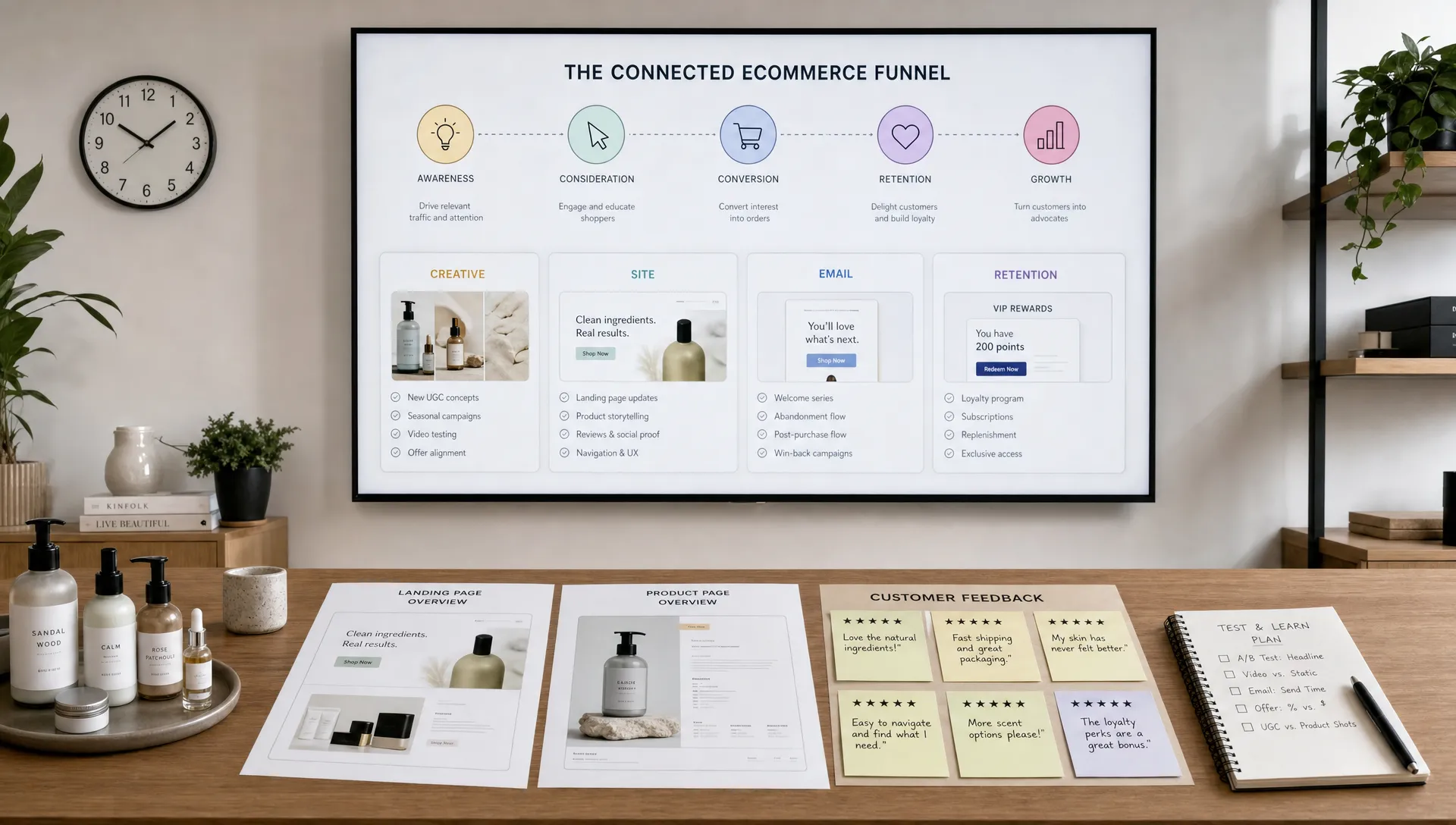
A strong D2C launch is not just a campaign calendar, a Meta ads budget, or a new product page. It is a connected system that answers five questions before money is spent: who are we selling to, why should they care now, what path will turn attention into revenue, how will we measure progress, and what happens after the first purchase?
That system is your go-to-market strategy.
For sports, fitness, and wellness brands, the stakes are especially high. Customers are not simply buying a product, they are buying into an identity, a performance outcome, a routine, or a healthier version of themselves. A hydration mix, recovery tool, training app, supplement, or performance apparel brand needs more than visibility. It needs trust, clear positioning, proof, and a buying journey that removes friction.
Below is a practical framework for building a go-to-market strategy for D2C brands, from customer research through launch execution, retention, and measurement.
What a go-to-market strategy means for D2C brands
A go-to-market strategy is the plan for taking a product, offer, or brand into the market in a way that creates demand and converts that demand into profitable growth. For D2C brands, it connects brand strategy, product positioning, ecommerce, paid media, creative, email, SEO, retention, fulfillment, and analytics.
That matters because D2C growth is rarely blocked by one isolated issue. A brand may think it has an advertising problem when the real issue is unclear positioning. It may think it has a website problem when the offer is not compelling. It may think it has a retention problem when the first-purchase experience never taught customers how to get the best result from the product.
A useful GTM strategy should define:
- The exact customer segment you are prioritizing
- The problem, desire, or outcome your product owns
- The positioning that separates you from alternatives
- The launch offer and buying journey
- The acquisition channels you will test first
- The creative angles and proof points you will use
- The metrics that determine whether to scale, adjust, or pause
The goal is not to create a document that sounds impressive. The goal is to make better decisions faster.
Start with a narrow target market
Most early D2C brands go too broad. They describe their buyer as active people, busy moms, weekend warriors, or health-conscious consumers. Those descriptions may be directionally true, but they are too vague to guide channel strategy, creative, product page messaging, or offer design.
A stronger starting point is a sharp segment with a specific context. For example, a recovery product may initially target recreational runners training for their first marathon, not everyone who exercises. A protein snack may start with young professionals who lift three to five times per week and need a convenient option between work and the gym. A wellness brand may focus on women in their 30s who already spend on supplements but are skeptical of exaggerated claims.
This level of specificity helps your team answer practical questions. What language does the customer use? What objections do they have? Which influencers or communities already have their trust? What alternatives do they currently buy? What moment triggers the need?
If you have not already done this work, OPTYO has a deeper guide on how to define your target market for faster growth, which is a critical input before you build a full GTM plan.
Your target market should not be chosen only because it is large. It should also be reachable, motivated, profitable, and underserved in a way your brand can credibly address.
Turn customer insight into positioning
Positioning is the bridge between what your product does and why your customer should choose it. It defines the space your brand wants to own in the buyer’s mind.
For D2C brands, good positioning is usually built around a combination of category, customer, outcome, proof, and personality. A brand selling a magnesium sleep product, for example, could position around clean ingredients, clinical credibility, better nightly routines, stress recovery, or athletic recovery. Each direction attracts a different buyer and requires different creative.
The mistake is trying to own everything at once. Clean, premium, affordable, science-backed, fun, sustainable, high-performance, and community-driven may all sound positive, but combined they blur the message. Your GTM strategy should choose the positioning that gives your product the clearest reason to be bought now.
A simple positioning statement can help:
For [specific customer], [brand/product] is the [category] that helps them [desired outcome] because [reason to believe].
This statement is not necessarily your public tagline. It is an internal filter. It helps your team decide what claims to emphasize, which landing page sections matter, which testimonials to feature, and what creative angles deserve testing.
For sports and wellness brands, be especially careful with claims. Performance, health, and supplement categories often require higher standards of proof and responsible language. The GTM strategy should define what you can say confidently, what needs evidence, and what should be avoided.
Build an offer that reduces launch friction
A product is not the same as an offer. The offer is the full reason to buy now, including the product, price, guarantee, bundle, bonus, subscription option, shipping terms, and first-purchase incentive.
A launch offer should make the next step feel obvious without damaging long-term brand equity. Heavy discounting can generate early revenue, but it may also train customers to wait for promotions. On the other hand, a weak offer can make even strong creative underperform.
For D2C ecommerce, common offer structures include introductory bundles, starter kits, limited launch drops, subscription trials, free shipping thresholds, gift-with-purchase promotions, and challenge-based programs. The right choice depends on your product economics and customer behavior.
A fitness brand selling resistance equipment may benefit from a starter kit because customers need a complete setup. A supplement brand may use a 30-day routine bundle because consistency drives perceived value. A performance apparel brand may launch with a limited colorway to create urgency and social proof.
Your GTM strategy should document the role of the offer. Is it designed to maximize first purchase conversion, increase average order value, introduce a subscription habit, clear inventory, or validate demand for a new product line? If the objective is unclear, the offer will be difficult to evaluate.
Choose launch channels based on customer intent and economics
There is no universal best channel for D2C. The best channel is the one where your target customer can be reached with the right message at a cost your margins can support.
Paid social is often valuable for demand creation because it lets brands test creative angles quickly. Search can capture existing demand from buyers already looking for a solution. SEO builds compounding visibility over time, especially for education-heavy categories. Email and SMS convert interest into purchase and turn customers into repeat buyers. Influencer partnerships can add credibility when trust is a major barrier.
The sequencing matters. Many D2C brands launch paid media before their product page, email flows, and measurement are ready. That creates noisy data. You may not know whether the channel failed, the creative failed, the offer failed, or the site failed.
A more disciplined approach is to connect channel choice to business economics. Before scaling spend, know your gross margin, target customer acquisition cost, average order value, contribution margin, expected repeat purchase rate, and payback window. If you are planning to scale across multiple channels, the principles in OPTYO’s guide to building a marketing strategy that actually scales are a useful complement to your GTM planning.
Your channel strategy should also reflect awareness level. A new recovery device may need educational content and demonstrations before conversion. A better-tasting protein bar may convert faster through sampling, creator content, and retail-style social proof. A premium wellness product may need founder storytelling, expert validation, and a longer nurture journey.
Prepare the ecommerce experience before launch traffic arrives
A go-to-market strategy fails when the buying path is not ready for the attention it creates. Before launch, your ecommerce experience should answer the buyer’s core questions quickly: what is this, who is it for, why is it different, how does it work, why should I trust it, and what should I buy first?
For D2C brands, the product detail page is often the most important sales asset. It should not only describe the product. It should sell the outcome, address objections, show proof, and make the next step clear.
Key page elements to pressure-test before launch include the hero section, product imagery, benefit hierarchy, comparison points, reviews or testimonials, usage instructions, ingredient or material details, shipping and return clarity, subscription explanation, and FAQ content.
Operational readiness matters too. A great launch can become a brand problem if inventory, fulfillment, customer service, or payment systems are not prepared. The same principle applies in more complex digital categories. For example, a regulated entertainment startup may need payments, compliance, analytics, and fraud prevention built into its launch infrastructure, which is why some founders evaluate modular platforms such as Spinlab’s white-label casino software instead of building everything from scratch.
For D2C ecommerce, the equivalent question is simple: what must be true behind the scenes for customers to have a smooth first experience? If the answer includes subscription logic, bundle configuration, returns handling, wholesale samples, creator codes, inventory forecasting, or post-purchase education, those pieces belong in the GTM plan.
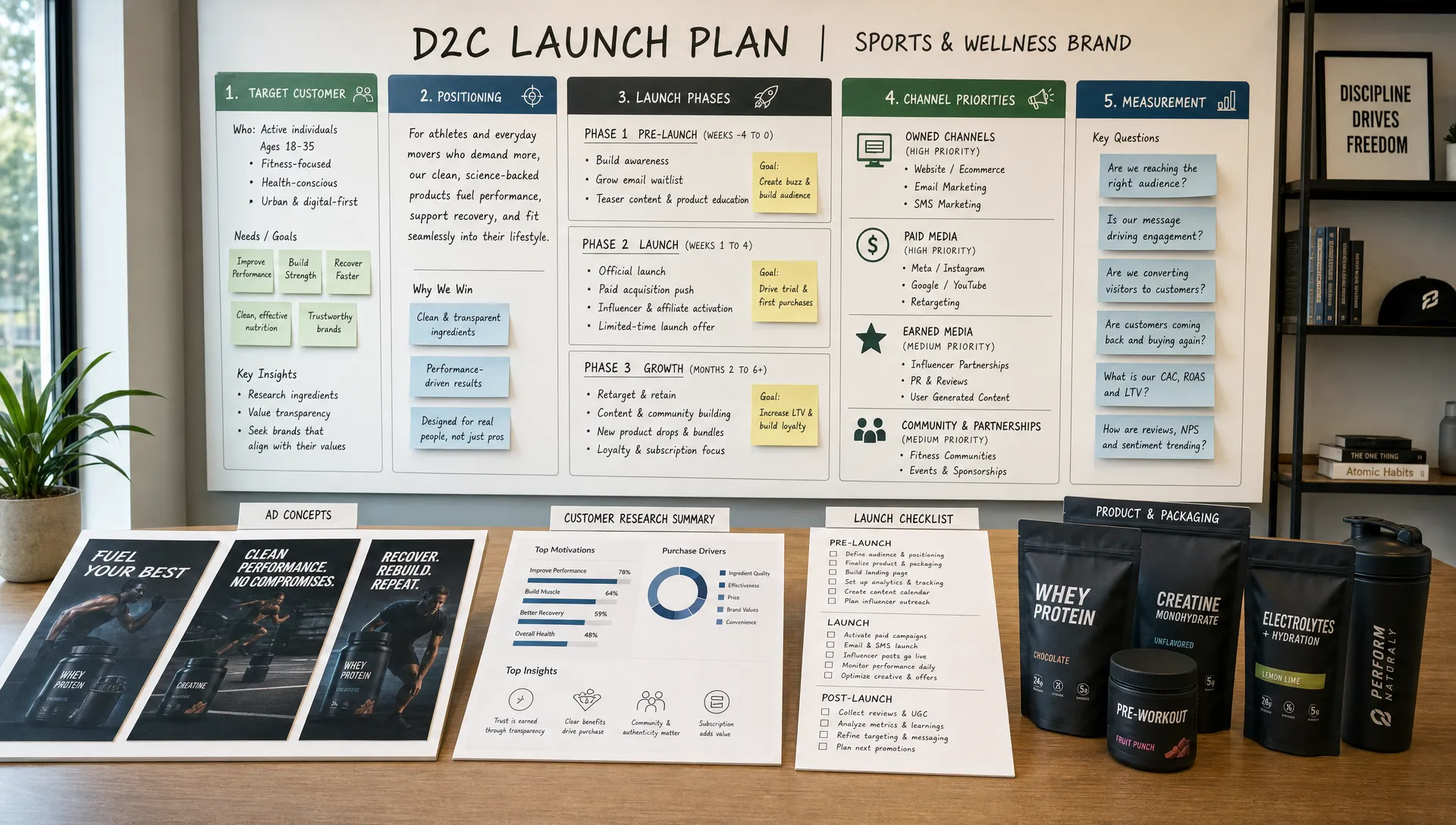
Create a phased launch roadmap
A D2C go-to-market strategy should be phased rather than treated as one launch day. The best launches build signal before they scale spend.
Pre-launch: validate demand and build an audience
The pre-launch phase is where you test your riskiest assumptions. That may include product positioning, price sensitivity, creative hooks, influencer response, email signup conversion, or landing page messaging.
This phase can include waitlists, founder-led content, sampling, surveys, small creator partnerships, private beta groups, community seeding, and low-budget creative tests. The objective is not vanity buzz. It is learning what resonates and building a warm audience before the product is widely available.
A sports nutrition brand, for instance, could test whether buyers respond more strongly to clean energy, no crash, endurance support, or better taste. A wellness brand could test whether customers need scientific proof first or prefer routine-based messaging. Those insights should shape the launch page, ad creative, email sequence, and offer.
Launch: convert attention into first purchases
The launch phase should concentrate attention. This is where your paid, owned, earned, and creator channels should point toward one clear buying path.
Your launch plan should define campaign dates, spend levels, creative variations, email timing, influencer posting windows, landing pages, offer rules, reporting cadence, and decision thresholds. If the plan is vague, the team will make emotional decisions when results come in.
During launch, resist the urge to change everything at once. If performance is weak, diagnose systematically. Is traffic quality low? Is click-through rate poor? Is the landing page not converting? Are carts being abandoned? Is the offer unclear? Each issue requires a different fix.
Post-launch: optimize, retain, and scale what works
The post-launch phase is where many brands lose momentum. They celebrate the first sales, then move on to the next campaign without extracting the lessons.
After launch, review performance by channel, creative angle, landing page, offer, cohort, and customer segment. Look for patterns. Which messages drove the highest-quality customers? Which products were most often purchased together? Which objections appeared in customer support? Which emails generated revenue? Which creators produced buyers rather than just engagement?
Post-launch work should also focus on retention. D2C brands do not scale efficiently if every sale depends on paying for a new customer. Onboarding emails, product education, replenishment reminders, loyalty moments, community touchpoints, and cross-sell flows help turn first purchases into repeat revenue.
Build a creative testing system
Creative is one of the biggest growth levers for modern D2C brands. It is also one of the fastest ways to learn what the market cares about.
Your go-to-market strategy should include a creative testing plan before launch. That plan should outline the hooks, formats, claims, proof points, and audiences you want to test. For sports, fitness, and wellness brands, useful creative angles often include transformation, routine integration, expert credibility, ingredient transparency, performance comparison, social proof, founder story, and problem agitation.
The goal is not to produce random content. It is to test strategic hypotheses. For example, if you believe your primary buyer is a serious runner, test content that speaks to training consistency, recovery time, race preparation, and injury prevention concerns. If another segment responds better to convenience and daily energy, that may reveal a more profitable positioning path.
Creative testing should also be connected to the funnel. A top-of-funnel video may be judged by thumb-stop rate, hold rate, click-through rate, and qualitative comments. A product page testimonial may be judged by conversion rate. A post-purchase email may be judged by repeat purchase or subscription activation.
Without this structure, brands often mistake more content for better creative. The best GTM teams use creative as market research, not just production volume.
Define the metrics that decide what happens next
A go-to-market strategy should include decision rules. Otherwise, launch performance becomes subjective. One founder may think sales are promising, another may panic because acquisition costs are high, and the team may not know whether to scale or iterate.
At a minimum, define the metrics that matter across awareness, conversion, and retention.
For awareness, track reach, engagement quality, video retention, click-through rate, creator performance, and branded search lift. For conversion, track conversion rate, average order value, customer acquisition cost, checkout completion, revenue per session, and contribution margin. For retention, track repeat purchase rate, subscription retention, time to second purchase, email revenue, refund rate, and customer lifetime value.
The most important metric depends on your stage. A pre-launch brand may care most about email signup cost and message resonance. A launch-stage brand may focus on conversion rate and CAC. A scaling brand needs contribution margin, payback period, and retention quality.
Do not evaluate every channel with the same expectation. Paid social may create demand that later converts through branded search or email. SEO may take longer to generate revenue but can reduce dependence on paid acquisition over time. Influencers may produce content value, trust, and retargeting assets even when direct attribution looks incomplete.
Good reporting should help you make decisions, not just summarize activity.
Common go-to-market mistakes D2C brands should avoid
The first mistake is launching too broadly. If your audience is everyone, your creative will feel generic and your media spend will be inefficient.
The second mistake is treating launch as a one-time event. A GTM strategy should include learning loops before, during, and after launch. Every campaign should make the next decision smarter.
The third mistake is separating brand and performance. Brand without conversion discipline can become expensive awareness. Performance without brand clarity can become short-term sales with weak retention. D2C brands need both.
The fourth mistake is scaling before the funnel is ready. If the offer, product page, email flows, customer support, and fulfillment experience are weak, more traffic will only expose the gaps faster.
The fifth mistake is ignoring retention until acquisition gets expensive. Retention should be built into the GTM plan from the beginning, especially for consumables, wellness routines, apparel drops, and products with accessories or replenishment cycles.
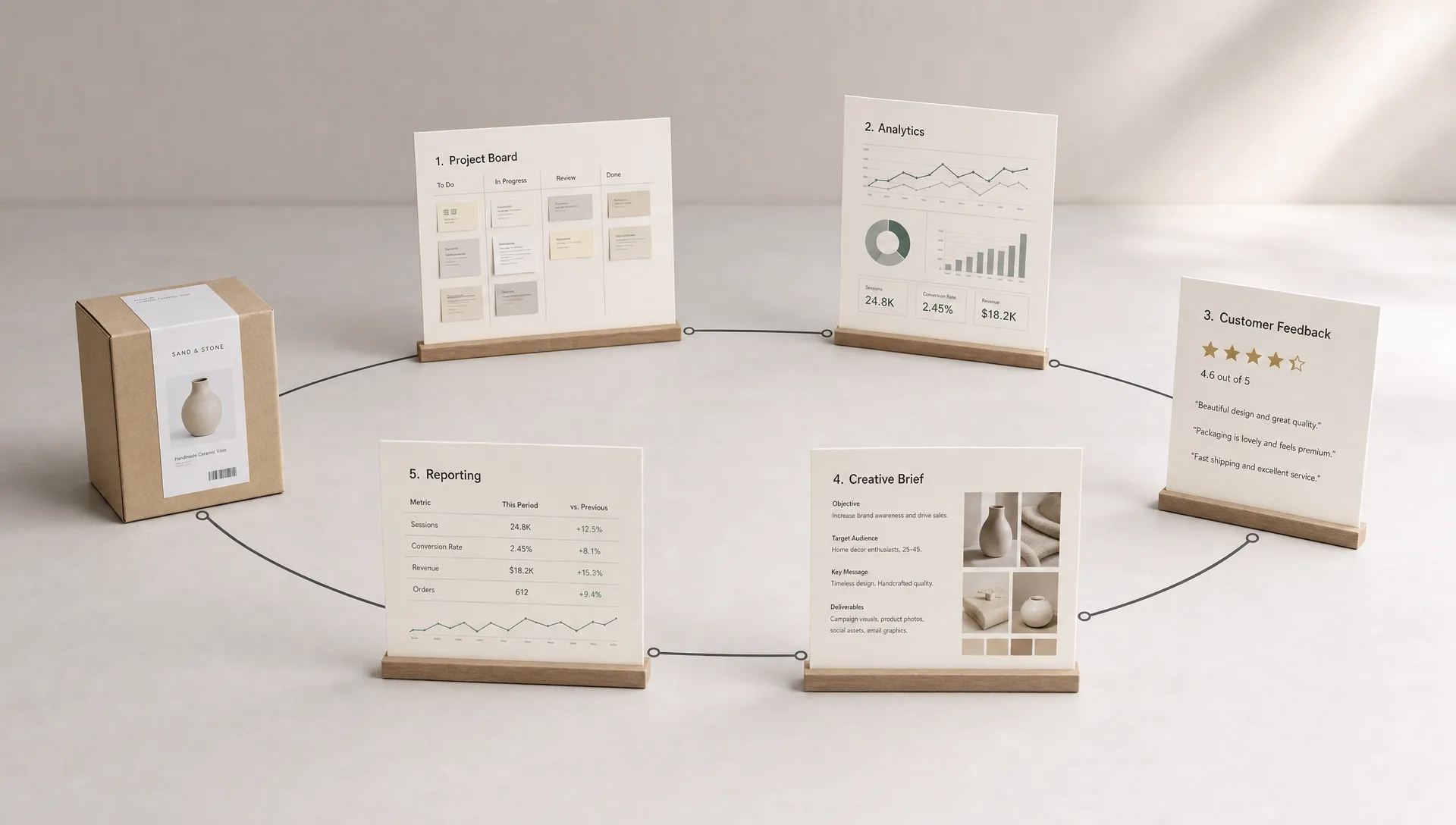
A strong GTM strategy gives your team a shared operating system. It keeps customer insight, creative, channels, ecommerce, and measurement connected.
Frequently Asked Questions
What is a go-to-market strategy for a D2C brand? A go-to-market strategy is the plan for launching and scaling a product directly to consumers. It defines the target customer, positioning, offer, channels, ecommerce journey, launch phases, and metrics used to decide what to optimize or scale.
How is a go-to-market strategy different from a marketing strategy? A go-to-market strategy is usually tied to bringing a specific product, brand, or offer into the market. A marketing strategy is broader and often covers ongoing growth across channels, campaigns, retention, and brand development.
What should a D2C brand do before launch? Before launch, a D2C brand should validate the target customer, test positioning, build a landing page or waitlist, prepare creative, set up email flows, confirm fulfillment readiness, define the offer, and establish measurement benchmarks.
Which channels are best for a D2C launch? The best channels depend on the customer and category. Paid social is useful for creative testing and demand creation, search captures existing intent, email converts warm audiences, SEO builds long-term demand, and creators can add trust and social proof.
How do you know if a GTM strategy is working? A GTM strategy is working when it produces clear learning and profitable momentum. Key signals include improving conversion rate, efficient customer acquisition, strong average order value, positive customer feedback, repeat purchase behavior, and creative insights that can be scaled.
Build a launch plan that can actually scale
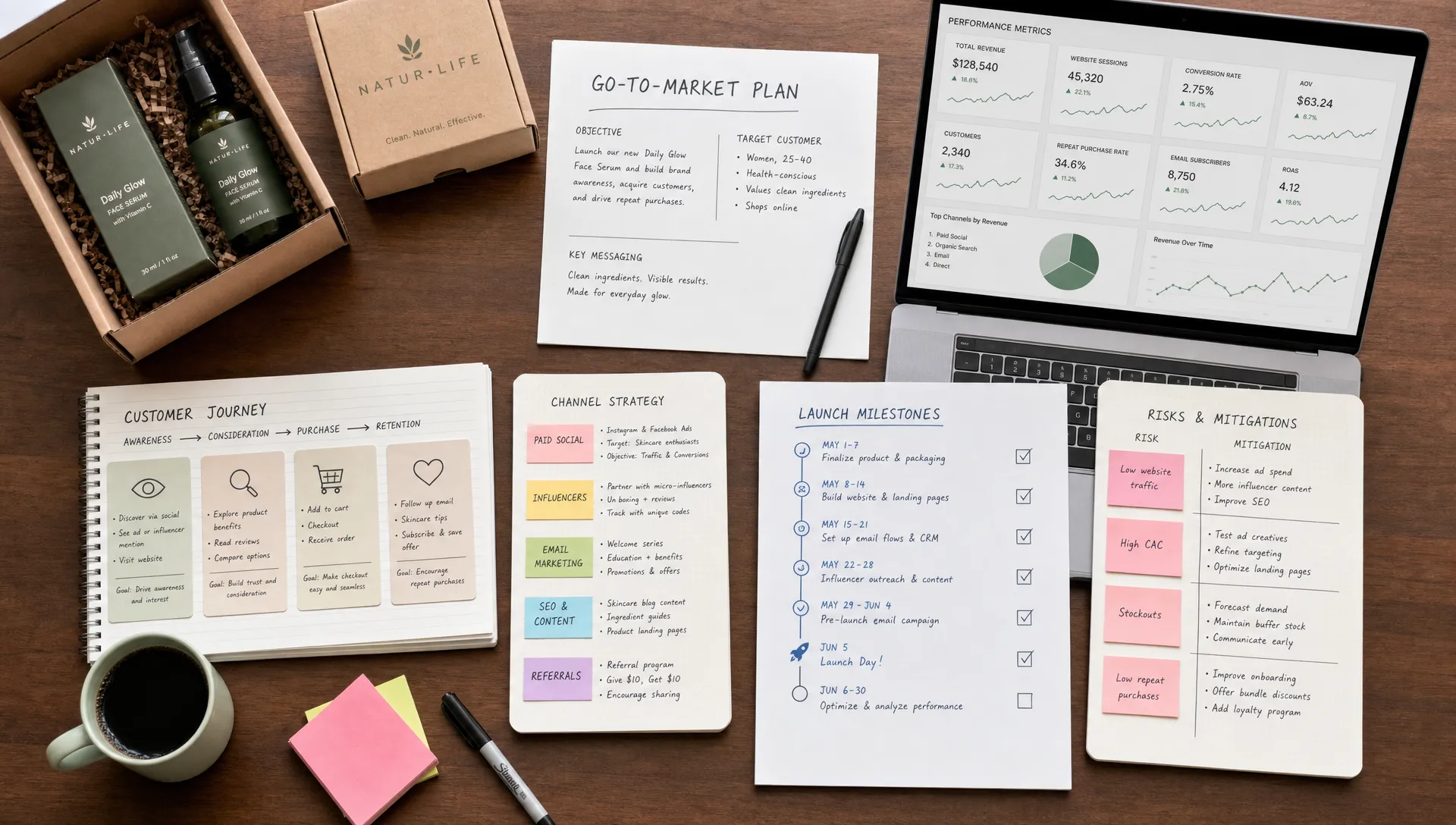
A go-to-market strategy is not a static document. It is the operating plan that helps a D2C brand enter the market with focus, learn quickly, and scale without guessing.
For sports, fitness, and wellness brands, that means connecting customer research, positioning, creative, ecommerce, paid media, retention, and reporting into one growth system. When those pieces work together, launch becomes more than a spike in attention. It becomes the foundation for durable growth.
If your brand needs help building or improving that system, OPTYO helps D2C and CPG companies scale through performance marketing, creative, ecommerce development, conversion optimization, email marketing, SEO, KPI reporting, and growth consulting.