.png)


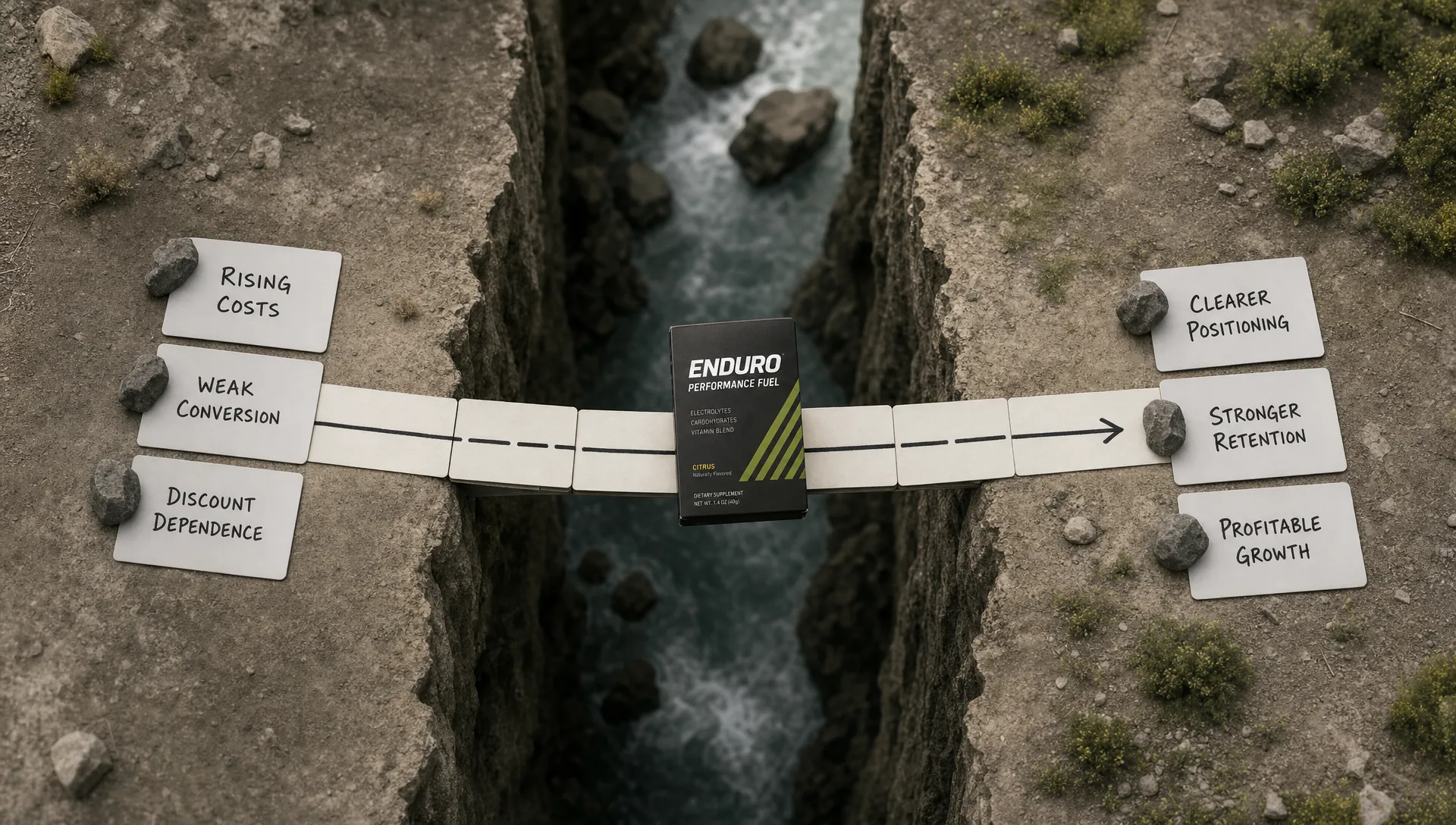

Ecommerce growth bottlenecks usually do not look like a single broken channel. They show up as rising customer acquisition costs, flat revenue, low repeat purchase, creative fatigue, discount dependence or a website that gets traffic but does not turn enough visitors into buyers.
That is why the right marketing services are not simply a menu of tactics. For ecommerce entrepreneurs, especially in sports, fitness, wellness and CPG, the real question is: which constraint is holding growth back right now?
A brand with weak positioning does not need more ad spend first. A brand with healthy traffic but poor conversion does not need another awareness campaign first. A brand with a strong first purchase but weak second purchase needs lifecycle marketing, not just new customer acquisition.
This guide breaks down the most common ecommerce growth bottlenecks and the marketing services that solve each one. If your brand is already stuck at a revenue ceiling, OPTYO also has a deeper guide on marketing suggestions for brands stuck at a growth plateau.
Why ecommerce bottlenecks are rarely solved by “more marketing”
When growth slows, the instinct is often to do more of what worked before: increase paid social budgets, launch more promotions, add new landing pages or test another influencer campaign. Sometimes that works. More often, it hides the underlying issue for another month.
A growth bottleneck is the tightest point in your revenue system. Improving anything else may help a little, but it will not change the trajectory until that constraint is fixed.
For ecommerce brands, bottlenecks tend to fall into seven areas:
- Positioning and offer clarity
- Paid acquisition efficiency
- Creative volume and quality
- Website conversion
- Retention and lifecycle marketing
- Organic demand generation
- Measurement and decision-making
The right marketing services should diagnose these areas before recommending execution. That is the difference between buying tasks and building a growth system.
Match the service to the bottleneck
A useful way to evaluate marketing services is to start with symptoms, then trace them back to the likely constraint. The table below gives ecommerce founders a practical starting point.
| Growth symptom | Likely bottleneck | Marketing service that helps | Metric to watch |
|---|---|---|---|
| Ad costs rise but sales do not | Weak offer, poor audience fit or creative fatigue | Brand strategy, performance marketing, creative production | CAC, MER, ROAS, contribution margin |
| Traffic is healthy but conversion is low | Website friction or poor product page clarity | Conversion rate optimization, ecommerce development | Conversion rate, add-to-cart rate, checkout completion |
| Customers buy once but do not return | Weak lifecycle marketing or poor post-purchase experience | Email marketing, retention strategy | Repeat purchase rate, LTV, email revenue share |
| Discounts drive too much revenue | Offer architecture or brand value problem | Brand strategy, merchandising strategy, email segmentation | Gross margin, promo revenue share, AOV |
| Reporting is confusing or slow | Poor KPI structure and attribution setup | KPI reporting, growth consulting | Forecast accuracy, channel mix, payback period |
| Organic traffic is thin | Low search visibility or weak content strategy | SEO, content strategy | Non-paid sessions, keyword growth, assisted revenue |
This mapping matters because ecommerce brands can waste months optimizing the wrong part of the funnel. A better agency relationship starts with finding the constraint before prescribing the channel.
Bottleneck 1: Your positioning is not sharp enough for the next stage
Many ecommerce brands get early traction through founder hustle, a strong hero product or a passionate niche. The same message that wins the first 1,000 customers may not persuade the next 50,000.
This is common in sports and wellness. Early buyers may understand the technical benefits of a recovery tool, supplement, training product or performance apparel. Broader audiences need clearer context, stronger proof and a more immediate reason to choose your brand over cheaper or more familiar alternatives.
The marketing services that solve this bottleneck include brand strategy consulting, customer research, offer positioning and messaging development. The goal is not to make the brand sound clever. The goal is to make the buying decision easier.
Strong positioning should answer four questions quickly:
- Who is this for?
- What problem does it solve?
- Why is it different from alternatives?
- Why should someone buy now instead of later?
If these answers are not clear, paid media will become more expensive, website conversion will suffer and email campaigns will rely too heavily on discounts.
Bottleneck 2: Paid acquisition is scaling spend faster than profit
Paid social and search can still be powerful growth channels, but they punish weak economics. If your average order value, gross margin, conversion rate or repeat purchase rate is not strong enough, scaling spend can create revenue growth without healthy profit growth.
Performance marketing services should go beyond campaign management. For ecommerce brands, strong paid media work connects channel strategy to unit economics. That means looking at customer acquisition cost, payback period, contribution margin, creative performance, landing page performance and audience quality together.
A founder should be cautious when paid media reporting only highlights ROAS without showing the wider business picture. ROAS can look acceptable while blended profitability weakens, especially when discounts, shipping costs, returns or wholesale channel conflicts are not fully considered.
A better paid acquisition engagement usually includes:
- Channel mix planning across paid social, paid search and retargeting
- Budget allocation based on marginal returns, not just last-click ROAS
- Creative testing tied to audience segments and buying objections
- Landing page feedback based on campaign performance
- Reporting that connects media spend to revenue quality
For a more complete view of how acquisition fits into the ecommerce growth system, OPTYO explains how an ecommerce marketing agency can scale revenue by connecting paid media, CRO, retention, SEO and reporting.
Bottleneck 3: Creative fatigue is slowing the funnel
Creative is often the hidden bottleneck behind paid media decline. Audiences see the same hooks too many times. Winning angles stop working. Product demonstrations feel repetitive. The brand starts testing minor visual changes instead of new reasons to believe.
For ecommerce brands, creative asset production is not only about making ads look better. It is about creating enough high-quality messaging variation to learn what buyers care about.
A strong creative service should build assets around hypotheses, not random content volume. For example, a sports nutrition brand might test creative angles around endurance, recovery, clean ingredients, athlete routines, subscription convenience and taste. A wellness device brand might test pain relief, sleep quality, portability, clinical credibility and customer transformation.
Each concept should connect to a specific question: does this audience respond more to performance outcomes, lifestyle identity, expert validation, social proof or price-value framing?

The best creative systems also respect production speed. If it takes six weeks to produce every test, the brand cannot learn fast enough. But speed should not mean generic assets. The work needs a clear testing structure, strong hooks, credible proof points and formats suited to the channels where the brand is spending.
Bottleneck 4: Your site is leaking qualified traffic
If acquisition is bringing the right visitors but revenue is not moving, the website may be the constraint. This is where conversion rate optimization and ecommerce development become essential marketing services.
CRO is not just button colors or headline tweaks. It is the process of identifying where buyers hesitate, lose confidence or abandon the path to purchase. That can happen on product pages, collection pages, cart pages, checkout, subscription flows, bundles or mobile navigation.
The stakes are high. Baymard Institute has long tracked documented cart abandonment rates and places the average at roughly 70 percent. Not every abandoned cart is recoverable, but many brands still lose buyers because shipping details, payment options, return policies, product information or trust signals are unclear.
For sports, fitness and wellness products, product education is especially important. Buyers may need to understand sizing, usage, ingredients, safety, compatibility, training benefits or results timelines. If the product page does not answer these concerns, the ad may earn the click but the page loses the sale.
A CRO engagement should review both data and customer behavior. Analytics show where the drop-off happens. User recordings, reviews, surveys and customer support questions often explain why it happens.
Bottleneck 5: Retention is underbuilt
Acquisition gets attention because it is visible and urgent. Retention is where many ecommerce brands protect margin.
If customers buy once and disappear, your business has to keep paying to replace them. That makes growth more expensive and puts pressure on ad channels. Email marketing and lifecycle strategy help solve this by turning first-time buyers into repeat customers, subscribers, referral sources or higher-value customers.
Good retention work starts with segmentation. A first-time customer should not receive the same message as a VIP buyer, a lapsed subscriber or someone who only purchased during a promotion. The customer journey should reflect purchase history, product category, replenishment timing, buying intent and engagement.
For ecommerce brands, email marketing services can improve:
- Welcome flows that convert new subscribers
- Abandoned cart and checkout recovery
- Post-purchase education and product usage
- Replenishment and cross-sell campaigns
- Winback campaigns for lapsed customers
- Launch campaigns for new products or bundles
Retention also reduces dependence on constant discounting. If your only way to bring customers back is a sale, the brand may have an education, value or product adoption problem that lifecycle marketing can help address.
Bottleneck 6: Organic demand is too weak
Paid media can create momentum, but ecommerce brands become fragile when every sale depends on paid traffic. SEO helps build non-paid demand and captures shoppers who are already researching problems, products and comparisons.
Search engine optimization for ecommerce should focus on commercial value, not vanity traffic. A sports recovery brand, for example, may not need broad informational traffic from people casually reading about soreness. It may need high-intent content around product comparisons, use cases, athlete recovery routines, category education and problem-aware searches.
Technical SEO also matters. Slow pages, duplicate content, weak internal linking, thin product descriptions and poor indexation can limit growth even when the brand has strong products.
SEO is rarely the fastest fix for a cash flow problem, but it is one of the best services for reducing overreliance on paid acquisition over time. It also supports paid and email by giving the brand clearer educational assets, stronger product language and more ways to capture demand before the shopper is ready to buy.
Bottleneck 7: Your reporting does not reveal the real problem
Many ecommerce teams have plenty of data and not enough clarity. They can see revenue, ad spend, traffic, email revenue and conversion rate, but they cannot confidently answer which action should happen next.
KPI reporting and growth consulting solve this bottleneck by turning metrics into operating decisions. The goal is not to build prettier dashboards. The goal is to create a shared view of performance that founders, marketers, operators and finance teams can use.
At minimum, ecommerce reporting should connect:
- Revenue by channel and campaign
- Blended CAC and acquisition efficiency
- Gross margin and contribution margin
- AOV and product mix
- Conversion rate by device and landing page
- Repeat purchase rate and LTV
- Inventory, fulfillment or operational constraints that affect marketing decisions
This is also where tool costs and operational complexity can become part of the growth conversation. If your ecommerce team uses enterprise CRM or sales software, the stack itself can create budget drag. For companies running Salesforce, a specialist review from SaaSed can help identify license waste and renewal risks before contract talks, which can free up budget for growth initiatives without cutting essential capability.
Good reporting should make tradeoffs visible. If paid media is ready to scale but inventory is constrained, the right decision may be operational. If conversion is weak on mobile, the next dollar may belong in CRO instead of acquisition. If repeat purchase is low, lifecycle marketing may create more value than another prospecting campaign.
How to choose marketing services without overbuying
Ecommerce founders do not need every service at the same time. They need the right sequence.
A brand under $1 million in annual revenue may need positioning, offer clarity, basic paid acquisition and core email flows before sophisticated CRO. A brand doing $5 million to $20 million may need stronger creative testing, conversion improvements, retention segmentation, SEO and KPI reporting. A larger brand may need channel diversification, deeper analytics, merchandising strategy and growth consulting tied to financial planning.
The key is to avoid buying disconnected execution. Paid media without creative testing becomes expensive. CRO without traffic quality analysis becomes narrow. Email without customer segmentation becomes noisy. SEO without brand and product strategy can bring visitors who never buy.
This is why integrated marketing services matter. The strongest ecommerce growth plans connect brand, creative, media, website experience, retention and reporting. OPTYO covers this connected approach in more depth in its article on how a marketing strategy agency builds smarter growth.
A simple diagnostic before hiring an agency
Before hiring for marketing services, answer these questions with your team. The answers will make the agency search more productive and help avoid vague scopes.
| Diagnostic question | What it reveals |
|---|---|
| Which metric worsened first? | Whether the issue started in acquisition, conversion, retention or economics |
| Are we growing revenue but losing efficiency? | Whether scale is masking margin pressure |
| Which customer segment is most profitable? | Whether targeting and messaging need refinement |
| Where do users drop off on the site? | Whether CRO or ecommerce development should be prioritized |
| What percentage of revenue comes from repeat customers? | Whether retention is underdeveloped |
| Which reports guide weekly decisions? | Whether KPI reporting is actionable or just informational |
If a potential agency jumps straight into tactics without discussing these questions, the engagement may become activity-heavy but strategy-light.
Frequently Asked Questions
What marketing services matter most for ecommerce growth? The most important services depend on the bottleneck, but ecommerce brands often need a mix of performance marketing, creative production, CRO, email marketing, SEO, KPI reporting and brand strategy. The sequence matters more than the size of the service menu.
How do I know if paid media is the problem or the website is the problem? Look at traffic quality, conversion rate, landing page performance and customer acquisition cost together. If qualified traffic is arriving but not buying, CRO may be the priority. If traffic quality is weak or costs are rising across audiences, paid strategy or creative may be the constraint.
When should an ecommerce brand invest in CRO? CRO becomes a strong priority when your site has enough traffic to learn from and clear signs of friction, such as low add-to-cart rates, weak mobile conversion, high checkout abandonment or product pages that generate repeated customer questions.
Can email marketing solve acquisition problems? Email marketing cannot replace acquisition, but it can improve profitability by increasing repeat purchase, recovering abandoned carts and converting subscribers who are not ready to buy on the first visit. Strong retention often makes paid acquisition easier to scale.
Should startups hire one agency for all marketing services or separate specialists? It depends on complexity and internal resources. Many ecommerce startups benefit from an integrated partner because acquisition, creative, CRO, retention and reporting affect each other. Specialist partners can work well when the founder or internal team can coordinate strategy across functions.
Turn bottlenecks into a growth plan
The best marketing services do not just create more activity. They identify the constraint, fix the weakest part of the revenue system and build the next stage of growth on stronger economics.
If your sports, fitness, wellness or CPG brand is scaling but running into acquisition, conversion, creative, retention or reporting bottlenecks, OPTYO can help you find the right growth levers and execute with a connected strategy.