.png)




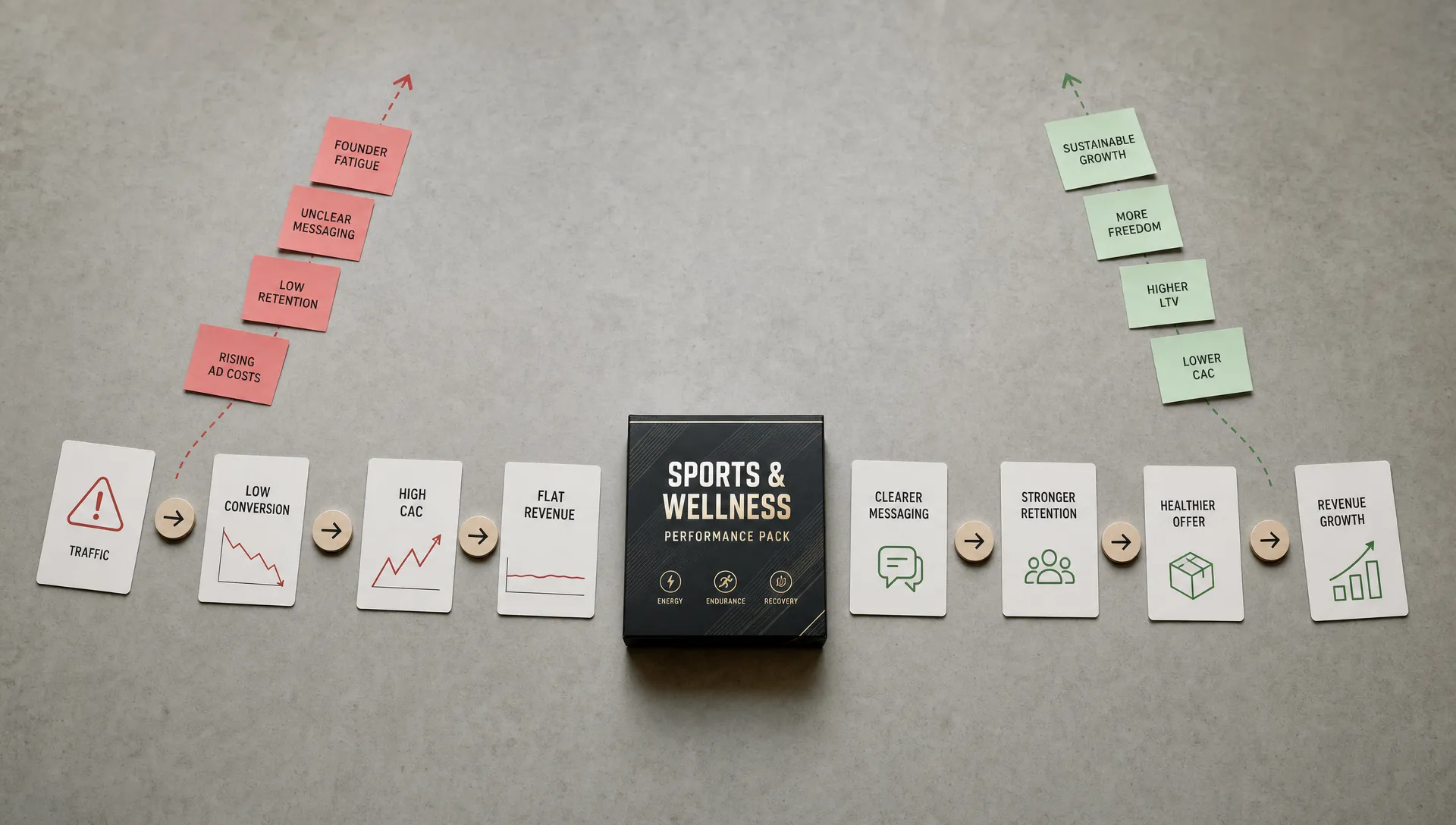
The first sale is often treated like a launch milestone, but it is more useful as a feedback signal. Someone saw the product, understood the value, trusted the offer enough to act and completed the buying process. That path rarely happens by accident.
For ecommerce founders, especially in sports, fitness and wellness, marketing a product starts before ad creative, launch emails or paid media budgets. It starts with a sharper understanding of the customer: what they are trying to improve, what they have already tried, what they doubt and what finally makes the purchase feel worth it.
A strong first-sale plan does not need to be complicated. It needs to connect customer insight to positioning, positioning to the offer, the offer to the right channel and the channel to a checkout experience that removes hesitation.
Start with the customer moment, not the product feature
Most early product marketing gets stuck because the founder leads with what the product is. Customers usually buy because of what the product helps them do, avoid or feel.
A recovery tool is not just a massage device. For one buyer, it may be a way to train again tomorrow without feeling stiff. For another, it may be a way to keep up with a weekend sport despite sitting at a desk all week. A protein snack is not just macros and flavor. It may be a convenient way to stay on track between meetings, workouts and family obligations.
The first job is to identify the specific customer moment your product fits into. That moment gives you the language for your product page, ads, emails and sales conversations.
Useful early research can come from:
- Customer interviews with people who already spend money in the category
- Reviews of competing products, including complaints and repeat praise
- Comments on social posts, Reddit threads, YouTube reviews and creator content
- Search queries that reveal what buyers are trying to solve
- Direct messages, support tickets and live chat transcripts if you already have an audience
Do not ask only whether someone likes the idea. People are polite and hypothetical answers are cheap. Ask what they bought last, what triggered the purchase, what nearly stopped them and what they wish worked better.
Turn insight into a sharper promise
Once you understand the customer moment, you can turn it into a marketable promise. This is where many launches become either too vague or too exaggerated. A useful promise is specific enough to be memorable and credible enough to be believable.
For a sports or wellness product, the strongest promise often sits at the intersection of outcome, identity and use case. A vague message might say, premium hydration for everyone. A sharper version might say, hydration support for long training days when water alone does not feel like enough. The second message gives the customer a situation to recognize.
| Customer insight | What it shapes | Example marketing decision |
|---|---|---|
| The buyer feels pain at a specific moment | Hero message and first ad angle | Lead with post-workout recovery instead of general wellness |
| The buyer has tried a workaround | Comparison and objection handling | Explain how the product improves on tape, ice packs or generic supplements |
| The buyer identifies with a niche activity | Audience and creative direction | Show runners, lifters, cyclists or pickleball players in realistic product use |
| The buyer is skeptical of claims | Proof and product detail page content | Add transparent ingredients, materials, certifications or customer reviews when available |
| The buyer buys for consistency | Retention and subscription messaging | Emphasize routine, replenishment reminders or habit building if the business model supports it |
This is not about writing clever copy. It is about making the customer feel understood quickly. If a visitor has to decode who the product is for, why it is different and why now is the right time to buy, the marketing is making the customer work too hard.
Define the first buyer before choosing the first channel
A common mistake is trying to launch to everyone who could use the product. That makes targeting expensive and messaging weak. The first sale becomes easier when you define a narrow first buyer and build the launch around that person.
For example, a mobility product could technically serve athletes, desk workers, older adults and physical therapy patients. Those segments have different motivations, trust standards and buying triggers. The first campaign should not try to satisfy all of them.
Choose a first buyer segment based on three filters: urgency, ability to pay and ease of reach. Urgency tells you whether the problem matters now. Ability to pay tells you whether the offer fits the market. Ease of reach tells you whether you can put the product in front of them without wasting the entire budget on broad awareness.
If you are still shaping the launch market, OPTYO has a deeper guide to building a go-to-market strategy around products customers actually want. That work pairs well with this first-sale process because it forces the launch to start with demand signals instead of assumptions.
Build a first-sale offer, not just a product page
The offer is the full reason to buy now. It includes the product, price, proof, guarantee, bundle, shipping experience and any urgency or incentive attached to the launch.
Early founders often think the offer means discounting. Discounts can help, but they can also train customers to wait. A stronger offer reduces risk and clarifies value.
A first-sale offer should answer four questions quickly. What does this product help me do? Why is it different from what I already know? Why should I trust it? What happens if it is not right for me?
For ecommerce, that usually means your product detail page needs more than polished photos. It needs a clear above-the-fold message, benefit-led sections, proof points, practical product information, shipping clarity and a checkout path with as little friction as possible.
The content should also match the buyer's stage of awareness. If people already search for your type of product, a direct product page may work. If they need education first, a landing page that explains the problem and frames the solution may convert better.

Create the minimum marketing system needed to sell
You do not need a massive tech stack to get the first sale. You do need the basic pieces that let a customer move from attention to action.
At minimum, the first-sale system includes a clear product page, a simple way to capture email, a few creative angles, a launch email or message sequence, basic analytics and a post-purchase follow-up. If paid media is part of the launch, you also need enough creative variation to learn which angle is creating intent.
Creative variation matters because the first ad concept is rarely the winner. Test different entry points into the same product promise. One ad might focus on the customer problem, another on the product demonstration and another on founder story or social proof. The goal is not to make endless assets. It is to learn which message earns attention from the buyer you chose.
This is also where outside perspective can help. A founder is close to the product and often overestimates how much a new visitor understands. Agencies with a full-funnel view, such as Gilead Digital's digital growth team, can be useful reference points for how SEO, paid media, content and ecommerce execution work together instead of operating as separate tactics.
Match the channel to how the buyer makes decisions
There is no universal best channel for marketing a new product. The right channel depends on whether the buyer already knows the problem, how much education is required and how much trust they need before purchase.
Paid social works well when the product can be understood visually, demonstrated quickly or attached to a strong identity. Search can work when customers are already looking for the category, comparison or solution. Creator partnerships can help when trust is a major barrier and the audience relies on recommendations. Email works best when you already have traffic, leads or a community to nurture.
For sports, fitness and wellness brands, the strongest launch systems often combine demand creation with demand capture. A demo-driven social ad may create curiosity. A landing page explains why the product matters. Email answers objections. Search captures people who start looking for the product or category after exposure.
That is why first-sale marketing should not be viewed as one isolated campaign. It is the start of a customer journey. OPTYO's article on why direct-to-consumer brands need full-funnel thinking expands on this point, especially for brands that want growth beyond a single launch spike.
Launch in a controlled sequence
A launch does not need to be loud to work. It needs to be sequenced. The sequence should warm up the audience, introduce the problem, present the product, drive action and collect feedback from every step.
A simple launch sequence might look like this:
| Launch stage | Goal | Example activity |
|---|---|---|
| Pre-launch insight | Validate the message | Interview buyers, review competitor feedback and test product claims in organic content |
| Audience warm-up | Build recognition | Share problem-led content, founder notes, demos and behind-the-scenes product context |
| Offer reveal | Explain the value | Publish the product page, send the launch email and release the first ad creative |
| Conversion push | Create action | Retarget engaged visitors, answer objections and test limited launch incentives |
| Post-sale learning | Improve the next cycle | Survey buyers, review analytics and collect customer language for future campaigns |
This sequence keeps the founder from treating launch day as the only moment that matters. The first sale may happen during the reveal, after a retargeting touch or after a customer reads three emails and checks reviews. The system should support all of those paths.
Measure the quality of the first sale
Revenue matters, but the first sale should teach you more than whether someone bought. You want to know whether the right person bought, whether the message created qualified intent and whether the economics can improve with better creative, better conversion rate or stronger retention.
Early metrics should be interpreted carefully because small samples can mislead. Still, even a handful of sales can reveal useful patterns if you combine numbers with qualitative feedback.
| Metric | What it tells you | What to watch |
|---|---|---|
| Conversion rate | Whether the page and offer turn interest into purchases | Segment by traffic source before making broad conclusions |
| Add-to-cart rate | Whether visitors see enough value to consider buying | Low rates often point to weak promise, price mismatch or poor product clarity |
| Checkout completion | Whether friction is blocking purchase | Review shipping costs, payment options, trust cues and mobile usability |
| Customer acquisition cost | Whether paid traffic can become scalable | Do not judge too early without creative testing and conversion improvements |
| First customer feedback | Why people bought or hesitated | Use exact customer language in future ads, emails and product pages |
The highest-value learning often comes from talking to the first buyers. Ask what made them click, what almost stopped them and what they expected before ordering. Those answers can reveal the next ad angle, the missing product page section or the objection your emails need to handle.
Improve before you scale
After the first sale, the temptation is to increase spend immediately. Sometimes that is the right move, but only if the signal is strong enough. A better next step is to improve the system based on what the sale taught you.
If customers bought after seeing a demonstration, produce more demo creative. If they asked the same shipping question three times, add that answer higher on the product page. If they loved one benefit you barely mentioned, make it more visible. If traffic clicked but did not convert, review the alignment between ad promise and landing page content.
This is where product marketing becomes a loop. Insight shapes the offer. The offer goes to market. Customer behavior produces new insight. The next version becomes sharper.
For many founders, this loop is more valuable than a single winning campaign because it creates a repeatable way to learn. If you want support translating customer insight into launch messaging, creative, paid social, CRO and retention strategy, working with a product marketing agency that helps new offers launch can reduce guesswork and speed up the path from idea to revenue.
Frequently Asked Questions
What is the first step in marketing a product? The first step is understanding the customer moment your product fits into. Before choosing channels or creating ads, define who has the problem, what triggers the need, what they have already tried and what would make them trust a new solution.
How do I market a product with no audience? Start with a narrow buyer segment and use channels where that audience already spends attention. This might include paid social tests, creator outreach, search content, partnerships or direct community engagement. The goal is to generate qualified learning before scaling spend.
Do I need paid ads to get my first sale? No. Paid ads can speed up learning, but first sales can also come from organic content, email, founder outreach, partnerships, events or creator mentions. The best channel depends on the product category, buyer awareness and available budget.
How many creative assets do I need for a first launch? You can begin with a small set of distinct creative angles. For example, one problem-led ad, one product demonstration, one founder story and one proof-led asset can teach you more than several versions of the same message.
What should I do after the first sale? Talk to the buyer, review the conversion path and identify what influenced the purchase. Then improve the product page, creative, email flow and offer before pushing for broader scale.
Turn customer insight into a launch that sells
Your first sale is not just a transaction. It is evidence that your customer insight, positioning, offer and buying experience are starting to connect.
If you are building a sports, fitness or wellness brand and want a clearer path from product idea to scalable demand, OPTYO helps ecommerce companies with performance marketing, creative, eCommerce development, CRO, email marketing and growth strategy. The right launch system can turn early customer insight into the first sale and the next stage of growth.