.png)



Most ecommerce brands do not have a list-growth problem. They have a trust problem hiding inside list growth.
It is easy to trade paid traffic for email addresses with a discount pop-up, giveaway or lead ad. The harder skill is acquiring subscribers who understand what they signed up for, want the next message and eventually become profitable customers. That is where email advertising becomes more than a list-building tactic. Done well, it turns paid attention into owned attention without making your brand feel pushy.
For sports, fitness and wellness brands, trust matters even more. Customers are putting your products into their bodies, using them in routines or associating them with identity and performance. If the first email feels misleading, overhyped or irrelevant, you do not just lose a subscriber. You weaken the relationship before it has a chance to become revenue.
What email advertising really means for ecommerce brands
Email advertising is not the same thing as sending more promotional emails. In ecommerce, it usually means using paid or partner-based channels to acquire qualified email subscribers, then converting those subscribers through a clear lifecycle strategy.
That can include paid social campaigns that drive people to an email signup landing page, newsletter sponsorships, creator partnerships, quiz funnels, sweepstakes, lead magnets, referral campaigns and onsite capture built around a specific offer.
It does not mean buying email lists. Purchased lists usually create the worst combination: low intent, weak consent, poor engagement, deliverability risk and brand distrust. Even if a rented or purchased list produces a short-term traffic spike, it can damage sender reputation and make it harder for your legitimate subscribers to see future messages.
If your brand is still building the foundation, OPTYO’s guide to email marketing basics for fast-growing ecommerce brands is a useful companion to this article. The strategy below focuses specifically on list growth through advertising, with trust as the constraint that protects long-term revenue.
The trust-first math of list growth
The wrong goal is to get the cheapest email address possible. Cheap leads often become expensive when they ignore your welcome series, unsubscribe after one campaign or drag down inbox placement.
A better goal is to lower the cost of acquiring a qualified subscriber who is likely to engage, buy and stay on your list. That changes how you judge campaigns. You stop optimizing only for cost per lead and start measuring what happens after the opt-in.
| Metric | What it tells you | Trust warning sign |
|---|---|---|
| Cost per qualified subscriber | Whether the campaign is acquiring relevant people, not just cheap contacts | Low cost per lead with weak opens, clicks or purchases |
| Welcome flow engagement | Whether the signup promise matched the first messages | Fast drop-off after email one |
| Unsubscribe and spam complaint rate | Whether subscribers feel surprised, pressured or misled | Complaints increase after acquisition campaigns |
| First purchase rate | Whether the list source attracts commercial intent | Many subscribers, few carts or purchases |
| Repeat engagement | Whether new subscribers keep finding value | New contacts stop opening after the incentive is used |
This is especially important in categories with strong education needs. A running recovery product, hydration brand, supplement company or connected fitness startup may need several trust-building touches before purchase. If your advertising attracts people who only wanted a prize, your email team is forced to convert attention that was never aligned with the product.
Start with a signup promise people can repeat
A strong email advertising campaign begins before the ad is written. You need a signup promise simple enough that a subscriber could explain it in one sentence.
Weak promise: Join our list for updates.
Better promise: Get a 5 day mobility plan for runners, plus early access to new recovery tools.
The second version tells the person why the email is worth giving, what kind of content they will receive and why the brand has a reason to keep showing up in the inbox. It also gives your creative team a clearer message for ads, landing pages and welcome emails.
A trust-first signup promise usually has four parts:
- Clear value: The subscriber should know what they receive immediately, whether it is a discount, guide, routine, quiz result, early access or training content.
- Relevant context: The offer should connect directly to the product category and the customer’s current problem.
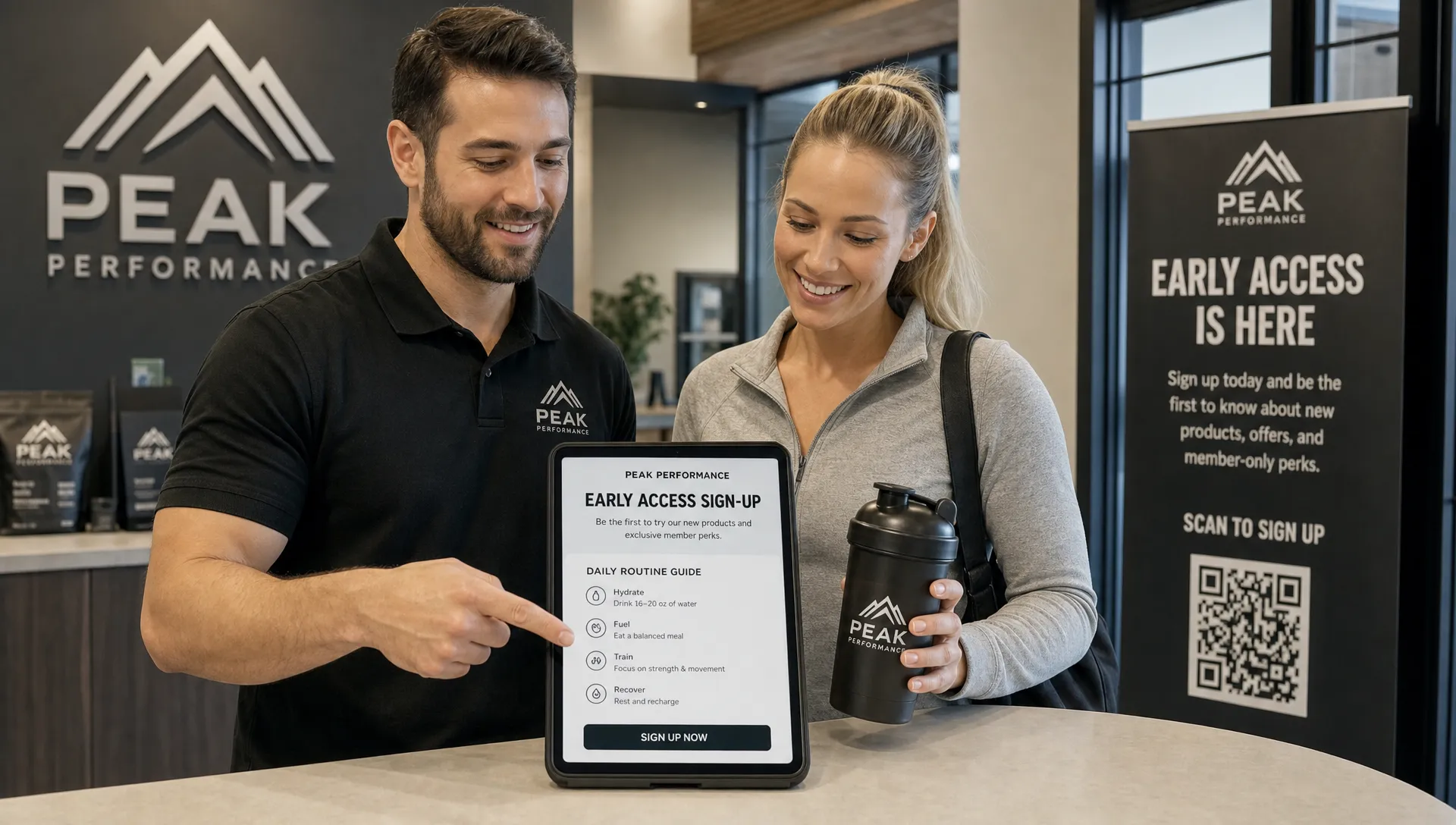
- Consent: The form should make it clear that the person is joining your email list, not just claiming a one-time file or entering a contest.
- Reasonable cadence: If you plan to send weekly tips, product drops or promotional offers, set that expectation early.
The best test is simple: would someone still want the next email after they get the incentive? If the answer is no, the campaign may grow the list but weaken trust.
Choose offers that attract buyers, not just signups
Discounts can work, especially for D2C brands with clear product-market fit and strong margins. The problem is using the same generic discount for every audience, at every stage, on every channel. When the offer is only 10 percent off, you train people to see the email relationship as a coupon dispenser.
Better list-growth offers give the subscriber value before asking for the sale. For sports and wellness brands, that value can be practical, educational or identity-based.
Examples include:
- A product finder quiz for athletes with different training goals
- A nutrition timing guide for endurance events
- A mobility routine created around a specific pain point
- Early access to limited product drops
- A recovery checklist for new gym-goers
- A challenge that combines education, community and product use
The principle applies outside ecommerce too. A high-consideration service can earn trust by helping people decide before asking them to commit. For example, a UK to Poland relocation guide works as a useful lead asset because it reduces uncertainty around a major life decision rather than pushing an immediate transaction.
That is the standard ecommerce brands should aim for. If your email advertising helps people make a better decision, the opt-in feels natural. If it hides the real value behind vague hype, the relationship starts with doubt.
Match the acquisition channel to the level of intent
Not every email advertising channel produces the same kind of subscriber. A Meta lead ad may create volume quickly, but the subscriber might have less context than someone who read a comparison article and joined from a landing page. A creator partnership might generate more trust up front, but only if the creator’s audience overlaps with your actual buyer.
Paid social works well when the offer is visual, fast to understand and tied to a clear problem. For example, a fitness apparel brand can advertise a fit guide or early-access drop to a highly specific audience. A supplement brand may need a more educational funnel, since health-related claims require care and clarity.
Newsletter sponsorships can work when the audience is already gathered around a relevant topic, such as triathlon training, strength coaching, women’s wellness or outdoor adventure. The trust transfer comes from context. The subscriber is not seeing a random ad in the feed. They are discovering your offer inside a content environment they already value.
Creator and affiliate campaigns often perform best when the creator explains why the offer matters, not just that a discount exists. A coach showing how they use a recovery tool in a real routine creates more trust than a static coupon mention.
Search and content-led acquisition usually converts more slowly, but the intent can be stronger. Someone looking for how to choose electrolytes for marathon training is showing a more specific need than someone casually scrolling. This is why email should not sit in a silo. OPTYO breaks down the broader channel relationship in how email and marketing work better together, including how paid ads, SEO, CRO and email can reinforce each other.
Build landing pages that feel like a fair exchange
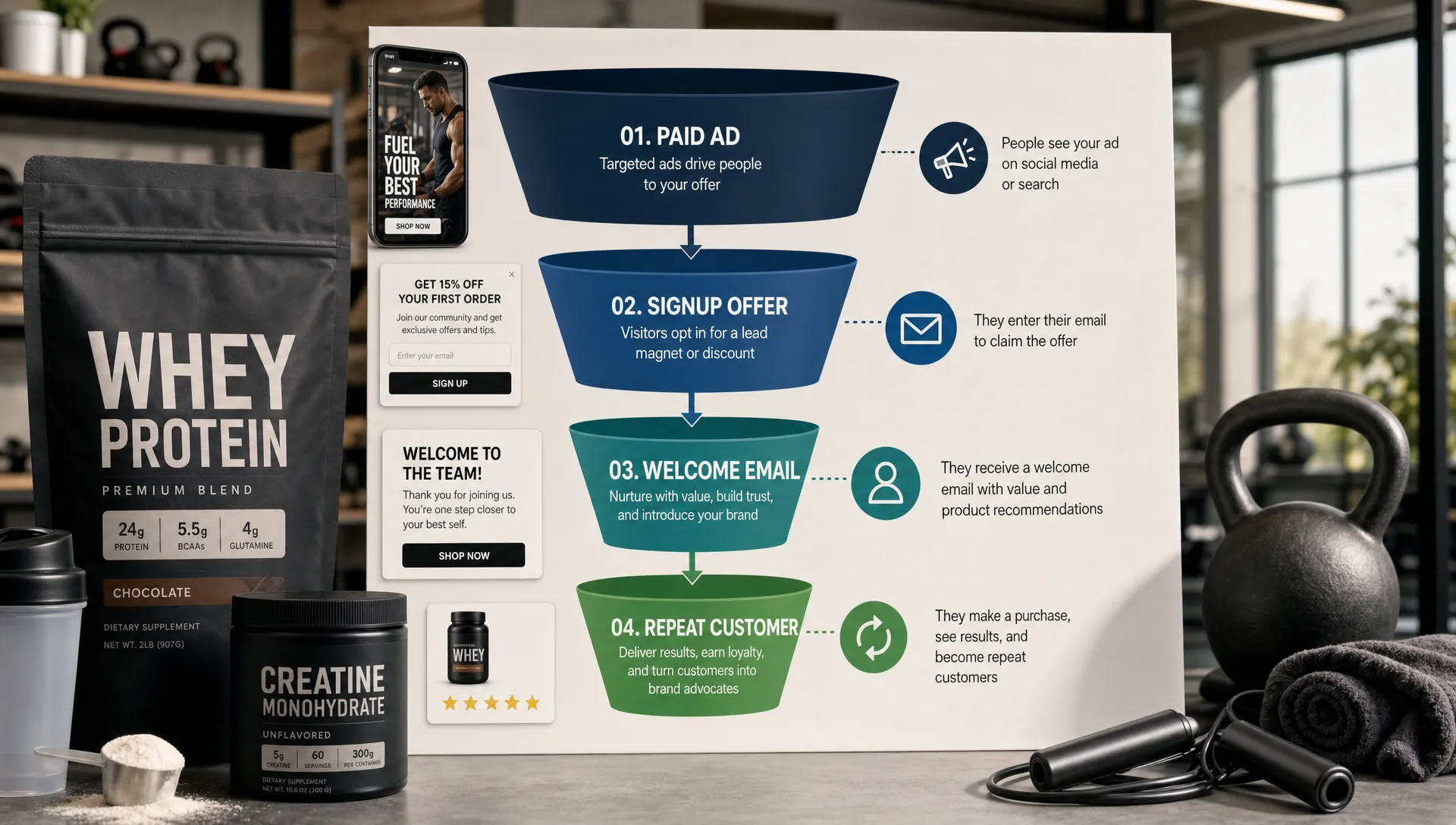
A list-growth ad can only do so much. The landing page has to confirm the promise, reduce friction and reassure the visitor that joining the list is a fair exchange.
For ecommerce, the strongest signup pages usually include a concise headline, a specific benefit, a visual of the product or lead asset, a simple form, privacy reassurance and a clear next step after submission. If the offer is a quiz, explain how long it takes and what the person gets at the end. If it is a guide, show what it covers. If it is early access, clarify what early access means.
Avoid bait-and-switch experiences. If an ad promises a runner’s recovery plan but the page pushes a product bundle before the email capture, the subscriber learns that your marketing is not precise. That friction may not show up in cost per lead, but it appears later in weak engagement.
Also watch the number of fields. More fields can improve segmentation, but each added question needs to earn its place. Asking for sport, training goal or product interest can be useful. Asking for too much too soon can feel extractive.
A good compromise is progressive profiling. Capture the email and one highly useful data point first, then learn more through quiz behavior, welcome flow clicks, post-purchase surveys and preference centers.
Protect consent, compliance and deliverability
Trust is not only a brand issue. It is also a deliverability issue.
Mailbox providers pay attention to how recipients interact with your email. If new subscribers ignore your messages, delete them without opening or mark them as spam, inbox placement can suffer over time. That means poor acquisition quality can hurt revenue from your best customers too.
At a minimum, your brand should follow the requirements that apply to its markets. In the United States, the FTC’s CAN-SPAM compliance guide explains rules around accurate header information, non-deceptive subject lines, a physical mailing address and clear opt-out handling. For bulk senders, Google’s email sender guidelines also emphasize authentication, low spam rates and easy unsubscribe.
Compliance is the floor, not the strategy. A subscriber can legally receive your email and still feel misled. The trust standard should be higher than the legal minimum.
Practical safeguards include using clear opt-in language, honoring unsubscribe requests quickly, suppressing unengaged subscribers, authenticating your sending domain and monitoring list-source performance. If deliverability is already affecting campaign revenue, OPTYO’s article on how an email deliverability agency protects revenue explains the core issues in more detail.
Make the welcome sequence do the trust-building
The moment after signup is when subscriber intent is highest. Too many brands waste it with a generic discount code email and then a sudden jump into normal promotions.
Your welcome sequence should connect the ad promise to the brand story, product value and next best action. It should also segment behavior early. Someone who clicks training content may need education. Someone who clicks a product comparison may be ready for a stronger offer.
A simple trust-first welcome structure can look like this:
| Primary role | Trust-building element | |
|---|---|---|
| Email 1 | Deliver the promised offer | Fast fulfillment with no extra hoops |
| Email 2 | Explain the problem your product solves | Education before sales pressure |
| Email 3 | Introduce proof | Reviews, founder context, ingredient transparency or product testing details |
| Email 4 | Guide the first purchase | Product recommendation based on interest or goal |
| Email 5 | Set expectations | Content cadence, community, support resources and preference options |
For wellness and performance products, be careful with claims. Avoid exaggerating outcomes, especially around health, recovery, fat loss or injury prevention. Specific, supportable language builds more trust than aggressive promises. If proof exists, present it clearly. If it does not, do not imply it.
Segment new subscribers by source and promise
A subscriber from a giveaway does not behave like a subscriber from a product quiz. A subscriber from a creator’s audience may already trust the brand more than someone from a cold paid social campaign. Treating them all the same is one of the fastest ways to waste list growth.
At minimum, tag subscribers by acquisition source, offer type, campaign theme and signup date. This lets you compare list quality across channels and adjust messaging. It also protects your main campaign calendar from becoming too broad.
For example, a hydration brand might create one entry path for marathon training content, another for summer heat safety and another for first-purchase discounts. Each group can receive a different welcome angle before moving into the broader newsletter.
Segmentation also helps you suppress people from irrelevant promotions. A subscriber who joined for women’s strength training content may not respond to the same creative as a subscriber who joined through a cycling hydration guide. Relevance is one of the most practical forms of respect.
Test for quality, not just volume
Email advertising needs a testing rhythm. Without it, teams often keep scaling the campaign with the lowest cost per lead, even when another campaign produces more revenue and stronger engagement.
A clean test compares one major variable at a time. You might test a discount against a guide, a quiz against early access or a creator landing page against a brand landing page. Run the test long enough to measure downstream behavior, not just opt-ins.
For most ecommerce teams, the useful review window includes immediate signup rate, welcome flow engagement, first purchase rate, revenue per subscriber and complaint or unsubscribe behavior. The last two are important because they reveal whether growth is coming at the expense of trust.
Do not judge every campaign by first purchase alone. Some educational offers may produce slower conversion but stronger repeat purchase or higher average order value later. The point is to know the role of each campaign before you scale it.
Common mistakes that make email advertising feel spammy
The first mistake is hiding the email opt-in inside a giveaway or download. If people do not realize they joined your list, your first campaign will feel like an interruption.
The second mistake is overusing urgency. Limited drops, seasonal promotions and event-based offers can be effective, but constant countdowns train subscribers to doubt the brand.
The third mistake is sending the same promotional calendar to every new subscriber immediately. A person who joined yesterday needs context. A loyal customer may want product depth, early access or replenishment reminders. A cold subscriber needs proof that staying on the list is worth it.
The fourth mistake is ignoring list hygiene because acquisition is working. If you keep adding low-intent subscribers and never suppress inactive contacts, your visible list size grows while the business value of the list declines.
Email advertising should create a cleaner path from attention to trust to purchase. If it creates confusion, pressure or surprise, it is not a growth channel. It is a churn machine with a signup form.
Frequently Asked Questions
What is email advertising in ecommerce? Email advertising is the use of paid ads, sponsorships, creator campaigns, referral programs or other promotional channels to acquire email subscribers. The goal is not just to collect addresses, but to bring the right people into a lifecycle email program.
Does offering a discount hurt trust? A discount does not automatically hurt trust. It becomes a problem when it is vague, overused or disconnected from the subscriber’s needs. Discounts work best when paired with clear expectations, relevant product education and a welcome flow that provides value beyond the coupon.
Should ecommerce brands use double opt-in? Double opt-in can improve list quality because subscribers confirm that they want to receive emails. It may reduce total signup volume, so the right choice depends on your category, markets, risk tolerance and deliverability history. Brands with quality issues, compliance concerns or high spam complaints should consider testing it.
How do you know if list growth is hurting trust? Watch unsubscribe rates, spam complaints, welcome flow engagement, revenue per subscriber and engagement by acquisition source. If a campaign produces cheap leads but poor engagement, it may be weakening trust and sender reputation.
What is the best lead magnet for sports and wellness brands? The best lead magnet solves a real pre-purchase problem. Product quizzes, training guides, recovery routines, early-access drops and educational challenges often outperform generic newsletter signups because they give subscribers a clear reason to engage.
Turn list growth into a trusted revenue channel
Email advertising works when the subscriber feels respected from the first impression to the first purchase. That means clear offers, honest consent, relevant segmentation, strong creative and reporting that looks beyond cost per lead.
OPTYO helps sports, fitness and wellness brands connect performance marketing, ecommerce development, creative production, CRO, email marketing, SEO and KPI reporting into growth systems that can scale without eroding trust. If your list is growing but revenue, engagement or deliverability is not keeping pace, the next step is not more emails. It is a better acquisition and lifecycle strategy.