.png)




Profitable ecommerce growth is not just a media buying problem. It is a system problem.
An ecommerce brand can have strong products, polished ads and a loyal early customer base, yet still struggle to scale because the pieces do not work together. Paid traffic gets more expensive. Discounts train customers to wait. Inventory absorbs cash. Creative fatigue appears before the team has a replacement pipeline. The brand grows revenue, but profit does not follow.
This playbook is for founders and operators who want a clearer operating model. It is especially relevant for sports, fitness and wellness brands, where buyers are outcome-driven, trust matters and repeat purchase behavior can make or break the business.
The goal is not to chase growth at any cost. The goal is to build an ecommerce brand that can acquire customers profitably, convert them efficiently, keep them longer and protect the brand equity that makes future demand cheaper.
What profitable growth really means for an ecommerce brand
Revenue growth feels good, but it can hide weak economics. A brand can double monthly sales and still become less healthy if contribution margin falls, payback periods stretch too far or inventory planning gets sloppy.
Profitable growth means your brand can add new customers without relying on unsustainable discounts, overly optimistic lifetime value assumptions or channel conditions that may disappear next quarter. It also means your team knows which metrics matter at each stage of scale.
| Metric | What it tells you | Why it matters |
|---|---|---|
| Contribution margin | Revenue left after variable costs | Shows whether each order funds growth or drains cash |
| Blended CAC | Total acquisition spend divided by new customers | Helps avoid overtrusting platform-reported ROAS |
| AOV | Average order value | Determines how much acquisition cost the first order can support |
| Gross margin | Product revenue after cost of goods | Sets the ceiling for marketing efficiency |
| Repeat purchase rate | Percentage of customers who buy again | Reveals whether the product and lifecycle experience create retention |
| Payback period | Time needed to recover acquisition cost | Protects cash flow during scale |
| MER | Revenue divided by total marketing spend | Gives a simple view of overall marketing productivity |
For many ecommerce founders, the biggest shift is moving from channel-first thinking to economics-first thinking. Instead of asking how much should we spend on Meta or Google, start by asking what a profitable customer is worth, what you can afford to pay for that customer and how quickly you need to recover that spend.
Step 1: Build the growth model before the media plan
A profitable growth plan starts with unit economics. Before you increase spend, map the real economics of your hero products, bundles and subscription offers.
At a minimum, account for product cost, packaging, merchant fees, fulfillment, shipping subsidies, returns, discounts, affiliate commissions and customer service costs. If your brand has high creative production costs, include those in your planning too. They may not attach to one specific order, but they still affect the cash required to scale.
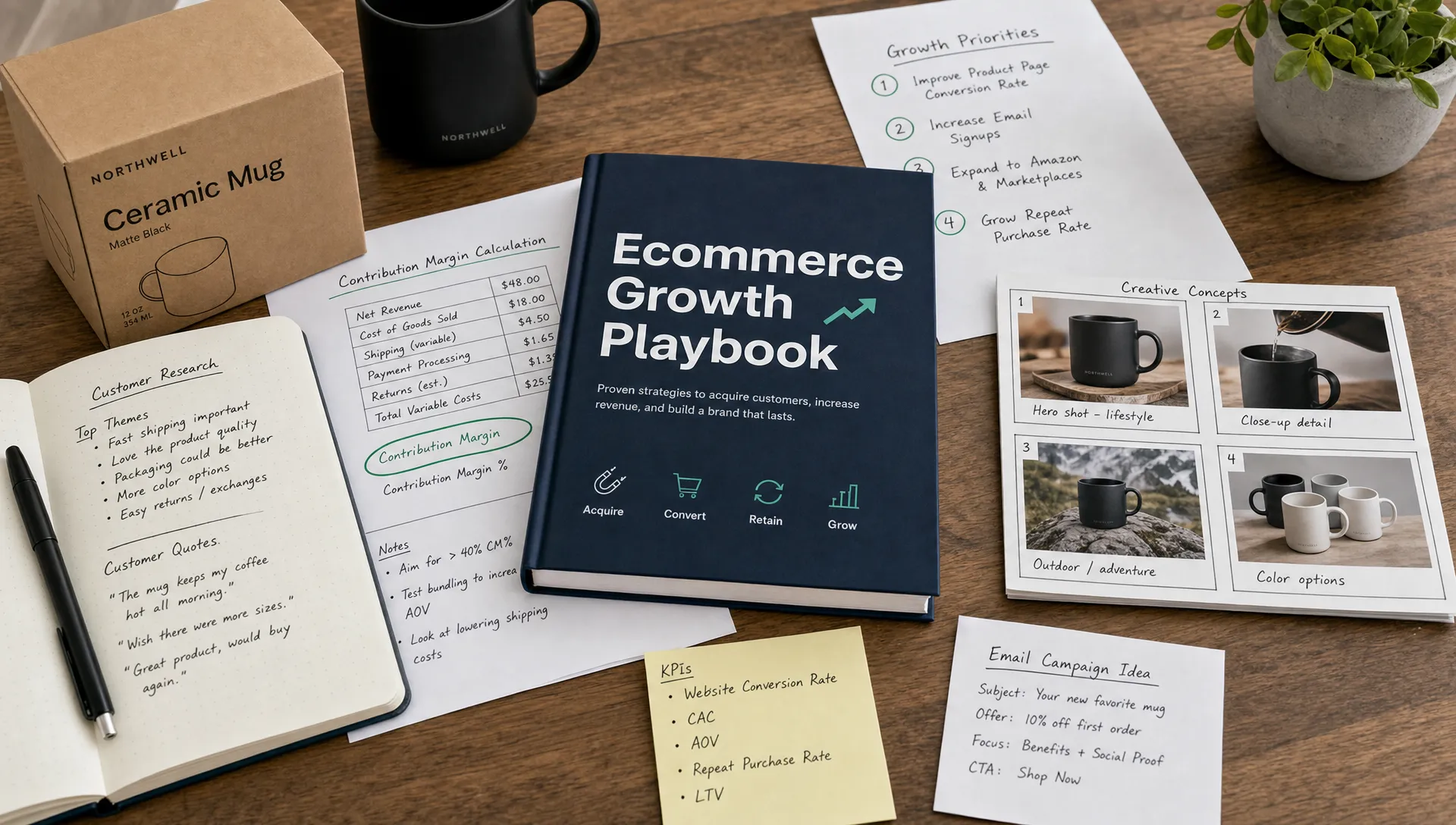
A simple contribution margin formula looks like this:
Net revenue - COGS - shipping - fulfillment - payment fees - discounts - returns = contribution margin
From there, calculate your breakeven CAC:
Contribution margin per first order = maximum breakeven CAC on first purchase
If you rely on repeat purchases, separate first-order profitability from customer lifetime profitability. A supplement brand, for example, may accept a tighter first order if retention is strong and replenishment happens quickly. A premium fitness equipment brand with a lower repeat purchase cadence may need the first order to carry more of the profit burden.
This is where many ecommerce brands find hidden constraints. The issue is not always the ad account. Sometimes the issue is a low-margin entry product, an offer that reduces AOV or a shipping policy that turns high-volume campaigns into low-profit campaigns.
If you want to go deeper on this foundation, OPTYO has also covered business strategies for growth that improve profitability, including how contribution margin and offer structure influence scale.
Step 2: Choose the customer you can win most profitably
A broad target audience makes media buying look easier at first, but it usually makes the brand weaker. Sports, fitness and wellness categories are full of products that claim to help everyone feel better, perform better or recover faster. Those claims are too generic to build efficient demand.
Profitable brands get specific. They define the customer by buying situation, desired outcome, level of sophistication and urgency. A recovery product for marathon runners in heavy training should not sound like a general wellness product for casual gym-goers. A protein snack for busy parents should not lead with the same creative angle as a protein snack for competitive athletes.
Specificity improves almost every part of the business. Ads become easier to write. Landing pages become more relevant. Reviews and testimonials become more persuasive. Offers become easier to package because the buying moment is clearer.
For wellness brands, it can help to study service businesses that make outcomes tangible. A data-led studio such as Custom Fit, a personal training, nutrition and testing facility in San Francisco shows how specificity builds trust through services like metabolic testing, DEXA scans, VO2 max testing and nutrition coaching. Ecommerce brands can apply the same principle by making product benefits concrete, measurable and tied to a defined customer journey.
The more clearly you can answer who this is for, what problem they are solving and why now is the time to buy, the less your brand has to rely on generic urgency tactics.
Step 3: Design offers that increase value, not just conversion rate
A discount can increase conversion rate and still hurt the business. The better question is whether your offer improves customer value, protects margin and creates a stronger reason to buy now.
A strong ecommerce offer is more than a price cut. It combines product selection, perceived value, risk reduction and timing. For a fitness or wellness brand, that might mean a starter kit, performance bundle, replenishment subscription, challenge-based program or limited seasonal pack tied to a real use case.
Good offers often include one or more of these elements:
- A clear entry point for first-time buyers
- A bundle that solves a complete problem instead of pushing random SKUs together
- A subscription or replenishment option when usage cadence supports it
- A guarantee or trial structure that reduces perceived risk
- Education that helps the customer get better results from the product
- A premium option for buyers who want the highest value solution
The key is to make the offer feel like a better solution, not a cheaper product. If every promotion is built around percentage-off messaging, customers learn to wait. If your offers are built around outcomes, routines and product education, you can raise perceived value while maintaining stronger economics.
Step 4: Turn creative into a repeatable testing system
Creative is often the biggest lever in paid social performance, but many ecommerce brands still treat it like a campaign deliverable. They produce a batch of ads, wait for performance to decline, then rush to make another batch.
A healthier approach is to build a creative testing system. That means your team is constantly developing hypotheses, producing variations and learning which messages move customers at different stages of awareness.
For sports, fitness and wellness brands, useful creative angles often include product demonstration, before-and-after context, ingredient or material education, founder story, expert explanation, customer routine, social proof, comparison against an old solution and objection handling.
Each angle should connect to a real buying barrier. If customers do not understand the product, test education. If they do not believe the claim, test proof. If they think the product is too expensive, test value framing and comparison. If they are unsure it fits their routine, test day-in-the-life usage content.
Brand consistency matters here. Performance creative should not look and sound disconnected from the brand customers experience on the website, in email and in the product itself. Strong brands develop distinctive cues that make ads more recognizable over time, then use performance testing to learn which messages convert.
OPTYO has a related breakdown on how branding and advertising make ecommerce more memorable, which is a useful companion to the creative system in this playbook.
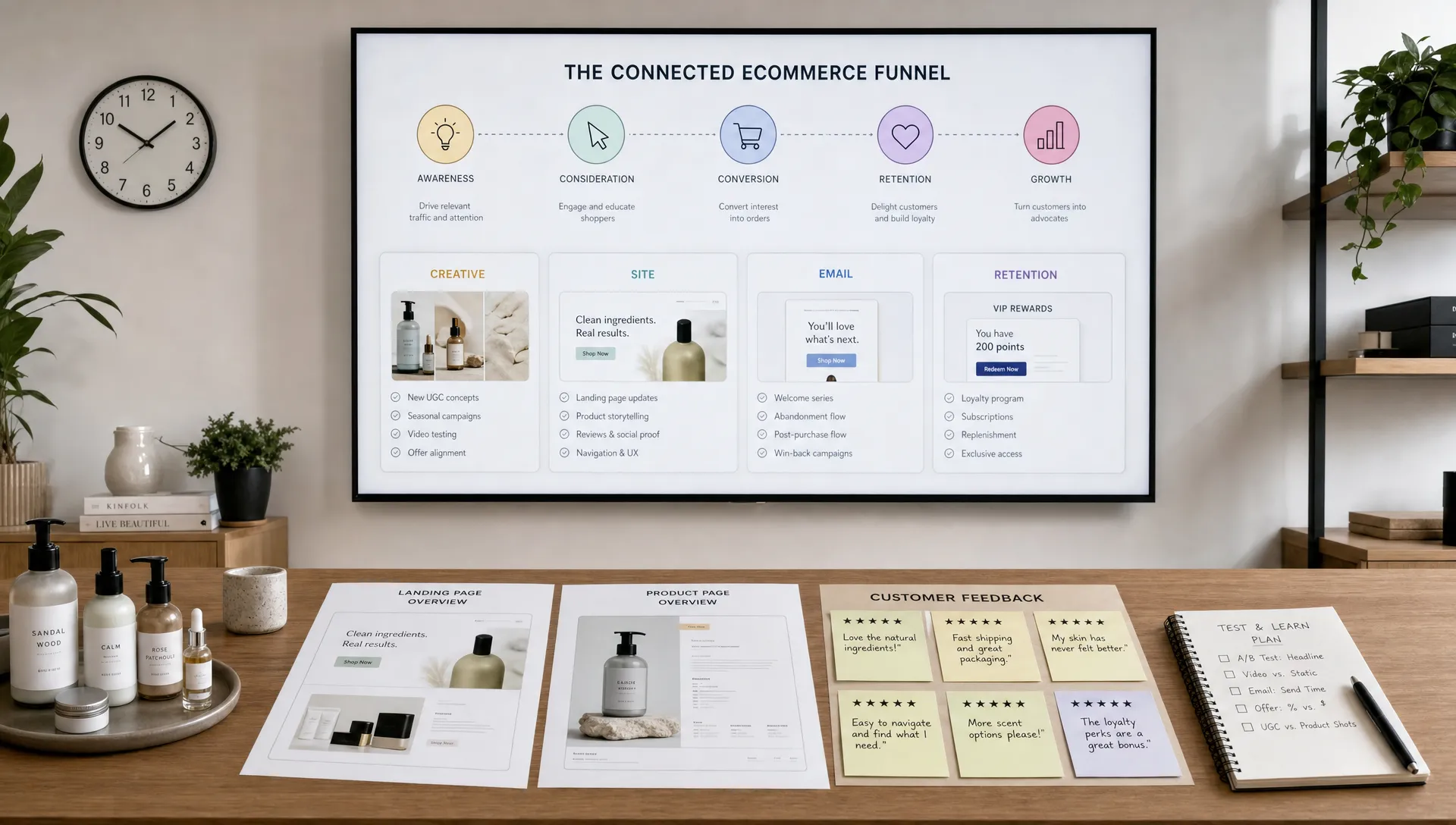
Step 5: Fix the conversion path before you scale traffic
If your site cannot convert qualified visitors efficiently, more media spend only exposes the leak faster. Conversion rate optimization is not about copying hacks from other brands. It is about removing friction and making the buying decision easier for your customer.
Start with message match. The promise in the ad should be visible on the landing page. If an ad speaks to joint recovery after training, the landing page should not open with broad lifestyle branding. If the ad promotes a starter bundle, the page should explain why the bundle exists, who it is for and how to use it.
Product pages should answer the questions customers need resolved before purchase. That includes what the product does, who it is for, how it compares to alternatives, what is included, how soon it ships, what happens if it does not work for them and why other customers trust it.
Trust signals matter, but they need context. Reviews are stronger when they reflect the buyer's situation. A testimonial from a strength athlete may be more persuasive for a lifting accessory than a generic five-star quote. Certifications, testing, expert involvement, ingredient transparency and clear return policies can all reduce hesitation when they are relevant.
Checkout should be clean, predictable and free of avoidable surprises. Unexpected shipping costs, unclear delivery timelines and confusing discount fields can damage conversion near the finish line. Baymard Institute has documented checkout friction for years, and the practical lesson is simple: clarity converts.
Step 6: Give each channel a specific job
A channel strategy should define roles, not just budgets. Paid social, search, SEO, email, creators and affiliates can all support growth, but they do not solve the same problem.
| Channel | Best role | Common mistake |
|---|---|---|
| Paid social | Create demand, test angles and scale winning creative | Expecting one audience or campaign structure to fix weak messaging |
| Paid search | Capture existing demand and high-intent comparison traffic | Overpaying for low-margin terms without measuring blended impact |
| SEO | Build durable demand capture and category authority | Publishing content without a clear commercial path |
| Email and SMS | Increase repeat purchases, education and launch performance | Sending promotions without lifecycle strategy |
| Creators and affiliates | Build trust, proof and new audience reach | Measuring only last-click revenue and ignoring content value |
| Marketplaces or retail | Expand access and trial | Letting channel expansion weaken owned customer relationships |
Paid social is often the fastest testing ground because it lets the brand learn which hooks, outcomes and objections matter. Search can capture demand already in-market, but it rarely creates a brand by itself. SEO takes longer, yet it can compound if your content matches real customer questions and buying journeys. Email and SMS protect profit by increasing repeat purchase, improving product adoption and reducing dependence on new customer acquisition.
The best ecommerce brands do not treat channels as isolated teams. Insights from customer service should inform ads. Paid social winners should influence landing pages. Search queries should inform product page copy. Email replies should reveal objections that creative can address.
If your acquisition strategy is becoming too platform-dependent, this guide on performance marketing for ecommerce explains how to use paid media, creative testing and conversion work together to improve profitability.
Step 7: Build the second purchase before the first order ships
Retention is not a post-purchase afterthought. It should be designed into the customer experience from the beginning.
For consumable wellness brands, retention often depends on usage education, replenishment timing and whether the customer experiences the product's value quickly. For equipment or apparel brands, retention may come through accessories, seasonal needs, training cycles, product drops or community. In every case, the post-purchase journey should help customers succeed with what they bought.
A strong retention system usually includes onboarding, product education, replenishment reminders, customer segmentation, winback campaigns and launch calendars. The tone should be helpful, not purely promotional. If the customer just purchased a performance supplement, the first emails should help them use it correctly, understand timing and build consistency. If they purchased recovery gear, show routines, care instructions and use cases.
Customer support also feeds retention. Questions, complaints and refund reasons show where expectations are misaligned. When teams review that feedback weekly, they can improve product pages, ads, onboarding flows and even product development.
The most profitable customer is often not the one with the cheapest first purchase. It is the one who understands the value, gets the desired outcome and sees the brand as part of their routine.
Step 8: Measure what helps you make better decisions
Data is only useful when it changes decisions. Many ecommerce teams review too many metrics and still miss the few that matter most.
Your measurement system should connect marketing activity to business health. Platform ROAS can help with in-platform optimization, but it should not be the only measure of performance. Attribution windows shift. Tracking can be incomplete. Discounts can inflate conversion while weakening margin. A blended view keeps the business grounded.
A practical reporting rhythm might look like this:
| Cadence | What to review | Decision it supports |
|---|---|---|
| Daily | Spend, revenue, site issues, inventory risks and major performance swings | Prevents avoidable losses and operational surprises |
| Weekly | Creative winners, blended CAC, MER, conversion rate, AOV and contribution margin | Guides budget shifts, testing priorities and offer adjustments |
| Monthly | Cohort behavior, retention, payback period, channel mix and product-level profitability | Determines whether growth is becoming more durable |
| Quarterly | Positioning, category opportunities, product roadmap, hiring and cash requirements | Aligns marketing with company strategy |
The most useful growth meetings focus on diagnosis. If CAC rose, was it caused by creative fatigue, lower conversion rate, weaker offer mix, increased competition, inventory limitations or a measurement change? If revenue increased but cash tightened, did discounting, shipping cost, returns or inventory buys absorb the gain?
Clear reporting turns growth from a guessing game into an operating cadence. It also keeps teams honest when revenue is growing but profit is not.
A 90-day playbook for profitable ecommerce growth
You do not need to rebuild the entire business at once. A focused 90-day plan can create momentum without overwhelming the team.
| Timeline | Focus | Output |
|---|---|---|
| Days 1 to 30 | Economics, customer definition and funnel diagnosis | Breakeven CAC, margin map, customer segments, top conversion leaks and creative audit |
| Days 31 to 60 | Offer, landing page and creative testing | New offer structure, revised product or landing pages, creative testing matrix and email improvements |
| Days 61 to 90 | Scale, retention and reporting | Budget rules, winning creative expansion, retention flows, KPI reporting rhythm and next-quarter growth priorities |
During the first month, resist the urge to jump straight into ad account changes. Diagnose the business model first. In the second month, improve the assets that influence conversion and profit: offers, product pages, creative and lifecycle messaging. In the third month, scale what is working and create a reporting rhythm that keeps the team aligned.
This kind of sequencing matters because growth problems are connected. A weak offer can make ads look bad. Unclear positioning can reduce conversion. Poor onboarding can lower lifetime value. A bad reporting setup can cause the team to cut the wrong campaign or scale the wrong product.
Common mistakes that make growth less profitable
Many ecommerce brands do not fail because they lack effort. They struggle because their effort is pointed at the wrong constraint.
One common mistake is scaling traffic before fixing the offer and site experience. If conversion is weak, the brand pays to learn what could have been fixed through better messaging, page structure and proof.
Another mistake is treating discounting as a growth strategy. Promotions have a place, but they should be used with discipline. If buyers only act when the price drops, the brand has a positioning or value communication problem.
A third mistake is chasing too many customer segments at once. This splits creative, weakens product storytelling and makes learning slower. It is usually better to win one profitable segment clearly, then expand from a stronger base.
Finally, many brands separate brand and performance too aggressively. Brand without commercial discipline can become expensive decoration. Performance without brand discipline can become short-term extraction. Profitable growth needs both: distinctiveness that compounds and direct response systems that turn demand into revenue.
Frequently Asked Questions
What is the most important metric for a growing ecommerce brand? Contribution margin is one of the most important metrics because it shows whether orders are actually creating profit after variable costs. Blended CAC, MER, repeat purchase rate and payback period should be reviewed alongside it.
How can an ecommerce brand grow without relying on discounts? Build offers around outcomes, bundles, education, risk reduction and customer routines. The goal is to increase perceived value instead of simply lowering price.
When should a brand increase paid media spend? Increase spend when the unit economics are clear, the site converts qualified traffic, creative testing is producing repeatable winners and the brand can support growth operationally through inventory, fulfillment and customer service.
How does brand strategy affect ecommerce profitability? Brand strategy makes the buying decision easier by clarifying who the product is for, why it matters and why customers should choose it over alternatives. Strong positioning can improve creative performance, conversion and retention.
What should a sports, fitness or wellness brand prioritize first? Start with the customer outcome and economics. Define the buyer, clarify the promise, map margins and identify the biggest constraint before scaling acquisition spend.
Make growth measurable, creative and profitable
Profitable growth comes from alignment. Your economics, customer definition, offer, creative, conversion path, retention system and reporting cadence all need to support the same strategy.
For sports, fitness and wellness founders, that alignment is especially valuable. Customers want products they can trust, routines they can stick with and brands that understand their goals. When your marketing system reflects that, growth becomes less dependent on short-term tactics and more connected to real demand.
OPTYO helps ecommerce brands connect performance marketing, creative, conversion rate optimization, email marketing, SEO and growth consulting into a clearer path to scale. If your brand has product traction but needs a more profitable growth system, the playbook above is the place to start.