.png)



Choosing an email marketing agency for retention is different from hiring one to send campaigns. Acquisition-focused email can help capture leads and convert first purchases, but retention email has a harder job: it has to make customers come back, buy the right product at the right time and feel more connected to the brand after each interaction.
For ecommerce founders, especially in sports, fitness and wellness, retention is often where profit is won or lost. Paid social may bring in the first order, but email can influence the second, third and fourth order without paying the same acquisition cost again. The often-cited Bain & Company retention analysis connected a 5 percent increase in customer retention with 25 percent to 95 percent profit gains in some industries, which is why the agency you choose should understand much more than subject lines and templates.
A strong email marketing agency for retention should know lifecycle strategy, customer behavior, contribution margin, creative testing, deliverability and how email fits into your broader growth system. Here is how to evaluate one before signing a contract.
Start with your retention economics, not the agency deck
Before you compare agencies, define what retention means for your brand. A supplement company, performance apparel brand, connected fitness product and healthy snack CPG brand may all use email, but their retention levers are not the same.
A good agency will ask about your model before pitching solutions. They should want to know your repeat purchase window, average order value, gross margin, SKU mix, subscription behavior, seasonality, product education needs and where customers usually drop off.
For a sports nutrition brand, retention may depend on replenishment timing and usage education. For a fitness apparel brand, it may depend on launch calendars, community storytelling and cross-selling. For wellness CPG, it may involve routine building, bundles and replenishment reminders. If an agency jumps straight into a fixed package without discussing these differences, they may be selling email production rather than retention growth.
The first question is not, “Can they send emails?” It is, “Can they identify why customers are not coming back often enough?”
Look for lifecycle strategy, not just campaign output
Many agencies can build a monthly calendar. Fewer can design a lifecycle system that moves customers from first purchase to loyalty.
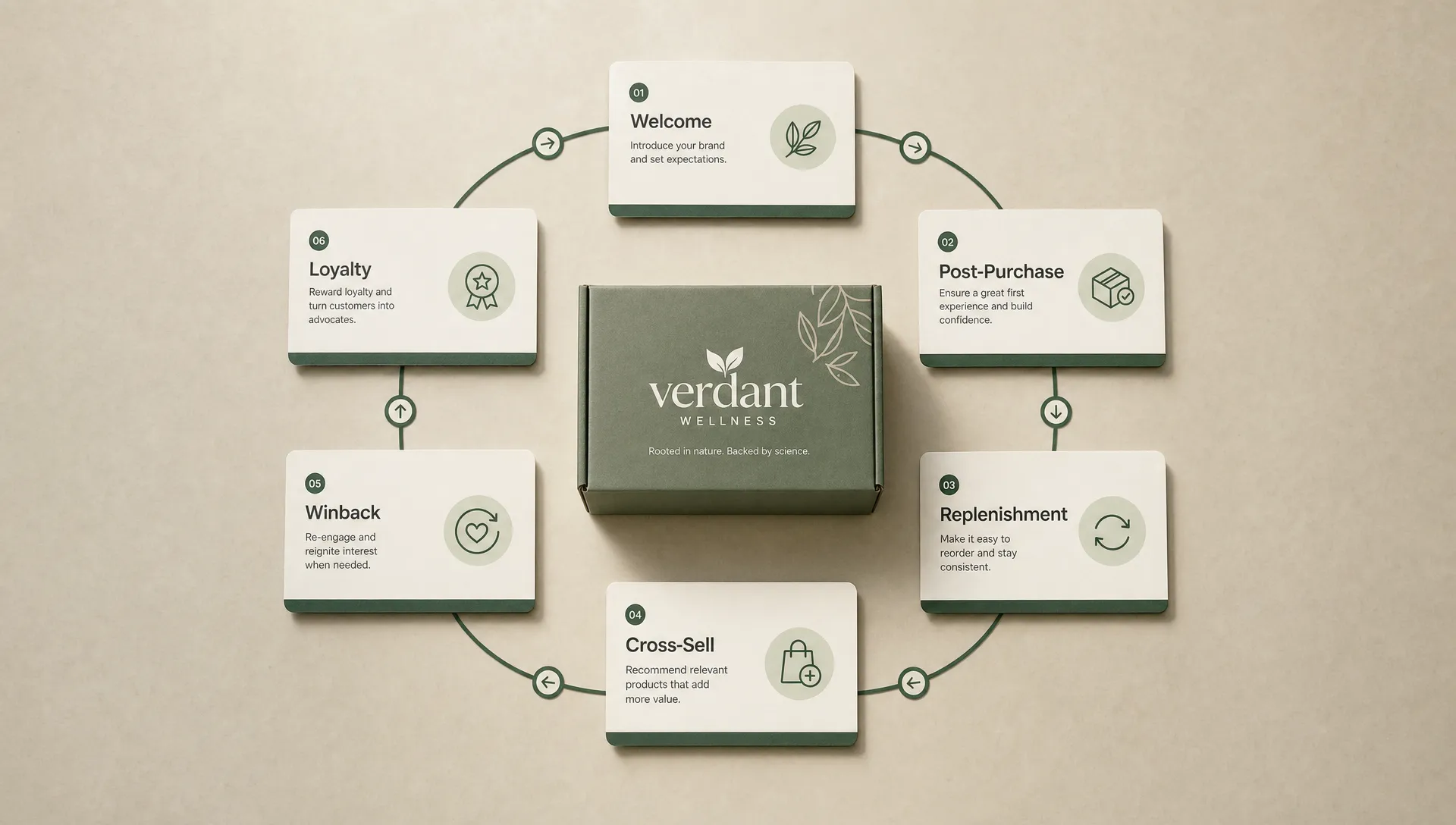
Retention email should include campaigns, but it should not depend on campaigns alone. The strongest programs combine automated flows, segmented campaigns and customer education. For ecommerce brands, a useful lifecycle map often includes:
- A welcome journey that introduces the brand promise and guides the first purchase
- A post-purchase journey that reduces buyer anxiety and helps customers use the product
- A replenishment or reorder journey based on realistic consumption cycles
- A cross-sell journey that recommends products based on purchase behavior
- A winback journey that responds to declining engagement or lapsed purchase behavior
- A VIP or loyalty journey that makes high-value customers feel recognized
When you interview an agency, ask them to explain which lifecycle gaps they would inspect first. Their answer should connect to business outcomes, not just flow names. “We would audit the post-purchase flow because your second purchase rate is low and your product requires habit formation” is much stronger than “We always build seven standard flows.”
If you want a broader ecommerce hiring framework beyond retention, OPTYO has a separate guide on what to look for in an email marketing agency for ecommerce. For this decision, keep pushing the conversation back to repeat revenue and customer behavior.
Evaluate how they use segmentation and first-party data
Retention improves when emails become more relevant. That requires clean segmentation and a practical understanding of first-party data.
An agency should be able to segment beyond “purchased” and “not purchased.” For retention, more useful segments may include first-time buyers, repeat buyers, category purchasers, high-AOV customers, discount-sensitive customers, lapsed buyers, subscribers, non-subscribers, VIPs and customers who bought a product with a specific replenishment cycle.
The goal is not to create endless segments that slow execution. The goal is to find the few behavioral differences that change what a customer should receive next.
For example, a customer who bought running socks once may need different messaging than someone who has purchased training shoes, recovery tools and electrolyte products over six months. One is still testing the brand. The other may be ready for early access, bundles or community-led content.
Ask the agency how they decide which segments are worth building. A strong answer will mention list size, revenue potential, message differentiation and testability. If every segment gets the same offer in slightly different wording, the agency is not really practicing retention strategy.
Judge creative by its effect on customer behavior
Retention creative should not be measured only by whether it looks polished. It should help customers make the next best decision.
For sports, fitness and wellness brands, this often means combining product education with emotional motivation. Customers may need to understand how to use a recovery product, when to reorder supplements, how a fabric performs during training or why a bundle supports a routine. Good creative can make those ideas clear without turning every email into a product manual.
The right agency should be able to develop emails that match different retention moments. A first-time buyer may need reassurance and education. A high-value customer may respond better to insider access or a new product story. A lapsed customer may need a reason to re-engage that is stronger than another discount.
Be cautious with agencies that rely heavily on promotions to drive repeat purchases. Discounts can be useful, but repeated blanket offers may train customers to wait. Retention creative should build habit, trust and perceived value, not only urgency.

Make sure they understand deliverability
Retention cannot work if your emails do not reach the inbox. Deliverability is not the most glamorous part of agency evaluation, but it affects every campaign and automation you send.
A qualified agency should understand sender reputation, list hygiene, engagement filtering, authentication, unsubscribe patterns and spam complaint risk. They should know how to protect long-term performance instead of chasing short-term revenue from over-mailing the full list.
Ask how they handle unengaged subscribers. Ask how often they review deliverability health. Ask what they would do if open rates, click rates or revenue suddenly dropped. A serious retention partner will have a process for diagnosing problems across list quality, sending frequency, content, technical setup and recent platform changes.
This matters even more as major inbox providers continue tightening standards for commercial senders. Your agency does not need to scare you with technical jargon, but they should be able to explain deliverability in plain language and show how it shapes sending strategy.
Require reporting that separates attribution from retention impact
Email platforms can make revenue look simple. A campaign is sent, customers buy and the platform attributes revenue to email. That view is useful, but it is not enough for retention decisions.
A retention-focused agency should help you understand whether email is truly increasing repeat purchase behavior or simply capturing sales that would have happened anyway. This does not mean every brand needs complex statistical modeling from day one. It does mean the agency should be careful with claims.
The best reporting conversations include metrics such as repeat purchase rate, time between purchases, customer lifetime value, churn risk, purchase frequency, flow revenue, campaign revenue, unsubscribe rate, spam complaints and contribution margin. For brands with enough volume, holdout tests or incrementality tests can help separate real lift from attributed revenue.
You should also ask how reporting changes by growth stage. A younger brand may need directional learning and lifecycle setup. A more mature ecommerce brand may need deeper cohort analysis, offer testing and stronger measurement around incremental revenue.
If an agency only talks about open rates and attributed revenue, they may not be equipped to manage retention as a business function.
Confirm that email connects with your wider marketing system
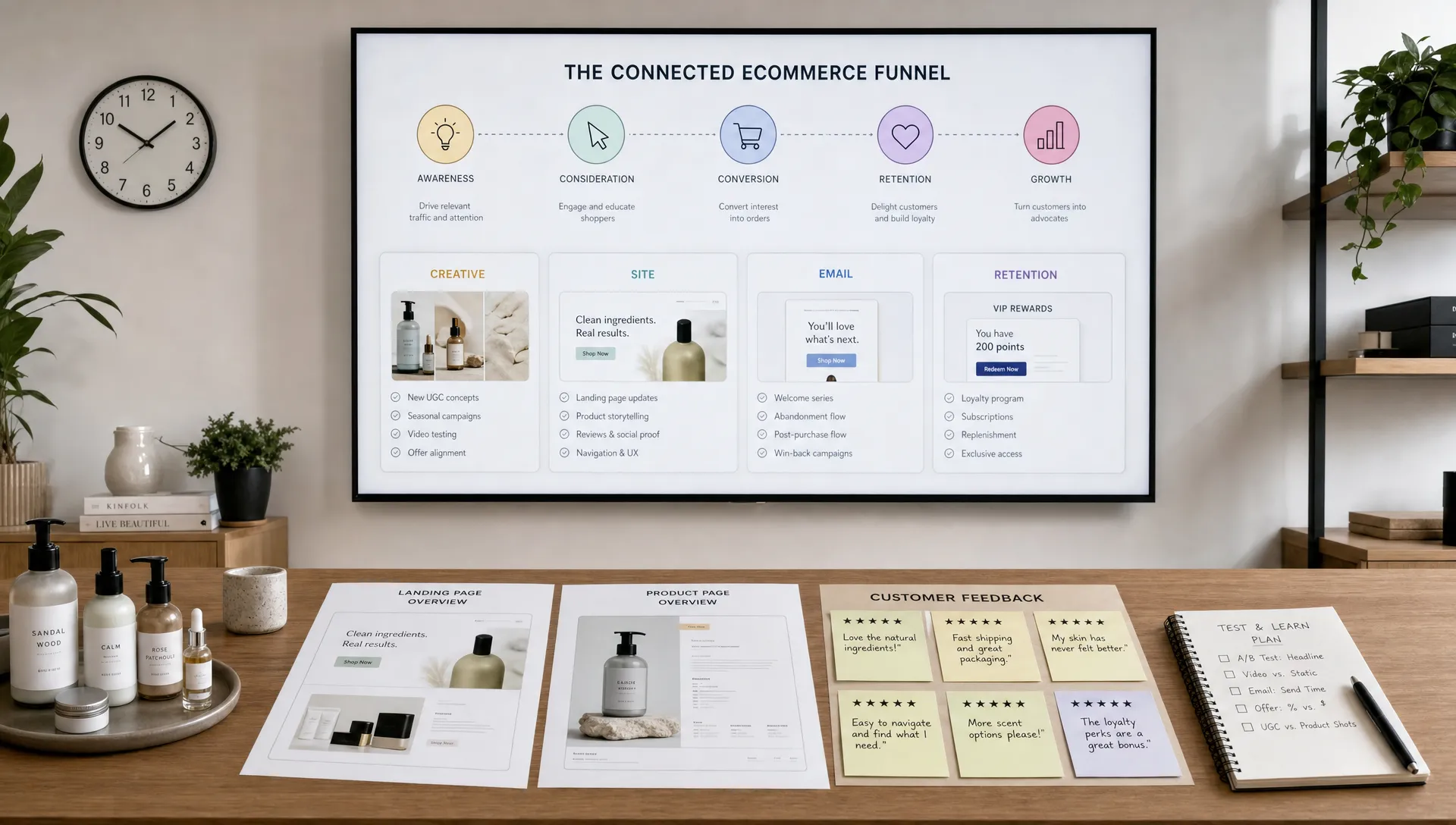
Retention email performs better when it is connected to paid media, SEO, landing pages, product launches and conversion rate optimization. Customers do not experience your brand by channel. They see ads, browse your site, read reviews, get emails, receive products and decide whether the experience is worth repeating.
An agency that manages retention in isolation may miss important context. For example, if paid social is pushing a new customer acquisition offer, email should prepare first-time buyers for the product experience that follows. If a landing page is attracting high-intent SEO traffic, email capture and nurture should match that intent. If CRO testing reveals objections on product pages, email can address those objections after signup or purchase.
OPTYO explains this channel connection in more detail in its article on how email and marketing work better together. When you evaluate an email agency, listen for signs that they can work across functions rather than protect their channel in a silo.
For retention, this collaboration is especially valuable. Product feedback from customer service can improve post-purchase education. Paid creative insights can inform email angles. Email performance can reveal which benefits, claims or objections should be tested on site. Strong agencies know how to turn those signals into action.
Review their platform fluency, but do not hire for platform skills alone
Your agency should understand the email and SMS tools your brand uses. Platform fluency matters because poor setup can limit segmentation, automation, reporting and personalization.
That said, platform expertise is not the same as retention expertise. Knowing how to build in Klaviyo, Omnisend, Mailchimp or another tool does not automatically mean an agency can improve repeat purchase behavior. The platform is the vehicle. Strategy determines where it goes.
Ask agencies to explain how they would use your current tech stack to improve retention. If they immediately recommend switching platforms, ask why. Sometimes a migration is justified. Other times, the brand has not fully used the tool it already pays for. If you are still comparing options, this OPTYO breakdown of marketing email platforms for ecommerce brands can help you understand how platform choice affects execution.
The right partner will be honest about what your current setup can and cannot do. They will also avoid making the tool the hero of the strategy.
Look at their operating cadence and learning culture
Retention improves through consistent learning. Your agency should have a clear operating rhythm for planning, production, QA, reporting and iteration.
Ask what happens every week, every month and every quarter. Who owns strategy? Who writes copy? Who designs? Who builds and tests emails? Who reviews performance? How are new learnings documented? How do they decide which tests deserve priority?
A strong partner should also keep its team current. Email retention changes quickly as privacy rules, AI workflows, deliverability standards and platform capabilities shift. Agencies that invest in structured training, including ongoing professional development through live online courses and microlearning paths, are better positioned to adapt instead of recycling old playbooks.
You are not only hiring the agency’s current knowledge. You are hiring its ability to keep improving as the market changes.
Ask better questions before you hire
The quality of your questions will reveal the quality of the agency’s thinking. Instead of asking only for case studies and pricing, use the sales process to see how they diagnose problems.
Good questions include:
- What retention metrics would you review first for our brand?
- Which lifecycle flows would you audit before building anything new?
- How would you reduce discount dependence while protecting revenue?
- How do you decide when to segment and when to keep a campaign broad?
- What does your testing process look like over 90 days?
- How do you measure incremental impact, not just attributed revenue?
- How do you coordinate email with paid social, CRO, product launches and SEO?
- What do you need from our team to do your best work?
Pay attention to how specific the answers are. A good agency will not pretend to know everything before seeing your data, but it should be able to explain its decision-making process clearly.
You should also ask what they would not do. Agencies with real retention experience often have strong opinions about over-mailing, excessive discounts, weak list hygiene and creative that does not match the customer journey.
Watch for red flags
Some warning signs show up early in the buying process. None automatically means an agency is bad, but they should make you slow down and ask more questions.
Common red flags include:
- They guarantee a fixed percentage of revenue from email without understanding your list, margins or purchase cycle
- They talk about campaign volume more than customer behavior
- They recommend heavy discounts as the primary retention lever
- They cannot explain deliverability in practical terms
- They do not ask about your product experience, fulfillment, customer service or repeat purchase window
- Their reporting focuses only on open rates and attributed revenue
- Their creative examples look good but all use the same offer structure
- They have no clear process for testing, QA or learning from results
Retention is too important to outsource to a team that only sends emails. You want a partner that can think like a growth operator and execute like a specialist.
What a strong first 90 days should include
The first 90 days with a retention-focused email marketing agency should not be chaotic. There should be enough structure to create momentum and enough flexibility to respond to what the data shows.
In the first month, the agency should audit your account, review historical performance, map lifecycle gaps, inspect deliverability, study your customer journey and clarify retention KPIs. They should also identify quick wins, but quick wins should not replace the strategic work.
In the second month, the agency should begin improving priority flows and campaigns. This may include rewriting post-purchase education, refining welcome emails, improving segmentation, testing offers or updating creative to better match product use cases.
By the third month, the work should move into a clearer testing and optimization rhythm. You should see reporting that connects actions to retention metrics, plus a roadmap for the next quarter. The agency should be able to explain what it learned, what changed and what it recommends next.
If the first 90 days only produce more emails without better insight, the engagement may not be moving toward true retention growth.
Frequently Asked Questions
What should an email marketing agency do for retention? An email marketing agency focused on retention should improve lifecycle flows, segmentation, post-purchase education, repeat purchase campaigns, deliverability, testing and reporting tied to repeat revenue. The goal is not just sending more emails, but increasing the likelihood that customers buy again.
How do I know if an agency is good at retention? Look for evidence that they understand customer behavior, purchase cycles, margins, product education and lifecycle strategy. During the sales process, they should ask detailed questions about your business model and explain how they would diagnose retention gaps before prescribing tactics.
Should retention email rely on discounts? Discounts can help in specific moments, but they should not be the default strategy. Strong retention email builds trust, habit, product understanding and loyalty. Overusing discounts can reduce margin and train customers to wait for promotions.
Which metrics matter most for retention email? Useful metrics include repeat purchase rate, purchase frequency, time between purchases, customer lifetime value, flow revenue, campaign revenue, unsubscribe rate, spam complaint rate and contribution margin. Attributed revenue is helpful, but it should not be the only measure.
When should an ecommerce brand hire an email marketing agency? Consider hiring when email is already generating revenue but lacks strategy, when your team cannot maintain lifecycle flows and testing, or when repeat purchase rate is holding back profitability. Brands with enough customer data usually get more value because the agency has behavior to analyze.
Build retention with a partner that understands growth
Choosing an email marketing agency for retention is really a decision about how seriously your brand treats customer relationships. The right partner will understand your economics, improve lifecycle communication, protect deliverability, test with discipline and connect email to the rest of your marketing system.
For sports, fitness and wellness brands, retention is not only about reminders and promotions. It is about helping customers get value from the product, stay engaged with the brand and return when the next need appears.
If you are building a D2C or CPG brand and want email to become a stronger retention engine, OPTYO helps growth-focused companies with performance marketing, email marketing, creative, ecommerce development, CRO, SEO, KPI reporting and brand strategy consulting.