.png)


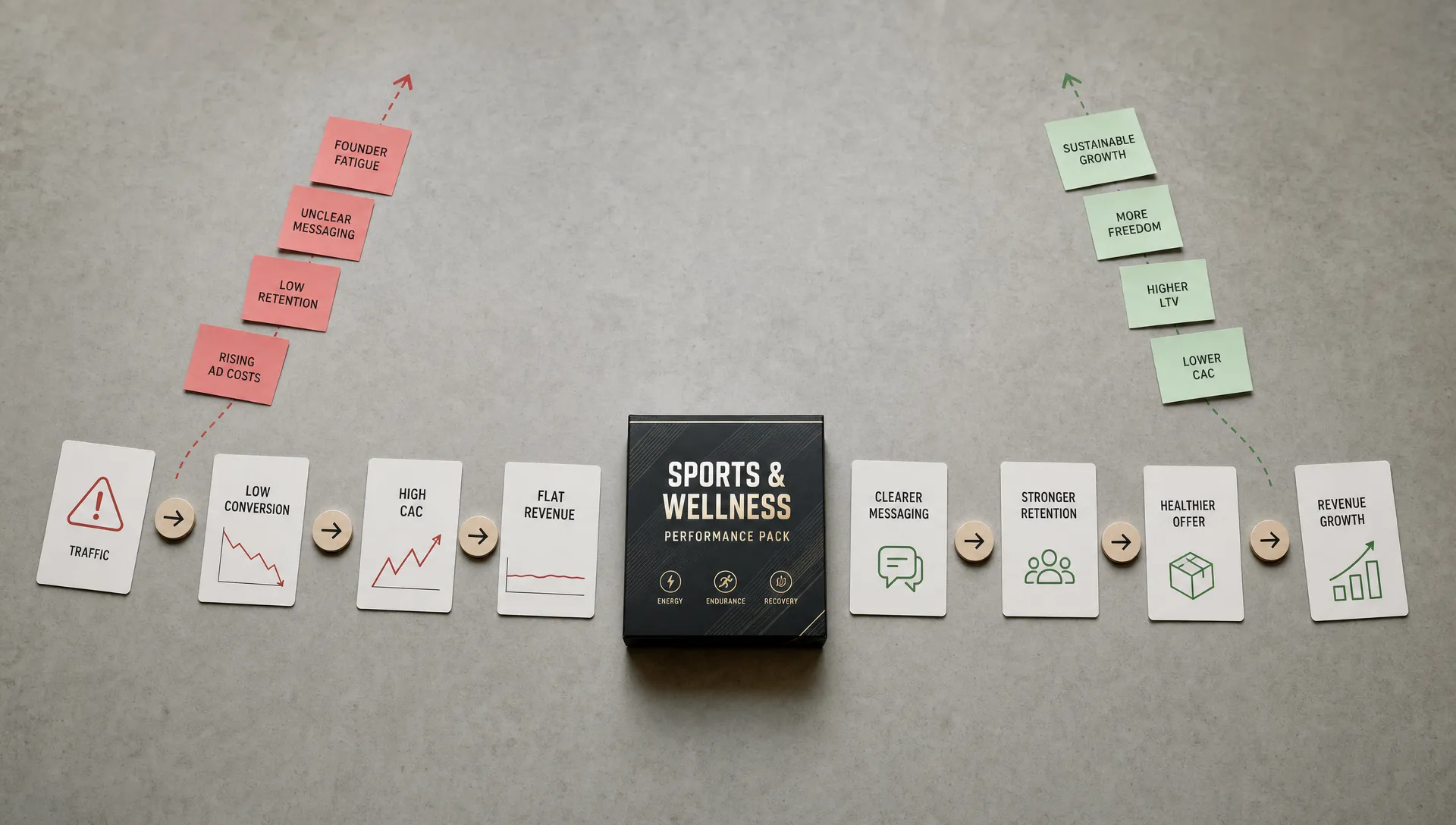

Growth plateaus are uncomfortable because they rarely look like failure at first. Revenue is still coming in, customers still like the product and the team is still working hard. The issue is that every extra dollar of effort produces less growth than it used to.
For ecommerce brands, especially in sports, fitness and wellness, a plateau usually means the growth system has reached the limit of its current audience, offer, creative or channel mix. The right marketing suggestions are not random tactics. They are targeted fixes that help you find the constraint, test against it and unlock the next stage without wasting budget.
Start by diagnosing the kind of plateau
Before changing agencies, doubling ad spend or launching five new channels, identify what has stopped improving. A revenue plateau caused by weak retention needs a different fix than one caused by rising customer acquisition cost. A traffic plateau is not the same as a conversion plateau.
This is where founders should zoom out from channel dashboards and look at the full customer journey. If your current plan does not connect positioning, unit economics, acquisition, conversion and retention, revisit the fundamentals of building a business marketing strategy that scales before adding more complexity.
| Plateau signal | What it may indicate | First place to investigate |
|---|---|---|
| Paid social spend rises but revenue stays flat | Audience saturation or creative fatigue | Hook performance, frequency, new customer CAC |
| Website traffic grows but sales do not | Conversion friction or weak product page clarity | Product pages, checkout flow, shipping terms |
| First purchase volume is steady but profit is flat | Low AOV or margin pressure | Bundles, pricing, discounting, fulfillment costs |
| Repeat purchase rate is weak | Retention gap or poor post-purchase education | Email, SMS, replenishment cycles, customer support data |
| Organic demand is limited | Low brand awareness or weak search footprint | SEO, content, partnerships, creator discovery |
A plateau is not always a marketing problem, but marketing is often where the symptoms become visible. The goal is to separate symptoms from causes.
Reposition around the next customer segment
Many brands plateau because their original audience is tapped out. Early adopters understood the product quickly, tolerated imperfect messaging and bought because they had a strong need. The next wave of customers is usually less aware, more skeptical and slower to decide.
That means your positioning may need to evolve. A recovery brand that sold first to competitive athletes may need different messaging to reach busy parents, desk workers or weekend runners. A supplement brand that grew through hardcore gym audiences may need clearer education for mainstream wellness buyers.
Use customer data to define the next segment, not just demographic labels. Look for differences in motivation, buying trigger, desired outcome and objections.
- What problem made your best customers start looking for a solution?
- Which objections appear most often in reviews, support tickets and social comments?
- What use cases are customers mentioning that your ads do not highlight yet?
- Which customer group has strong retention but low acquisition volume?
When growth slows, the next customer is rarely identical to the first customer. Your message has to make the product feel obvious to people who do not already live inside your category.
Rebuild the offer before changing channels
A common plateau mistake is assuming the channel is broken when the offer has simply lost force. If ads were profitable at a smaller scale but struggle at higher spend, the issue may be that your current offer only converts the highest-intent buyers.
Discounting is the fastest lever, but it is rarely the best long-term fix. Better offer architecture can improve conversion, AOV and perceived value without training customers to wait for sales.
| Offer lever | What it improves | Example for a sports, fitness or wellness brand |
|---|---|---|
| Starter bundle | Reduces decision friction | Beginner recovery kit with best-selling products |
| Routine-based bundle | Increases AOV and product education | Pre-workout, hydration and recovery stack |
| Risk reducer | Lowers first-purchase anxiety | Clear return policy or satisfaction guarantee if operationally feasible |
| Threshold incentive | Protects margin better than blanket discounts | Free shipping above a profitable cart value |
| Gift with purchase | Adds value without cutting price | Branded shaker, towel or sample pack tied to order size |
The best offer makes the buying decision easier while preserving contribution margin. If every promotion erodes profit, the brand may grow revenue while making the plateau harder to escape.
Treat creative fatigue as message fatigue
Creative fatigue is often discussed as a production problem: make more videos, refresh the visuals, test more formats. That can help, but creative usually fatigues faster when the underlying message is too narrow.
If every ad says the same thing in a new layout, the market still hears the same argument. Plateaued brands need fresh angles, not just fresh assets.
Build creative around the questions customers are already asking. For a fitness product, that might include how it fits into a routine, how it compares with cheaper alternatives, how quickly customers should expect to feel a difference and whether the product works for beginners. For a wellness consumable, the strongest creative may explain ingredients, sourcing, taste, habit formation or long-term usage.
A practical framework is to separate creative into four message buckets: problem recognition, product mechanism, proof and comparison. Problem recognition helps cold audiences see themselves in the ad. Product mechanism explains why the product works. Proof reduces skepticism through reviews, demonstrations or creator usage. Comparison helps customers understand why this option is different from substitutes.
Brands often plateau when one bucket does all the work. If your account is full of testimonial ads but has no education, or full of founder story videos but no direct product proof, the creative system becomes fragile.
Fix the conversion path before scaling spend
When acquisition costs rise, many brands push harder on media buying. That can work if the conversion path is already strong. If it is not, paid traffic simply exposes the leaks faster.
Conversion rate optimization does not have to mean a full website rebuild. Start with the highest-traffic product pages and ask whether a new visitor can answer the core buying questions without scrolling endlessly, opening multiple tabs or contacting support.
Strong product pages usually make the following clear: who the product is for, what outcome it supports, how it is used, what is included, what makes it credible, how shipping and returns work and why buying now makes sense. For sports and wellness products, usage context matters. Customers want to know whether the product fits their training schedule, recovery routine, dietary preferences, skin type, facility needs or lifestyle.
If cash efficiency is part of the plateau, the priority should be improving the dollars you already spend before adding more. OPTYO covers this mindset in more depth in its guide on growing without burning cash.

Make retention carry more of the growth load
A brand that relies only on new customer acquisition will eventually feel the pressure. As spend scales, new audiences become less efficient, ad platforms need more creative and CAC tends to rise. Retention reduces that pressure by increasing the value of each customer you already paid to acquire.
For consumables, retention starts with timing. Email and SMS should match the natural replenishment cycle. If a 30-serving product usually runs out in a month, the post-purchase flow should educate during use, check in before the product runs out and give customers a reason to restock before they lapse.
For durable products, retention may come from accessories, education, community, challenges or adjacent products. A training equipment brand might build content around workouts and progression. A recovery brand might send routines for different sports or pain points. A wellness brand might segment customers by goal, such as sleep, energy, mobility or stress support.
The key is to stop treating retention as a coupon calendar. Useful retention marketing increases confidence, habit formation and product success. Revenue follows when customers understand how to get more value from what they bought.
Add one channel at a time, with a clear job
Channel expansion is tempting when growth stalls. The risk is that the team spreads attention across too many half-built channels. A plateaued brand does not need more activity. It needs clearer channel roles.
| Channel | Best job during a plateau | Watch-out |
|---|---|---|
| Paid social | Test demand, angles and creative quickly | Performance drops if creative learning slows |
| Paid search | Capture existing demand and competitor intent | Limited scale if category search volume is small |
| SEO | Build compounding demand and category authority | Requires consistency before results compound |
| Email and SMS | Improve repeat purchase and launch efficiency | Weak results if segmentation is too basic |
| Creators and affiliates | Expand trust and reach through third parties | Needs clear briefs, usage rights and tracking |
| Wholesale or retail | Add distribution and credibility | Can strain margin, operations and inventory planning |
The best next channel depends on the bottleneck. If your brand lacks awareness, creators and SEO may matter more than search. If demand exists but conversion is weak, CRO and product page messaging should come first. If your product is replenishable and retention is weak, lifecycle marketing may beat another acquisition channel.
Use partnerships and product adjacency carefully
Some plateaus are not solved by more media. They are solved by finding new contexts where the product becomes relevant. Sports, fitness and wellness brands have strong partnership potential because customers often discover products through gyms, trainers, studios, events, hotels, clinics and communities.
Partnerships work best when the use case is natural. A hydration brand can partner with endurance events. A mobility product can work with physical therapists or recovery studios. A wellness brand with premium lifestyle positioning may test hotel, spa or retreat partnerships.
Product adjacency can also unlock growth, but only when it reinforces the brand promise. A recovery or hospitality-focused wellness brand exploring towels, robes or spa textiles should treat sourcing as part of the customer experience. For example, private-label manufacturers such as Extreme Towel can be relevant for brands evaluating custom towels, hotel linens, bathrobes or bulk textile products for a new branded line or partnership channel.
The caution is simple: do not add products just to create novelty. Add products when they increase customer value, expand use occasions or improve distribution opportunities.
Run a 45-day plateau sprint
Plateaus become expensive when teams debate them for months without a structured test plan. A focused sprint creates momentum and keeps everyone honest about what is being tested.
| Sprint phase | Focus | Output |
|---|---|---|
| Days 1 to 7 | Diagnose the constraint | Plateau scorecard covering CAC, AOV, CVR, MER, retention and margin |
| Days 8 to 14 | Choose the highest-leverage test area | One clear hypothesis tied to the main bottleneck |
| Days 15 to 30 | Launch tests | New offer, landing page, creative angle, lifecycle flow or channel experiment |
| Days 31 to 40 | Read early signals | Performance by audience, product, message and cohort |
| Days 41 to 45 | Decide what scales | Keep, cut or iterate with budget and owner assigned |
The discipline matters more than the exact timeline. Do not test a new offer, new audience, new website layout and new channel all at once unless you have enough traffic and clean tracking to interpret the result. Most growing brands learn faster by isolating variables.
Common mistakes that keep brands stuck
The first mistake is confusing busyness with progress. More campaigns, more posts and more meetings do not guarantee better growth. If the work is not tied to a bottleneck, it can make the plateau harder to diagnose.
The second mistake is scaling spend before improving the conversion system. A brand with unclear product pages, weak email capture and low repeat purchase will usually pay more for growth than it needs to.
The third mistake is copying tactics from brands at a different stage. A nine-figure brand can run awareness plays that a smaller brand cannot afford yet. A seed-stage brand can accept messy manual processes that a scaling brand has outgrown. Your playbook has to match your economics, team capacity and customer journey.
The fourth mistake is waiting too long to refresh the message. Markets move, competitors copy and customers become more sophisticated. If your brand is saying the same thing it said two years ago, the plateau may be a sign that the story needs to mature.
Frequently Asked Questions
What causes an ecommerce growth plateau? An ecommerce growth plateau usually comes from one or more constraints: audience saturation, rising CAC, weak conversion, low repeat purchase rate, margin pressure or a channel mix that has reached its current limit. The fix depends on which constraint is holding back growth.
Should a plateaued brand increase ad spend? Not automatically. Increasing spend can help if campaigns are profitable and the website converts well. If CAC is rising, AOV is weak or retention is poor, the smarter move is often to improve the offer, creative, conversion path or lifecycle marketing first.
Which marketing suggestions should a brand test first? Start with the area closest to the bottleneck. If traffic is flat, test new audiences, creators, SEO or partnerships. If traffic is healthy but sales are flat, focus on product pages, offers and checkout. If first purchases are strong but profit is not, prioritize retention and margin.
How long does it take to break through a growth plateau? Some improvements, such as offer tests or product page changes, can show signals within weeks. Bigger changes like SEO, retention, partnerships and repositioning take longer. A 45-day sprint is a useful starting point because it forces action without pretending every result will be immediate.
When should a brand bring in outside marketing support? Outside support can help when the team lacks the time, channel expertise or strategic distance to diagnose the plateau. It is especially useful when performance marketing, creative, CRO, email, SEO and reporting need to work together rather than operate in silos.
Need a clearer path out of the plateau?
If your sports, fitness or wellness brand has momentum but cannot break through the next revenue ceiling, the answer may not be more tactics. It may be a sharper growth system.
OPTYO helps ecommerce and CPG brands connect performance marketing, creative production, conversion rate optimization, email marketing, SEO, growth consulting and KPI reporting into a plan built for scale. If your brand is ready to diagnose the bottleneck and act on the right opportunities, OPTYO can help you turn a plateau into the next stage of growth.