.png)


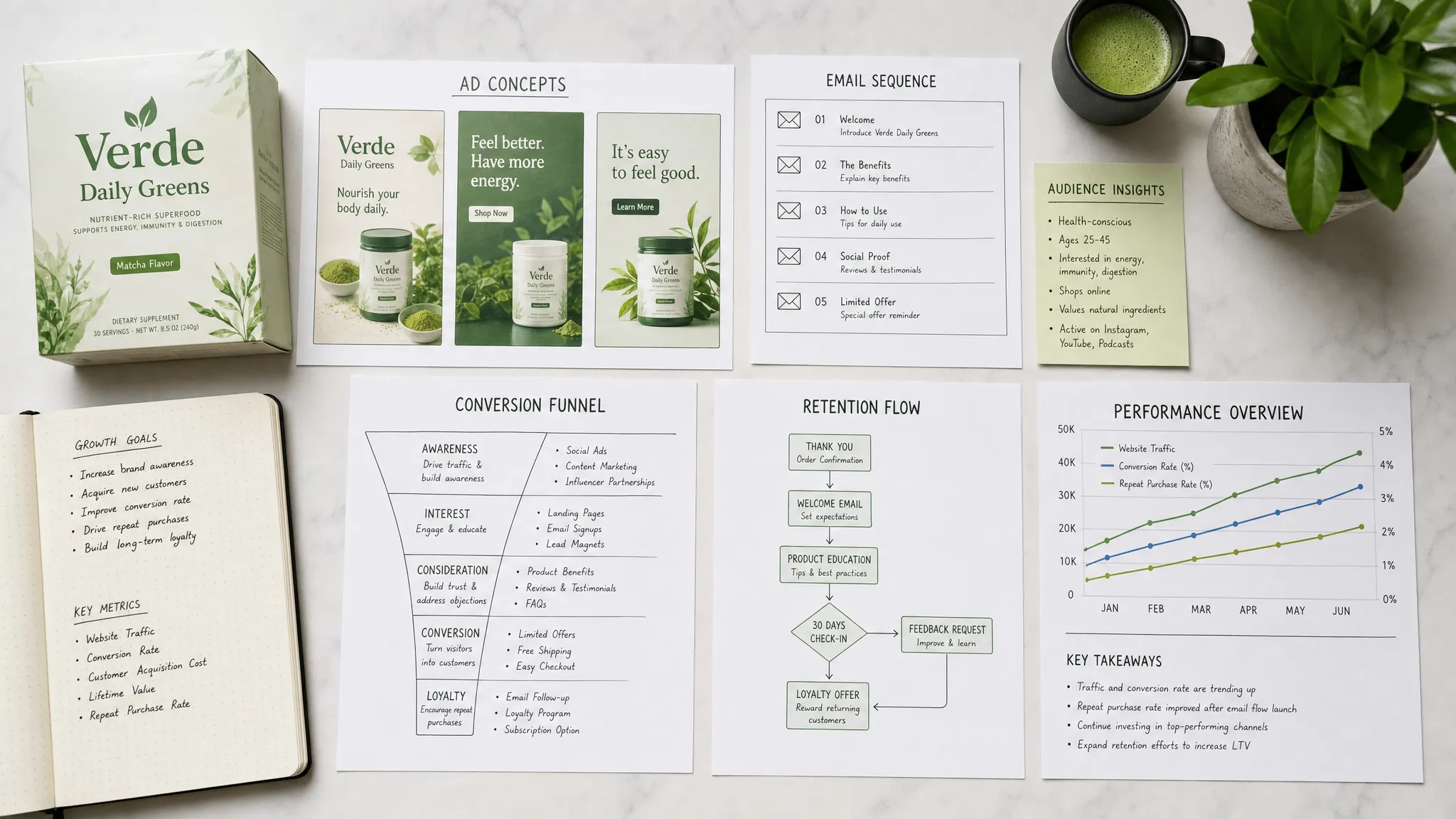

Emerging brands usually hire a growth agency at a moment of tension. Sales are coming in, customers are responding, and the product has real promise, but the next stage feels harder than it should. Paid ads are inconsistent. Content is irregular. Email revenue is underdeveloped. The website converts some traffic but leaks too many buyers. The team has data, yet no clear read on what to do next.
A strong growth agency should turn that complexity into a measurable operating system. It should not simply run ads, make content, or send weekly reports. It should connect strategy, creative, acquisition, conversion, retention, and reporting so the brand can scale with more confidence.
For emerging ecommerce, D2C, and CPG brands, especially in sports, fitness, and wellness, this matters. These categories are competitive, trust-sensitive, and often driven by community, proof, and repeat purchase behavior. The right agency partner should help you grow demand, convert more of it, and learn faster from every dollar spent.
Growth is not a channel, it is a system
A traditional marketing vendor often owns one output. An ad agency manages campaigns. A creative shop produces assets. An SEO consultant improves organic visibility. Those services can be valuable, but an emerging brand usually needs more than isolated execution.
A growth agency should identify the biggest constraint in the business, then coordinate the work needed to remove it. Sometimes the constraint is paid media efficiency. Sometimes it is weak positioning, poor landing pages, low repeat purchase, unprofitable product mix, or a lack of creative testing. If the agency only sees the problem through one channel, it will often prescribe the wrong solution.
The best growth partners think in terms of the full customer journey. They ask how people discover the brand, what makes them trust it, what motivates a first purchase, what stops them at checkout, and what brings them back. That is especially important as ecommerce keeps maturing. The U.S. Census Bureau’s quarterly ecommerce reports continue to show that online retail remains a major part of total retail sales, which means emerging brands are competing in a market where acquisition and conversion discipline matter more every year.
A business-first growth diagnosis
The first thing a growth agency should deliver is clarity. Before launching campaigns or rebuilding a site, the agency should understand the economics of the brand. That means looking beyond revenue and traffic to the numbers that determine whether scale is actually profitable.
A proper growth diagnosis should clarify:
- Which products are strongest entry points for new customers
- Which products have the best margin, repeat purchase potential, or bundle opportunity
- Where acquisition costs are rising and why
- Which customer segments are most valuable over time
- Where the funnel is leaking, from first impression to post-purchase retention
This is where many emerging brands get stuck. A campaign can show a strong platform ROAS while the business still loses money after discounts, shipping, returns, fulfillment, and product costs. A growth agency should help founders understand the difference between channel metrics and business performance.
The deliverable should be concrete: an audit, a prioritized opportunity map, and a clear explanation of what needs to change first. If the agency cannot tell you what constraint they are solving, they are probably just adding activity.
A strategic roadmap tied to your stage of growth
Emerging brands do not need a generic marketing plan. They need a roadmap that fits their stage, budget, team capacity, and inventory reality.
A brand doing its first six figures in sales should not be managed the same way as a brand preparing for national retail expansion or a major paid media scale-up. A growth agency should define what the next stage requires, then sequence the work so the brand is not trying to fix everything at once.
For many D2C brands, the roadmap should answer questions like these:
- What is the primary growth goal for the next 90 days?
- Which channel should create demand, and which should capture demand?
- What creative angles need to be tested before scaling spend?
- What website changes would most likely improve conversion rate?
- What retention flows should be in place before customer acquisition increases?
This is also where strategy needs to be honest about tradeoffs. If the brand has limited budget, the agency should not recommend five channels at once. If the brand has strong paid search intent but weak awareness, the roadmap should reflect that. If the offer is unclear, the agency should fix the message before pushing more traffic into the funnel.
For a deeper look at building a scalable plan, OPTYO’s guide on how to build a marketing strategy that actually scales breaks down the same idea: growth works best when strategy, economics, channels, creative, and retention are aligned.
Customer and positioning clarity
A growth agency should not treat targeting as a platform setting. Your audience is not just an age range, interest group, or lookalike seed. It is a real group of people with motivations, anxieties, objections, routines, and buying triggers.
For sports, fitness, and wellness brands, this is critical. A home gym customer buying premium equipment has different concerns than a runner buying recovery products, a trainer recommending supplements, or a parent shopping for youth sports gear. The product may be similar, but the job it performs in the customer’s life can be completely different.
A strong agency should help define:
- The highest-value customer segments
- The problem each segment is trying to solve
- The language customers use to describe that problem
- The reasons they choose your brand instead of a competitor
- The objections that must be addressed before purchase
This work should show up everywhere. It should influence ad hooks, landing page headlines, email flows, product page copy, SEO topics, and creative briefs. If audience strategy lives in a document but never changes the work, it is not doing its job.
If your brand is still refining this foundation, start with OPTYO’s article on how to define your target market for faster growth.
Performance marketing that learns, not just spends
Paid media is often the reason founders search for a growth agency, but ad buying alone is not the full value. Campaign management matters, but the real deliverable is a testing system that improves decision-making over time.
A growth agency should bring discipline to paid social, paid search, shopping campaigns, and retargeting. That includes account structure, budget allocation, creative testing, offer testing, audience strategy, and landing page alignment. It also includes knowing when not to scale. More spend is only useful when the brand has enough confidence in the economics behind it.
The agency should be able to explain what is being tested and why. For example, a Meta campaign might test product demonstration against customer testimonial, while Google Search captures high-intent demand around a specific use case. A landing page test might pair with those ads to see whether benefit-led messaging outperforms feature-led messaging.
The key is learning velocity. Emerging brands need to discover what resonates before they spend aggressively. A good agency creates a repeatable loop: test, measure, interpret, apply, and test again.
A creative engine built for proof and performance
Creative is one of the strongest levers in modern growth. It is also one of the easiest areas to under-resource.
A growth agency should deliver more than polished visuals. It should build a creative testing engine based on customer insight, channel behavior, and performance data. That means developing creative concepts, writing hooks, producing variations, analyzing winners, and turning results into the next round of assets.
For sports, fitness, and wellness brands, high-performing creative often needs proof. Customers want to see the product in use. They want to understand the transformation, the use case, the material quality, the taste, the routine, the performance benefit, or the reason it belongs in their life. Depending on the product, that proof might come from demonstrations, founder content, athlete usage, trainer education, customer stories, comparison content, or before-and-after style narratives when appropriate.
Claims and endorsements also need care. The FTC’s endorsement guidance makes it clear that endorsements, influencer content, and claims must be truthful and properly disclosed. A credible growth agency should understand that performance cannot come at the expense of compliance or long-term trust.
The deliverable should be a creative pipeline, not a one-time asset drop. Emerging brands need fresh angles, structured testing, and a clear read on which messages are driving profitable customers.
Ecommerce development and conversion rate optimization
No media plan can outrun a weak purchase path. If your site creates friction, hides key information, loads slowly, or fails to answer buyer objections, paid traffic becomes more expensive than it needs to be.
A growth agency should evaluate your ecommerce experience with revenue in mind. This includes product pages, collection pages, landing pages, cart, checkout, mobile navigation, offer presentation, merchandising, product education, reviews, FAQs, subscriptions when relevant, bundles, and post-purchase flows.
The goal is not redesign for the sake of design. The goal is to improve conversion rate and average order value while protecting the brand experience. For emerging brands, even small improvements can compound quickly. If you are spending to drive traffic, a higher conversion rate can make every channel more efficient.
Checkout friction deserves special attention. Baymard Institute’s checkout research has long documented that average cart abandonment sits near 70 percent, with issues like unexpected costs, forced account creation, slow delivery, and complicated checkout contributing to lost sales. A growth agency should use this kind of insight to prioritize practical fixes instead of relying only on surface-level design opinions.

Retention and lifecycle marketing
If acquisition is the only growth lever, the brand will always be vulnerable to rising ad costs. A growth agency should help improve the value of every customer after the first order.
For D2C and CPG brands, retention can come from email marketing, SMS when appropriate, post-purchase education, replenishment reminders, loyalty strategies, bundles, subscriptions, winback campaigns, and customer segmentation. The right approach depends on the product category. A supplement brand, fitness apparel company, and premium equipment brand all have different purchase cycles.
The agency should build lifecycle marketing around customer behavior. A new customer may need education on how to use the product. A repeat customer may need cross-sell recommendations. A lapsed customer may need a timely reason to return. McKinsey has reported that companies that excel at personalization can generate significantly more revenue from those activities than average players, a point explored in its research on the value of getting personalization right.
The deliverables should include core flows, campaign strategy, segmentation, message testing, and revenue reporting. More importantly, lifecycle marketing should be connected to acquisition. If paid media brings in a specific type of customer, email should continue the relationship in a way that matches why they bought.
SEO and content that compound over time
Paid media can create speed, but organic visibility helps build compounding demand. A growth agency should understand how SEO and content fit into the broader growth system.
For emerging ecommerce brands, SEO should not be limited to blog posts. It should include product page optimization, collection page structure, technical SEO, internal linking, search-intent research, comparison content, educational content, and category authority. In sports, fitness, and wellness, this can be especially valuable because customers often research before they buy.
The best content does more than attract traffic. It answers objections, supports paid media, improves trust, gives email campaigns useful material, and helps customers understand why the product is worth choosing. This is why SEO should sit alongside creative, CRO, and paid acquisition instead of being treated as a separate silo.
OPTYO has covered this in more detail in its articles on how a content marketing agency supports brand growth and how a search engine optimization agency grows D2C brands.
KPI reporting that leads to better decisions
A weekly report is not a growth deliverable by itself. A useful report tells the founder what happened, why it happened, what it means, and what the team will do next.
A growth agency should report on the metrics that connect marketing activity to business outcomes. That may include revenue, contribution margin, MER, CAC, ROAS, conversion rate, AOV, repeat purchase rate, LTV, email revenue, organic traffic quality, landing page performance, and creative test results. The exact dashboard should match the business model and stage.
The agency should also explain attribution limits. Platform-reported ROAS can be useful, but it is not the whole truth. A brand needs to understand blended performance, channel interaction, customer quality, and profitability. Strong KPI reporting creates shared understanding, not confusion.
This is one of the biggest differences between a vendor and a true growth partner. A vendor reports activity. A growth partner reports insight.
A 90-day operating cadence
Growth work needs momentum. A growth agency should deliver a clear operating cadence so the brand knows what is happening, what has been learned, and what decisions are needed.
A practical first 90 days often looks like this:
- Days 1 to 30: Audit the business, review data, clarify audience segments, identify funnel constraints, align on KPIs, and build the first testing roadmap.
- Days 31 to 60: Launch priority tests across creative, media, landing pages, email, or SEO depending on the highest-impact opportunities.
- Days 61 to 90: Analyze results, scale what is working, cut what is not, improve reporting, and build the next wave of experiments.
The specific work will vary, but the rhythm should be visible. Founders should not feel like they are guessing what the agency is doing. Communication, accountability, and documentation are part of the deliverable.
A strong operating cadence also prevents random acts of marketing. Instead of reacting to every short-term fluctuation, the brand builds a learning system that compounds.
Red flags when choosing a growth agency
Not every agency that uses the word growth is built to support emerging brands. Some are channel specialists with a broader label. Others are too focused on presentations and not enough on execution.
Watch for these red flags:
- They promise aggressive revenue growth before reviewing your economics, margins, product, or funnel.
- They focus only on ad spend and ignore conversion rate, retention, creative, and customer quality.
- They cannot explain how success will be measured beyond platform ROAS.
- They recommend the same channel mix for every brand regardless of stage or audience.
- They provide reports without clear decisions, next steps, or strategic interpretation.
- They push scale before the brand has enough proof that acquisition is profitable.
The right partner should be confident, but not careless. Growth requires ambition and discipline at the same time.
Questions to ask before hiring a growth agency
Before signing with a growth agency, founders should ask questions that reveal how the agency thinks. You are not just buying tasks. You are choosing a partner that may influence your brand’s positioning, acquisition strategy, customer experience, and cash efficiency.
Useful questions include:
- How do you diagnose the biggest constraint in a business before launching campaigns?
- Which metrics do you use to judge profitable growth for emerging ecommerce brands?
- How do creative testing, media buying, CRO, email, and SEO work together in your process?
- What does the first 90 days typically look like?
- How do you communicate learnings, priorities, and decisions to founders?
- Can you show examples of work in a similar category or growth stage?
The answers should feel specific. If an agency gives vague responses, overuses jargon, or talks only about tactics, it may not be the right fit.
For a real example of integrated growth work in the fitness space, OPTYO’s MX Select case study shows how coordinated paid media, landing page optimization, email automation, and budget testing supported the growth of a premium fitness equipment brand.
Frequently Asked Questions
What does a growth agency do for an emerging brand? A growth agency helps emerging brands build a scalable system for acquisition, conversion, retention, and measurement. The work can include performance marketing, creative testing, ecommerce optimization, email marketing, SEO, reporting, and growth consulting.
How is a growth agency different from a traditional marketing agency? A traditional agency may focus on one service, such as ads, creative, or SEO. A growth agency should connect multiple levers and prioritize the work that will most improve business performance.
When should an ecommerce brand hire a growth agency? It often makes sense once the brand has product-market signal, some sales data, and a desire to scale more systematically. If the brand is still validating the product, a smaller consulting or strategy engagement may be more appropriate than a full growth program.
What KPIs should a growth agency report on? Important KPIs may include revenue, CAC, MER, ROAS, conversion rate, AOV, repeat purchase rate, LTV, email revenue, organic search performance, and contribution margin. The right metrics depend on the business model and growth stage.
Should a growth agency handle both strategy and execution? For most emerging brands, yes. Strategy without execution does not create growth, and execution without strategy creates wasted activity. The best partner should translate strategy into campaigns, creative, website improvements, lifecycle marketing, and measurable tests.
Build a growth system your brand can actually scale
If your sports, fitness, or wellness brand has traction but needs a more disciplined path to scale, the right growth partner can help turn scattered marketing activity into a connected operating system.
OPTYO supports emerging D2C and CPG brands through performance marketing, ecommerce development, conversion rate optimization, email marketing, creative asset production, SEO, KPI reporting, and growth consulting. If you are ready to clarify what is working, fix what is holding you back, and build a smarter path to growth, OPTYO can help you move with more focus and confidence.