.png)


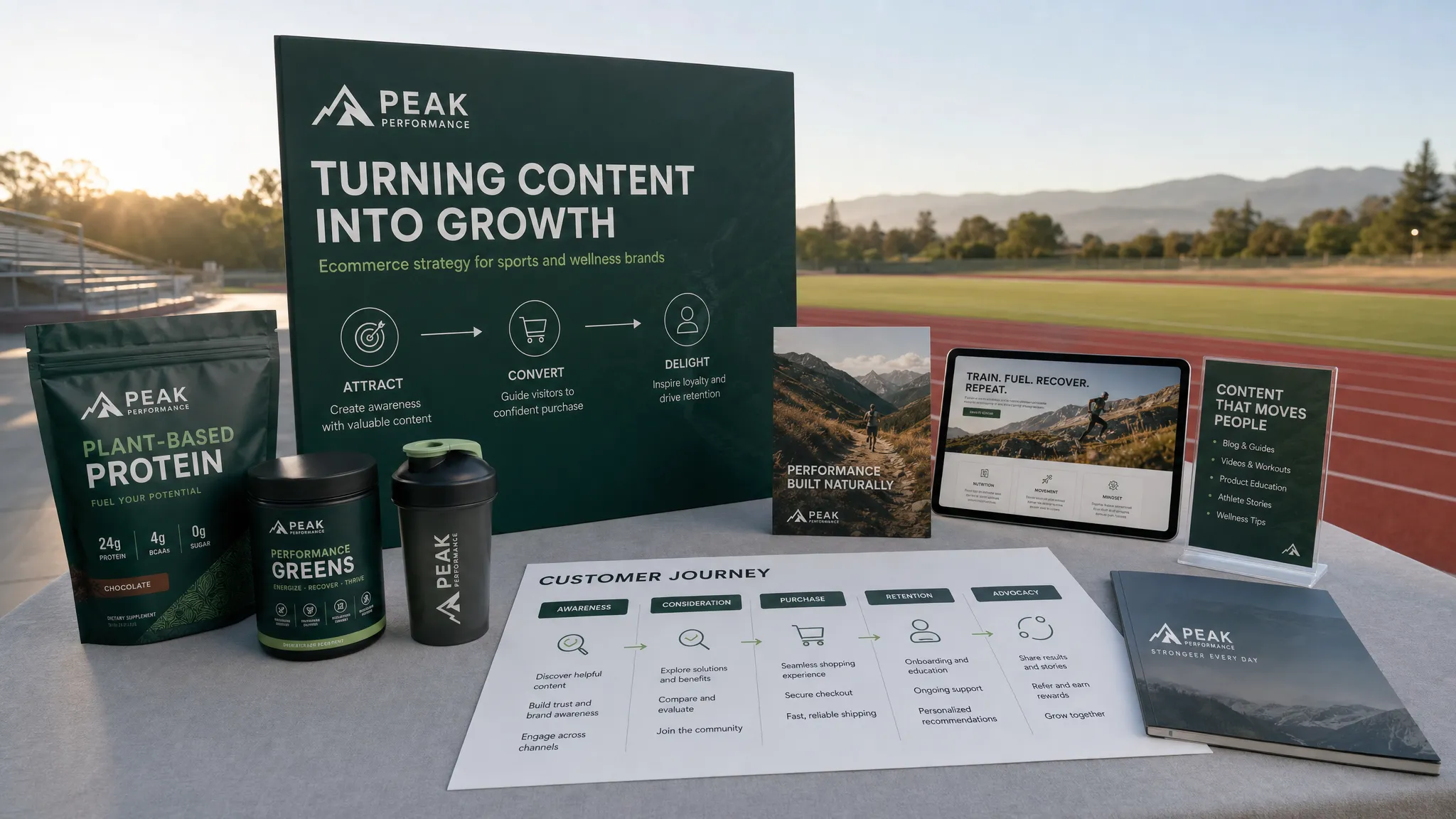

Brand growth rarely comes from one viral post, one ad campaign, or one product launch. For ecommerce entrepreneurs, especially in sports, fitness, and wellness, growth happens when the right audience repeatedly sees a clear promise, trusts the brand, understands the product, and feels confident enough to buy.
That is where a content marketing agency becomes a growth partner, not just a vendor that writes blog posts. The right agency helps translate your product, mission, customer insights, and performance data into a full content engine that supports awareness, conversion, retention, and brand equity.
For D2C and CPG brands, this matters because customer acquisition is more competitive than ever. Paid media can create momentum, but content helps that momentum compound. It gives shoppers reasons to discover you, compare you, trust you, buy from you, and come back.
What a content marketing agency actually does
A content marketing agency plans, creates, distributes, and measures content that helps a brand reach business goals. That can include SEO articles, landing pages, product education, email campaigns, social creative, buying guides, comparison pages, video concepts, and conversion-focused assets.
The best agencies do not start by asking, What should we post this week? They start by asking, What does the customer need to believe before they buy, and where are we losing them today?
For an ecommerce brand, the answer might be different at every stage of the journey. A shopper who has never heard of your recovery tool needs education. A customer comparing protein powders needs proof and differentiation. A repeat buyer of training apparel may need styling ideas, usage tips, community content, or a reason to subscribe.
A strong agency connects those moments into a system. Content becomes less random and more strategic.

How content supports brand growth across the funnel
Content marketing works best when it is built for the full customer journey. A blog post might help someone discover your brand, but growth also depends on what happens after that first click.
It sharpens brand positioning
Before content can scale, the brand message needs to be clear. A content marketing agency helps define what your brand stands for, who it serves, why it is different, and which benefits matter most to customers.
This is especially important in crowded categories like fitness equipment, supplements, wellness products, activewear, and recovery tools. Many brands make similar claims, such as better performance, cleaner ingredients, premium quality, or science-backed results. Content gives you room to prove those claims with specificity.
Instead of saying your product is high quality, you can explain the materials, testing process, design choices, customer use cases, founder story, or expert input behind it. That depth builds trust.
It creates organic discovery through SEO
Search is one of the most valuable channels for brand growth because it captures intent. When customers search for questions, comparisons, symptoms, routines, or product categories, your content can meet them before they reach a competitor.
A content marketing agency can identify the topics your buyers already search for, then build content that answers those questions better than generic articles. For example, a sports nutrition brand might create content around training recovery, ingredient education, protein timing, or product comparisons. A fitness equipment brand might target home gym planning, exercise tutorials, space-saving setups, or buying guides.
SEO is not about stuffing keywords into articles. Search engines increasingly reward helpful, reliable content that is written for people first. Google explains this clearly in its guidance on creating helpful content, which emphasizes originality, expertise, and usefulness.
For brands, that means the best SEO content is not only optimized for search. It should also sound like the brand, answer real customer objections, and move readers toward the next step.
It improves paid media performance
Content and paid advertising should not operate in separate silos. Strong content can make ads more efficient by giving campaigns better angles, stronger landing pages, and more persuasive follow-up.
If your paid social ads are driving traffic but not enough conversions, the issue may not be the ad alone. It could be that shoppers need more education, clearer product comparisons, stronger proof, or a better landing page experience.
Content can support paid performance through:
- Landing pages built around specific customer segments or product benefits
- Advertorial-style pages that educate before selling
- Creative concepts based on customer pain points and objections
- Retargeting content that answers questions after the first visit
- Email and SMS flows that continue the sales conversation
For ecommerce brands, this is where content becomes a performance lever. It does not just create awareness. It helps improve conversion rates, reduce wasted spend, and support more profitable scaling.
It builds trust before the sale
Customers are skeptical, especially in wellness and performance categories where claims can sound exaggerated. Content helps brands earn belief before asking for the purchase.
That trust can come from educational guides, transparent sourcing information, ingredient breakdowns, product usage tips, customer stories, expert perspectives, FAQs, or founder-led content. The goal is to reduce uncertainty.
A shopper may be asking questions like: Will this work for my routine? Is it worth the price? How is it different from cheaper alternatives? Can I trust the ingredients or materials? What results should I realistically expect?
A content marketing agency helps map those questions and create assets that answer them clearly. When those answers are available on your website, in email, on social, and across campaigns, customers have fewer reasons to hesitate.
It increases customer lifetime value
Brand growth is not only about acquiring new customers. It is also about keeping the customers you already earned.
Post-purchase content can help customers use the product correctly, get better outcomes, discover complementary products, and feel connected to the brand. For a fitness brand, that might include workout programming, care instructions, form tips, product tutorials, or training challenges. For a wellness brand, it might include routines, habit-building content, recipe ideas, or educational sequences.
When customers get more value from the product, they are more likely to buy again, leave reviews, refer friends, and engage with the brand long term.
Why sports, fitness, and wellness brands need a different content approach
Sports and wellness customers are not just buying products. They are often buying into an identity, a goal, or a lifestyle. They want to become stronger, healthier, faster, more confident, more consistent, or more prepared.
That emotional layer makes content especially powerful. It allows a brand to speak to aspiration, discipline, progress, and community, while still explaining product value in practical terms.
At the same time, these categories require care. Performance and wellness claims must be credible. Educational content should avoid exaggeration. Product benefits should be explained with clarity and, when appropriate, supported by evidence.
A content marketing agency with experience in sports, fitness, and wellness can help balance inspiration with accuracy. The content should motivate people, but it should also respect customer intelligence.
What content assets support ecommerce growth?
Not every brand needs every format. The right content mix depends on your category, margins, sales cycle, average order value, traffic sources, and customer questions. Still, most growing ecommerce brands benefit from a few core asset types.
Common growth-focused content assets include:
- SEO articles that answer high-intent customer questions
- Buying guides that help shoppers choose the right product
- Product page copy that explains benefits, specs, use cases, and objections
- Landing pages for paid campaigns, launches, and promotions
- Email flows for welcome sequences, abandoned cart, post-purchase, and winback
- Social creative concepts that turn brand messages into scroll-stopping hooks
- Comparison content that clarifies differentiation without relying on hype
- Educational resources that support customer success and repeat purchase
The key is to connect these assets. A guide can feed email. A customer question can become a landing page section. A product benefit can become an ad angle. A high-performing ad hook can become a blog post or video concept.
This is how brands get more value from every insight.
The agency process: from strategy to measurable growth
A content marketing agency should bring structure to what often feels chaotic for founders and lean teams. Instead of creating content reactively, the agency builds a repeatable process.
Audit the current growth system
The first step is understanding what already exists. This includes website content, product pages, SEO performance, email flows, paid media creative, social messaging, customer reviews, analytics, and conversion data.
An audit reveals gaps. Maybe the brand has strong traffic but weak conversion. Maybe paid ads are generating clicks but customers are not educated enough to buy. Maybe blog content exists, but it does not target commercial intent. Maybe email is underused after the first purchase.
A good audit turns those observations into priorities.
Build a strategy around customer intent
Content strategy should be driven by customer intent, not a content calendar alone. The agency identifies what customers need at each stage of the journey and which content formats can move them forward.
For example, top-of-funnel content may focus on education and discovery. Middle-of-funnel content may compare options and address objections. Bottom-of-funnel content may support product pages, landing pages, reviews, offers, and email flows.
This intent-based approach keeps content tied to revenue, not vanity publishing.
Produce creative that fits the channel
A blog article, landing page, Meta ad, product page, and email campaign all require different writing and creative choices. The message may be consistent, but the execution should match the channel.
A content marketing agency helps adapt the same core brand idea into multiple formats. This makes campaigns more efficient and gives customers a consistent experience from first impression to checkout.
Distribute content where it can perform
Publishing content is not enough. Distribution determines whether it gets seen. That may include SEO, email, paid social, search campaigns, organic social, influencer support, or website merchandising.
For ecommerce brands, distribution should be tied to sales moments. Content can support product launches, seasonal campaigns, holiday promotions, retail expansion, subscription pushes, and new customer acquisition.
Measure and optimize over time
Content should be measured with business context. Not every asset will generate direct revenue immediately, but each asset should have a role.
Useful content metrics include organic traffic, rankings for relevant searches, assisted conversions, email revenue, landing page conversion rate, average order value, repeat purchase rate, engagement, branded search lift, and customer acquisition cost trends.
The goal is not to chase every metric. The goal is to understand which content is helping the brand grow and where to improve.
When should a brand hire a content marketing agency?
Many founders create content themselves in the early stages. That can work for a while, especially when the founder has a strong voice and deep customer knowledge. But as the brand grows, content needs become more complex.
It may be time to hire an agency if your brand is experiencing any of these signs:
- Paid ads are getting more expensive and you need stronger owned channels
- Your website gets traffic, but conversion rates are not improving
- Customers keep asking the same questions before buying
- Your team creates content inconsistently because everyone is busy
- Your product needs education before customers understand its value
- You have customer reviews and insights, but they are not being used in campaigns
- Email marketing, SEO, and landing pages are not working together
Hiring an agency can also help when your internal team has ideas but lacks execution bandwidth. The right partner brings strategy, creative production, testing, and reporting without requiring you to build a full in-house content department immediately.
How to choose the right content marketing agency
The best agency for your brand is not always the biggest one. It is the one that understands your category, your economics, and your growth stage.
For ecommerce brands, look for an agency that can connect content to performance. Beautiful storytelling matters, but it should support measurable outcomes. Ask how the agency approaches SEO, paid media, conversion rate optimization, email marketing, and reporting. If they only talk about publishing volume, that is a red flag.
You should also look for category fluency. Sports, fitness, and wellness brands need content that understands customer motivation, product usage, seasonality, community, and credibility. An agency that understands these nuances can often move faster and create sharper messaging.
Finally, evaluate how they use data. Strong content strategy should be informed by customer research, search demand, ad performance, conversion behavior, and retention metrics. Creativity and data should work together.
How OPTYO supports brand growth through content and performance
OPTYO works with sports, fitness, wellness, D2C, and CPG brands that need more than disconnected marketing tasks. As a performance marketing agency and brand accelerator, OPTYO helps brands align strategy, creative, ecommerce development, conversion rate optimization, email marketing, paid social, SEO, KPI reporting, and growth consulting.
That combination matters because content performs best when it is connected to the rest of the growth engine. A landing page should reflect paid ad messaging. Email flows should answer customer objections. SEO content should support product discovery and category authority. Creative assets should be informed by real performance data.
OPTYO's work with MX Select shows the value of connecting multiple growth levers, including data-driven advertising, landing page optimization, email automation, and budget testing. You can explore the example in the MX Select case study.
For growing brands, the lesson is simple: content should not live in isolation. It should help the entire marketing system work harder.
Frequently Asked Questions
What does a content marketing agency do? A content marketing agency develops strategy, creates content, distributes it across relevant channels, and measures performance. For ecommerce brands, this can include SEO articles, landing pages, email campaigns, product education, social creative, and conversion-focused assets.
How does content marketing support brand growth? Content supports brand growth by increasing discovery, building trust, educating customers, improving conversion, strengthening retention, and giving paid campaigns better messaging and landing page support.
Is content marketing only about blogging? No. Blogging can be part of content marketing, but it is only one format. Content marketing can include product pages, buying guides, emails, video concepts, social creative, landing pages, FAQs, customer stories, and post-purchase education.
How long does it take for content marketing to work? It depends on the channel and goal. SEO content often takes months to compound, while landing pages, email flows, and paid media creative can influence performance faster. A strong strategy usually includes both short-term and long-term content assets.
Should ecommerce brands hire a specialized agency? A specialized agency can be valuable when your brand needs category expertise, consistent execution, and content tied to performance metrics. Sports, fitness, and wellness brands often benefit from partners who understand product education, customer motivation, and conversion strategy.
Build a content engine that compounds
A content marketing agency supports brand growth by turning customer insight into strategy, creative, and measurable action. For ecommerce entrepreneurs, that means fewer random campaigns and a stronger system for acquisition, conversion, and retention.
If your sports, fitness, or wellness brand is ready to connect content with performance marketing, OPTYO can help you build a growth strategy designed around your audience, products, and goals. Connect with OPTYO to explore how a more strategic content engine can support your next stage of growth.