.png)




A brand strategy agency is often misunderstood because the word brand gets used to describe almost everything, including logos, colors, ads, packaging, social content, influencer campaigns, and sometimes even a founder's personal taste.
But a real brand strategy agency does not start with fonts or taglines. It starts with business direction.
For ecommerce entrepreneurs, especially in sports, fitness, and wellness, brand strategy is the work that answers a few critical questions before you spend heavily on acquisition: who are we for, why should they believe us, what makes us meaningfully different, and how should that difference show up across every customer touchpoint?
That clarity matters because most growing brands do not lose because they lack effort. They lose because their message is scattered, their product value is under-explained, their ads and website feel disconnected, or their customer experience does not reinforce the promise that got someone to buy in the first place.
A brand strategy agency helps fix that by turning a brand from a collection of assets into a coherent growth system.
What a Brand Strategy Agency Does in Plain English
A brand strategy agency defines how a company should be positioned, communicated, and experienced in the market.
That means it helps you make choices. Not vague choices like look premium or sound bold, but practical choices that affect marketing, product pages, packaging, paid ads, email flows, partnerships, and customer retention.
At its best, brand strategy connects three things:
- The customer you are trying to win
- The business goal you are trying to reach
- The differentiated promise you can actually deliver
For a sports nutrition brand, that might mean choosing whether the company is built around elite performance, everyday consistency, clean formulation, community, convenience, or a specific training lifestyle. For a fitness equipment brand, it might mean clarifying whether the strongest position is durability, space efficiency, coaching support, premium design, or measurable progress.
Without that choice, every campaign becomes harder. Creative teams do not know what to emphasize. Paid media teams test too many disconnected angles. Product pages become feature-heavy but emotionally flat. Customers struggle to understand why the brand is different.
A brand strategy agency reduces that confusion.
Brand Strategy Is Not Just Visual Identity
Visual identity is part of brand strategy, but it is not the whole job.
A logo can make a brand recognizable, but it cannot compensate for weak positioning. A color palette can create consistency, but it cannot explain why a customer should trust your supplement, purchase your recovery tool, or switch from a competitor they already know.
A brand strategy agency may collaborate on visual identity, packaging, photography direction, and creative guidelines, but those decisions should come after the strategic foundation is clear.
The order matters. Strategy should inform expression, not the other way around.
For example, a performance-focused wellness brand might need a clinical, precise, evidence-led identity. A lifestyle fitness apparel brand might need a more aspirational and community-driven feel. A recovery brand for busy professionals might need calm, simplicity, and credibility. Those visual choices are not arbitrary. They come from positioning.
The Core Work: Customer, Category, and Competition
The first job of a brand strategy agency is research. Not research for the sake of research, but research that leads to sharper decisions.
Most agencies will look at three areas.
First, they study the customer. This can include interviews, surveys, review mining, social listening, purchase behavior, customer support logs, and analysis of why people buy or do not buy. The goal is to understand the customer's language, pain points, objections, ambitions, and decision triggers.
Second, they study the category. Every market has conventions. Protein powders often use strength, science, or flavor. Running brands often use endurance, community, or personal progress. Recovery products often use pain relief, sleep, mobility, or longevity. A smart agency identifies what customers already expect and where there is room to stand apart.
Third, they study the competition. This is not just a logo audit. It is an analysis of claims, pricing cues, offers, reviews, landing pages, content, paid creative, retail presentation, and customer experience. The goal is to find where competitors are strong, where they are overusing the same messages, and where your brand can own a more specific space.
For ecommerce brands still refining their audience, this work pairs closely with learning how to define your target market for faster growth. The narrower and more accurate the customer definition, the easier it becomes to build a brand customers recognize themselves in.
Positioning: The Strategic Center of the Brand
Positioning is one of the most valuable outputs of a brand strategy engagement.
Your positioning defines how you want to be understood in the mind of your ideal customer relative to alternatives. It is not simply what you sell. It is the specific place your brand should occupy in the buying decision.
A strong positioning statement usually clarifies:
- Who the brand is for
- What problem or desire it addresses
- What category or alternative it competes against
- What makes it distinct
- Why customers should believe the promise
For example, a generic position might be high-quality supplements for active people. That is not very useful because thousands of brands can say it.
A sharper position might be daily performance nutrition for endurance athletes who want clean fuel without digestive discomfort. That gives the business a clearer customer, a clearer problem, a clearer product standard, and a clearer message.
Positioning becomes the filter for everything else. If an ad concept does not reinforce it, it may not be worth testing. If a product page buries it, the page may need restructuring. If a partnership does not support it, the opportunity may be a distraction.
Messaging: Turning Strategy Into Words Customers Understand
Once positioning is clear, a brand strategy agency often builds the messaging system.
This is where many ecommerce brands see an immediate impact. A company may have a strong product, but if its messaging is too technical, too generic, or too founder-centric, customers may not understand the value quickly enough to convert.
A messaging system can include the brand promise, headline frameworks, product value propositions, proof points, objection responses, tone of voice, email themes, ad angles, and landing page narratives.
The goal is not to create one perfect slogan. The goal is to create a repeatable language system that can flex across channels without losing consistency.
For a fitness brand, messaging might need to speak differently to first-time buyers, competitive athletes, gym owners, and coaches. The core brand should remain consistent, but each audience may need different proof, urgency, and context.
This is especially important in paid media. If your Meta ads say one thing, your landing page says another, your product page emphasizes a third idea, and your email flow changes the tone again, customers feel friction even if they cannot name it.
Brand strategy helps remove that friction.
Customer Experience: Where the Brand Becomes Real
A brand is not just what a company says. It is what customers experience before, during, and after purchase.
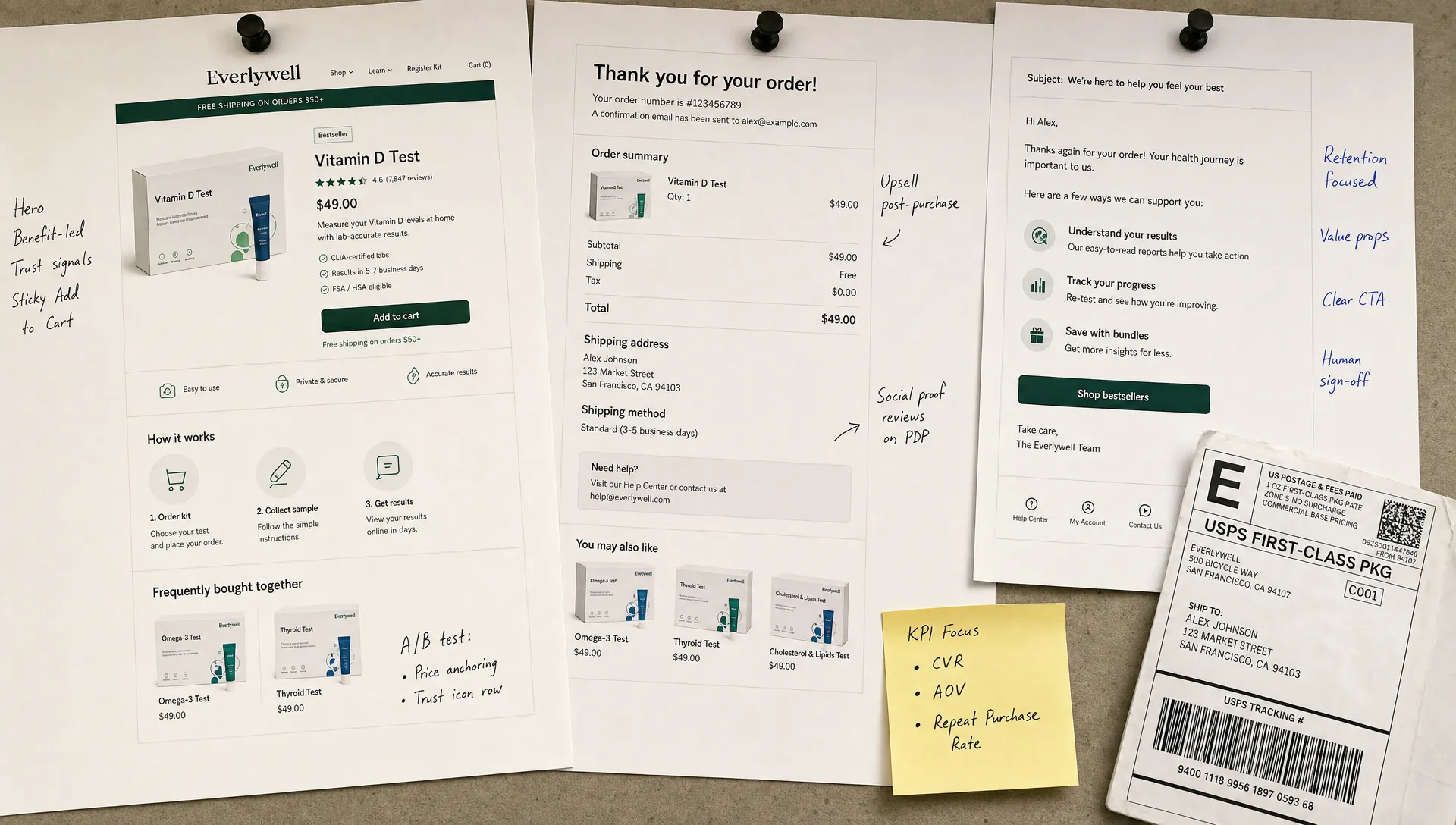
That is why a brand strategy agency often maps the customer journey. It looks at how someone first discovers the brand, what they need to believe before buying, what doubts might stop them, what happens after checkout, and what would make them come back.
For ecommerce brands, this can touch many parts of the business:
- Homepage hierarchy and product page messaging
- Landing page structure and offer clarity
- Email and SMS flows
- Packaging and unboxing experience
- Subscription or replenishment communication
- Social proof, reviews, and community content
- Retail displays, event booths, and pop-up experiences
This is where strategy becomes tangible. A brand strategy can influence shelf packaging, expo booths, recovery lounge decor, event signage, and high-visibility assets like custom neon signs for stores, events, and activations. The point is not decoration. The point is making the brand recognizable and memorable wherever customers encounter it.

How Brand Strategy Supports Performance Marketing
Brand strategy and performance marketing are sometimes treated as opposites. In reality, they should strengthen each other.
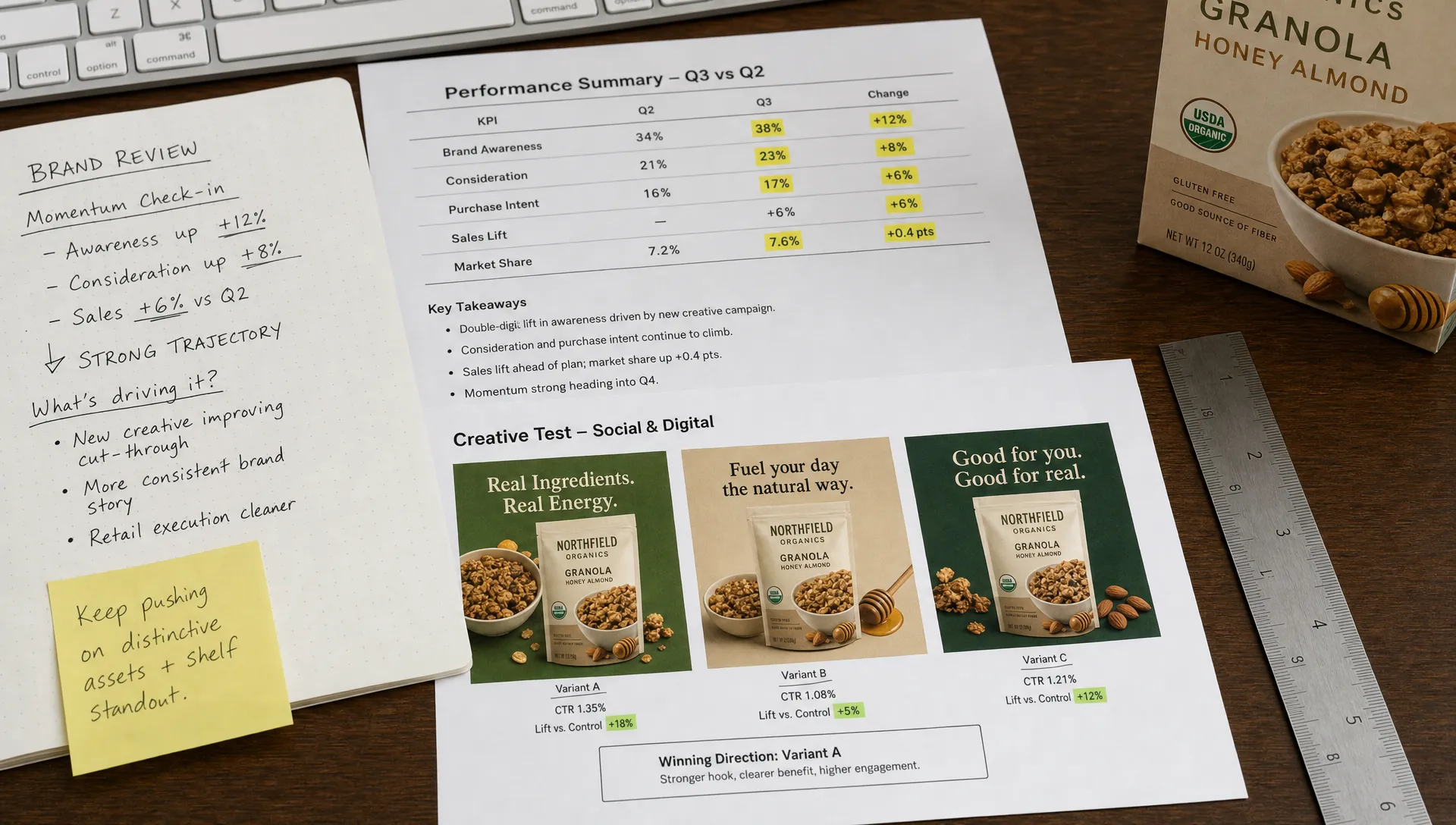
Performance marketing needs clear angles, strong offers, compelling creative, and landing pages that convert. Brand strategy gives those elements direction. It helps decide which pain points to lead with, which claims to prove, which audiences to prioritize, and which creative concepts are on-brand versus merely attention-grabbing.
For example, if a wellness brand has a clear position around recovery for high-output professionals, its paid ads can test creative around work stress, sleep quality, training recovery, and daily energy. Those tests are still performance-driven, but they are not random. They ladder back to the brand's strategic territory.
That makes learning faster because each test produces insight, not just isolated campaign data.
This is also why a brand strategy agency should understand growth channels. A beautiful strategy deck that cannot be translated into paid social, search, email, and conversion rate optimization will not help an ecommerce business scale. Strategy must survive contact with the market.
If your brand is already spending on acquisition, it can be useful to compare this work with what to look for in a performance marketing agency. The strongest growth partners understand that media efficiency depends on more than bids and budgets. It depends on message-market fit.
Common Deliverables From a Brand Strategy Agency
The exact deliverables vary by agency, business stage, and scope. A startup preparing for launch may need foundational strategy, while a scaling D2C brand may need repositioning, message architecture, and channel alignment.
Common deliverables include:
- Brand audit and competitive analysis
- Customer research summary and audience personas
- Positioning strategy and differentiation framework
- Brand promise, mission, vision, and values
- Messaging architecture and tone of voice guidelines
- Creative direction for visuals, content, and campaigns
- Customer journey recommendations
- Website, landing page, or ecommerce messaging guidance
- Brand guidelines for internal and external teams
- Go-to-market recommendations for launch or relaunch
The best deliverables are practical. They should help your team make faster decisions, brief creatives more clearly, evaluate new opportunities, and create more consistent customer experiences.
A 60-page deck that nobody uses is not strategy. It is documentation. Real strategy changes behavior.
What a Brand Strategy Agency Does Not Do
It is just as important to understand what a brand strategy agency does not do.
It does not magically create product-market fit. If customers do not want the product, strategy may help uncover why, but it cannot turn a weak offer into a category leader by language alone.
It does not replace operational discipline. A premium brand promise will fall apart if shipping is unreliable, customer service is poor, inventory is inconsistent, or product quality does not match the claims.
It does not mean ignoring performance data. In ecommerce, brand strategy should be tested against customer behavior. If the market responds differently than expected, the strategy may need refinement.
It also does not mean making every decision more abstract. Good strategy simplifies. It should give founders and marketing teams a sharper sense of what to say yes to, what to say no to, and what to test next.
When Should an Ecommerce Brand Hire a Brand Strategy Agency?
Not every business needs a full brand strategy engagement on day one. But there are moments when it becomes especially valuable.
You may need a brand strategy agency if your revenue has plateaued, customer acquisition costs are rising, your creative testing feels inconsistent, or your website traffic is not converting as well as it should.
You may also need one if your product line has expanded and the brand no longer feels focused. This happens often in sports, fitness, and wellness. A company launches with one hero product, adds new SKUs, enters new channels, and suddenly the original story no longer fits the business.
Brand strategy is also useful before a major launch, rebrand, retail expansion, fundraising push, or shift from founder-led sales to a more scalable marketing engine.
If your challenge is broader than branding alone, such as aligning acquisition, retention, creative, and ecommerce conversion, it may help to step back and review how to build a marketing strategy that actually scales. Brand strategy should support the larger growth system, not sit separately from it.
How to Evaluate a Brand Strategy Agency
Choosing the right agency is less about finding the most impressive portfolio and more about finding a partner that understands your market, your business model, and your growth stage.
Look for an agency that asks about margins, customer acquisition cost, retention, channel mix, product roadmap, and customer behavior. If the conversation only focuses on aesthetics, the work may not go deep enough.
You should also look for evidence that the agency can translate strategy into execution. For ecommerce brands, that means understanding product pages, paid social creative, SEO, email marketing, conversion rate optimization, and analytics. Strategy is only valuable if it can guide what your team actually does next.
Good questions to ask include:
- How do you define positioning for ecommerce brands?
- What research inputs do you use before making recommendations?
- How do you connect brand strategy to paid media, content, and conversion?
- What deliverables will our internal team use after the engagement?
- How do you measure whether the strategy is working?
- Have you worked with brands in sports, fitness, wellness, CPG, or D2C?
Pay attention to how the agency answers. If they jump straight to visual concepts, they may be more of a design studio. If they only talk about ad metrics, they may be more of a media buying shop. A strong brand strategy agency can connect customer insight, market position, creative expression, and commercial outcomes.
What Success Looks Like After Brand Strategy Work
Brand strategy is not always measured by one immediate metric, but it should create measurable business advantages over time.
You may see clearer creative briefs, stronger landing page copy, improved conversion rates, more consistent content, better email engagement, more efficient ad testing, and higher customer retention. You may also see qualitative changes, such as customers repeating your language, influencers describing the brand more accurately, or retail buyers understanding your value faster.
In practical terms, success looks like alignment.
Your founder, marketing team, creative partners, media buyers, and customer support team should all understand the same core story. Your ads should feel connected to your website. Your packaging should match your promise. Your product education should reduce buyer hesitation. Your retention messaging should reinforce the same reasons people bought in the first place.
That is what a brand strategy agency actually does. It gives the business a clear market identity and helps turn that identity into growth.
Frequently Asked Questions
What is a brand strategy agency? A brand strategy agency helps companies define their positioning, audience, messaging, differentiation, and customer experience. The goal is to create a clear brand direction that supports marketing, sales, and long-term growth.
Is a brand strategy agency the same as a branding agency? Not always. A branding agency may focus heavily on visual identity, naming, logos, and design systems. A brand strategy agency focuses on the strategic foundation behind those assets, including customer insight, positioning, messaging, and market differentiation.
Do ecommerce brands need brand strategy? Yes, especially when they are scaling. Ecommerce brands rely on clear messaging across ads, landing pages, product pages, email, packaging, and retention channels. Brand strategy helps those touchpoints work together instead of feeling disconnected.
How does brand strategy improve paid advertising? Brand strategy gives paid campaigns clearer angles, stronger claims, better audience relevance, and more consistent landing page alignment. This can improve the quality of creative testing and help teams learn faster from campaign performance.
When is the right time to invest in brand strategy? Common moments include launching a new brand, preparing for a rebrand, entering a new market, expanding a product line, struggling with conversion, or seeing acquisition costs rise because the brand message is not distinct enough.
Build a Brand That Can Scale
A strong brand is not just recognizable. It is easier to understand, easier to trust, and easier to buy from.
For sports, fitness, wellness, D2C, and CPG companies, the right strategy can connect positioning with performance marketing, ecommerce conversion, creative production, email, SEO, and long-term customer retention.
OPTYO helps growth-minded brands turn strategy into execution across the systems that drive revenue. If your brand feels scattered, your ads are working harder than they should, or your message needs a sharper edge, start by building the strategic foundation your next stage of growth depends on.