.png)


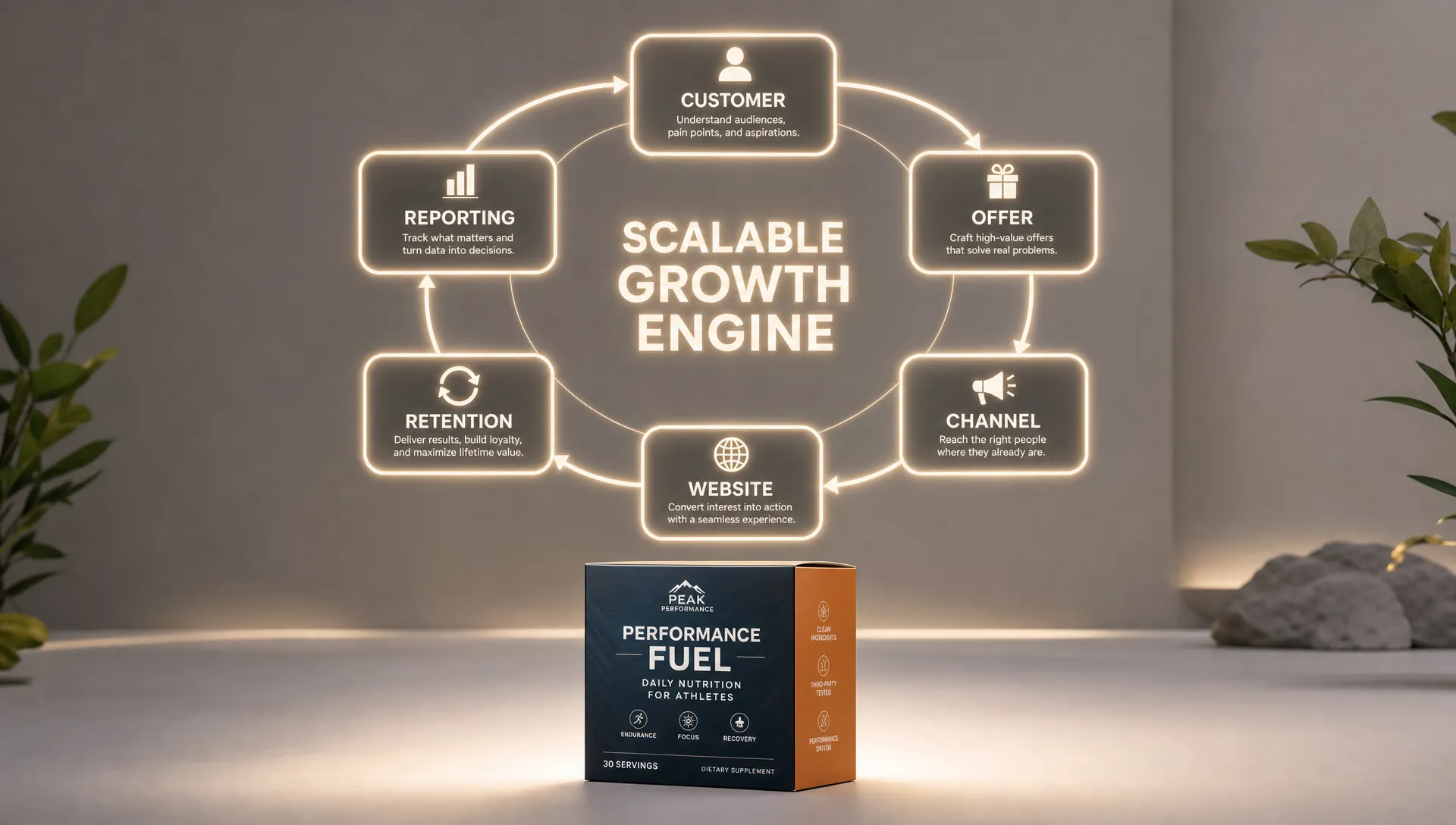

A scalable business marketing strategy is not a longer content calendar, a bigger ad budget, or a trendier channel mix. It is a system that connects your business model, audience, offer, creative, channels, website, retention, and reporting into one growth engine.
For ecommerce entrepreneurs, especially in sports, fitness, and wellness, this matters because demand can spike quickly. A product goes viral, a retail opportunity appears, an influencer post hits, or paid social starts working. But if your margins, conversion rate, inventory, retention, and creative pipeline are not ready, growth can turn into cash burn.
The goal is not just to get more customers. The goal is to build a business marketing strategy that can acquire customers profitably, keep them engaged, and improve as spend increases.
Start with the business model, not the marketing channel
Most marketing plans start with tactics: run Meta ads, post on TikTok, optimize SEO, launch email flows, test creators. Those tactics may matter, but they should not come first.
A scalable strategy starts with the economics of the business. Before deciding where to spend, you need to know what each customer is worth, what you can afford to pay to acquire them, and how quickly cash returns to the business.
At minimum, founders should know:
- Gross margin by product or bundle
- Average order value
- Contribution margin after shipping, discounts, payment fees, and fulfillment
- Repeat purchase rate
- Customer acquisition cost by channel
- Payback period
- Lifetime value by cohort
- Inventory constraints and cash conversion cycle
This is where many brands overestimate their readiness to scale. If you have a $70 average order value, a 55 percent gross margin, and high shipping costs, your profitable CAC ceiling may be much lower than you think. If your paid media target ignores real fulfillment and discount costs, scaling spend will only expose the weakness faster.
A strong business marketing strategy defines the economic guardrails before the campaign plan. That way, every channel has a job and every growth decision is tied to profitability, not vanity metrics.
Define the customer with buying context, not demographics alone
“Active women ages 25 to 40” is not a marketing strategy. Neither is “gym-goers,” “runners,” or “health-conscious consumers.” These descriptions are too broad to guide creative, landing pages, product bundles, or channel selection.
Scalable marketing requires a sharper view of the customer. You need to understand the moment that creates demand.
For a fitness supplement brand, the real buying context might be: “I want clean energy before early-morning training, but I do not want jitters or a crash.” For a recovery product, it might be: “I train hard, my sleep is inconsistent, and I need something that helps me feel ready tomorrow.” For an apparel brand, it might be: “I need gear that performs during workouts but still looks good outside the gym.”
That buying context gives your marketing direction. It shapes the promise, proof, offer, visuals, and objections you need to address.
A useful customer profile should include:
- The trigger that makes the customer start looking
- The outcome they want most
- The frustration with current alternatives
- The objections that stop them from buying
- The channels they trust for discovery and validation
- The proof they need before purchasing
The more specific this becomes, the easier it is to create ads, emails, SEO content, product pages, and offers that convert. Scale comes from repeatability, and repeatability starts with clear customer insight.
Build positioning that can survive more attention
When a brand is small, weak positioning can hide behind novelty, founder hustle, or early adopter enthusiasm. As the business scales, that changes. More people see the brand, compare alternatives, question claims, read reviews, and look for proof.
Your positioning needs to answer three questions quickly:
- Why this product?
- Why this brand?
- Why now?
A sports or wellness product does not need to claim it is for everyone. In fact, scalable positioning usually starts with a specific wedge. You might own a training moment, a performance outcome, a recovery ritual, a community identity, a clean ingredient standard, or a product design advantage.
The key is to connect the claim to proof. If your product supports endurance, what backs that up? If it is built for high-intensity training, how does the design prove it? If it is cleaner than alternatives, which ingredients, certifications, sourcing choices, or customer experiences make that believable?
Positioning should also show up consistently across the business. Your paid ads, homepage, PDPs, email flows, packaging, influencer briefs, and SEO content should reinforce the same strategic idea. That does not mean every message is identical. It means every message builds the same market belief.
Design offers that increase customer value
A scalable business marketing strategy does not rely only on discounts. Discounts can be useful, especially for first purchase friction, but they can also train customers to wait and reduce contribution margin.
Instead, build offers that increase perceived value and business value at the same time. For ecommerce brands, this often means improving bundles, subscriptions, starter kits, limited drops, gifts with purchase, replenishment reminders, or loyalty-based incentives.
A strong offer should make the first purchase easier while improving long-term economics. For example, a starter bundle might increase AOV and help customers experience the product correctly. A subscription might improve retention, but only if the product has a natural usage cycle and the customer receives clear value. A limited-edition drop can create urgency, but only if scarcity is credible and aligned with the brand.
The best offers are not random promotions. They are based on customer behavior, margin realities, and the role of each product in the growth model.
Choose channels by role, not popularity
Every channel should have a clear job in your strategy. Paid social, paid search, SEO, email, SMS, influencers, affiliates, retail partnerships, marketplaces, and organic social do not all serve the same function.
Paid social is often strongest for demand creation, message testing, and fast learning. Paid search captures existing demand and competitor comparison intent. SEO compounds visibility across education, category research, and purchase-intent queries. Email and SMS increase revenue per customer and improve payback. Influencers and creators build trust, generate assets, and expand reach. Retail and marketplace channels can add distribution, but they also change margin, data access, and brand control.
A scalable channel mix balances short-term acquisition with long-term demand capture. If you rely only on paid social, rising CPMs and creative fatigue can hurt growth. If you rely only on organic content, you may not have enough velocity. If you rely only on retail, you may lose direct customer relationships.
Search is also changing as AI answers, local results, and entity-based discovery become more important. For brands with local partners, service extensions, gyms, studios, clinics, or regional retail strategies, it is useful to study how specialists approach AI-driven local SEO and AEO strategies so your visibility strategy accounts for how people search now, not just how they searched five years ago.
The right mix depends on your stage. Early brands need learning speed. Growing brands need channel diversification. More mature brands need efficiency, incrementality, and brand demand.
Turn creative into a testing engine
Creative is one of the biggest scaling levers in modern ecommerce. It is also one of the easiest areas to mismanage.
Many brands treat creative as production: make more videos, make more statics, post more content. Scalable brands treat creative as research. Every ad tests a hypothesis about the customer, the product, the problem, the proof, or the offer.
Your creative testing system should answer questions like:
- Which customer problem creates the strongest response?
- Which product benefit drives qualified traffic?
- Which proof points increase conversion?
- Which objections need to be addressed earlier?
- Which formats produce usable learnings, not just temporary clicks?
This matters because scaling spend requires a steady supply of fresh, high-performing creative. One winning ad will not carry a brand forever. Audiences fatigue, competitors copy, platforms shift, and customer expectations evolve.
Build a creative learning agenda. Organize tests around angles, hooks, formats, offers, personas, and proof types. Review results based on both platform metrics and business outcomes. A high click-through rate is not enough if the traffic does not convert or retain.
Improve the post-click system before scaling traffic
Driving more traffic to a weak website is one of the fastest ways to waste capital. Before increasing spend, make sure your post-click experience can convert the attention you are buying.
For ecommerce brands, conversion rate optimization is not just button colors and headline tweaks. It is the process of reducing friction and increasing confidence from landing page to checkout.
Your product pages should answer the questions customers need resolved before buying. What is the product? Who is it for? How does it work? What makes it different? What proof supports the claim? How do I choose the right size, flavor, bundle, or routine? What happens after I order?
Strong post-click systems often include clear product hierarchy, fast page speed, mobile-first design, strong reviews, benefit-led product descriptions, comparison content, FAQs, shipping clarity, return policy visibility, and checkout simplicity.

Landing pages also matter. Not every paid ad should send traffic to the homepage or a standard product page. If your ad speaks to a specific use case, audience, or objection, the landing page should continue that same conversation.
This is where strategy and execution meet. A great ad can create intent, but your website must convert that intent into revenue.
Build retention into the strategy from day one
Acquisition gets attention because it feels like growth. Retention creates durability because it improves the value of every customer you acquire.
For sports, fitness, and wellness brands, retention usually depends on customer education, usage consistency, product experience, replenishment timing, and community connection. If customers do not understand how to use the product, when to use it, or what result to expect, they are less likely to buy again.
Email and SMS should do more than announce discounts. They should guide the customer journey. A first-purchase flow can reinforce the product promise, set expectations, teach usage, introduce complementary products, and invite reviews. A replenishment flow can arrive when the customer is likely running low. A winback flow can address hesitation or introduce a new reason to return.
Retention strategy should also influence acquisition. If repeat customers tend to start with a specific product, bundle, or education path, your first-purchase strategy should prioritize that path. If customers acquired through a certain message churn quickly, that message may be attracting the wrong audience.
Sustainable scale happens when acquisition and retention learn from each other.
Set KPIs that guide decisions, not just reporting
A scalable marketing strategy needs a measurement system that tells you what to do next. Reporting should not be a monthly screenshot of revenue, ROAS, and traffic. It should explain whether the growth engine is getting healthier.
The right KPIs depend on your model, but most ecommerce brands should track a mix of acquisition, conversion, retention, and financial metrics. ROAS can be useful, but it is incomplete without margin, new customer mix, CAC, payback period, and cohort behavior.
A practical KPI system includes:
- Revenue and contribution margin
- New customer CAC
- Returning customer revenue
- Conversion rate by traffic source
- AOV by product and offer
- Email and SMS revenue share
- Repeat purchase rate
- Creative testing volume and win rate
- Blended MER or marketing efficiency ratio
- Payback period by cohort
The point is not to track everything. The point is to track the few metrics that reveal constraints. If traffic is growing but conversion rate is falling, you may have a landing page or audience quality problem. If CAC is stable but cash is tight, you may have a margin, inventory, or payback issue. If first purchases are strong but repeat purchases are weak, the product experience or lifecycle strategy needs attention.
OPTYO’s perspective on growing without burning cash goes deeper into why discipline around margins, retention, and testing matters before increasing spend.
Know when you are ready to scale
Scaling is not the same as spending more. Spending more is easy. Scaling means spend increases while the business remains operationally and financially healthy.
You are closer to ready when your core offer converts consistently, your CAC target is based on real contribution margin, your creative pipeline produces new winners, your website can handle traffic efficiently, and your retention system is improving customer value.
You are probably not ready if performance depends on one ad, one influencer, one discount, or one product with unstable inventory. You are also not ready if your reporting cannot separate new and returning customer revenue, or if your team debates channel metrics without understanding unit economics.
A smart scale plan usually increases budgets in stages. Each stage has a clear threshold for continuing, pausing, or adjusting. This keeps the team from making emotional decisions based on a few strong days or a temporary dip.
Create an operating rhythm for growth
Strategy only scales when the team can execute it repeatedly. That requires a rhythm for planning, testing, reviewing, and improving.
A simple operating cadence might include weekly performance reviews, biweekly creative testing reviews, monthly channel strategy reviews, and quarterly business planning. Each meeting should have a decision-making purpose. If a review does not change priorities, budgets, tests, or execution, it is probably just reporting theater.
Your team also needs clear ownership. Who owns creative strategy? Who owns paid media decisions? Who owns CRO? Who owns retention? Who connects marketing performance back to inventory, margin, and cash flow?
As complexity increases, many founders look for external support. If you are evaluating partners, it helps to understand how an ecommerce marketing agency can scale revenue across paid media, creative, CRO, email, SEO, and reporting without treating those functions as disconnected tasks.
A practical 90-day roadmap
You do not need a 40-page strategy deck to start building a scalable marketing system. You need a focused roadmap that improves the biggest constraints first.
In the first 30 days, audit the business model, customer segments, offer performance, channel data, creative library, website funnel, email flows, and retention metrics. Identify the main bottleneck. Is it traffic quality, conversion rate, weak AOV, poor repeat purchase, creative fatigue, or unclear positioning?
In days 31 to 60, build and test. Refresh messaging, launch structured creative tests, improve landing pages, update core email flows, refine offers, and tighten reporting. Focus on learning speed, not perfection.
In days 61 to 90, scale what is working and cut what is not. Increase spend gradually behind proven audiences, offers, and creative angles. Expand winning messages across email, SEO content, landing pages, and influencer briefs. Reforecast CAC, payback, inventory, and cash needs based on actual results.
By the end of 90 days, you should have a clearer growth model, better customer insight, stronger creative direction, and a more reliable operating cadence.
Common mistakes that keep marketing from scaling
The most common scaling problems are rarely caused by one bad campaign. They usually come from misalignment across the system.
A brand may have strong ads but a weak landing page. Another may have good traffic but unclear positioning. Another may acquire customers efficiently but fail to bring them back. Another may scale revenue while quietly shrinking contribution margin.
Avoid these traps:
- Scaling spend before proving contribution margin
- Treating creative as content volume instead of customer research
- Optimizing for ROAS without understanding new customer CAC
- Using discounts as the primary growth lever
- Sending all traffic to the same page
- Ignoring retention until acquisition becomes expensive
- Letting each channel operate with a different message
A scalable business marketing strategy forces these pieces to work together. That is what makes growth repeatable.
Frequently Asked Questions
What is a business marketing strategy? A business marketing strategy is the plan that connects your target customer, positioning, offer, channels, budget, creative, website, retention, and KPIs to achieve specific business goals. For ecommerce brands, it should be tied directly to unit economics and customer value.
How do you know if a marketing strategy can scale? A strategy can scale when increased spend produces predictable customer acquisition, healthy contribution margin, manageable payback periods, and improving retention. It also needs a repeatable creative testing process and a website that converts traffic efficiently.
Which marketing channel should ecommerce brands scale first? There is no universal answer. Many brands begin with paid social because it offers fast testing, but paid search, SEO, email, creators, affiliates, and retail partnerships may be better depending on demand, margins, category behavior, and growth stage.
How often should a marketing strategy be updated? The core strategy should be reviewed quarterly, while channel performance, creative tests, and conversion data should be reviewed weekly or biweekly. The goal is to keep the strategic direction stable while improving execution based on real data.
Why do brands burn cash when trying to scale? Brands usually burn cash when they increase spend before fixing margins, offer structure, conversion rate, retention, inventory planning, or measurement. Growth exposes weak economics faster than it fixes them.
Build a strategy that can handle growth
A scalable business marketing strategy is not about doing more. It is about building a system where every part of marketing supports the business model.
For ecommerce, sports, fitness, and wellness brands, that means aligning economics, customer insight, positioning, creative, channels, CRO, retention, and reporting before aggressively increasing spend.
If your brand is ready to move from disconnected tactics to a growth system, OPTYO helps D2C and CPG companies scale through performance marketing, creative, ecommerce development, conversion optimization, email marketing, SEO, and growth consulting built around measurable business outcomes.