.png)



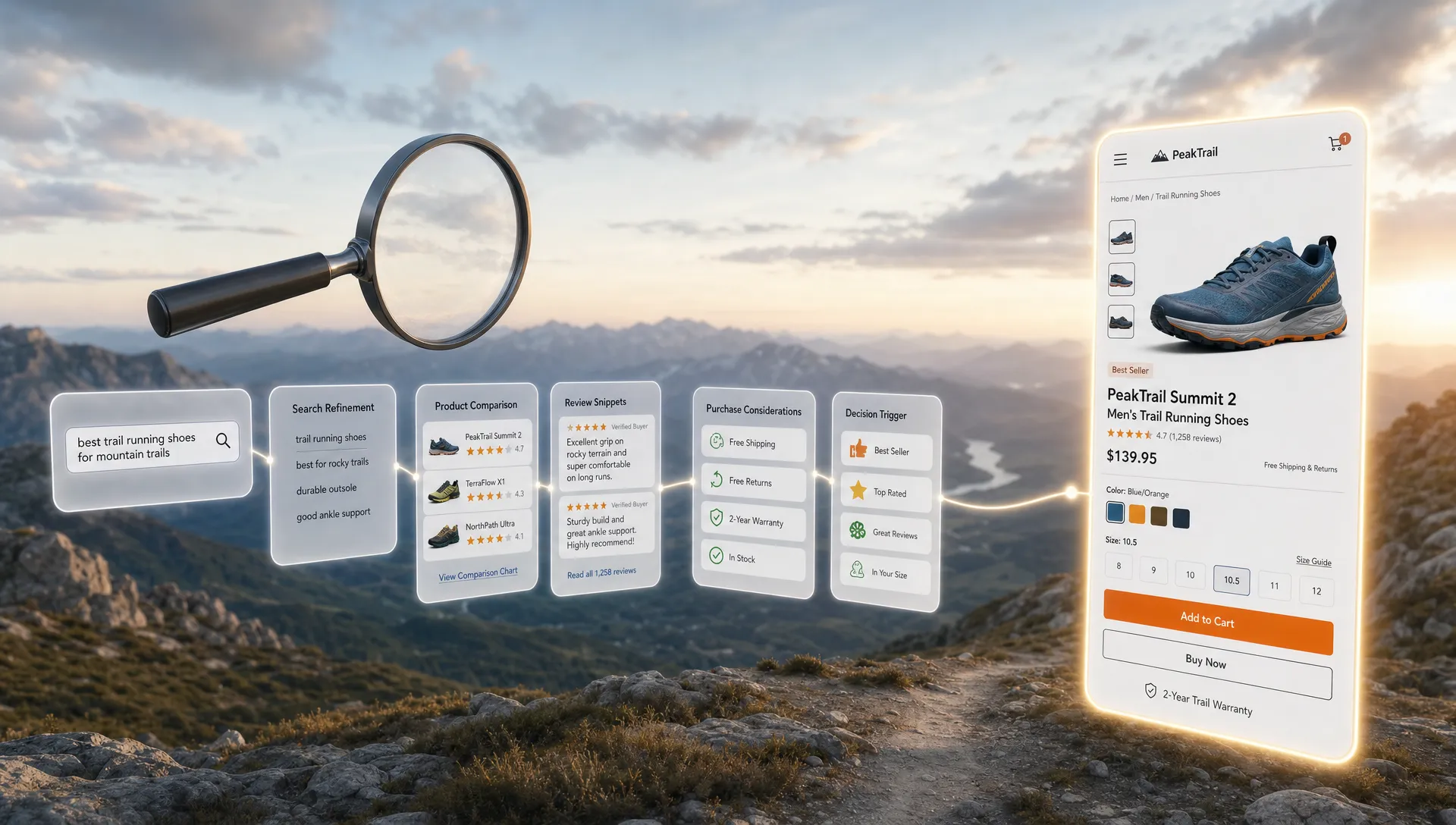
Growth is not the same thing as spending more. For ecommerce founders, especially in sports, fitness, wellness, and CPG, it is easy to confuse momentum with burn: higher ad budgets, larger inventory buys, more tools, more agencies, more hires, and more discounts. Revenue goes up, but cash gets tighter.
The better goal is capital-efficient growth. That means every dollar you put into product, marketing, operations, and customer experience should either increase profit, shorten payback time, or create a repeatable learning loop. You are not trying to avoid spending altogether. You are trying to spend in the order that makes your business stronger.
Here is how to help your business grow without burning cash before the fundamentals are ready.
Start with the economics, not the marketing channel
Many founders ask, “What channel should we scale next?” The more useful question is, “Can this business model absorb more demand profitably?”
Before increasing ad spend or launching a new campaign, get clear on the numbers that determine whether growth creates cash or consumes it. At minimum, know:
- Gross margin: What is left after product costs, freight, packaging, and fulfillment?
- Contribution margin: What is left after variable selling costs, including payment fees, discounts, shipping subsidies, and ad spend?
- Average order value: How much does a customer spend in one transaction?
- Customer acquisition cost: How much do you pay to acquire a new customer?
- Payback period: How long does it take to earn back your acquisition cost?
- Repeat purchase rate: How often do customers come back without being reacquired?
If these numbers are unclear, scaling spend can hide problems for a while, but it usually makes them more expensive. A brand can look like it is growing while quietly draining cash through low margins, slow inventory turns, excessive discounts, or poor retention.
This is why the best growth plans begin with unit economics. If you need a deeper framework for what should be fixed before putting more dollars into paid media, OPTYO’s guide on what an advertising agency should fix before scaling ads breaks down the core levers founders should evaluate first.
Improve margin before you chase more traffic
Traffic is expensive when the offer is weak. It is even more expensive when every new order is barely profitable. Before you spend more to bring people in, look for ways to make each order healthier.
Start with pricing. Many founders underprice because they are afraid of slowing conversion, but small pricing changes can have an outsized impact on contribution margin. If your brand has a differentiated product, strong proof, and a clear outcome, you may have more pricing power than you think.
Next, review your discount strategy. Discounts can be useful, but they should have a job. A welcome offer, limited bundle incentive, or inventory-clearing promotion can make sense. Permanent discounting trains customers to wait and makes it harder to build a premium brand.
Then look at bundles and thresholds. A fitness supplement brand might use a two-pack bundle to lift average order value. A wellness accessories brand might create a routine-based kit. An athletic recovery brand might offer free shipping above a threshold that protects margin. The goal is not to trick customers into spending more. It is to make the higher-value purchase feel more useful, complete, and convenient.
Finally, revisit fulfillment and packaging. Heavy packaging, inefficient carton sizes, and unnecessary inserts can quietly reduce cash flow. Sometimes growth comes from finding 3 to 5 percent in operational savings before spending another dollar on acquisition.
Grow from the customers you already paid to acquire
The most overlooked growth channel is your current customer base. You have already paid to earn their attention, build trust, and deliver a product. If the experience is strong, the next purchase should cost less than the first.
For sports, fitness, and wellness brands, retention should be built around use cases and habits. Customers do not just buy a product. They buy performance, recovery, confidence, consistency, convenience, or identity. Your post-purchase experience should reinforce that outcome.
Email and SMS are especially valuable here because they let you grow without constantly renting attention from ad platforms. A good retention system might include education after purchase, product usage tips, replenishment reminders, customer stories, complementary product recommendations, and win-back campaigns for customers who have gone quiet.
Retention also improves paid acquisition. If repeat purchases increase, you can tolerate a higher acquisition cost because the customer is worth more over time. That does not mean you should spend recklessly. It means retention gives you more room to scale when the signal is real.
Test demand before making expensive bets
Cash gets burned when founders make big commitments before validating demand. Large inventory buys, full rebrands, major product launches, custom packaging runs, and high-production creative shoots all feel like growth moves, but they can become liabilities if the market response is weaker than expected.
A smarter approach is to test the smallest version of the bet first. Instead of ordering a large run of a new SKU, test demand with a waitlist, limited drop, preorder, landing page, or small batch. Instead of rebuilding your entire website, test new messaging on one high-traffic landing page. Instead of producing a massive campaign, test several hooks and angles with scrappy creative.
This is where growth strategy and cash discipline overlap. You want to learn quickly without locking the business into decisions that are hard to reverse. If a test wins, scale it. If it fails, the loss is contained and the lesson is useful.
For a broader look at building systems that can scale without random acts of marketing, read OPTYO’s article on how to build a marketing strategy that actually scales.

Make every marketing dollar work harder
You do not need to abandon paid ads to conserve cash. You need to make paid ads more accountable. The question is not, “Are ads good or bad?” The question is, “Are we spending against a tested offer, clear audience, strong creative, and a conversion path that can support scale?”
Cash-efficient marketing usually improves in this order: positioning, offer, creative, landing page, follow-up, then budget. Many brands do the opposite. They increase budget first and hope the rest catches up.
Creative is one of the highest-leverage areas because it shapes both acquisition cost and conversion quality. A good creative testing system does not simply rotate visuals. It tests customer pain points, objections, product demonstrations, founder stories, social proof, comparisons, routines, and outcomes.
Landing pages matter just as much. If your ad promises a specific transformation, the page should continue that story immediately. It should answer the buyer’s obvious questions: What is this? Who is it for? Why is it different? What proof do you have? What do I get? Why should I trust you?
The brands that grow most efficiently treat marketing as an engine, not a slot machine. They are not looking for one lucky ad. They are building repeatable feedback loops between customer insight, creative, conversion rate, and retention.
Keep fixed costs low until demand is predictable
Burn often comes from hiring, tools, leases, and infrastructure before the business has predictable demand. Fixed costs raise the pressure on every month. If sales slow, the expense remains.
This does not mean you should stay small forever. It means you should keep as many costs variable as possible until you know the growth curve can support them. Use freelancers, fractional specialists, short-term production partners, and performance-based vendor relationships where appropriate. Rent or outsource before you buy. Document repeatable processes before you hire full-time around them.
Operations deserve the same discipline. If your inventory needs are growing but a full warehouse lease is premature, consider flexible storage, shared warehousing, 3PL support, or modular space. For example, brands with seasonal inventory, event equipment, or pop-up retail needs may compare local storage options with shipping containers for sale with nationwide delivery when a flexible physical footprint makes more sense than a long lease.
The principle is simple: avoid permanent costs for temporary uncertainty. When demand becomes consistent, you can invest more confidently.
Use content as a compounding asset
Paid media can create fast feedback, but content can create durable value. For ecommerce brands, content should not be limited to generic blog posts. It can include product education, comparison pages, buying guides, training tips, recipes, recovery routines, founder stories, customer use cases, and objection-handling assets.
Content helps your business grow without burning cash because it compounds across channels. A strong article can support SEO, email, paid landing pages, sales enablement, customer education, and organic social. A good product demo can become an ad, a product page asset, an email module, and a short-form video.
The best content strategy starts with buyer questions. What does the customer need to believe before buying? What are they comparing you against? What risks do they feel? What language do they use to describe the problem? Answer those questions clearly and repeatedly.
If you are looking for practical ideas to test across channels, OPTYO’s list of marketing strategies every growth brand should test can help you prioritize experiments without scattering your focus.
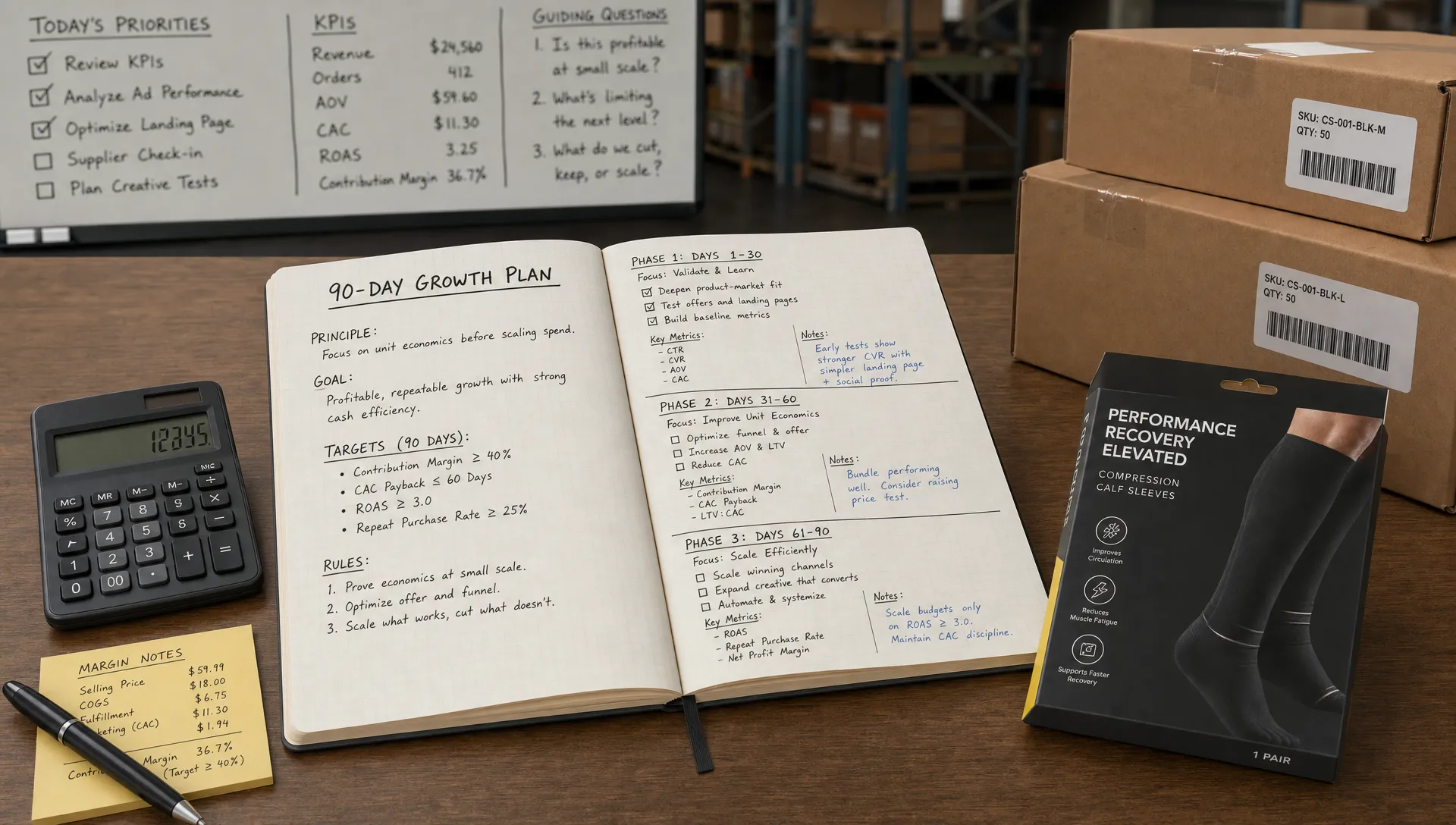
Build a 90-day no-burn growth plan
A cash-efficient growth plan should be short enough to execute and measurable enough to judge. Ninety days is a useful window because it gives you time to test, learn, and compound results without drifting into vague strategy.
For the first 30 days, focus on diagnosis. Audit margins, customer acquisition cost, conversion rate, retention, creative performance, inventory position, and cash conversion cycle. Identify the two or three constraints most likely to unlock profitable growth.
For days 31 to 60, focus on optimization. Improve the offer, test new pricing or bundles, tighten landing pages, launch retention flows, and produce creative around proven buyer objections. This is where you make the business more efficient before asking it to scale.
For days 61 to 90, scale only what has earned it. Increase spend on winning offers, expand creative based on validated angles, add inventory where demand is clearer, and invest in tools or partners only when they remove a proven bottleneck.
A strong 90-day plan should answer four questions:
- What constraint are we solving first? Choose the bottleneck that most affects cash flow or profitable growth.
- What metric proves improvement? Use contribution margin, conversion rate, repeat purchase rate, payback period, or another clear measure.
- What experiment will we run? Define the specific test before spending.
- What decision will we make after the test? Know in advance whether you will scale, iterate, or stop.
This keeps the team honest. It also prevents the common mistake of running too many disconnected experiments that create noise instead of learning.
Know when spending more is the right move
Avoiding waste does not mean avoiding ambition. There are moments when spending more is exactly what a business should do. The key is that the spend should follow evidence.
It may be time to invest more aggressively when your gross margin is healthy, your contribution margin is positive, your payback period is acceptable, and your repeat purchase behavior is improving. You should also have enough creative testing volume to understand what is driving performance, not just one temporary winning ad.
Growth capital should amplify a working system. If the system is not working, more cash usually amplifies confusion. If the system is working, more cash can help you buy inventory, expand channels, improve creative quality, hire key operators, and capture market share.
The difference is discipline. Cash-efficient founders do not ask, “How fast can we spend?” They ask, “Where does the next dollar create the most durable value?”
Frequently Asked Questions
How can I help my business grow with a small budget? Focus first on the fundamentals that do not require massive spend: improve margins, increase average order value, strengthen email retention, test offers with small audiences, and fix conversion issues before scaling traffic.
Is paid advertising a bad idea when cash is tight? Not necessarily. Paid ads can be useful for testing messaging and generating sales, but they become risky when the offer, landing page, margins, or retention are weak. Spend should increase only when the numbers support it.
What is the fastest way to reduce cash burn in an ecommerce business? Review discounts, fulfillment costs, inventory commitments, software subscriptions, and ad campaigns with poor payback. Cutting waste is useful, but the bigger goal is reallocating cash toward channels and offers that produce measurable returns.
Should I hire a marketing agency before or after I have product-market fit? An agency can help at different stages, but the scope should match your maturity. Early brands may need positioning, testing, and conversion support, while later-stage brands may need channel scaling, creative systems, retention, and reporting.
What metric matters most for cash-efficient growth? Contribution margin is one of the most important because it shows what is left after variable costs. Pair it with payback period and repeat purchase rate to understand whether growth is creating cash or consuming it.
Build growth that does not depend on waste
The healthiest brands do not grow because they spend the most. They grow because they understand their economics, know their customer, test before overcommitting, and scale only when the system is ready.
If you are building a sports, fitness, wellness, D2C, or CPG brand, the path to efficient growth starts with sharper strategy and better execution. OPTYO helps growth-minded brands connect performance marketing, creative, ecommerce, retention, and consulting so the next stage of growth is built on stronger fundamentals, not higher burn.