.png)



For a product company, the best first customers are not simply the people who could use the product. They are the people who feel the problem acutely, believe your promise quickly and give you usable feedback after they buy. Find them first and your launch becomes less about convincing everyone and more about proving a specific use case.
This matters even more for ecommerce founders in sports, fitness and wellness, where products often sit inside habits, identity and personal goals. A recovery tool, protein snack, running accessory or supplement is not bought only because it exists. It is bought because it fits a moment the customer already recognizes.
Start with the customer who needs the outcome now
Your first customer segment should be narrow enough that you can describe their situation in one sentence. “Active adults” is too broad. “Marathon trainees dealing with calf tightness during peak mileage weeks” is much better because it suggests pain, timing, language, channels and a concrete buying trigger.
A product company earns better signals when it frames the first market as a testable beachhead, not a permanent box. You are not deciding who will ever buy from you. You are deciding who is most likely to buy first, leave a review, refer a friend and teach you what the market values.
A strong first customer usually has three qualities: an urgent problem, an existing workaround and a reason to trust your category. If people already spend money, time or attention trying to solve the issue, you are not creating demand from zero. You are giving that demand a sharper option.
Separate your best first customers from your biggest market
Many founders confuse total addressable market with launch focus. A huge market can look exciting in a pitch deck, but it is often too vague for useful messaging. Your best first customers are the people who can understand your product with the least explanation because they already live with the problem.
For a product company, the cleanest customer definition often comes from context, not demographics. Age, gender and income can help later, but the first layer should be behavioral. What are they trying to improve? What have they already tried? What makes the problem expensive, frustrating or embarrassing right now?
A fitness apparel brand, for example, might discover that its strongest early customers are not “women who work out.” They could be new Pilates members who need flattering, studio-appropriate sets and feel uncertain about what to wear. That insight changes the offer, creative, landing page and email welcome flow.
| Weak customer definition | Better first-customer definition | Why it helps |
|---|---|---|
| People who want to get fit | Beginners joining a gym after a health scare | Reveals urgency and emotion |
| Runners | Half-marathon trainees increasing weekly mileage | Reveals timing and use case |
| Parents | Parents buying sports nutrition for teen athletes | Reveals buyer and user roles |
| Wellness consumers | Office workers using sleep aids after travel | Reveals trigger and channel |
How a product company validates first-customer demand
Validation does not mean asking strangers if they “like” your idea. Most people are polite, vague or unrealistically optimistic when no money is involved. Better validation looks for evidence that the customer already behaves like someone who needs the outcome.
Start by mapping demand signals. Search queries, Reddit threads, Amazon reviews, TikTok comments, competitor reviews, support questions and in-person conversations can show the exact words customers use when they are trying to solve the problem. OPTYO explains this broader path in its guide to marketing a product from customer insight to first sale, especially for brands that need sharper positioning before scaling spend.
A product company can usually spot promising demand by looking for repeated frustration. If customers complain about the same missing feature, poor fit, bad taste, confusing instructions or weak results, you may have a wedge. The key is to connect that frustration to willingness to act, not just willingness to comment.
Ask interview questions that force specificity:
- What were you doing the last time this problem happened?
- What did you try before buying something new?
- What made you trust one option over another?
- What nearly stopped you from buying?
- What would make this product feel worth recommending?
Interview buyers, non-buyers and near-buyers
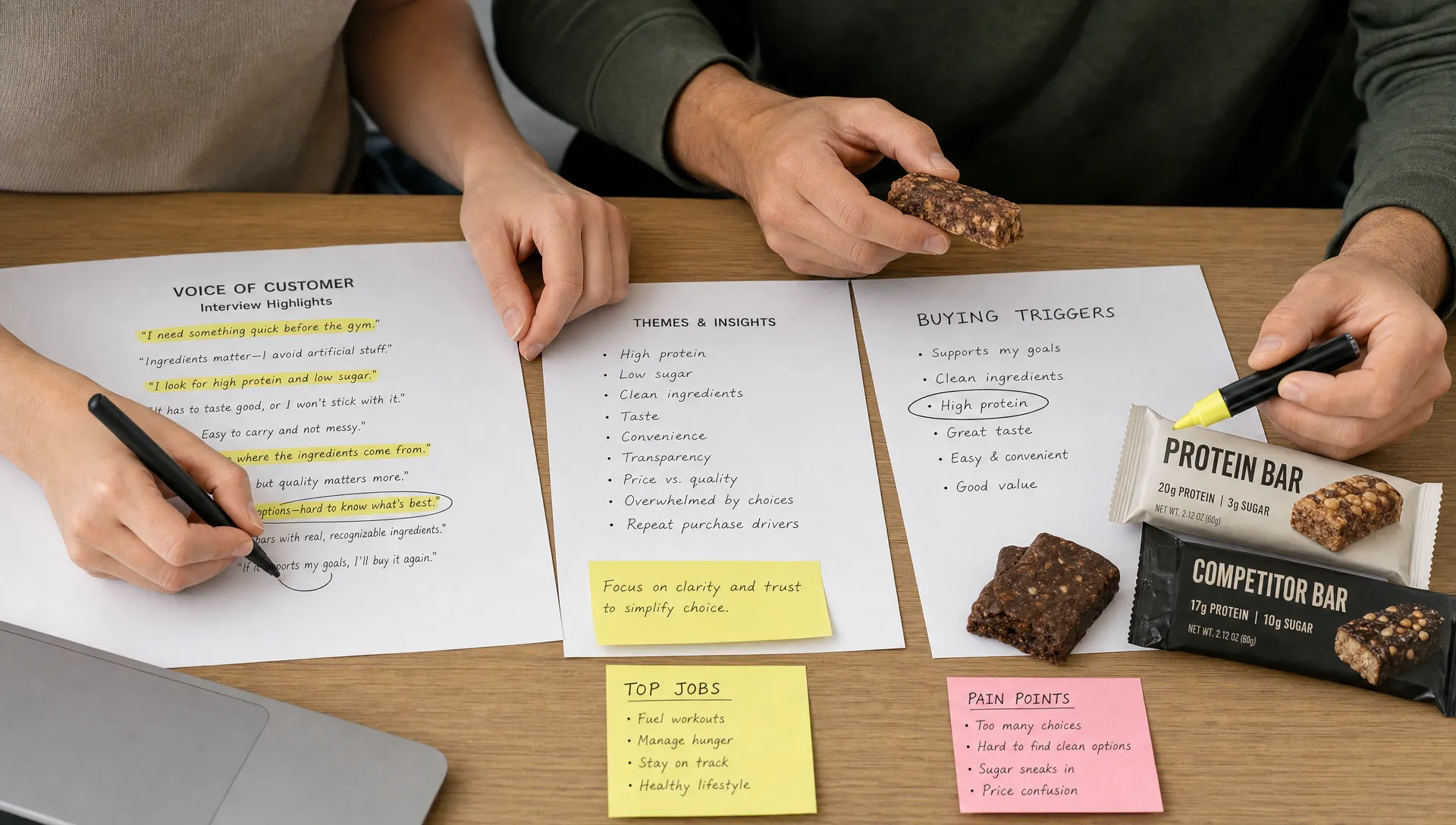
Your first customers will teach you more than survey averages if you ask about real moments. Talk to people who purchased, people who abandoned checkout and people who considered the product but chose a competitor. Each group reveals a different part of the buying equation.
Buyers show you the promise that worked. Non-buyers expose risk, confusion or weak urgency. Near-buyers often reveal the most valuable insights because they were close enough to care but not convinced enough to act.
This is where specificity beats broad messaging. A service brand can offer the same lesson. A specialized provider like Bridges Speech Center in Dubai makes its relevance clearer by naming distinct needs across speech therapy, occupational therapy, physiotherapy and psychological support rather than speaking to every family or adult in the same generic way. Product brands can use the same principle: name the exact situation so the right buyer recognizes themselves faster.
When you interview, listen for repeated phrases. If five customers describe your recovery product as “the only thing that fits in my gym bag,” that phrase may be more useful than a polished brand tagline.

Test channels where first customers already look for help
Once you have a defined segment, choose channels based on existing customer behavior. Do not start with the channel you personally like or the one competitors talk about most. Start where the customer already searches, compares, learns or asks for recommendations.
For a product company, channel testing should answer one question at a time. Paid social can test hooks and creative angles quickly. Search can capture existing intent. Email can validate whether interested shoppers need education, urgency or proof. Retail events, gyms, races and studios can reveal objections that never appear in analytics.
Sports, fitness and wellness products often benefit from a mix of performance and community signals. A new hydration product might test Meta ads for creative angles, Google Search for high-intent terms and local run clubs for live feedback. Each channel plays a different role, so judge it by the signal it is supposed to produce.
If you are still defining the launch path, a demand-led framework can help you avoid random channel testing. OPTYO’s article on building a go-to-market strategy around real demand covers how to connect the market, offer and channel before you scale.
Turn early buyers into proof, not just revenue
The first sale feels good, but the first useful sale is better. Useful early customers give you quotes, objections, photos, usage patterns, repeat purchase signals and referral clues. Treat those signals as assets, not background noise.
A product company with limited budget should build a simple feedback loop from day one. Ask why people bought, what nearly stopped them and what changed after using the product. Then connect those answers to performance data. If one customer segment converts at a lower cost and leaves stronger reviews, that segment may deserve more attention than a larger audience with weaker post-purchase behavior.
First-party data matters here because platforms will not give you the full story. Quiz answers, post-purchase surveys, email engagement, SMS replies, reviews and support tickets can show which customers are most valuable beyond their first order. For a deeper look at the data side, read OPTYO’s breakdown of why direct-to-consumer brands need better first-party data.
Use early proof in the next round of creative. Replace generic claims with buyer language. Turn objections into FAQ copy. Turn before-and-after moments into retention emails. Turn repeat use cases into bundles or subscriptions only when the behavior supports it.
Common mistakes that delay first-customer traction
The most common trap for a product company is trying to look bigger than it is. Broad messaging can feel safer because it avoids excluding anyone, but early growth usually needs the opposite. You need a clear point of view about who the product is for first.
Another mistake is copying competitor creative without understanding competitor context. A market leader can run broad lifestyle ads because it already has awareness, reviews and distribution. A newer brand often needs sharper problem-solution creative, more education and stronger proof.
Founders also move too quickly from early sales to scale. A small set of purchases does not automatically mean you have repeatable acquisition. Before increasing spend, check whether your first customers share a recognizable pattern.
Look for these warning signs before scaling:
- Customers buy for different reasons and no pattern is emerging
- Paid ads drive clicks but not qualified purchase intent
- Reviews praise the idea but not the outcome
- Repeat purchases or referrals are weaker than expected
- Your landing page answers features but not customer objections
A messy signal does not mean the product is doomed. It means the market, offer or message may need a tighter first-customer hypothesis.
A simple 30-day plan to find better first customers
You do not need a massive research project to improve your first-customer focus. You need a disciplined month of evidence collection and small tests.
In week one, define three possible first-customer segments based on problem intensity, not audience size. Write one sentence for each segment that includes the customer, the moment and the desired outcome. For example, “Strength athletes who need a portable way to manage shoulder soreness after heavy training blocks.”
In week two, gather voice-of-customer evidence. Read reviews, conduct interviews, analyze abandoned checkouts and capture repeated phrases. A product company should leave this week with clearer language, not just more opinions.
In week three, test one landing page or product page angle per segment. Keep the product mostly the same, but change the promise, proof and objections addressed. Watch conversion rate, email signups, add-to-cart rate and qualitative replies.
In week four, choose the segment with the strongest mix of purchase intent, feedback quality and post-purchase potential. The “best” segment is not always the cheapest to acquire. It is the one most likely to help you build repeatable learning and stronger proof.
Frequently Asked Questions
What is the best first customer for a product company? The best first customer has a clear problem, is already trying to solve it and can quickly understand why your product is relevant. They should also provide useful feedback after buying.
How many customer segments should a new brand test? Three segments is a practical starting point. It gives you enough contrast without spreading research, creative and ad budget too thin.
Should first customers come from paid ads or organic channels? Either can work. Paid ads are useful for fast message testing, while organic channels often reveal deeper trust signals. Choose the channel based on where your first customer already looks for help.
How do I know when to scale beyond the first customer segment? Scale when you see repeatable acquisition, consistent objections, clear post-purchase satisfaction and enough proof to adapt your message to adjacent segments.
Build your first-customer strategy with OPTYO
Finding first customers is not about guessing who might buy. It is about building a sharper link between customer evidence, positioning, creative, channel strategy and performance data.
If you are building a sports, fitness or wellness brand, OPTYO helps D2C and CPG companies turn that evidence into growth through performance marketing, ecommerce development, conversion rate optimization, email marketing, creative production, SEO, KPI reporting and brand strategy consulting.