.png)


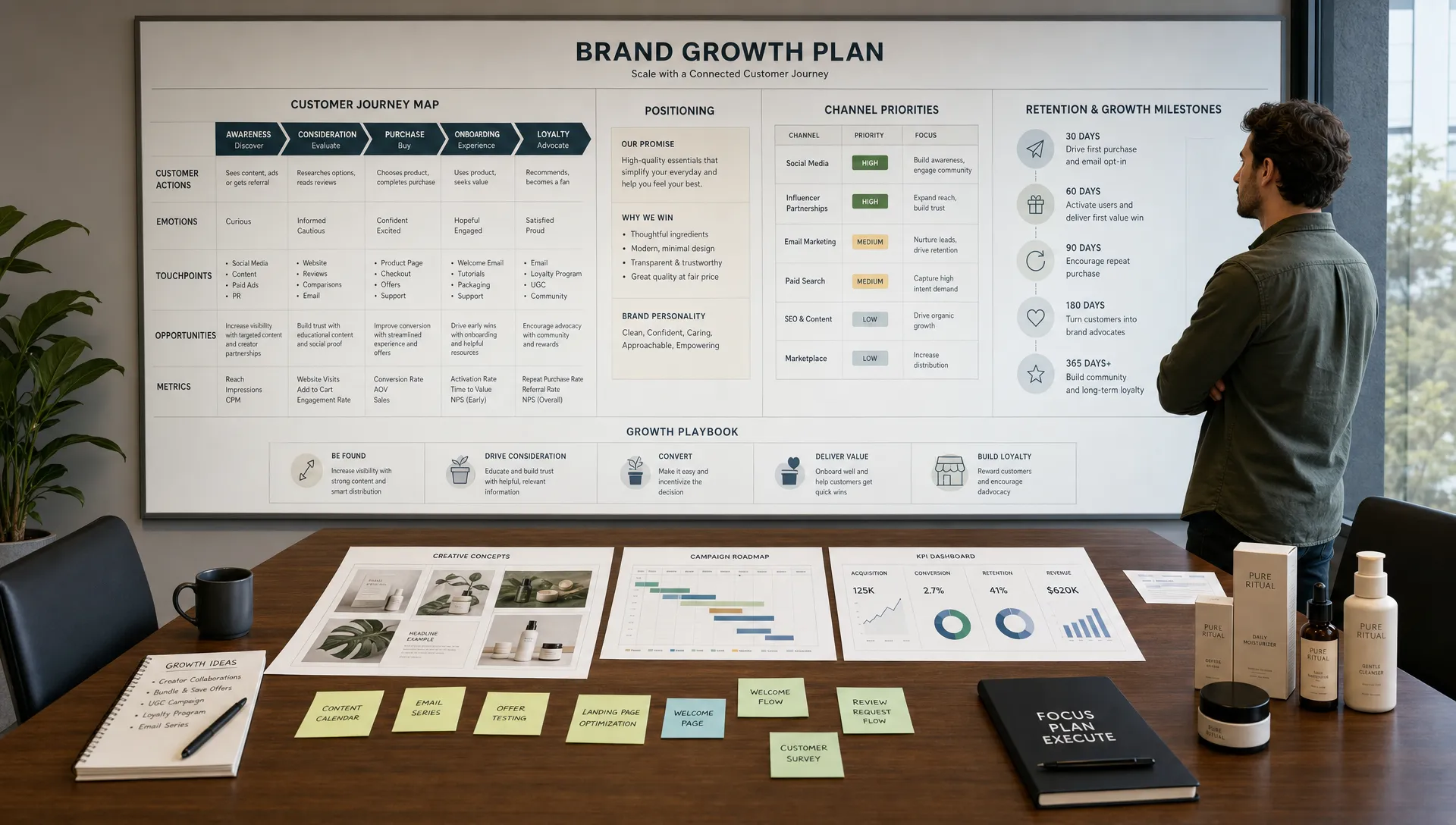

Scaling a business is not just about spending more on ads, launching more products, or posting more often. Those activities can create motion, but they do not always create momentum. A brand growth agency helps businesses scale faster by connecting brand strategy, performance marketing, creative, conversion, retention, and reporting into one growth system.
For ecommerce entrepreneurs, especially in competitive sports, fitness, wellness, D2C, and CPG categories, this matters because growth gets more complex as soon as early traction turns into real demand. The tactics that worked at $50K per month may not work at $500K. The founder-led messaging that once felt authentic may become inconsistent across ads, emails, product pages, and retail conversations.
A strong agency does not simply “run marketing.” It helps identify what is limiting growth, then builds the strategy, assets, tests, and operating cadence needed to scale with more speed and less waste.
Why Businesses Hit Growth Plateaus
Most scaling problems are not caused by a single broken channel. They usually come from friction between different parts of the business.
A brand might have strong paid social ads but weak landing pages. It might have a loyal customer base but no structured email or SMS retention strategy. It might have a product customers love, yet the brand positioning does not clearly explain why it is different. Or it might be growing revenue while margins quietly erode because customer acquisition cost keeps rising.
These plateaus often show up as familiar symptoms:
- Customer acquisition costs increase faster than revenue.
- Creative performance drops and winning ads fatigue quickly.
- Website traffic grows, but conversion rate stays flat.
- Repeat purchase rate is lower than expected.
- The brand looks different across ads, emails, packaging, and product pages.
- The team has data, but no clear decision-making framework.
When these issues stack up, working harder is not enough. The business needs a more integrated growth model.
That is where a brand growth agency creates leverage. Instead of treating marketing as a collection of disconnected tasks, it builds a system where every channel supports the same positioning, customer journey, and business objective.
What a Brand Growth Agency Actually Does
A brand growth agency sits at the intersection of strategy and execution. It looks beyond a single campaign and asks a more important question: what needs to be true for this brand to scale profitably?
That question changes the work. The agency is not only concerned with clicks, impressions, or short-term revenue spikes. It evaluates the brand’s market position, product economics, audience segments, creative performance, conversion funnel, retention opportunities, and reporting structure.
For a fast-growing ecommerce brand, this kind of support can shorten the learning curve. Instead of guessing which lever to pull next, the business can prioritize the highest-impact opportunities first. If you are evaluating what that partnership should include, OPTYO’s breakdown of what a growth agency should deliver for emerging brands is a helpful companion resource.
It Builds a Clear Growth Strategy Before Scaling Spend
One of the biggest mistakes businesses make is increasing spend before clarifying strategy. More budget amplifies whatever is already happening. If the positioning is unclear, the offer is weak, or the customer journey leaks revenue, scaling spend simply makes those problems more expensive.
A brand growth agency helps define a growth strategy around a few core questions:
- Who is the most valuable customer segment?
- What problem does the brand solve better than alternatives?
- Which products or bundles should lead acquisition?
- What is the acceptable customer acquisition cost based on margins and lifetime value?
- Which channels should be tested now, and which should wait?
- What metrics determine whether a test should scale, iterate, or stop?
This strategy gives the business a filter. Instead of chasing every trend, the team can make faster decisions because everyone understands the goal, the customer, and the economics behind growth.
For sports, fitness, and wellness brands, this clarity is especially important. Customers are often buying more than a product. They are buying identity, performance, confidence, recovery, consistency, or a lifestyle outcome. The growth strategy needs to reflect that emotional and functional value.
It Sharpens Positioning So Customers Understand the Value Faster
Speed matters in ecommerce. Customers decide quickly whether a brand feels credible, relevant, and worth exploring. If the message takes too long to understand, the brand loses attention before the product gets a fair chance.
A brand growth agency helps tighten positioning so the value proposition becomes clear across every touchpoint. This includes paid ads, product pages, homepage messaging, email flows, social content, packaging language, and even founder storytelling.
Strong positioning answers three questions quickly:
- What is this brand?
- Why should the customer care?
- Why should they buy this instead of another option?
Consider premium ecommerce categories where quality, trust, and delivery experience are part of the purchase decision. A specialty retailer such as Beef Boutique must communicate product quality, assortment, freshness, and service in a way that helps customers feel confident buying online. The same principle applies to wellness supplements, recovery tools, performance apparel, healthy snacks, and training equipment. If the brand story does not reduce uncertainty, conversion suffers.
Better positioning makes every growth channel work harder. Paid ads become more distinctive. Landing pages become more persuasive. Email campaigns feel more relevant. Influencer partnerships become easier to brief. The brand becomes recognizable instead of interchangeable.
It Turns Creative Into a Repeatable Testing Engine
Creative is one of the biggest growth levers in modern ecommerce. The problem is that many brands treat creative as a production task instead of a testing system.
A brand growth agency changes that. It develops creative based on hypotheses, not random ideas. Each ad concept should test something specific: an audience pain point, product benefit, offer angle, objection, use case, founder story, testimonial, comparison, or lifestyle aspiration.
This approach helps the brand learn faster. Instead of asking, “Did this ad work?” the team can ask, “What did this ad teach us about our customer?” That learning then informs the next round of creative, the product page, the email strategy, and the broader brand narrative.
For example, a fitness equipment brand might test creative around convenience, performance gains, space saving, durability, and community. A wellness brand might test education, ritual, ingredient quality, social proof, and outcome-driven messaging. Over time, the data reveals which themes deserve more investment.
The result is not just more ads. It is a creative feedback loop that improves the entire growth system.
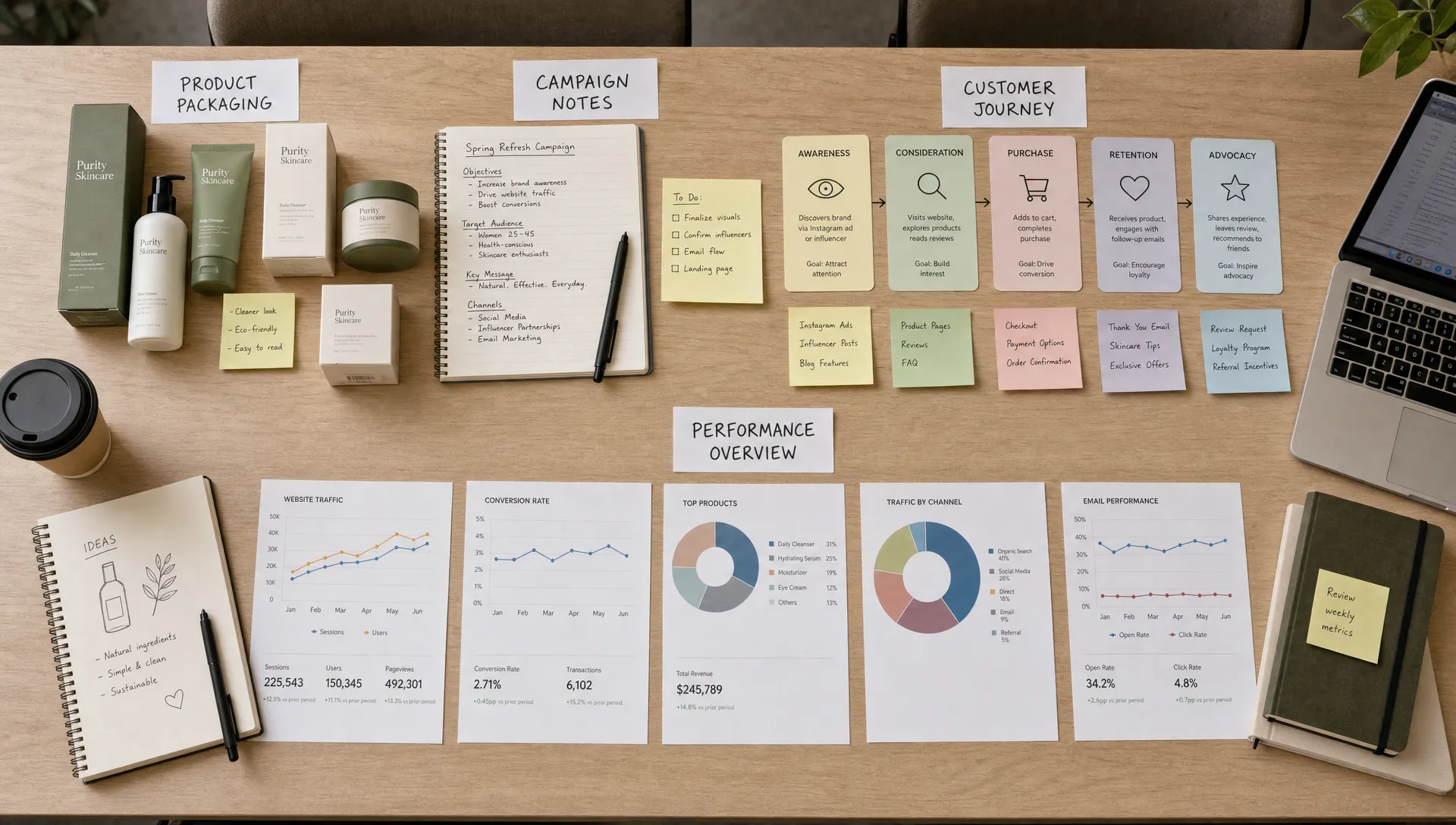
It Improves Conversion Instead of Only Buying More Traffic
Traffic is expensive. That is why conversion rate optimization is one of the fastest ways to improve growth efficiency.
A brand growth agency reviews the ecommerce experience from the customer’s point of view. The goal is to identify where shoppers hesitate, get confused, or abandon the purchase journey. Sometimes the fix is a clearer product page. Sometimes it is better offer architecture, stronger proof, improved navigation, faster page speed, more useful FAQs, or a smoother checkout experience.
The best conversion work is not just cosmetic. It is strategic. It connects customer psychology with business economics.
For example, if a brand has strong traffic but weak conversion, the issue may be unclear messaging or insufficient trust. If conversion is high but average order value is low, the opportunity might be bundles, subscriptions, or cross-sells. If mobile traffic dominates but mobile conversion lags, the purchase journey needs to be evaluated on the device customers actually use.
This is where ecommerce-specific expertise matters. OPTYO’s article on how an ecommerce agency helps brands scale efficiently goes deeper into how acquisition, conversion, retention, and brand systems work together rather than operating as separate projects.
It Builds Retention Into the Growth Model
Scaling faster does not mean acquiring new customers at any cost. Sustainable growth depends on what happens after the first purchase.
Retention increases the value of every acquired customer. It can also reduce the pressure on paid media because the brand is not forced to replace every buyer with a new one. For D2C and CPG brands, retention can come from replenishment cycles, product education, loyalty experiences, bundles, subscriptions, community, and lifecycle marketing.
A brand growth agency helps map the post-purchase journey and identify moments where the brand can deepen the relationship. This often includes welcome flows, abandoned cart flows, post-purchase education, replenishment reminders, winback campaigns, review requests, product recommendations, and VIP customer segments.
Retention also feeds acquisition. Reviews, testimonials, user-generated content, referrals, and repeat purchase data all improve the front-end marketing engine. When customers stay engaged, the brand has more proof, more insight, and more margin to support growth.
It Gives Founders Better Reporting and Faster Decisions
Many businesses do not lack data. They lack clarity.
A brand growth agency helps translate performance data into decisions. Instead of overwhelming founders with disconnected dashboards, the right partner focuses on the metrics that actually guide growth. These might include blended customer acquisition cost, contribution margin, conversion rate, average order value, lifetime value, repeat purchase rate, creative fatigue, email revenue contribution, and channel-level efficiency.
The real value is not the report itself. It is the operating rhythm around the report.
When performance is reviewed consistently, teams can move faster. They know which tests are working, which assumptions are wrong, which products deserve more attention, and which channels need adjustment. This reduces emotional decision-making and helps the business scale with discipline.
If your team is still building the strategic foundation for measurement, positioning, and channel prioritization, this guide on how a marketing strategy agency builds smarter growth can help frame what should happen before aggressive scaling.
It Adds Specialized Expertise Without Slowing the Business Down
Hiring a full in-house growth team is expensive and time-consuming. A brand growth agency gives businesses access to specialized skills without forcing them to build every function internally before they are ready.
Depending on the agency, that expertise may include paid social, search, SEO, email marketing, creative production, ecommerce development, conversion optimization, brand strategy, reporting, and growth consulting. The advantage is coordination. Instead of managing multiple vendors who each optimize for their own channel, the business can work with a partner that understands the whole growth picture.
This is especially valuable for entrepreneurs who are still close to product development, operations, partnerships, fundraising, or retail expansion. The agency helps create marketing structure so the founder is not trapped approving every ad, rewriting every email, or guessing what to test next.
When Should a Business Hire a Brand Growth Agency?
A brand growth agency is usually most valuable when a business has evidence of demand but needs a stronger system to scale. That evidence might be consistent sales, strong customer feedback, improving repeat purchase behavior, early paid media traction, wholesale interest, or a growing organic audience.
It may be time to hire one if:
- You have product-market fit, but growth feels inconsistent.
- You are spending on ads but do not know what is driving profit.
- Your creative pipeline cannot keep up with testing needs.
- Your website traffic is growing, but conversion is underperforming.
- Your brand message feels fragmented across channels.
- You need senior growth thinking but are not ready for a full in-house team.
The key is readiness. An agency can accelerate growth, but it cannot replace a weak product, poor fulfillment, or unclear customer demand. The best results happen when the business has a strong foundation and the agency helps turn that foundation into a scalable engine.
What to Look for in the Right Partner
Not every agency that talks about growth is built to drive it. Some are channel specialists. Some are creative studios. Some are strategy consultants. A true brand growth partner should be able to connect strategy with execution and explain how each activity supports business outcomes.
Look for a partner that asks about margins, customer segments, product mix, retention, fulfillment, positioning, and decision-making processes before recommending tactics. If the conversation jumps straight to ad spend, that is a warning sign.
The right agency should also be comfortable saying no. Faster growth requires focus. A strong partner will help prioritize the few actions that matter most instead of adding more noise to an already busy business.
Frequently Asked Questions
What is a brand growth agency? A brand growth agency helps businesses scale by connecting brand strategy, performance marketing, creative, conversion optimization, retention, and reporting into a coordinated growth system.
How does a brand growth agency help businesses scale faster? It helps teams prioritize the highest-impact growth levers, reduce wasted spend, improve messaging, test creative faster, increase conversion, strengthen retention, and make better decisions from performance data.
Is a brand growth agency only for ecommerce brands? No, but ecommerce brands often benefit because their growth depends on multiple connected systems, including traffic acquisition, website conversion, email marketing, product positioning, and repeat purchases.
When is the right time to hire a brand growth agency? The right time is usually after the business has early traction and clear demand, but before growth becomes too complex for the founder or small team to manage effectively.
What is the difference between a brand growth agency and a traditional marketing agency? A traditional marketing agency may focus on specific campaigns or channels. A brand growth agency looks at the broader system, including positioning, economics, customer journey, creative testing, conversion, and retention.
Build a Faster, More Focused Growth System
Scaling faster is not about doing everything at once. It is about knowing which levers matter, aligning the brand around them, and executing with enough speed and discipline to learn quickly.
For sports, fitness, wellness, D2C, and CPG brands, the right growth partner can turn scattered marketing activity into a more focused engine for acquisition, conversion, and retention. If your brand has traction but needs clearer strategy, stronger creative, sharper performance marketing, or better growth systems, explore how OPTYO supports ambitious ecommerce brands with performance marketing and brand acceleration built for scale.