.png)


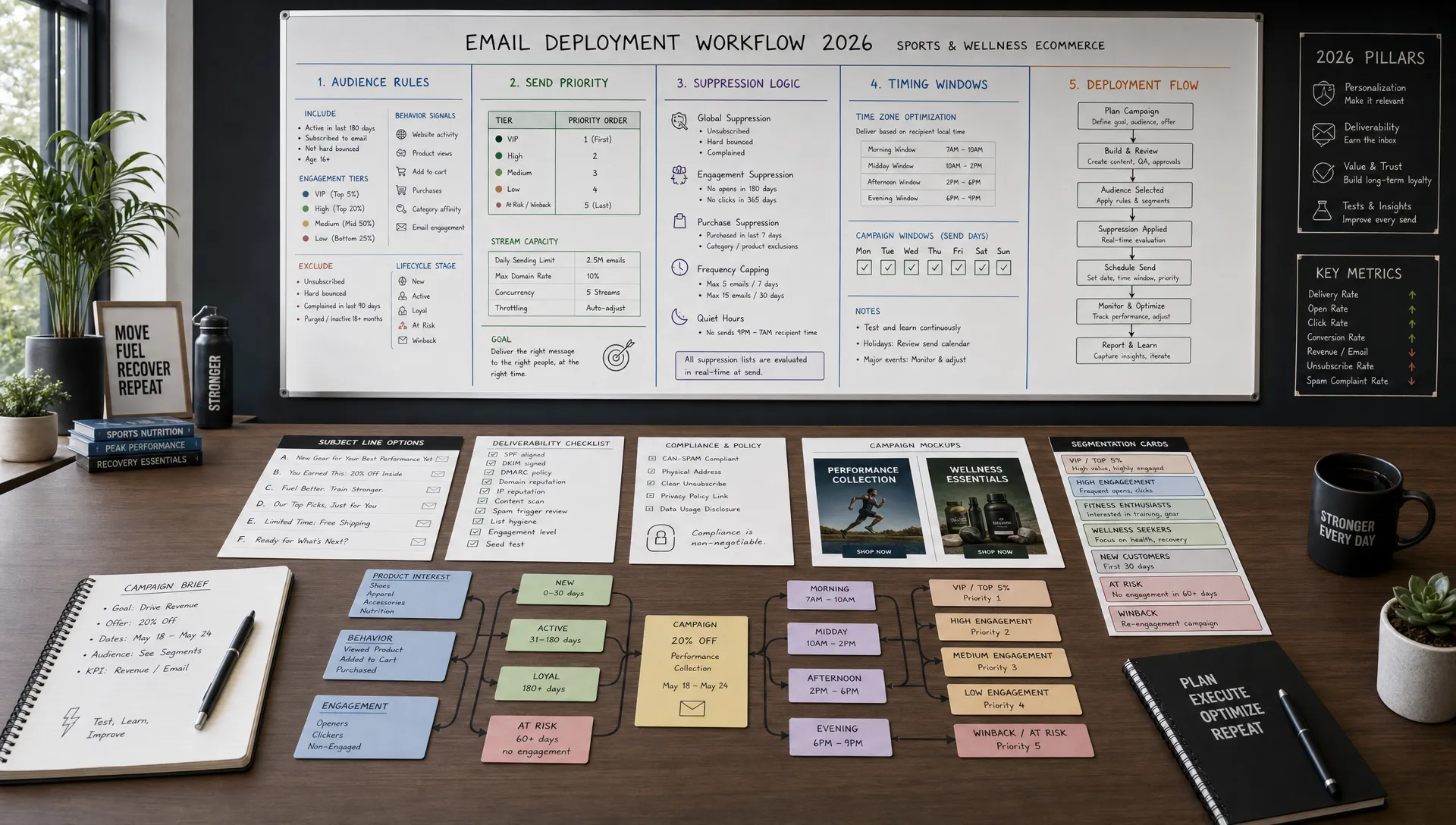

Email deployment used to mean scheduling a campaign, checking the subject line, and pressing send. In 2026, that definition is too narrow.
For ecommerce, sports, fitness, and wellness brands, email deployment now sits at the intersection of revenue strategy, customer lifecycle, deliverability, creative testing, segmentation, and retention. A good deployment plan does not simply ask, “What email are we sending today?” It asks, “Who should receive this, why now, what behavior are we trying to influence, and how will this affect future performance?”
That shift matters because inboxes are more competitive, privacy rules are stricter, acquisition costs remain high, and consumers expect brands to communicate with relevance. If your email calendar is still built around one-off promos and last-minute product pushes, it is likely leaving revenue on the table.
Here is what modern email deployment should look like in 2026.
Email deployment should start with business goals, not send dates
The biggest mistake brands make is treating deployment as a calendar exercise. A campaign calendar is important, but it should be the output of strategy, not the strategy itself.
Before deciding what goes out on Tuesday, your team should know what the business needs email to accomplish this month. That goal could be increasing first purchase conversion, lifting repeat purchase rate, clearing seasonal inventory, growing subscriptions, launching a new product, improving customer education, or reactivating dormant buyers.
For example, a performance apparel brand preparing for marathon season should not simply send “new arrivals” emails every week. A smarter deployment strategy might segment runners by past purchase behavior, send training-related content to engaged prospects, deploy shoe or gear recommendations based on browsing behavior, and trigger replenishment reminders for nutrition products.
This is the difference between sending email and deploying email as a revenue system.
If your brand is still tightening the fundamentals, OPTYO’s guide to email marketing basics for fast-growing ecommerce brands is a useful foundation before moving into more advanced deployment strategy.
Batch-and-blast campaigns should be the exception
There is still a place for broad campaigns. Major product drops, seasonal sales, brand announcements, and limited-time offers may deserve large sends. But in 2026, blasting the same email to the full list too often is a sign of weak segmentation.
Modern deployment should account for customer context. That means differentiating between subscribers who are new, active, lapsed, high-value, discount-sensitive, education-driven, or already close to purchase.
A better approach is to build the same campaign around multiple audience versions. The core offer may stay consistent, but the angle changes:
- New subscribers may need trust, social proof, and brand education.
- Repeat buyers may respond better to complementary products or loyalty messaging.
- VIP customers may deserve early access, limited drops, or community-driven messaging.
- Lapsed buyers may need a stronger reason to return, not just another generic discount.
- Recent purchasers should often be excluded from aggressive promotional sends.
This does not mean every email needs 15 different versions. It means your deployment process should include a clear decision about who receives what, who is excluded, and why.
Deliverability is now part of deployment, not a technical afterthought
A campaign is only valuable if it reaches the inbox. In 2026, deliverability needs to be built into every deployment decision.
Google and Yahoo have enforced stricter sender requirements for bulk email, including authentication, low spam complaint rates, and easy unsubscribes. These standards are not just technical boxes to check. They influence whether your campaigns consistently land in the inbox or quietly drift into spam and promotions folders.
Strong deployment teams monitor list health before sending. They avoid mailing chronically unengaged subscribers too frequently, suppress risky segments when needed, and watch for sudden drops in opens, clicks, conversions, and inbox placement. They also make sure core authentication, such as SPF, DKIM, and DMARC, is properly configured.
For ecommerce brands, deliverability problems can look like creative fatigue or weak offers when the real issue is that customers are not seeing the emails. If revenue from email suddenly falls without a clear explanation, deliverability should be investigated early.
OPTYO covers this in more depth in its article on how an email deliverability agency protects revenue, especially for brands that rely heavily on owned channels.
Your campaign calendar should work with lifecycle flows
Email deployment in 2026 is not just campaigns. It is the coordination of campaigns and automated flows.
Flows usually capture high-intent moments: welcome series, abandoned cart, browse abandonment, post-purchase education, replenishment, winback, review requests, loyalty, and subscription reminders. Campaigns create demand, shape brand perception, launch offers, and support merchandising priorities.
When these two systems are disconnected, customers get messy experiences. A shopper may receive a welcome discount, a full-price product launch, an abandoned cart reminder, and a sitewide sale email within 48 hours. That kind of overlap can reduce trust and train customers to wait for discounts.
A strong deployment process includes campaign-to-flow coordination. Before a campaign goes live, your team should check which automated messages the audience might also receive. From there, you can suppress recent purchasers, pause conflicting flows during major launches, adjust timing windows, or use smart sending rules where appropriate.
The goal is not to send fewer emails by default. The goal is to send emails that make sense together.
Frequency should be managed by engagement and buying cycle
There is no universal answer to how often an ecommerce brand should email. A daily send may work during a major shopping period for a highly engaged list. It may damage performance for a brand with a longer consideration cycle or a less engaged audience.
In 2026, frequency should be dynamic. Your most engaged subscribers can usually handle more communication, especially if the content is varied and useful. Less engaged subscribers should receive fewer emails, stronger hooks, or reactivation campaigns before being suppressed.
Sports, fitness, and wellness brands also need to think about product usage cycles. Supplements, performance nutrition, skincare, training gear, recovery products, and apparel all have different buying rhythms. Deployment should reflect those rhythms.
For instance, a customer who buys protein powder every 30 days should not receive the same cadence as someone who bought a high-ticket home fitness product once. One may need replenishment reminders and flavor recommendations. The other may need education, accessories, community content, or upgrade paths over a longer window.
Frequency is not just a send-volume decision. It is a customer experience decision.
Creative should be planned for the inbox, not just the brand deck
Email creative has to do more than look good. It has to drive action in a crowded inbox, load properly on mobile, communicate quickly, and match the stage of the customer journey.
In 2026, effective email deployment requires a creative system. That system should include repeatable formats for product education, founder notes, social proof, comparison content, launch announcements, replenishment, bundles, and promotional urgency.
For sports and wellness brands, creative also has to connect with identity and aspiration. Customers are not just buying a supplement, pair of shorts, or recovery tool. They are buying into a version of themselves: stronger, healthier, more consistent, more prepared, more confident.
That does not mean every email needs heavy lifestyle storytelling. Some emails should be direct and conversion-focused. But the deployment mix should balance brand-building and selling. If every send screams “20% off,” customers learn to ignore you until the next sale.
A healthy email calendar might include educational content, product benefit breakdowns, user-generated content, expert guidance, comparison angles, community stories, and promotional campaigns. The exact mix depends on your category, margin profile, and customer behavior.

AI should support deployment, not replace strategy
AI can make email deployment faster, but speed without strategy creates more noise.
In 2026, AI is useful for drafting subject line variations, summarizing customer reviews, identifying content themes, building segmentation hypotheses, creating testing ideas, and adapting copy for different audiences. It can also help analyze campaign patterns across engagement, revenue, and customer cohorts.
But AI should not decide your brand position, promotional strategy, or customer lifecycle logic in isolation. Those decisions require business context: inventory, margins, seasonality, audience maturity, offer strength, customer objections, and competitive positioning.
The best teams use AI to reduce production drag while keeping strategic control. They still ask human questions:
- Does this email match the customer’s current intent?
- Is the offer strong enough for this segment?
- Are we protecting margin or overusing discounts?
- Does the message sound like the brand?
- Are we learning something useful from this send?
AI can help you deploy faster. It should not make your email program feel generic.
Measurement should move beyond open rates
Open rates have become less reliable because of privacy changes such as Apple Mail Privacy Protection, which can inflate or obscure engagement signals. Opens still provide some directional value, but they should not be the main success metric for deployment.
In 2026, email teams should measure performance across multiple layers. Revenue is important, but it is not the only metric. You also need to understand click quality, conversion rate, revenue per recipient, unsubscribe rate, spam complaints, list growth, customer lifetime value, and the incremental value of campaigns.
For ecommerce brands, attribution can be especially messy. A customer may discover a product through paid social, click an email three days later, search the brand on Google, and purchase after receiving an abandoned cart reminder. If your reporting credits only the last click or overcredits email based on platform defaults, you may make poor budget decisions.
A stronger measurement approach looks at how email supports the whole funnel. Email can convert traffic acquired from paid media, increase repeat purchases, educate prospects, reduce dependence on discounts, and improve the payback period on customer acquisition.
That is why email should not be managed as a silo. It should connect with paid social, search, SEO, creative, landing pages, and retention strategy. OPTYO’s breakdown of what performance marketing services should include in 2026 explains why growth now requires a more integrated system.
Personalization should be useful, not creepy
Personalization has matured. Adding a first name to a subject line is no longer impressive, and over-personalization can feel invasive.
The most effective personalization in 2026 is behavior-based and value-driven. It helps the customer make a better decision. That might mean recommending products based on past purchases, adjusting content based on fitness goals, changing replenishment timing based on usage, or highlighting relevant benefits by customer segment.
For example, a wellness brand selling hydration products might speak differently to endurance athletes, busy parents, and office workers. A recovery brand might segment messaging for runners, weightlifters, and general wellness consumers. The product may be the same, but the use case and motivation differ.
Good personalization feels like relevance. Bad personalization feels like surveillance.
The deployment question should be simple: “Does this data help us create a more useful customer experience?” If not, it may not belong in the email.
Compliance and consent should be built into the process
Email compliance is not just a legal concern. It is a trust concern.
Brands need clear consent practices, accurate unsubscribe handling, truthful subject lines, and respect for regional requirements such as CAN-SPAM, GDPR, and other privacy regulations that may apply based on where subscribers live. Ecommerce teams should also avoid questionable list acquisition tactics that might create short-term volume but long-term deliverability risk.
This is especially important for brands expanding into wholesale, retail partnerships, gyms, clinics, studios, or B2B channels. Consumer email and outbound B2B prospecting are different motions with different expectations. If your ecommerce brand also sells to businesses, it may make sense to pair your owned email program with a specialized B2B customer acquisition agency that understands outbound pipeline development.
For your D2C list, the principle is straightforward: earn attention, respect consent, and make it easy for people to manage or leave the relationship. A smaller, engaged list is more valuable than a large list that does not trust you.
Deployment should include pre-send quality control
The final stage of email deployment should be a disciplined pre-send review. Many revenue leaks come from preventable mistakes: broken links, expired discount codes, poor mobile rendering, incorrect segments, missing exclusions, image-heavy designs, or campaigns that conflict with active flows.
A 2026-ready pre-send checklist should review the essentials:
- Audience segment and suppression logic
- Subject line, preview text, and sender name
- Mobile rendering and dark mode appearance
- Links, UTMs, discount codes, and product availability
- Flow conflicts and recent purchaser exclusions
- Compliance elements, including unsubscribe visibility
- Deliverability risk for the selected audience
- Campaign goal and measurement plan
This does not need to slow your team down. In fact, a repeatable checklist usually speeds things up because everyone knows what “ready to send” means.
The best email deployment feels like orchestration
By 2026, the strongest ecommerce brands will not win email by sending more. They will win by orchestrating better.
That means connecting customer data, offer strategy, lifecycle timing, content, creative, deliverability, and measurement into one operating rhythm. It means knowing when to push a promotion and when to educate. When to send broadly and when to narrow the audience. When to use automation and when a campaign needs a timely human angle.
For entrepreneurs, this can feel like a lot to manage. But the core idea is simple: every email should have a job, every audience should have a reason to receive it, and every deployment should teach you something about your customers.
If your email program follows that standard, it becomes more than a marketing channel. It becomes a compounding asset.
Frequently Asked Questions
What does email deployment mean? Email deployment is the process of preparing, scheduling, sending, and measuring email campaigns or automated messages. In modern ecommerce, it also includes segmentation, deliverability checks, creative review, compliance, and coordination with lifecycle flows.
How is email deployment different in 2026? Email deployment in 2026 is more data-driven, lifecycle-focused, and deliverability-aware. Brands need to account for privacy changes, stricter inbox provider requirements, customer behavior, AI-assisted workflows, and more integrated performance measurement.
How often should ecommerce brands send marketing emails? The right frequency depends on engagement, buying cycle, product category, and campaign quality. Highly engaged customers may tolerate more sends, while inactive subscribers should receive fewer, more intentional messages or be moved into reactivation strategies.
What should brands check before deploying an email campaign? Brands should review audience logic, exclusions, subject line and preview text, mobile rendering, links, discount codes, flow conflicts, compliance requirements, and the campaign’s measurement plan before sending.
Should email deployment be handled in-house or by an agency? It depends on your team’s expertise, volume, and growth goals. If email is a major revenue channel but your team lacks lifecycle strategy, deliverability knowledge, creative capacity, or testing discipline, an experienced ecommerce email agency can help.
Build an email deployment system that scales
Email deployment in 2026 is not about filling a calendar. It is about building a smarter revenue engine across campaigns, flows, creative, segmentation, and measurement.
OPTYO helps sports, fitness, wellness, D2C, and CPG brands connect performance marketing with brand strategy, email marketing, creative, CRO, and growth consulting. If your email program needs to become more strategic, more profitable, and more aligned with the rest of your marketing, start by building a deployment system designed for how ecommerce growth works now.