.png)


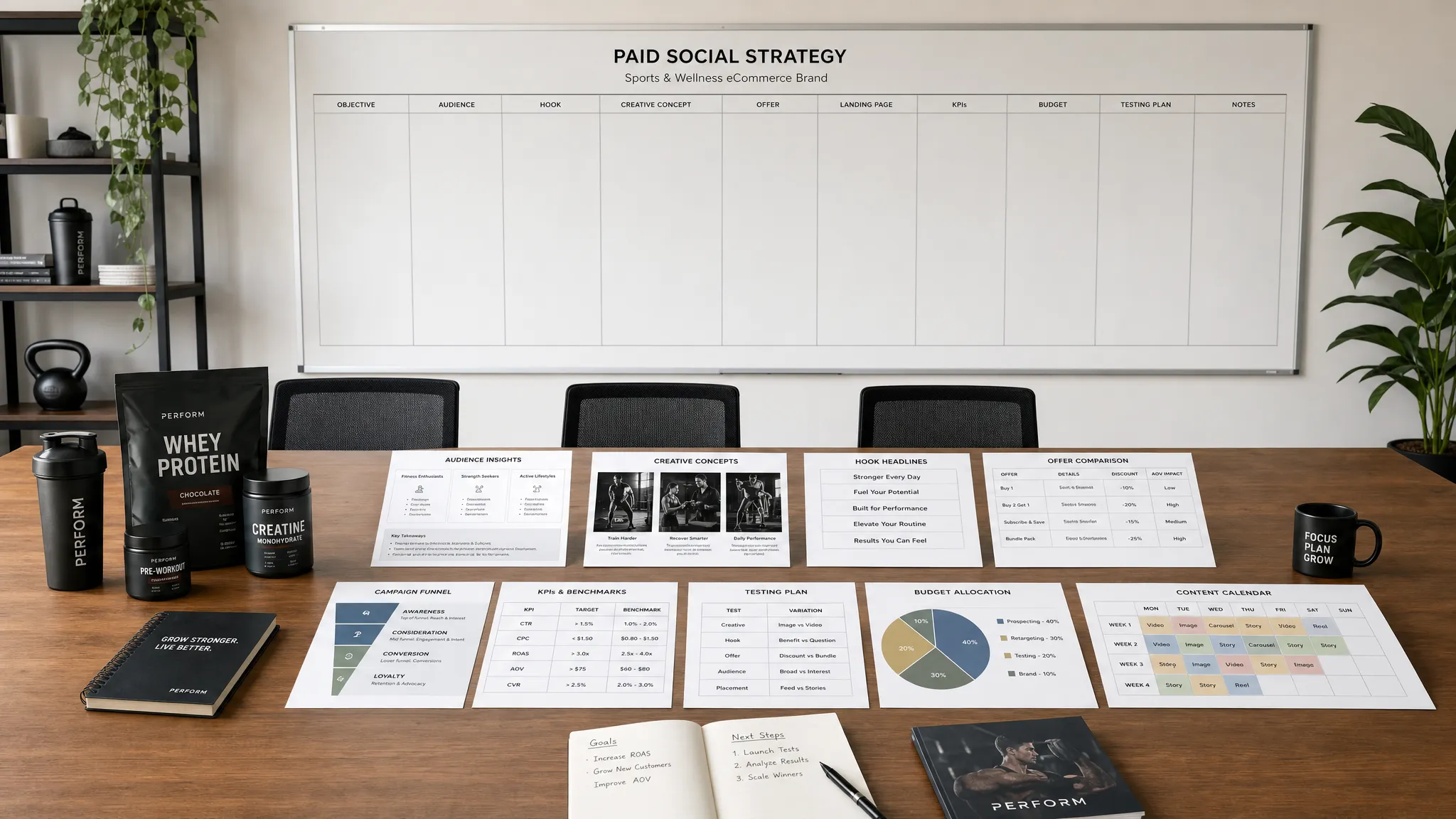

Winning paid social campaigns do not come from a lucky ad, a clever caption, or one audience hack. They come from a system. For ecommerce entrepreneurs, especially in sports, fitness, and wellness, that system has to connect the brand promise, the offer, the creative, the funnel, and the numbers behind customer acquisition.
A strong social ad agency builds campaigns with that full system in mind. The goal is not simply to launch ads. The goal is to turn paid social into a repeatable growth channel that can acquire customers, validate messaging, improve conversion rates, and create the confidence to scale.
In 2026, this matters more than ever. Social platforms are increasingly automated, privacy changes have made attribution harder, and consumers are more selective about which brands they trust. The brands that win are not the ones that spend the most. They are the ones that learn the fastest and make better decisions with every dollar.
Winning paid campaigns start before Ads Manager
Many brands think campaign building begins when an agency opens Meta Ads Manager, TikTok Ads Manager, or another platform dashboard. In reality, the most important work happens before a campaign is built.
A social ad agency first needs to understand the business model. A $35 supplement, a $120 pair of training shoes, and a $900 home fitness product all require different acquisition math. Average order value, gross margin, repeat purchase rate, shipping costs, subscription behavior, and customer lifetime value all shape what a campaign can afford to pay for a customer.
This is where paid social becomes a business strategy question, not just a media buying task. If a brand needs a $40 customer acquisition cost to remain profitable, the campaign structure, creative testing plan, and landing page experience must all be designed around that target. If the first purchase is intentionally breakeven because retention is strong, the agency needs to understand that too.
For brands trying to improve acquisition efficiency, it helps to understand how the moving pieces work together. OPTYO covers that broader system in its guide on how a paid social agency improves customer acquisition, including the role of audience strategy, offers, tracking, and conversion paths.
Turning business goals into campaign architecture
A winning campaign begins with a clear job. Is the brand launching a new product? Entering a new market? Scaling a proven hero SKU? Clearing inventory? Building a subscription base? Retargeting warm shoppers? Each goal requires a different structure.
A social ad agency typically separates campaign architecture by intent. Prospecting campaigns focus on reaching new buyers. Retargeting campaigns help convert shoppers who have already engaged. Retention or upsell campaigns may promote bundles, replenishment, accessories, or new collections. Launch campaigns may prioritize speed of learning over immediate efficiency in the first few days.
The agency also defines the KPI hierarchy. Not every metric deserves the same attention. A campaign can have a strong click-through rate and still fail if shoppers do not convert. Another campaign may have expensive clicks but a high purchase rate because the traffic is more qualified.
The most useful paid social scorecard usually includes:
- Primary business metrics: Revenue, new customer acquisition cost, contribution margin, MER, and blended ROAS.
- Platform performance metrics: CPA, ROAS, CPM, CTR, CPC, add-to-cart rate, and purchase conversion rate.
- Creative learning metrics: Hook rate, thumbstop rate, hold rate, engagement quality, and comment sentiment.
- Funnel metrics: Landing page conversion rate, average order value, checkout completion rate, and email capture rate.
The point is not to drown in reporting. The point is to understand where performance is coming from and where the constraint sits. If CPMs are rising but conversion rate is steady, the issue may be media cost. If traffic is cheap but purchases are weak, the problem may be the offer, page, or audience match.
Building the customer insight layer
Paid social is interruption based. Most people are not opening Instagram, TikTok, Facebook, or Pinterest hoping to see an ad. The campaign has to earn attention quickly by speaking to a real desire, frustration, identity, or moment.
For sports, fitness, and wellness brands, this insight layer is especially important because purchases are often emotional as well as functional. A customer is not only buying protein powder. They may be buying consistency, confidence, recovery, or a better training routine. A runner is not only buying shorts. They may be buying comfort during long miles, fewer distractions, and the identity of someone who takes training seriously.
A good social ad agency looks for the language customers already use. Reviews, customer surveys, support tickets, Reddit threads, creator comments, post-purchase interviews, and competitor ads can all reveal the real reasons people buy or hesitate.
The agency is looking for patterns such as:
- What problem does the customer want solved right now?
- What have they already tried that did not work?
- What outcome would make the purchase feel worth it?
- What objections might stop them from buying today?
- What proof would make the claim feel believable?
This research becomes the foundation for creative angles, landing page copy, product education, and offer strategy. Without it, brands often end up with generic ads that look polished but fail to connect.
Matching the offer to the buying moment
An offer is more than a discount. It is the reason a customer should act now.
For an ecommerce brand, the right offer depends on product type, margin, and customer behavior. A consumable wellness product might test a starter bundle, subscription incentive, or first-order savings. A fitness equipment brand might test financing, free shipping, limited-time bonuses, or a comparison against higher-cost alternatives. An apparel brand might test product drops, seasonal collections, bundles, or fit guarantees.
A social ad agency evaluates whether the offer supports the brand rather than weakening it. Constant discounting can train customers to wait. On the other hand, no incentive at all can make it harder for a new brand to overcome hesitation. The best offer reduces friction while preserving perceived value.
This is also where operations matter. If a campaign succeeds, the business must be able to fulfill demand. Inventory, production timelines, shipping capacity, and customer service readiness all affect whether a campaign can scale smoothly. That is especially true for apparel and gear brands, where launch timing and product availability are tightly linked. For brands developing fitness apparel or performance products, working with a full-service apparel development and manufacturing partner like Arcus Apparel Group can help align sourcing, sampling, and production planning with the marketing calendar.
A winning campaign is not only the one that gets purchases. It is the one the business can actually support.
Creating ads that function as a testing engine
Creative is now one of the biggest levers in paid social. As platforms automate more targeting and bidding decisions, the ad itself becomes a major way to find the right customer. The hook, visual, message, format, and proof all signal who the ad is for.
A social ad agency does not simply produce one batch of assets and hope for the best. It builds a creative testing engine. That means developing multiple angles, testing them with enough structure to learn, then turning winners into new variations.
Common creative angles include problem and solution, product demonstration, founder story, customer testimonial, comparison, objection handling, routine integration, ingredient education, before and after context, and seasonal use cases. For sports and fitness brands, demonstration can be especially powerful because buyers want to see how the product performs in real life.
The key is to avoid random testing. If every ad changes the hook, visual, copy, format, and offer at the same time, the team may not know why one ad won. A disciplined agency tests variables intentionally. One round may compare three hooks using the same product demo. Another may test creator-led video against studio-shot product content. Another may test a performance claim against a lifestyle identity angle.

Winning creative is rarely a final destination. It is a signal. If a testimonial ad wins, the next step may be to test more testimonials by customer type, sport, age group, or objection. If a product demo wins, the next step may be to test the first three seconds, the setting, the spokesperson, or the call to action.
Structuring media buying so the platform can learn
Even strong creative can underperform if the campaign structure prevents learning. Too many ad sets, tiny budgets, overlapping audiences, and constant edits can fragment data and slow optimization.
A strong social ad agency builds media plans that give platforms enough signal while still protecting the brand from waste. That usually means simplifying account structure, grouping similar audiences, setting clear budget rules, and avoiding unnecessary changes during key learning periods.
The right structure depends on the brand’s maturity. A newer brand may need broader testing across audiences, hooks, and offers. A more mature ecommerce brand may benefit from consolidated prospecting, dedicated creative testing, and carefully managed retargeting. Brands with high traffic and purchase volume may use more automated campaign types, while niche brands may still need more controlled audience testing.
The agency’s job is to balance control with learning. Over-segmentation can make reporting feel precise while hurting performance. Over-automation can hide insights if no one is analyzing what is actually driving results. Winning campaigns sit between those extremes.
Connecting landing pages, CRO, and post-click experience
A paid campaign does not end at the click. In many accounts, the biggest gains come from improving what happens after someone leaves the social platform.
If an ad promises a specific benefit, the landing page should continue that same message immediately. If the creative speaks to runners, the page should not open with generic brand copy. If the ad focuses on recovery, the page should reinforce recovery benefits, proof, product education, and a clear path to purchase.
Conversion rate optimization is often where a social ad agency can create leverage beyond media buying. Improvements to page speed, product page layout, offer clarity, reviews, FAQs, bundles, checkout flow, and email capture can improve the return on every paid click.
This is why paid social should not operate in a silo. The best campaigns connect advertising, ecommerce development, email marketing, SEO, creative, and brand strategy into one growth system. OPTYO expands on that integrated approach in its article on how a marketing strategy agency builds smarter growth.
Tracking attribution without chasing false certainty
Attribution is imperfect. Platform dashboards, ecommerce analytics, GA4, post-purchase surveys, and email data often tell different stories. A social ad agency should not pretend one dashboard has the full truth.
Instead, the agency should build a practical measurement system. That includes properly installed pixels, server-side tracking where appropriate, consistent UTMs, clean naming conventions, and reporting that separates platform performance from blended business performance.
The goal is to understand contribution, not just credit. Paid social may introduce a customer who purchases later through email. Retargeting may claim credit for customers who were already going to buy. A viral organic post may lift paid performance for a week. A strong agency looks at the full picture before making decisions.
This is where KPI reporting becomes more than a spreadsheet. It should answer strategic questions. Are new customers becoming more expensive? Are winning ads fatiguing? Is scale reducing profitability? Are landing page tests improving conversion rate? Are certain products better suited for acquisition than others?
Optimizing with a clear decision cadence
Winning campaigns are built through consistent decision making. That does not mean making changes every few hours. In fact, overreacting too quickly can reset learning and kill campaigns before they have enough data.
A social ad agency should establish a decision cadence. Early data can reveal obvious issues, such as broken tracking, poor page load speed, disapproved ads, or a hook that fails to earn attention. But deeper decisions usually require enough spend and conversion volume to be meaningful.
Good optimization looks at the full path. If thumbstop rate is weak, the creative hook may need work. If clicks are strong but add-to-cart rate is low, the landing page or product-market match may be the issue. If add-to-cart rate is strong but purchases lag, the offer, shipping cost, checkout experience, or trust signals may need improvement.
The most effective agencies do not only ask, “Which ad should we turn off?” They ask, “What did the market teach us, and what should we test next?”
Scaling without breaking profitability
Scaling is where many paid campaigns fail. A campaign that works at $300 per day may not work at $3,000 per day unless the creative pipeline, offer, audience size, landing page, and operations can support the increase.
A social ad agency scales in layers. Vertical scaling increases budget on proven campaigns. Horizontal scaling expands into new creative angles, new audiences, new platforms, new offers, or new product entry points. Both approaches require careful monitoring because efficiency can change quickly as spend rises.
For sports, fitness, and wellness brands, scaling also depends on brand credibility. Customers often need trust before buying products that affect performance, health, recovery, or identity. Proof, education, community, and clear product differentiation become more important as campaigns reach colder audiences.
This is why case studies matter. In OPTYO’s MX Select case study, the growth strategy combined targeted paid media with landing page improvements and performance measurement to support a premium fitness equipment brand. That kind of integrated execution is often what separates scalable campaigns from short-lived wins.
A campaign is truly winning when it can grow without hiding margin problems, exhausting creative too quickly, or creating operational strain.
What entrepreneurs should expect from a social ad agency
The right agency should bring more than platform knowledge. It should bring strategic judgment. Entrepreneurs should expect clear thinking around acquisition economics, creative testing, conversion paths, reporting, and scale.
A strong social ad agency will challenge assumptions. If the offer is weak, it should say so. If the landing page is hurting conversion, it should identify the issue. If the brand needs more creative volume, it should build a plan. If the numbers do not support scaling yet, it should protect the business from inefficient spend.
That transparency is especially important for ecommerce founders. Paid social can create fast feedback, but it can also burn cash quickly when strategy is unclear. The best agency relationship feels like a growth partnership, not a vendor relationship.
For sports, fitness, and wellness brands, this partnership should also respect the category. Selling performance products requires credibility. Selling wellness products requires trust. Selling fitness gear requires demonstration and differentiation. A generic ad playbook is rarely enough.
Frequently Asked Questions
What does a social ad agency do? A social ad agency plans, launches, manages, and optimizes paid campaigns across platforms such as Meta, TikTok, Pinterest, and others. The best agencies also support creative strategy, landing page feedback, reporting, and growth planning.
How long does it take to know if a paid social campaign is working? Some early signals appear within days, such as hook performance, click quality, and technical issues. Stronger conclusions usually require enough spend and purchase data, often over several weeks, depending on budget, price point, and conversion volume.
How much should an ecommerce brand spend on social ads? The right budget depends on target CPA, product price, margin, and how quickly the brand needs to learn. A useful testing budget should be large enough to generate meaningful data without putting the business at unnecessary financial risk.
Does creative matter more than targeting? Creative has become one of the most important paid social levers because platforms increasingly automate targeting. However, targeting, offer, landing page experience, and measurement still matter. Winning campaigns align all of them.
When should a brand hire a social ad agency? A brand should consider hiring an agency when it needs more structured testing, stronger creative output, clearer reporting, or help scaling beyond founder-led ad management. It is also useful before major launches when strategy and execution need to move quickly.
Build paid campaigns with strategy behind every dollar
Winning paid campaigns are not built by guessing. They are built through clear economics, customer insight, strong creative, disciplined media buying, conversion-focused landing pages, and honest reporting.
OPTYO helps sports, fitness, and wellness brands connect those pieces through performance marketing, creative asset production, ecommerce development, CRO, email marketing, SEO, KPI reporting, and brand strategy consulting.
If your brand is ready to turn paid social into a more accountable growth channel, OPTYO can help you build campaigns designed to learn, convert, and scale.