.png)




Sports brands live in a competitive space where attention is emotional, communities are vocal, and customers often know exactly what performance improvement they want. That is an advantage, but only if your advertising is built around how people actually choose gear, supplements, apparel, equipment, or wellness products.
The advertising strategies that work for sports brands are rarely the loudest ones. They are the ones that connect a specific athlete, fan, or active customer to a clear use case, prove the product belongs in that moment, and make the next step easy.
For ecommerce entrepreneurs, this means your ads cannot stop at awareness. They need to create trust, reduce hesitation, and turn demand into measurable revenue.
Why Sports Advertising Needs a Different Playbook
Sports buyers are not just purchasing a product. They are buying confidence in their next workout, race, game, recovery session, hike, match, or lifestyle identity. A running shoe ad, a protein powder ad, and a pickleball paddle ad may all use paid social, search, creators, and email, but the psychology behind each purchase is different.
A strong sports advertising strategy starts by answering three questions:
- Who is the product for in a real-life sport, fitness, or wellness context?
- What goal, frustration, or identity does the buyer care about most?
- What proof does the buyer need before they trust the claim?
That last question matters. Sports customers are often skeptical because they have seen exaggerated performance claims, generic influencer posts, and products that look good online but fail during use. The brands that win are specific, credible, and consistent across every touchpoint.
1. Start With the Customer's Performance Moment
Many sports brands begin their advertising with the product. Better brands begin with the moment.
A performance moment is the real situation where the customer feels the need for your product. It could be mile eight of a half marathon, the last set in a strength workout, the first practice after an injury, the morning after a hard training day, or the frustration of athletic apparel that does not fit properly.
This matters because broad messaging such as premium training gear or clean recovery formula is easy to ignore. Specific messaging such as stay fueled past mile six or recover faster between two-a-day sessions gives your ad a purpose.
To find these moments, look at customer reviews, support tickets, Reddit threads, Amazon reviews in your category, coach conversations, and comments on competitor ads. Do not just collect compliments. Look for repeated pain points, objections, and phrases customers use before they buy.
Strong ad concepts often come from these simple prompts:
- When does the customer realize their current solution is not working?
- What does the customer fear wasting money on?
- What result would make them recommend the product to a friend?
- What would a coach, trainer, or experienced athlete say matters most?
Once you define the moment, your creative, landing page, offer, and follow-up can all speak to the same buying trigger.
2. Build Creative Around Proof, Not Hype
Sports advertising performs best when creative shows the product earning trust. Visual polish still matters, but proof usually beats production value.
For ecommerce brands, proof can take several forms. Customer testimonials can show everyday credibility. Athlete demos can show how the product works under pressure. Founder videos can explain why the product exists. Comparison creative can show what makes it different from common alternatives. Educational creative can explain a problem customers already feel but have not yet solved.
The strongest proof-driven ads usually include one clear claim and one clear reason to believe it. For example, instead of saying built for serious athletes, a brand might show a sprinter testing fit through acceleration, a lifter demonstrating grip stability, or a runner explaining why a specific feature helped on long training days.
Useful creative formats for sports brands include:
- Product-in-use demos that show movement, sweat, impact, resistance, or recovery context.
- Problem-solution videos that begin with a common frustration and show the product resolving it.
- Coach or expert explainers that translate technical features into practical benefits.
- Founder-led ads that tell the origin story behind a product improvement.
- Customer story ads that show a relatable transformation without overpromising.
If you use athletes, creators, or trainers, keep disclosures clear and claims responsible. The FTC provides practical guidance for social media endorsements, and following it helps protect both the brand and the credibility of the creator.
3. Segment by Sport, Skill Level, and Use Case
One of the biggest mistakes in sports advertising is treating all active customers the same. A beginner training for a first 5K has different motivations than a competitive runner chasing a personal record. A recreational golfer wants different proof than a coach buying equipment for a team. A wellness customer focused on joint comfort may respond differently than a high-intensity athlete focused on performance output.
Segmentation does not have to make your campaigns complicated. It simply means your messaging should match the buyer's context.
For example, a recovery product could be positioned around post-lift soreness for strength athletes, long-run recovery for endurance athletes, and daily mobility for active adults. The product may be the same, but the ad angles, imagery, landing page sections, and testimonials should differ.
This is especially important for paid social. Algorithms can find buyers, but they still need strong creative signals. If every ad speaks in broad category language, the platform has less useful information to match the message to the right customer.
4. Use Paid Social to Test Angles Before Scaling Spend
Paid social is not just a sales channel. For sports brands, it is one of the fastest ways to learn which customer problems, proof points, and offers actually matter.
Instead of launching with one polished hero campaign, test multiple angles with clear hypotheses. One angle might focus on performance. Another might focus on comfort. Another might focus on durability, recovery, community, convenience, or identity. The goal is not to guess the perfect message in a conference room. The goal is to let the market show you which messages earn attention, clicks, and purchases.
The right metrics depend on your stage, but early testing should look beyond return on ad spend alone. Watch thumb-stop rate, hold rate, click-through rate, landing page view rate, add-to-cart rate, conversion rate, customer acquisition cost, and contribution margin. A high-click ad that sends unqualified traffic is not a winner. A lower-click ad with stronger purchase intent might be more valuable.
For a deeper view of how campaign structure, creative testing, and measurement work together, OPTYO's guide on how a social ad agency builds winning paid campaigns breaks down the process in more detail.
5. Send Traffic to Pages Built for the Buying Decision
Sports ecommerce brands often waste good ad creative by sending traffic to generic product pages. A product page can work for warm traffic, but cold or problem-aware visitors usually need a clearer path.
A high-performing landing page should continue the same story the ad started. If the ad focuses on marathon fueling, the page should not open with generic brand language. It should validate the marathon use case, show product benefits in that context, provide proof from relevant customers, and answer the objections that stop someone from buying.
Important landing page elements include:
- A headline that repeats or expands the ad promise.
- Visual proof of the product being used in the relevant sport or activity.
- Specific benefits translated from features.
- Reviews, testimonials, certifications, or expert support where appropriate.
- Clear buying options, shipping information, returns, sizing, subscriptions, or bundles.
This is where conversion rate optimization becomes a growth lever. Better advertising is not only about lowering media costs. It is about increasing the percentage of qualified visitors who become customers. If you want to connect audience attention more directly to revenue, this OPTYO article on sports advertising that turns attention into sales is a useful companion read.
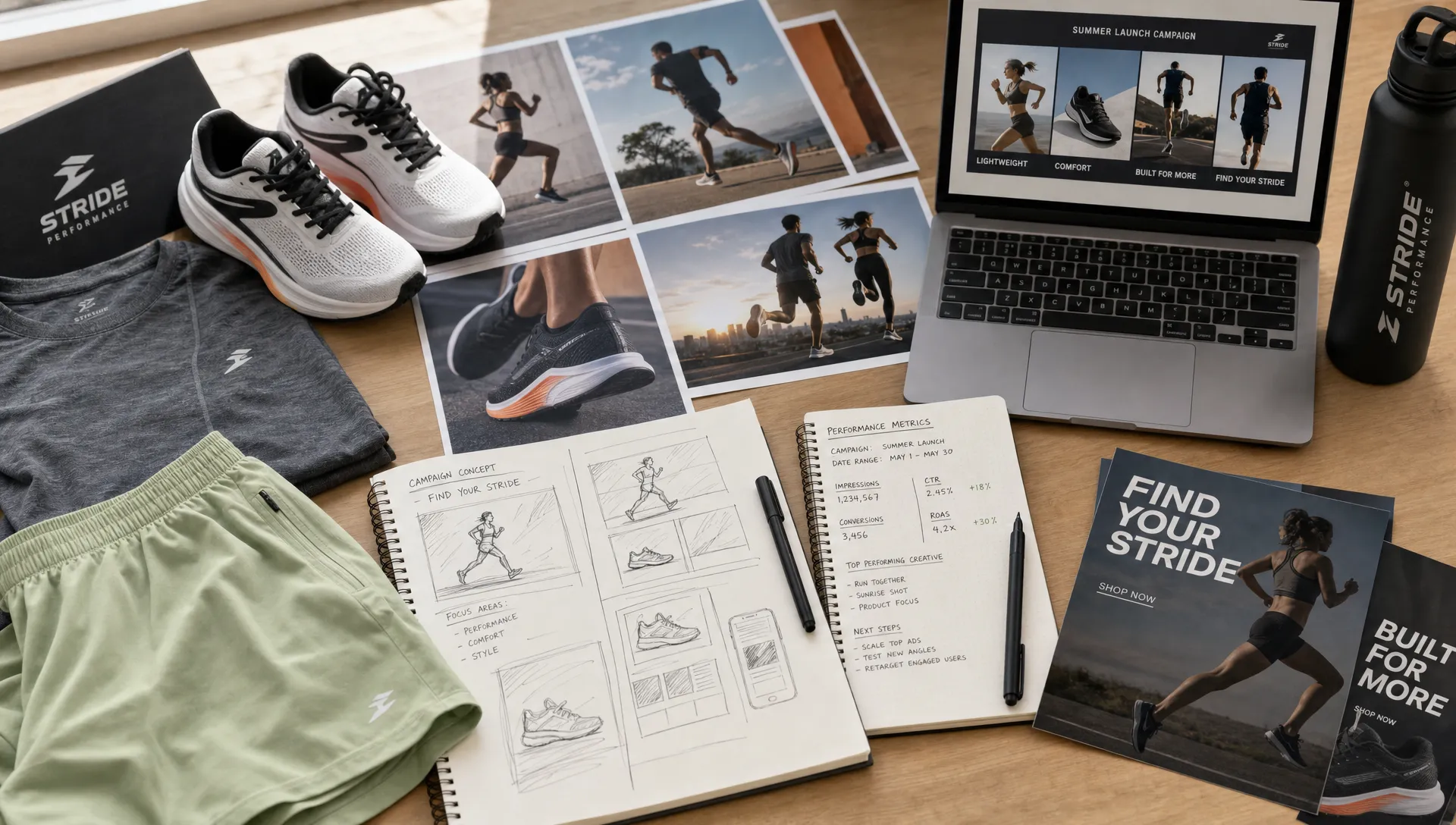
6. Create Moments Customers Want to Share
Sports brands have a natural advantage that many categories do not: people like to share challenges, milestones, routines, events, and personal wins. Your advertising should tap into that behavior instead of relying only on static product promotion.
A shareable moment can be small. A local run club challenge, gym partner workout, pickleball tournament, recovery booth, pop-up testing station, athlete meet-up, or virtual leaderboard can all generate content and community participation. The point is to turn the brand into something people experience, not just something they see in a feed.
For larger campaigns, live activations and record-style stunts can create strong brand memory when they are connected to the product story. A brand planning a high-visibility launch could take inspiration from event specialists such as Luuk Broos Events, whose work shows how memorable physical displays and record-driven moments can become marketing assets beyond the event itself.
The key is relevance. A spectacle only helps if the audience understands why the brand is involved. If the activation demonstrates endurance, precision, recovery, strength, teamwork, or commitment, it can reinforce the same story your ads are already telling.
7. Retarget With Education, Not Repetition
Retargeting often fails because brands simply show the same ad again to people who did not buy. In sports categories, hesitation usually has a reason. The customer may be unsure about fit, flavor, ingredients, durability, performance claims, sizing, shipping, or whether the product suits their skill level.
Your retargeting should answer those doubts in sequence.
A visitor who watched a product demo might need customer reviews. Someone who added to cart might need shipping clarity or a bundle offer. Someone who viewed a technical product page might need an expert explanation. Someone who browsed multiple products might need a comparison guide.
Email and SMS can support this journey, especially for higher-consideration purchases. A welcome flow should do more than offer a discount. It should introduce the brand point of view, show proof, explain best sellers, answer objections, and guide the customer toward the right product.
For subscription-friendly categories such as supplements, hydration, wellness products, or consumables, post-purchase education is just as important. The first purchase is not the finish line. Usage guidance, routine-building content, replenishment reminders, and customer stories can improve retention and lifetime value.
8. Capture High-Intent Demand With Search and SEO
Paid social can create demand, but search often captures people who are already closer to buying. Sports brands should not ignore high-intent search terms, especially when customers compare products by sport, benefit, material, ingredient, or use case.
Search ads and SEO can work together across queries such as best recovery drink for runners, knee sleeves for squats, wide toe box training shoes, electrolyte powder for hot weather, or pickleball paddle for beginners. These searches reveal intent. The customer is not just browsing. They are looking for a solution.
For ecommerce entrepreneurs, SEO is especially useful when it supports product education. Buying guides, comparison pages, sport-specific use-case pages, and FAQs can help customers choose confidently while also creating assets that paid campaigns can reuse.
The best approach is to connect search content to the same messaging system used in your ads. If your paid campaigns reveal that durability is the top converting angle, build organic content around durability questions. If customers repeatedly ask about sizing, create a strong sizing guide. If one sport-specific landing page converts well, consider turning that use case into a full content cluster.
9. Measure What Actually Drives Growth
Sports advertising can generate plenty of exciting surface metrics: views, likes, shares, event attendance, creator engagement, and traffic spikes. Those metrics can be useful, but they do not prove profitable growth by themselves.
A brand that wants to scale should measure the full commercial system. That includes customer acquisition cost, conversion rate, average order value, contribution margin, repeat purchase rate, payback period, marketing efficiency ratio, and lifetime value.
This does not mean every campaign must be judged only by last-click revenue. Brand awareness, community growth, and experiential campaigns can influence future sales. But even upper-funnel campaigns should have a measurement plan. Decide what success looks like before launch, whether that is qualified email signups, branded search lift, retail conversations, creator content volume, or assisted revenue.
The most reliable sports brands build a testing rhythm. They review creative performance weekly, landing page performance regularly, and customer economics monthly. They do not change strategy every time one ad has a bad day, but they also do not ignore repeated signals from the market.
Common Advertising Mistakes Sports Brands Should Avoid
Even strong products can struggle when advertising is built on weak assumptions. The following mistakes are especially common in sports, fitness, and wellness ecommerce:
- Making broad performance claims without enough proof or context.
- Using athlete content that looks impressive but does not explain the product benefit.
- Sending all traffic to the same generic product page.
- Optimizing only for cheap clicks instead of qualified buyers.
- Treating first-time purchasers as the end of the funnel instead of the start of retention.
Another common mistake is copying larger brands without matching their budget, audience maturity, or retail presence. A global sportswear company can afford campaigns that are mostly about emotion and reach. A growing ecommerce brand usually needs sharper targeting, clearer proof, and a more direct conversion path.
How to Choose the Right Strategy Mix
The right advertising strategy depends on your stage of growth.
If you are early, focus on message testing, customer research, creator seeding, and landing page validation. Your goal is to learn which audience and promise create profitable traction.
If you are scaling, invest in paid social systems, search capture, stronger creative production, email flows, conversion rate optimization, and product-specific landing pages. Your goal is to make acquisition more repeatable while protecting margins.
If you are more mature, layer in brand campaigns, partnerships, larger activations, community events, SEO content clusters, and more sophisticated measurement. Your goal is to create demand and capture it efficiently across channels.
No single channel fixes a weak strategy. The brands that win combine clear positioning, credible creative, smart media buying, conversion-focused ecommerce, and retention systems that turn customers into repeat buyers and advocates.
Frequently Asked Questions
What is the best advertising strategy for a sports brand? The best strategy is one that connects a specific customer segment to a specific performance or lifestyle moment, then supports the claim with proof. For most ecommerce sports brands, this includes paid social testing, strong landing pages, search capture, and email retention.
How much should a sports brand spend on advertising? The right budget depends on margins, average order value, conversion rate, and stage of growth. Early brands should spend enough to collect meaningful creative and audience data, while scaling brands should base spend on contribution margin, payback period, and repeat purchase potential.
Do athlete endorsements still work? Yes, but only when the partnership feels credible and the athlete's audience matches the product. A smaller creator, trainer, or competitive amateur with real category trust can outperform a larger name if the content demonstrates the product clearly.
Should sports brands prioritize paid social or SEO? Most growing brands need both, but at different speeds. Paid social is faster for testing and demand generation. SEO takes longer, but it can capture high-intent demand and reduce reliance on paid media over time.
How do you know if advertising is working? Look beyond clicks and views. Track customer acquisition cost, conversion rate, average order value, repeat purchase rate, marketing efficiency ratio, and contribution margin. A campaign is working when it helps create profitable customers, not just attention.
Build Advertising That Compounds
Effective sports advertising is not about chasing every trend. It is about building a system where customer insight informs creative, creative informs media buying, media buying sends traffic to the right pages, and retention turns first-time buyers into long-term customers.
If your sports, fitness, or wellness brand is ready to scale with sharper performance marketing, ecommerce strategy, conversion optimization, creative, SEO, and growth consulting, OPTYO helps brands turn attention into measurable growth.