.png)




Marketing consulting services create real growth when they do more than tell a founder what to do next. The best consulting connects strategy to execution, identifies the constraint holding the business back, and gives the team a clearer way to make decisions after the consultant leaves.
For ecommerce entrepreneurs, especially in sports, fitness, wellness, and CPG, growth often gets complicated fast. Paid media gets more expensive. Creative fatigue appears sooner. A website that converted well at one stage starts leaking revenue at the next. Email performance plateaus. The founder has plenty of opinions from agencies, platforms, and peers, but no single operating system for deciding what matters most.
That is where marketing consulting services can become a growth driver. Not because outside advice is magic, but because an experienced strategist can step back, find the bottleneck, and help the brand build a repeatable growth system.
Real growth is more than a revenue spike
A short-term lift in sales can feel like growth, but it is not always healthy. A brand can increase revenue while becoming less profitable, more dependent on discounts, or more vulnerable to one channel. Real growth improves the quality of the business.
For a D2C brand, that usually means revenue is increasing while the fundamentals also get stronger. Customer acquisition becomes more efficient or at least more predictable. Website conversion improves without relying only on promotions. Repeat purchase behavior becomes easier to influence. Creative testing produces clearer learnings. The team understands which metrics matter and which numbers are just noise.
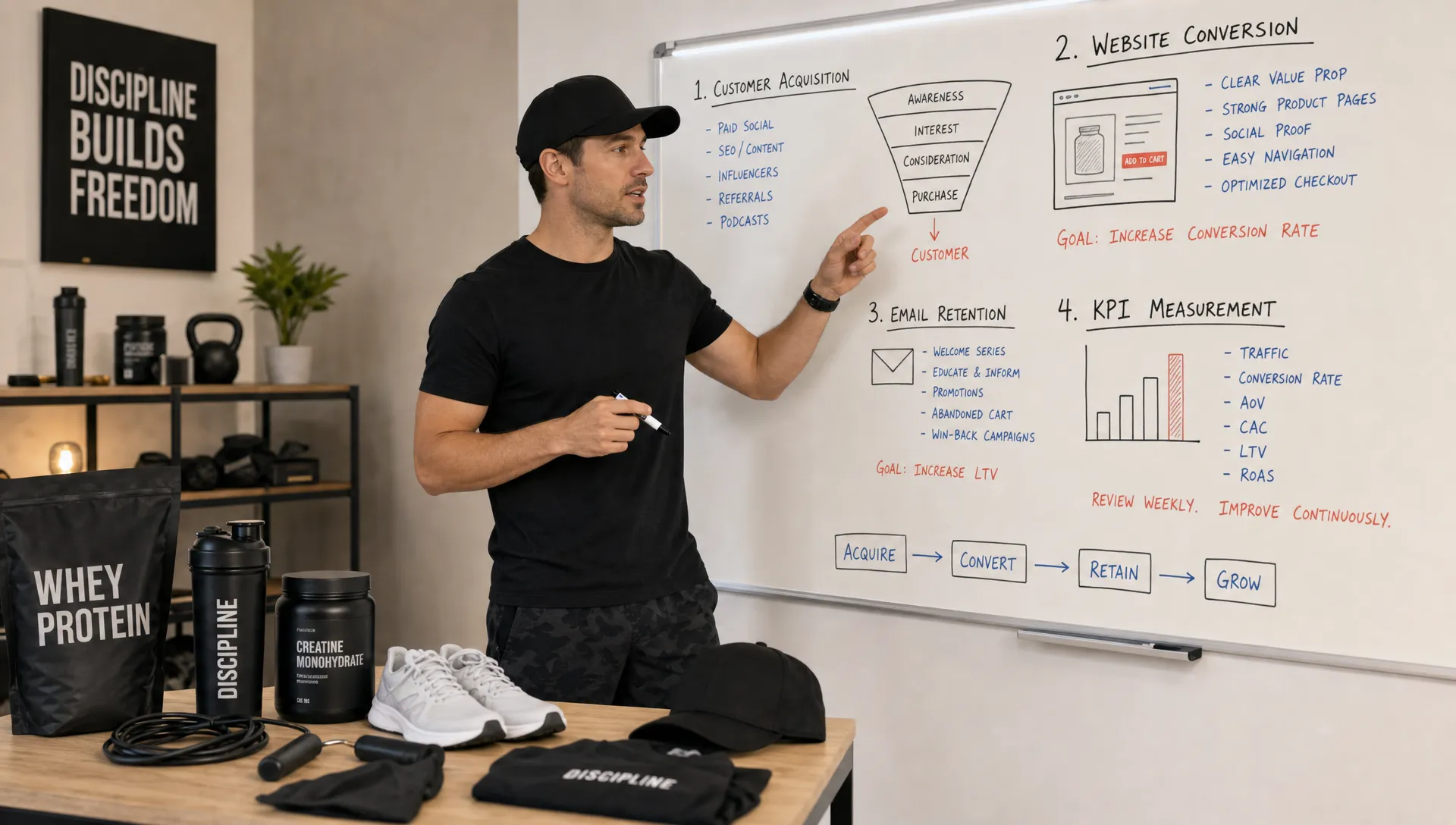
Marketing consulting services create real growth when they improve the system behind demand, conversion, retention, and measurement. The output should not be a disconnected set of recommendations. It should be a clearer path from brand strategy to channel execution.
When consulting is most likely to move the business
Consulting tends to work best when a brand has already proven some level of demand. If no one has bought the product, no amount of marketing strategy can replace product validation. But if customers are buying, reviews are promising, and there is a real audience, consulting can help the brand scale with less guesswork.
The right timing often shows up as tension. Sales are happening, but growth feels inconsistent. Paid social works one month and struggles the next. The team is testing creative, but the insights are not changing the strategy. Email and SMS exist, but retention is not being treated as a serious profit lever. The founder knows the brand has potential, but the growth plan feels reactive.
If your brand is still deciding whether outside help is appropriate, OPTYO has a deeper breakdown of when marketing consulting makes sense for growing brands. The key point is simple: consulting is most valuable when the business has enough traction to diagnose, but enough uncertainty to benefit from sharper strategic direction.
What a strong consultant diagnoses first
Weak consulting starts with tactics. Strong consulting starts with diagnosis.
Before recommending campaigns, channels, or creative angles, a consultant should understand the business model. That includes gross margin, average order value, repeat purchase rate, fulfillment realities, inventory constraints, customer acquisition cost, and contribution margin. For D2C and CPG brands, the most exciting marketing idea can still be the wrong move if the economics cannot support it.
They should also understand the customer. Not just basic demographics, but the real buying trigger. A runner buying recovery products, a gym owner purchasing equipment, and a wellness customer trying a new supplement all have different anxieties, motivations, and proof requirements. Growth improves when messaging reflects the customer’s actual decision process.
The best consultants also look at operational bandwidth. A founder-led brand may not be able to execute a complex multi-channel plan. A lean team might need fewer priorities, tighter reporting, and a clearer test cadence. Real growth comes from strategy the team can actually implement.
The conditions that turn consulting into growth
Marketing consulting services are not automatically valuable. They become valuable when the engagement has the right ingredients.
- A clear business constraint: The consultant and founder should agree on the primary bottleneck. It might be acquisition cost, weak conversion, low repeat purchase, unclear positioning, or poor creative throughput.
- Enough data to interpret: The brand does not need enterprise-level analytics, but it needs enough order, traffic, ad, email, and customer data to separate patterns from assumptions.
- A specific audience and offer: Consulting becomes sharper when the brand knows who it serves and why customers choose it over alternatives.
- Founder and team buy-in: Recommendations only matter if the team is willing to change priorities, test new ideas, and stop doing work that is not contributing to growth.
- Specialized expertise: A generalist may help with broad planning, but category understanding matters when buying behavior, seasonality, and competitive dynamics are specific.
Specialization is underrated. In manufacturing, for example, a business that needs precision components would not look for a generic vendor, it would look for a certified manufacturer of custom shafts and rollers with the right technical capabilities. Marketing is different, but the principle is similar. A sports, fitness, or wellness brand benefits from partners who understand the category, the customer, and the economics of scaling physical products.
Where marketing consulting services actually create lift
Growth rarely comes from fixing one isolated tactic. It usually comes from improving several connected parts of the business. A consultant’s role is to decide which levers matter most right now and how they should work together.
Positioning is often the first lever. If customers cannot quickly understand what the brand does, who it is for, and why it is different, every channel becomes more expensive. Strong positioning makes ad creative sharper, product pages clearer, email flows more persuasive, and retention campaigns more relevant.
Offer architecture is another growth lever. Many ecommerce brands have good products but weak buying paths. Consulting can help clarify bundles, starter offers, subscription logic, gifting opportunities, wholesale considerations, or product sequencing. The goal is not to discount more. The goal is to make the next purchase decision easier.
Paid acquisition also benefits from consulting, especially when brands have been treating platforms as strategy. Meta, Google, TikTok, and other channels can distribute demand, but they do not create a growth thesis by themselves. A consultant can help define which audiences, hooks, creative concepts, and funnel stages deserve investment.
Conversion rate optimization is where strategy meets the store experience. A founder may think they have a traffic problem when they actually have a trust problem, a product education problem, or a checkout friction problem. Improving product pages, landing pages, navigation, social proof, and offer clarity can make existing traffic more valuable.
Retention is often where profitable growth is unlocked. Email, SMS, loyalty, replenishment, content, and post-purchase education can increase lifetime value without constantly chasing new customers. For sports and wellness brands, this is especially important because customers often need education, habit formation, and trust before repeat purchase behavior becomes consistent.
These levers should connect to a broader company growth strategy, not sit as one-off projects. Consulting creates real growth when every recommendation supports the same commercial objective.
How to measure whether consulting is working
Founders should not judge consulting only by how impressive the strategy sounds. They should judge it by whether the business starts making better decisions and producing better outcomes.
Some results are lagging indicators. Revenue, profit, customer acquisition cost, blended ROAS, conversion rate, average order value, customer lifetime value, repeat purchase rate, and email revenue contribution take time to move. These metrics matter, but they may not shift immediately if the brand needs creative testing, site changes, or lifecycle improvements first.
Leading indicators are equally important. A consulting engagement is working when the team has a clearer testing roadmap, faster creative learning cycles, cleaner reporting, more disciplined priorities, and stronger alignment between brand and performance. These changes often appear before the revenue curve visibly improves.
The best reporting does not drown the founder in dashboards. It answers practical questions. Are we acquiring the right customers? Are we improving conversion quality? Are we learning which messages create action? Are customers coming back? Are we investing in the channels that match our economics?
When consulting will not create growth
There are times when marketing consulting services are not the right answer. If the product has no meaningful demand, consulting may only reveal that the brand needs deeper product work. If margins are too thin, marketing may accelerate a model that cannot scale profitably. If fulfillment is unreliable, more demand can create more customer dissatisfaction.
Consulting also fails when the founder wants validation instead of change. A consultant can diagnose the problem, but they cannot force a team to stop wasteful work, simplify priorities, or confront weak positioning. Growth requires decision-making discipline.
A consulting engagement is also unlikely to work if there is no owner for implementation. Strategy without execution becomes expensive documentation. Even if the consultant is not managing every channel, someone needs to translate the strategy into shipped creative, updated site experiences, lifecycle campaigns, SEO work, reporting, or paid media tests.
Finally, beware of consulting that promises certainty where uncertainty is unavoidable. Good consultants can improve the odds, design better tests, and reduce waste. They should not pretend that every campaign will win or that growth can be guaranteed on a fixed timeline.
What founders should ask before hiring a consultant
The right questions can reveal whether a consultant will create clarity or just more activity. Instead of asking only about services, ask how they think.
- What do you diagnose before recommending tactics? This shows whether they understand business economics, customer behavior, and funnel constraints.
- How do you prioritize growth opportunities? This reveals whether they can separate high-impact work from nice-to-have ideas.
- What metrics do you use to judge success? This helps prevent vanity reporting and unclear expectations.
- How do you turn strategy into execution? This matters because growth depends on what gets shipped, tested, and improved.
- What category experience do you bring? For sports, fitness, wellness, and CPG brands, category fluency can shorten the learning curve.
The answer you want is not a generic promise to scale. You want a clear process for identifying the constraint, building the plan, executing the highest-impact work, and measuring whether the business is improving.
Why category fit matters for sports, fitness, and wellness brands
Sports, fitness, and wellness customers do not buy only on features. They buy based on trust, identity, proof, aspiration, and perceived fit with their goals. That makes growth strategy different from selling a commodity product.
A performance nutrition brand may need education and credibility before conversion. A fitness equipment brand may need product demonstrations and financing clarity. A wellness CPG brand may need strong subscription logic, reviews, ingredient transparency, and post-purchase support. In each case, the growth system should reflect how customers actually buy.
That is why consulting for these categories should connect brand and performance. If brand work never reaches ads, product pages, or email, it stays abstract. If performance marketing ignores positioning and customer trust, it becomes expensive and fragile. The strongest growth strategies bridge both sides.
How OPTYO approaches growth consulting
OPTYO works at the intersection of performance marketing and brand acceleration for sports, fitness, wellness, D2C, and CPG companies. That combination matters because real growth is rarely only a media buying problem or only a branding problem.
For an emerging ecommerce brand, the useful work may include performance marketing strategy, creative asset production, ecommerce development, conversion rate optimization, email marketing, search engine optimization, KPI reporting, and growth consulting. The mix depends on the brand’s stage, constraints, and goals.
The most valuable outcome is not more marketing activity. It is a clearer operating system for growth. That means sharper priorities, better creative decisions, stronger conversion paths, more useful retention programs, and reporting that helps founders make better calls.
Frequently Asked Questions
What are marketing consulting services? Marketing consulting services help a business diagnose growth constraints, define strategy, prioritize channels, improve customer acquisition and retention, and create a plan for better execution. For ecommerce brands, this often includes positioning, paid media strategy, conversion optimization, email marketing, SEO, creative direction, and measurement.
When do marketing consulting services create real growth? They create real growth when the business has traction, a clear market opportunity, and enough willingness to act on the diagnosis. The best results happen when consulting improves the whole growth system, not just one campaign.
How long does it take to see results from marketing consulting? It depends on the constraint. Strategic clarity can happen quickly, but measurable performance changes usually require implementation, testing, and enough traffic or customer data to evaluate results. Be cautious of anyone promising guaranteed outcomes on a fixed timeline.
Is consulting better than hiring an agency? They solve different problems. Consulting is useful when the brand needs diagnosis, strategy, prioritization, and direction. An agency is useful when the brand needs ongoing execution. Many growing brands need both, but the order matters.
Can a small ecommerce brand benefit from consulting? Yes, if it has enough traction to analyze and enough capacity to implement. Very early brands may need product validation first. Growing brands with real demand often benefit most because better strategy can prevent expensive mistakes.
Build growth on a clearer strategy
If your sports, fitness, wellness, or CPG brand has traction but growth feels inconsistent, marketing consulting services can help identify what is holding the business back and where to focus next.
OPTYO helps ecommerce brands connect performance marketing, creative, conversion, retention, SEO, reporting, and brand strategy into a more disciplined growth system. To explore how that could apply to your brand, start with OPTYO.