.png)



Paid traffic can accelerate ecommerce growth quickly, but it can also expose every weak spot in your business model. A campaign that looks successful in an ad dashboard may still be unprofitable once you account for product costs, shipping, discounts, payment fees, returns, creative production, and retention gaps.
That is why the best pay per click advertising services are not just built to generate clicks or revenue. They are built to protect margin. For sports, fitness, and wellness brands where products often involve inventory risk, seasonal demand, subscription offers, influencer pressure, and competitive acquisition costs, the difference between growth and cash burn is often the discipline behind the PPC system.
Margin-protective PPC connects media buying to unit economics. It asks better questions before spend increases. Which products can we afford to scale? Which audiences buy once and never return? Which offers lift conversion without training customers to wait for discounts? Which campaigns are profitable after all variable costs, not just after platform-reported ROAS?
The real job of PPC is profitable demand capture
PPC is often treated as a traffic lever. Put budget into Google, Meta, TikTok, or another platform, then wait for sales. But profitable ecommerce teams treat PPC as a demand capture and demand creation system tied to cash flow.
The key metric is not just return on ad spend. ROAS matters, but it is only useful when it is connected to contribution margin. A 3x ROAS can be excellent for one product and disastrous for another, depending on gross margin, fulfillment costs, discounting, and repeat purchase behavior.
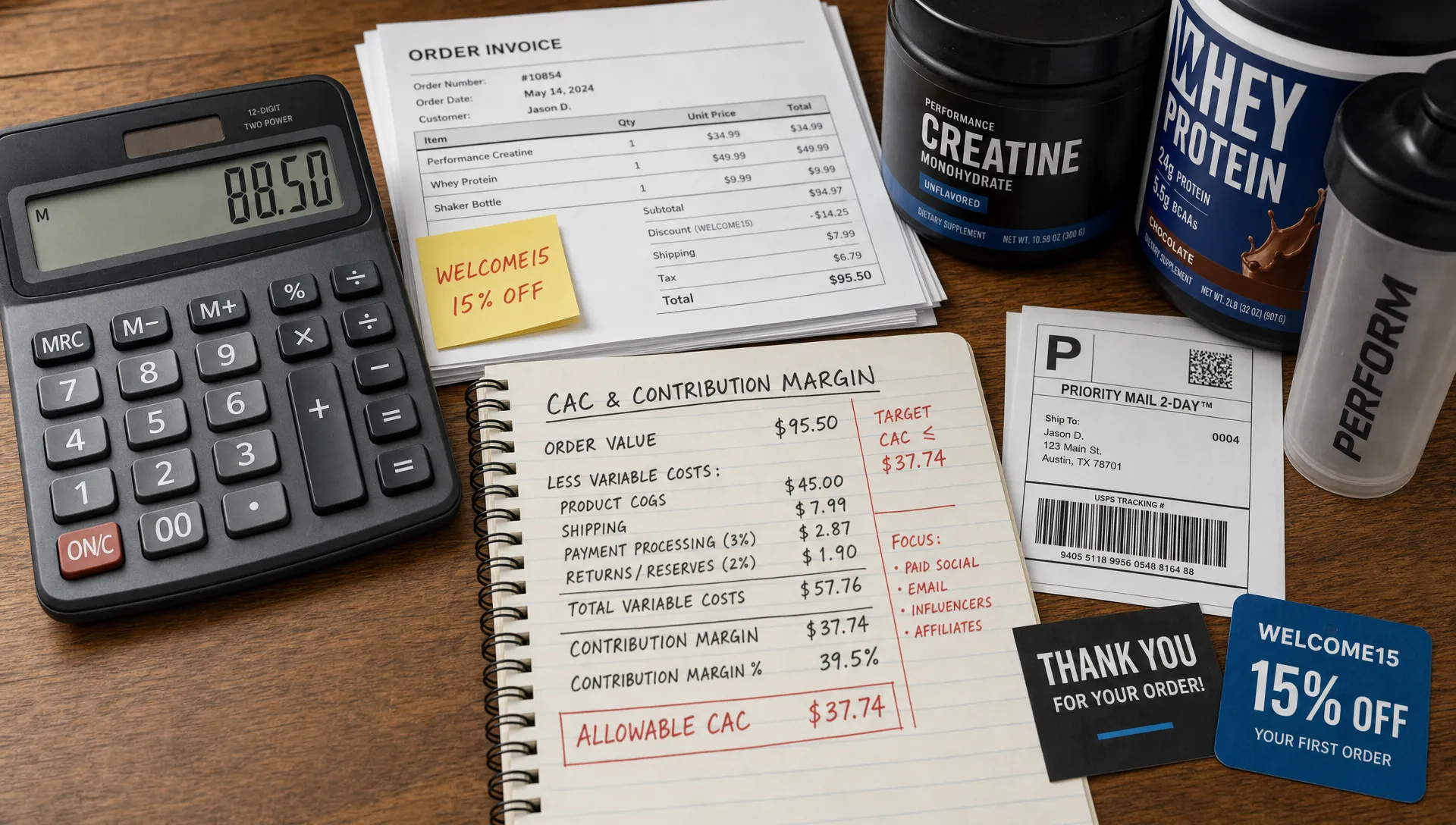
A simple margin model starts with the money left after each order:
- Average order value: The revenue generated per order before refunds and returns.
- Product cost: Cost of goods sold, packaging, and any product-specific handling cost.
- Variable fulfillment cost: Shipping, pick and pack, third-party logistics, and payment processing.
- Discount and return reserve: The margin you expect to lose through promotions, refunds, exchanges, or damaged goods.
- Allowable acquisition cost: The maximum you can spend to acquire a customer while still hitting your profit target.
For example, an $80 order may only leave $30 before acquisition costs after product cost, fulfillment, payment fees, and expected discounts. If the brand wants to retain $8 of contribution profit on the first order, the allowable customer acquisition cost is $22. That means the campaign needs to acquire customers at or below $22, or the brand needs a strong retention case to justify a higher first-order CAC.
Without that math, PPC teams can unintentionally scale revenue while thinning margin. With it, they can make smarter decisions about bidding, creative, offers, landing pages, and product prioritization.
What margin-focused pay-per-click advertising services include
A margin-focused PPC engagement begins before campaigns are built. The agency or internal team needs to understand what the business can afford, where profit actually comes from, and where media spend is most likely to leak.
Unit economics before campaign structure
The first service should be a unit economics review. This does not need to be complicated, but it does need to be specific. Blended margin is rarely enough because ecommerce catalogs usually contain products with very different economics.
A premium supplement bundle, a single low-margin accessory, and a clearance item should not be treated the same way inside the ad account. The same is true for sports apparel, fitness equipment, wellness products, and consumables. A campaign can look healthy in aggregate while one product line quietly drains cash.
A strong PPC team will map products into groups based on margin, conversion rate, inventory position, AOV, reorder potential, and strategic value. That map becomes the foundation for campaign structure and budget allocation.
Campaign structures that prevent hidden cross-subsidies
One of the most common PPC margin problems is cross-subsidy. High-margin products or branded search campaigns make the account look profitable while prospecting campaigns, low-margin SKUs, or aggressive retargeting quietly underperform.
A better structure separates campaigns by intent, product economics, and role in the funnel. Branded search should not be blended with non-branded acquisition. Existing customers should not be mixed with first-time buyers if the goal is new customer growth. Products with different margin profiles should not always share the same budget pool.
This is also where wasted spend gets reduced. If you want a deeper breakdown of the mechanics, OPTYO has a practical guide on how a pay per click agency lowers wasted spend across keywords, tracking, landing pages, and product feeds.
Intent control across search and shopping
Google Search and Shopping can be extremely profitable when campaigns are aligned with buyer intent. They can also become expensive quickly when broad queries, weak product feeds, or poor negatives pull spend toward low-intent traffic.
Margin protection in search usually includes tighter query review, negative keyword management, brand versus non-brand separation, product feed optimization, and bid strategies that reflect real conversion value. For ecommerce brands, this means not every click deserves the same bid. A searcher comparing generic workout gear may need a different bid and landing page than someone searching for a specific product type, size, feature, or use case.
The goal is not to block all exploration. It is to make sure discovery traffic has a defined test budget, clear success criteria, and a path toward profitable conversion.
Creative testing that improves conversion quality
On paid social, creative is often the main targeting lever. The message you put in-market determines who stops, who clicks, and who buys. That means creative testing is not just a brand activity. It is a margin activity.
For sports, fitness, and wellness brands, creative should test more than visuals. It should test the purchase argument. Does the buyer respond to performance outcomes, ingredient transparency, durability, community, transformation, convenience, or expert credibility? Does the ad attract serious buyers or casual browsers? Does it sell the product honestly, or does it create expectations that increase returns and customer service issues?
Margin-protective creative focuses on qualified conversion, not just low-cost attention. A cheap click that never turns into a profitable customer is not efficient. A slightly more expensive click from a better-qualified buyer can be the smarter acquisition path.
Margin leaks that PPC services should catch early
The ad account is rarely the only source of PPC inefficiency. Paid traffic amplifies whatever is already happening in the business. If the offer is weak, the landing page is slow, the checkout has friction, or the post-purchase journey is thin, campaigns will pay for those problems.
Some of the most common margin leaks include discount dependency, where sales rise only when promotions cut too deeply into profit. Another is blended reporting, where total ROAS hides the difference between high-margin acquisition and low-margin repeat purchases. Return rates can also distort performance, especially in categories where sizing, taste, fit, or usage expectations matter.
Inventory adds another layer. Scaling spend into a product that is about to stock out can waste learning and frustrate customers. Continuing to advertise low-stock products can push buyers toward substitute products with worse economics. On the other hand, using PPC to move inventory can be smart when the discount and margin tradeoff are intentional.
Technical reliability matters too. A profitable campaign can become unprofitable if the site slows down during peak traffic, checkout breaks, or customer data is not secure. That is why growth teams should not ignore the infrastructure behind the sale. For brands operating in regions where local resilience is important, such as the Antilles-Guyane market, partners offering IT management, cloud, and cybersecurity support can help keep the ecommerce stack stable enough to handle paid traffic peaks.

Reporting should show profit signals, not just platform metrics
A margin-protective PPC service does not rely only on the numbers inside the ad platform. Platform dashboards are useful, but they are not the complete financial picture. They may over-credit campaigns, miss returns, ignore cost of goods, or treat all revenue as equally valuable.
Good reporting should help the founder, operator, or marketing lead answer business questions:
- Are we acquiring new customers at or below our allowable CAC?
- Which products and offers are producing the strongest contribution margin?
- Are discounts improving total profit or only increasing top-line revenue?
- Are returning customers being overcounted as paid acquisition wins?
- Which campaigns deserve more budget, and which should be capped or rebuilt?
- Is LTV strong enough to justify a higher first-order CAC?
This is where paid media connects to broader performance marketing. PPC, CRO, email, SEO, and retention should not operate in separate silos. If PPC is buying traffic that does not convert, CRO needs to improve the path to purchase. If CAC is rising, email and SMS retention may need to increase repeat purchase value. If paid search is expensive for certain queries, SEO may be a better long-term acquisition channel. OPTYO explains this broader profit lens in its article on how performance marketing for ecommerce improves profitability.
CRO is part of PPC margin protection
Conversion rate optimization is often treated as a separate service, but it is one of the most important ways PPC protects margin. If conversion rate improves without increasing media cost, allowable CAC effectively becomes easier to hit.
For example, if a landing page converts 2 percent of paid traffic and then improves to 3 percent, the same traffic can produce 50 percent more orders. That can reduce pressure on bidding, improve learning efficiency, and give the brand more room to test creative and offers.
Margin-focused CRO looks at the full buying path. Product detail pages need clear positioning, strong proof, fast-loading media, transparent shipping information, and fewer distractions. Cart and checkout need to reduce hesitation. Bundles, subscriptions, and upsells should raise order value without confusing the buyer or creating post-purchase dissatisfaction.
For sports and wellness brands, CRO also needs to address trust. Customers want to know whether the product fits their goal, their body, their routine, or their standards. Strong landing pages answer those questions before the buyer has to search elsewhere.
Offer strategy should protect contribution, not just lift conversion
Offers can make PPC look better in the short term. Free shipping, bundles, percentage discounts, buy-one-get-one promotions, and limited-time deals can all improve conversion rate. But an offer that lifts ROAS while cutting too deeply into margin is not a win.
A better PPC service tests offers through contribution margin. Sometimes the best offer is not the biggest discount. It may be a higher-AOV bundle, a subscription incentive, a gift with purchase using a high-perceived-value item, or a threshold-based shipping offer that nudges customers into a more profitable cart.
The offer should match the buyer stage. Cold prospects may need education and proof more than a discount. Warm retargeting audiences may respond to urgency or social proof. Existing customers may be better served through email rather than paid ads, especially if paying to reacquire them reduces profit.
Scaling rules keep growth from becoming cash burn
Scaling is where many PPC accounts lose discipline. A campaign works for a week, the budget increases aggressively, and performance slips. Sometimes the issue is audience saturation. Sometimes it is creative fatigue. Sometimes the campaign was never profitable after full costs in the first place.
Margin-protective PPC uses scaling rules. Budget increases should be tied to stable CAC, consistent conversion rate, sufficient order volume, inventory readiness, and creative depth. The team should know when to increase spend, when to hold, and when to cut back.
A practical scaling system usually includes a learning budget for new ideas, a validation budget for concepts with early traction, and a scaling budget for campaigns that prove they can maintain contribution margin at higher spend. This prevents one promising test from consuming the entire account before it has earned that level of investment.
It also protects the founder from emotional decision-making. PPC performance will fluctuate. The question is whether the system is designed to identify real signal rather than react to every daily spike or dip.
What to ask before hiring PPC services
If you are evaluating pay-per-click advertising services, the sales conversation should go deeper than platform certifications, campaign examples, or promises of higher ROAS. You are not just hiring someone to spend money. You are hiring a team to make spending decisions under financial constraints.
Ask questions that reveal whether the provider understands margin:
- How will you calculate target CAC for each product or offer?
- Will reporting include contribution margin or only platform ROAS?
- How do you separate branded demand from new customer acquisition?
- How do you account for discounts, refunds, returns, and shipping costs?
- What is your process for creative testing and fatigue management?
- How do you decide when to scale, pause, or restructure a campaign?
- How will PPC connect with landing pages, email, retention, and inventory planning?
The best answers will be specific. A strong PPC partner should be comfortable discussing financial tradeoffs, not just media tactics. They should be able to explain how they will protect cash while still finding opportunities for growth.
The best PPC services make growth more predictable
PPC will never be perfectly predictable. Auction dynamics shift, competitors change bids, creative fatigue sets in, attribution gets messy, and customers behave differently across seasons. But the system around PPC can be disciplined.
For ecommerce entrepreneurs, especially in sports, fitness, and wellness, margin protection is not about being conservative forever. It is about earning the right to scale. When campaigns are tied to unit economics, creative testing, CRO, retention, and better reporting, growth becomes more durable.
The brands that win with PPC are not always the ones that spend the most. They are often the ones that know exactly what they can afford to spend, what kind of customer they are trying to acquire, and which parts of the funnel need improvement before more budget is added.
Frequently Asked Questions
What makes pay-per-click advertising services margin-focused? Margin-focused PPC services use target CAC, contribution margin, product-level economics, conversion quality, and retention potential to guide campaign decisions. They optimize for profitable growth, not just clicks, traffic, or platform-reported revenue.
Should ecommerce brands optimize PPC for ROAS or profit? ROAS is useful, but profit is the better decision metric. A high ROAS campaign can still be weak if it sells low-margin products, relies on heavy discounts, or mostly reaches customers who would have purchased anyway.
How much should a brand spend before judging PPC performance? It depends on AOV, conversion rate, sales cycle, and the size of the test. Before launching, define a testing budget, minimum conversion threshold, target CAC, and stopping rules so decisions are based on signal rather than guesswork.
Can PPC protect margin if the website conversion rate is low? PPC can reduce waste and improve traffic quality, but a low-converting website will still limit profitability. CRO, landing page improvements, offer testing, and checkout optimization are often required to make paid traffic financially viable.
When should an ecommerce brand scale PPC spend? Scale when CAC, conversion rate, contribution margin, creative performance, and inventory position are stable enough to support higher spend. Increasing budget without those guardrails can turn a promising campaign into cash burn.
Build PPC around profit, not just spend
If your paid media is growing revenue but not improving contribution margin, the problem may not be budget. It may be the system behind the budget.
OPTYO helps sports, fitness, and wellness ecommerce brands connect performance marketing, creative, CRO, email, SEO, KPI reporting, and growth strategy so paid traffic supports healthier growth. If you want PPC that is built around margin protection from the start, work with OPTYO to build a more disciplined path to scale.