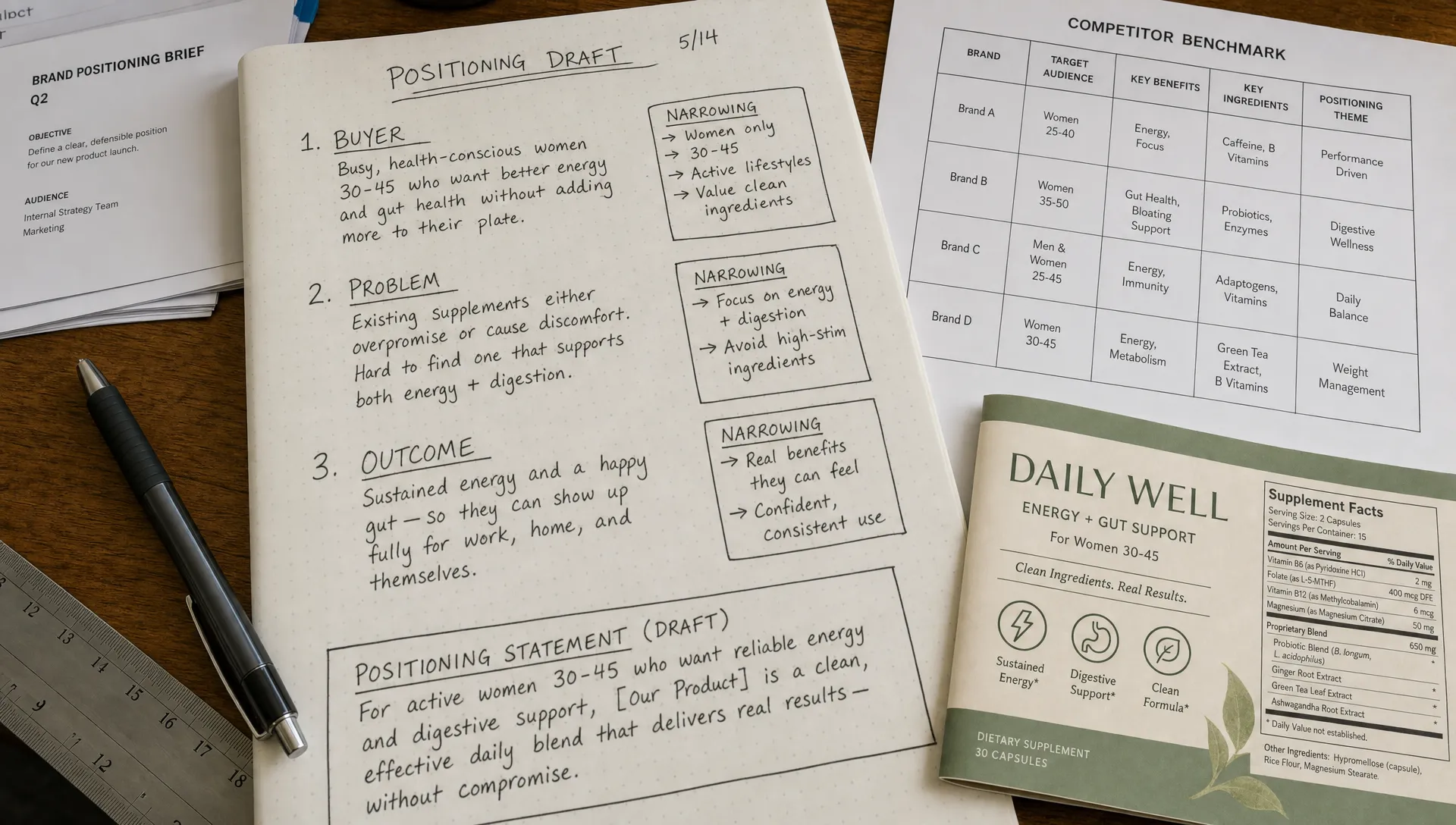
.png)




In a crowded ecommerce market, customers rarely choose the objectively best product. They choose the product they understand fastest, remember easiest, and trust most when it is time to buy.
That is where a creative branding agency can have a direct impact on growth. Not by making a brand look more polished in isolation, but by shaping how the market sees the brand, what the brand becomes known for, and why customers should pick it over everything else in the category.
For sports, fitness, wellness, and consumer product brands, market position is especially important. Many brands sell similar outcomes: better performance, better recovery, better energy, better confidence, better health. If the creative expression is generic, the offer becomes easy to compare on price. If the position is clear, the brand becomes easier to choose.
What market position really means
Market position is the space your brand owns in the mind of a specific customer. It is not only your tagline, visual identity, packaging, or ad creative. Those are expressions of the position.
A strong position answers four practical questions:
- Who is this brand for?
- What problem or desire does it solve better than alternatives?
- Why should the customer believe it?
- What emotional or functional idea should people associate with it?
For an ecommerce founder, this matters because market position affects nearly every growth lever. It influences what customers click on in paid ads, how they interpret your product page, whether they understand your pricing, what they tell friends, and whether they come back after the first purchase.
A brand can have strong products and still struggle if the market cannot quickly understand its role. A hydration brand may be formulated for endurance athletes, but if the creative looks like every lifestyle beverage on the shelf, the performance customer may not see themselves in it. A fitness equipment brand may be premium, but if the messaging does not communicate durability, training outcomes, and trust, shoppers may treat it like a commodity.
Why creative is central to positioning
Positioning starts with strategy, but it becomes real through creative. Customers do not experience a strategy deck. They experience product photos, headlines, packaging, landing pages, creator content, emails, ads, and the tone of every interaction.
A creative branding agency translates strategic choices into visible and memorable signals. That work can include naming systems, messaging, visual identity, campaign concepts, product storytelling, social creative, and ecommerce experience design. The goal is not just consistency. The goal is recognition, clarity, and preference.
This is where creative branding differs from surface-level design. A nice-looking brand can still be forgettable. A well-positioned brand uses creative choices to reinforce a specific place in the market. Color, typography, copy, photography, product claims, and offer structure all point in the same direction.
If you are still defining the strategic foundation underneath the creative, it can help to understand what a brand strategy agency actually does before moving into execution. Strategy defines the ground. Creative makes that ground visible to the buyer.
How a creative branding agency shapes market position
A good agency does not begin by asking what style you like. It begins by understanding the business, the buyer, and the competitive field. The best creative decisions are grounded in commercial reality.
It clarifies the customer you want to win
Market position becomes sharper when the customer is specific. Many ecommerce brands make the mistake of positioning around everyone who could buy the product. That usually leads to broad claims, diluted creative, and a weak reason to choose.
A creative branding agency looks at the highest-value customer segments, buying motivations, objections, and moments of need. For sports and wellness brands, the difference between customer groups can be dramatic. A casual gym-goer, competitive athlete, busy parent, and physical therapy patient may all buy recovery products, but they respond to different proof points, visuals, and emotional triggers.
This work is closely connected to market definition. If your customer segments still feel too broad, OPTYO’s guide on how to define your target market for faster growth is a useful next step.
It audits category norms and finds whitespace
Every category has patterns. Performance nutrition brands often lean on bold colors, ingredient callouts, and athlete imagery. Wellness brands often use soft palettes, minimal packaging, and calming language. Fitness equipment brands often emphasize strength, durability, and transformation.
None of these patterns are automatically wrong. In fact, category conventions can help customers understand what you sell. The problem starts when every brand uses the same visual and verbal playbook.
A creative branding agency evaluates what competitors are saying, how they look, what they promise, and which customer emotions they own. Then it identifies whitespace: the position your brand can credibly claim without blending in.
Whitespace might be functional, such as the most convenient recovery solution for travel athletes. It might be emotional, such as a strength brand built around discipline rather than hype. It might be cultural, such as a wellness brand that rejects perfection and speaks to real-life consistency.
It turns differentiation into a simple promise
Differentiation only works when customers can repeat it. Many founders know why their product is different, but they communicate that difference through too many details at once.
A creative branding agency helps compress complexity into a market-facing promise. That promise should be specific enough to matter and broad enough to scale.
For example, a supplement brand may have patented ingredients, cleaner sourcing, and a subscription model. Those details matter, but the customer may need a simpler idea first: daily performance support without the crash. Once that promise is clear, ingredient proof, sourcing standards, reviews, and offers can support it.
The strongest positioning often has a clear hierarchy. The big idea creates attention. The proof points reduce doubt. The offer makes action easy.
It builds brand assets customers can recognize
Recognition is one of the most underrated parts of market position. If customers cannot recognize your brand across channels, your marketing has to work harder every time.
A creative branding agency develops memory assets that help customers connect repeated impressions. These can include a distinctive color system, photography style, layout structure, product naming convention, campaign language, packaging cues, or recurring content themes.
For ecommerce brands, these assets need to work in fast-moving environments. A customer may see your brand first in a Meta ad, then later in a TikTok video, Google search result, Amazon listing, retail shelf, email, or post-purchase insert. The position should feel connected everywhere without every asset looking identical.
It aligns performance creative with brand meaning
For growth-stage ecommerce companies, positioning cannot live separately from performance marketing. Ads, landing pages, and offers are often where customers first understand the brand.
This is why creative branding should support customer acquisition, not compete with it. The agency should help translate the brand position into testable hooks, angles, landing page narratives, and conversion-focused creative. The result is a brand that is both distinctive and measurable.
A premium fitness product, for instance, should not rely only on beautiful studio photography. It may also need comparison ads, durability demonstrations, founder storytelling, user-generated content, and product education. Each format can serve a different buying objection while reinforcing the same position.

Where market position shows up in ecommerce
A market position is not complete until it appears throughout the customer journey. If your paid ads say one thing, your product page says another, and your email flow sounds like a third brand, the customer has to do extra work to understand you.
In ecommerce, positioning is usually expressed through several key touchpoints:
- Paid social creative: The first few seconds should make the category, customer, and core benefit clear.
- Product pages: Headlines, visuals, claims, reviews, and FAQs should reinforce the reason to choose.
- Landing pages: The page narrative should turn the brand promise into a focused conversion journey.
- Email and SMS: Retention messaging should deepen the position after purchase, not just promote discounts.
- Packaging and unboxing: Physical brand moments should confirm the value customers believed they were buying.
- SEO and content: Educational content should build authority around the same problem space the brand wants to own.
This is why landing page strategy is such a useful test of positioning. If the core promise is unclear, the page will often feel cluttered. If the position is sharp, the page has a natural narrative. For more on that conversion layer, see how a landing page agency can lift conversion rates.
How creative positioning improves decision-making
One of the biggest benefits of a clear market position is operational focus. It gives founders and marketing teams a filter for decisions.
Without a clear position, every new creative direction can seem plausible. One month the brand sounds premium and technical. The next month it sounds playful and lifestyle-driven. Then the team chases a competitor’s campaign style because it performed well for someone else.
With a clear position, decisions become easier. The team can ask: Does this campaign strengthen what we want to be known for? Does this creator partnership match the customer we are trying to win? Does this product page reinforce our reason to believe? Does this discount strategy support or weaken our perceived value?
For lean teams, tools can help with parts of the workflow, from research and analytics to creative production and content planning. If you are comparing software to support that process, independent digital tool guides can be useful, especially when you need to evaluate options quickly without adding unnecessary complexity.
Still, tools do not replace positioning judgment. They can organize data, speed up execution, and improve testing, but the brand still needs a clear point of view.
A practical example for sports, fitness, and wellness brands
Imagine a direct-to-consumer recovery brand selling compression gear. The product is high quality, but the category is crowded. Competitors talk about recovery, circulation, comfort, and performance. If the brand uses the same claims and similar visuals, customers may compare it mainly on price or reviews.
A creative branding agency might uncover a sharper opportunity. Perhaps the brand is best suited for serious recreational athletes, people who train hard before or after work and need recovery products that fit into a busy life. That insight could shift the market position from general recovery gear to recovery for athletes with full schedules.
That position would shape creative choices. Photography might show early mornings, work bags, gym floors, race preparation, and post-training routines rather than only elite athletes in studio settings. Copy might focus on consistency, readiness, and making training sustainable. Product pages might emphasize comfort during long wear, easy care, and credible performance proof. Email flows might educate customers on building recovery habits around real schedules.
The product did not change. The meaning became sharper.
That is the power of market position. It helps the right customer see the product as made for them.
Signs your market position needs work
Not every branding problem requires a full rebrand. Sometimes the issue is message hierarchy, creative consistency, or customer definition. But there are signals that your market position may be holding back growth.
You may need to revisit positioning if customers often misunderstand what makes your product different. The same is true if your ads generate clicks but your product pages struggle to convert, or if your team keeps testing creative angles that feel disconnected from each other.
Other warning signs include frequent price objections, weak repeat purchase behavior, inconsistent creator content, unclear product architecture, or a brand identity that looks attractive but could belong to many competitors.
In these cases, more ad spend is rarely the full answer. Paid media can amplify a position, but it cannot fix confusion at the core of the brand. The stronger move is to clarify what the brand should own, then rebuild creative and performance systems around that idea.
What to look for in a creative branding agency
The right partner should understand both brand and growth. For ecommerce brands, especially in sports, fitness, and wellness, creative has to do more than look premium. It has to help customers choose.
Look for an agency that asks about business economics, customer segments, conversion issues, product margins, retention, and channel performance. This shows they understand that brand positioning is connected to revenue, not just aesthetics.
A strong creative branding agency should also be comfortable with testing. Positioning provides direction, but execution still needs iteration. Hooks, visuals, offers, landing page flows, and proof points should be refined based on customer response.
The best partner will help you create a brand system that is distinct enough to be remembered, clear enough to convert, and flexible enough to scale across channels.
Frequently Asked Questions
What does a creative branding agency do? A creative branding agency turns brand strategy into market-facing assets such as messaging, visual identity, campaigns, ecommerce creative, and customer touchpoints. Its role is to help the brand become easier to understand, remember, and choose.
How does a creative branding agency shape market position? It clarifies the target customer, studies the competitive landscape, defines the brand’s differentiated promise, and expresses that position through creative systems across ads, product pages, packaging, content, and retention channels.
Is market position the same as brand identity? No. Market position is the place your brand aims to own in the customer’s mind. Brand identity is one way that position is expressed visually and verbally through design, messaging, tone, and creative assets.
Can better positioning improve paid advertising performance? Yes, because clear positioning makes ad creative easier to understand and more relevant to the right buyer. It can improve message clarity, creative testing, landing page alignment, and perceived value.
When should an ecommerce brand revisit its positioning? Revisit positioning when growth stalls, customer acquisition costs rise, competitors start sounding similar, your product line expands, or customers do not clearly understand why your brand is different.
Build a position your market can remember
A creative branding agency shapes market position by turning strategy into signals customers can instantly recognize and trust. For ecommerce brands, that can be the difference between being another option in the category and becoming the obvious choice for a specific buyer.
OPTYO helps sports, fitness, and wellness brands connect brand strategy, creative, and performance marketing so growth is not built on guesswork. If your brand needs a sharper position and a clearer path to scale, start with OPTYO.