.png)




Sports ecommerce is crowded, but it is not random. The brands that grow are usually the ones that connect performance, identity, proof, and convenience into one buying journey. A customer is not only purchasing shoes, supplements, recovery tools, apparel, or equipment. They are buying the feeling of being stronger, faster, healthier, more disciplined, or more connected to a community.
That is why the best sports marketing strategies do more than drive traffic. They create demand, remove doubt, improve conversion, and keep customers engaged after the first purchase. For entrepreneurs and ecommerce operators, the opportunity is to build a growth system where brand and performance support each other instead of competing for budget.
Below are seven strategies sports, fitness, and wellness brands can use to drive measurable ecommerce growth.
1. Position the brand around a specific athletic identity
A common mistake in sports ecommerce is trying to appeal to everyone who “works out.” That sounds broad enough to scale, but it often makes the brand forgettable. Strong positioning gives customers a clear reason to choose you over a marketplace, a legacy brand, or a cheaper alternative.
Your positioning should answer three questions:
- Who is this built for?
- What outcome does it help them achieve?
- Why should they believe your product is different?
For example, a running apparel brand may not simply sell “high-performance gear.” It might serve first-time marathoners training in unpredictable weather. A wellness brand might not simply sell recovery products. It might help busy athletes reduce soreness between training sessions. The more specific the customer context, the easier it becomes to write ads, landing pages, emails, and product descriptions that convert.
This does not mean you stay small forever. It means you create a strong beachhead. Once your first audience believes the brand was built for them, expansion becomes easier and more credible. If you need a deeper framework for this, OPTYO’s breakdown of what a brand strategy agency actually does explains how positioning, messaging, and customer experience work together.
2. Turn athlete and customer stories into conversion assets
Sports marketing has always relied on aspiration. The difference in ecommerce is that aspiration has to be converted into action quickly. A beautiful campaign can build awareness, but shoppers still need to understand how the product fits into their training, recovery, routine, or lifestyle.
That is where customer stories, creator content, and athlete use cases become powerful. They help shoppers see the product in context. Instead of only showing the item on a white background, show the moment it matters: before a workout, during competition, after training, while traveling, or as part of a morning wellness routine.
The best content usually combines three ingredients: a relatable problem, a credible product use case, and a clear next step. This could be a creator explaining why they switched from one type of training gear to another, a coach demonstrating proper product use, or a customer sharing how the product became part of their weekly routine.
For paid social, avoid treating creator content as a single “UGC ad.” Build a library of angles. One video might handle skepticism. Another might compare features. Another might show a quick routine. Another might focus on the emotional benefit of consistency. Over time, this gives your media team more ways to test demand without constantly reinventing the brand.
Also remember disclosure and compliance. If you work with athletes or creators, sponsored content should be clearly identified. If your product touches health, recovery, or performance claims, keep the language accurate and supportable.
3. Build paid media around intent, not just demographics
Many sports brands start paid advertising by targeting interests: runners, gym-goers, cyclists, yoga fans, golfers, CrossFit athletes, and so on. Interest targeting can help, but it is rarely enough by itself. The better question is, “What intent does this person have right now?”
A shopper comparing recovery tools has different needs than someone discovering the category for the first time. A loyal customer looking for a new flavor, size, or accessory has different intent than someone who has never heard of the brand. Your campaigns should reflect those differences.
For ecommerce growth, paid media should usually cover several intent layers:
- Discovery campaigns that introduce the problem and the brand promise.
- Consideration campaigns that educate shoppers on features, proof, and use cases.
- Search and shopping campaigns that capture active demand.
- Retargeting campaigns that address objections and bring people back.
- Retention campaigns that promote replenishment, bundles, launches, or upgrades.
This is where sports marketing strategies need performance discipline. Measure channel-level results, but do not let platform ROAS become the only truth. Look at contribution margin, blended CAC, returning customer revenue, payback period, and MER (marketing efficiency ratio). A campaign can look good in-platform while still failing the business if discounts, shipping costs, and return rates eat the margin.
For a closer look at revenue-focused media execution, see OPTYO’s guide on how a sports advertising agency drives measurable sales.
4. Treat your product page as a sales rep, not a catalog page
In sports, fitness, and wellness ecommerce, the product page often has to do more selling than founders expect. Shoppers may need to understand fit, sizing, ingredients, materials, training benefits, safety considerations, warranty, delivery time, or how one model compares with another.
This is especially true for higher-consideration products. A customer buying recovery equipment, connected fitness tools, or premium gear may need more reassurance than someone buying a low-cost accessory. For example, ecommerce stores that sell professional-grade recovery and wellness devices need to communicate product specs, use cases, trust signals, expert support, and post-purchase expectations clearly because shoppers are making a more informed decision.
Your product detail page should reduce uncertainty. Strong pages typically include clear imagery, concise benefit-led copy, proof points, reviews, comparison guidance, FAQs, shipping and return details, and a visible path to purchase. For apparel, sizing and fit guidance can be a growth lever. For supplements, transparent ingredients and compliance matter. For equipment, setup, durability, and support can make or break conversion.
Checkout also deserves attention. Baymard Institute’s cart abandonment research consistently shows that a large share of online carts are abandoned, which means even small improvements to checkout clarity can protect revenue you already paid to acquire. Hidden fees, unclear delivery timelines, forced account creation, and weak mobile usability all create friction.
The key principle is simple: every product page should answer the questions a great in-store expert would answer before the customer asks.

5. Use email and SMS to turn one purchase into a customer relationship
Paid media may create the first purchase, but owned channels often determine whether the business becomes profitable. Email and SMS are not just promotional tools. They are retention systems that help customers use the product, build trust, and come back at the right time.
For sports ecommerce, lifecycle marketing should match the customer’s journey. Someone buying running gear may need training tips, weather-specific product education, and race-season recommendations. Someone buying supplements may need usage guidance, replenishment reminders, and content that supports consistency. Someone buying recovery tools may need setup education and routine ideas.
The highest-impact flows often include welcome, abandoned cart, browse abandonment, post-purchase education, replenishment, winback, review request, and VIP or loyalty messaging. But the real advantage comes from segmentation. A cyclist, weightlifter, runner, and wellness shopper should not receive the exact same message if their motivations and buying cycles differ.
Good retention marketing also lowers dependency on discounts. If every email is a sale, customers learn to wait. Mix promotions with education, community, expert guidance, product launches, and customer stories. This helps owned channels support brand equity while still driving revenue.
6. Create community loops that generate both trust and content
Sports brands have a built-in advantage: people like to share progress. Training milestones, race results, personal records, recovery routines, transformation stories, team events, and lifestyle rituals all create natural community moments.
The mistake is thinking community only means launching a Facebook group or posting motivational content. A stronger approach is to build loops where customers participate, create, and invite others into the brand.
That might look like a monthly challenge, a local run club, a coach-led training series, an ambassador program, a Strava club, a referral campaign, or event partnerships. The goal is not to manufacture hype. It is to give customers a reason to identify with the brand beyond the transaction.
Community also strengthens performance marketing. Real customer photos, testimonials, event clips, reviews, and product-in-use content can become creative assets. Those assets often feel more believable than studio-only content because they show the product living in the customer’s world.
For entrepreneurs, start small. You do not need a national ambassador program on day one. Start with your most engaged customers. Ask what sport they participate in, what goals they are working toward, and what content they wish existed. Then build community programs around real behavior, not assumptions.
7. Measure the full growth system, not isolated tactics
The final strategy is the one that makes the other six scalable. Sports ecommerce brands need measurement that connects brand, media, creative, conversion, and retention. Otherwise, decisions become reactive. One week the brand cuts prospecting because ROAS dipped. The next week it over-discounts because revenue slowed. Then creative fatigue sets in, email revenue spikes temporarily, and nobody knows what is actually working.
A better approach is to build a simple growth scorecard. It should include acquisition metrics, conversion metrics, retention metrics, and profitability metrics. You do not need to track everything, but you do need to track the few numbers that explain growth quality.
Useful metrics include CAC, blended ROAS, MER, conversion rate, average order value, gross margin, contribution margin, repeat purchase rate, LTV, email revenue share, return rate, and creative testing velocity. For higher-consideration products, you may also track lead capture, quiz completion, consultation requests, or financing usage if those steps are part of the buying path.
Measurement should also account for the fact that purchase journeys are not linear. Google’s research on the “messy middle” of purchase behavior describes how consumers loop between exploration and evaluation before deciding. That is exactly what happens in sports ecommerce, especially when customers compare products, read reviews, watch creators, and return later through search or email.
The goal is not perfect attribution. The goal is better decision-making. If your data shows strong traffic but weak conversion, fix product pages and offers before adding more spend. If conversion is strong but repeat purchase is low, improve lifecycle marketing. If retention is healthy but acquisition is expensive, test new creative angles and higher-intent channels.
How to prioritize these strategies
You do not need to execute all seven at once. The right starting point depends on your current bottleneck.
If traffic is low, focus on positioning, creator content, and paid media. If traffic is strong but sales are inconsistent, prioritize product page optimization and checkout clarity. If first purchases are growing but profit is weak, improve retention, bundles, replenishment, and customer segmentation. If growth feels chaotic, build a measurement system before scaling budget.
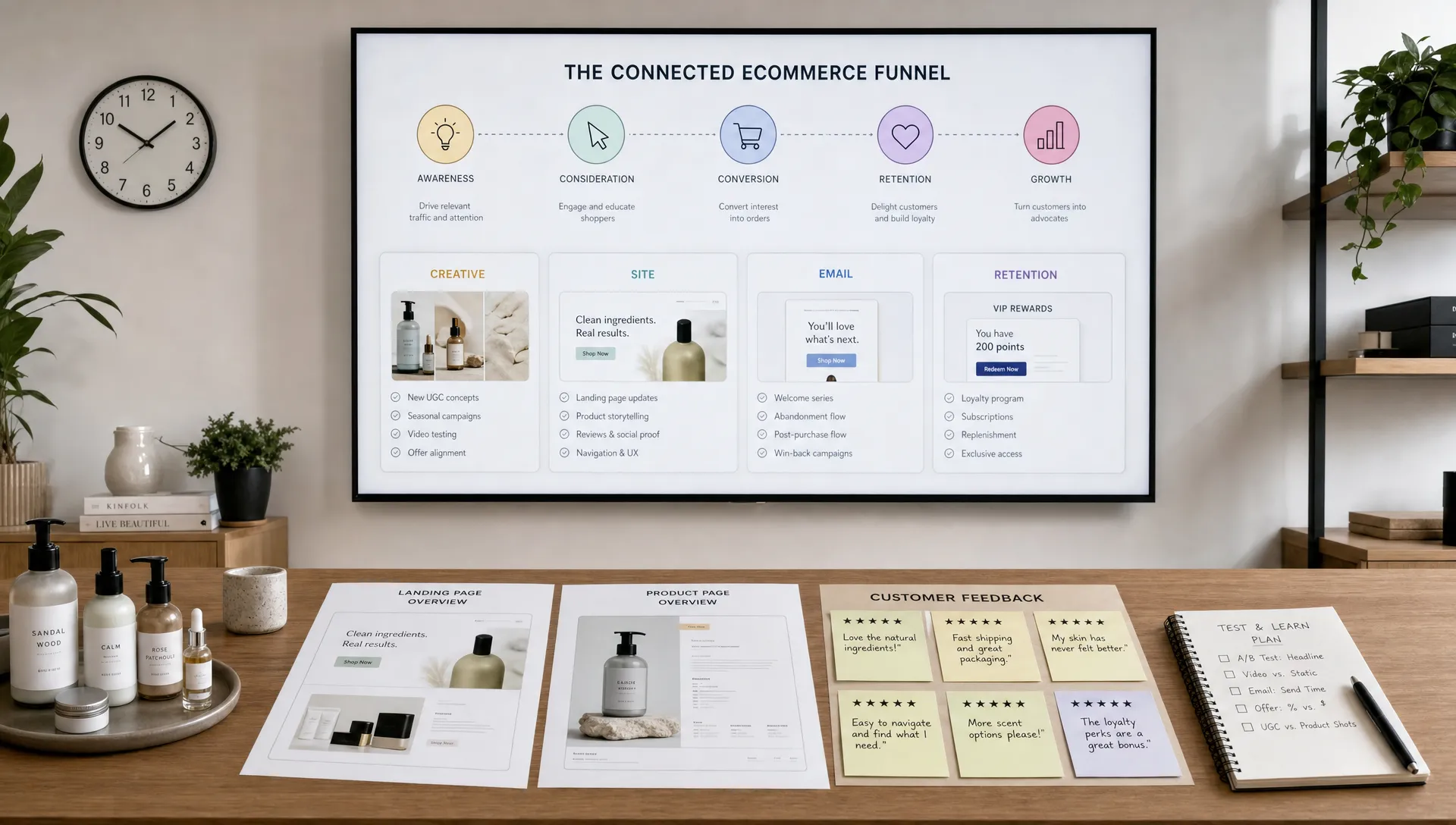
This is where many founders benefit from outside perspective. A strong growth partner can identify whether the real issue is brand clarity, media efficiency, creative volume, conversion rate, retention, or economics. OPTYO’s article on how an ecommerce marketing agency can scale revenue expands on how these pieces work together across the full ecommerce funnel.
Frequently Asked Questions
What are the most effective sports marketing strategies for ecommerce brands? The most effective strategies usually combine clear positioning, creator content, paid media, conversion rate optimization, email and SMS retention, community building, and measurement. The exact mix depends on your product category, margin, buying cycle, and customer behavior.
How can a small sports brand compete with larger companies? Smaller brands can win by being more specific, faster, and closer to the customer. Instead of copying large brands, focus on a niche audience, strong product education, authentic community, and creative that speaks directly to a real use case.
Should sports ecommerce brands invest more in brand or performance marketing? They need both. Brand creates preference and trust, while performance marketing captures and scales demand. The strongest growth systems make brand assets measurable and make performance campaigns feel distinctive rather than generic.
How often should sports brands test new ad creative? Most growing ecommerce brands should test creative continuously, especially on paid social. The right pace depends on spend level, audience size, and creative fatigue, but brands should always be learning which hooks, formats, offers, and proof points drive profitable action.
Build a sports ecommerce growth system that scales
The strongest sports marketing strategies are not isolated tactics. They connect customer insight, brand positioning, creative, paid media, ecommerce conversion, retention, and reporting into one operating system.
If you are building a sports, fitness, or wellness ecommerce brand and want a more performance-driven path to growth, OPTYO helps brands align marketing strategy, creative, ecommerce, CRO, email, SEO, and KPI reporting around measurable revenue outcomes.