.png)


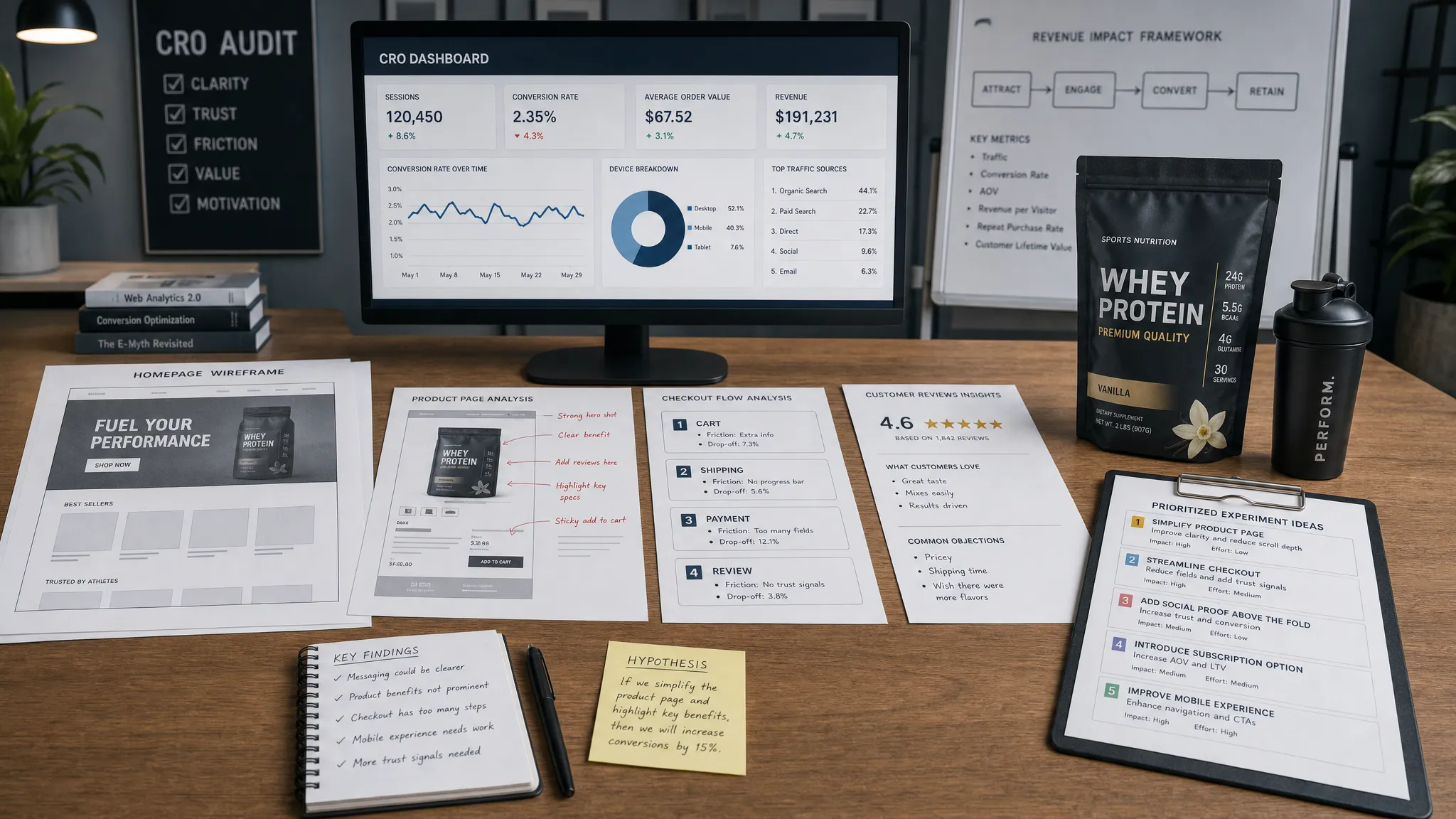

Most ecommerce founders do not have a traffic problem first. They have a conversion clarity problem. Ads are running, visitors are clicking, and product pages are getting views, but too many qualified shoppers leave without buying.
That is where a conversion rate optimization agency should earn its keep. Not by randomly changing button colors or chasing generic “best practices,” but by auditing the full buying journey to identify what is blocking revenue, trust, and repeat purchase.
For sports, fitness, wellness, D2C, and CPG brands, this matters even more. Shoppers are often evaluating performance claims, ingredient quality, fit, durability, subscription value, or lifestyle identity before they commit. A strong CRO audit should uncover those friction points and turn them into a focused testing roadmap.
Below is what a conversion rate optimization agency should audit before recommending experiments, redesigns, or landing page changes.
Start with the goal: profitable conversion, not just a higher conversion rate
A CRO audit should never begin with “how do we get more people to click buy?” It should begin with “which conversions are worth improving?”
For an ecommerce brand, a higher conversion rate can still be a bad outcome if average order value drops, returns increase, customer quality declines, or paid acquisition becomes less efficient. A discount-heavy test might lift conversion today while training customers to wait for promotions tomorrow.
A serious agency should define the conversion goal in business terms. That may include first purchase rate, subscription starts, bundle adoption, lead capture, trial purchase, revenue per visitor, contribution margin, or customer lifetime value. For a fitness equipment brand, the key metric might be qualified add-to-cart rate on a high-ticket product. For a supplement brand, it might be subscription attach rate. For an apparel brand, it might be reducing size-related returns.
This is why CRO should sit close to performance marketing, creative, and retention. If your acquisition team is optimizing for low-cost clicks while your site experience is built for a different buyer, the numbers will not line up. OPTYO’s perspective on what to look for in a performance marketing agency applies here too: growth works best when the funnel is managed as one connected system.
Audit analytics and tracking before auditing design
A conversion rate optimization agency should first verify that the data is trustworthy. Many CRO mistakes happen because teams optimize around broken analytics, incomplete attribution, or misleading averages.
The audit should confirm that key events are firing correctly across the site. That includes product views, add to cart, checkout initiation, purchase, form submissions, subscription selections, account creation, and email or SMS signups. It should also inspect whether events are duplicated, missing, or firing at the wrong moment.
Segmentation matters just as much as event accuracy. A blended conversion rate hides the difference between new and returning users, mobile and desktop visitors, paid social and organic search traffic, first-time customers and subscribers, or cold traffic and retargeting audiences. A page that performs well for returning customers may fail completely for first-time visitors who need more education.
A good CRO audit should answer questions like:
- Which traffic sources convert profitably, and which only look good on the surface?
- Where do mobile users drop off compared with desktop users?
- Are returning shoppers abandoning because of price, shipping, product uncertainty, or checkout friction?
- Are paid social visitors landing on pages that match the ad promise?
- Are the highest-margin products getting enough visibility in the customer journey?
Without this foundation, every recommendation is guesswork dressed up as strategy.
Audit the offer, positioning, and buyer promise
Conversion problems are often positioning problems. If the offer is unclear, weak, or misaligned with the audience, no amount of design polish will fix the issue.
A conversion rate optimization agency should inspect whether the site quickly answers the shopper’s core question: “Why should I buy this, from this brand, right now?” For sports and wellness brands, that answer usually depends on a blend of functional benefit, credibility, identity, and urgency.
For example, a hydration brand cannot simply say “better performance.” It needs to clarify who the product is for, when to use it, what makes it different, and why the customer should trust the claim. A recovery product needs to explain the mechanism, expected use case, and proof points. A training apparel brand needs to communicate fit, fabric, durability, and lifestyle relevance without forcing shoppers to dig.
This same principle applies outside ecommerce. A service business with a specific model, such as flat-fee real estate listing providers like NetRealtyNow, needs to make the offer structure, location coverage, process, savings, and trust signals obvious before a visitor is ready to take action. The category changes, but the CRO principle stays the same: reduce uncertainty before asking for commitment.
The agency should review headlines, product naming, collection page copy, PDP messaging, offer hierarchy, and calls to action. If the site cannot explain the value proposition in plain language, customers will hesitate.
Audit landing page message match
Landing pages are where paid traffic either compounds or leaks. If someone clicks an ad about “high-protein recovery for runners” and lands on a generic supplement collection page, the brand has created unnecessary work for the shopper.
A CRO audit should compare ads, emails, influencer content, search intent, and landing pages side by side. The promise that earns the click should be immediately visible after the click. This includes the headline, hero image, product selection, social proof, offer, and CTA.
A good landing page audit looks for message gaps such as:
- The ad promotes a specific problem, but the page opens with a generic brand statement.
- The creative shows a particular product, but the landing page sends users to a broad catalog.
- The ad targets beginners, but the page speaks to advanced athletes.
- The offer in the ad is missing, buried, or worded differently on the page.
- The landing page asks for a purchase before explaining why the product is different.
If landing pages are a major bottleneck, it may be worth exploring how a specialized team approaches landing page conversion rate improvement, especially when creative, copy, and testing need to work together.
Audit product detail pages like sales conversations
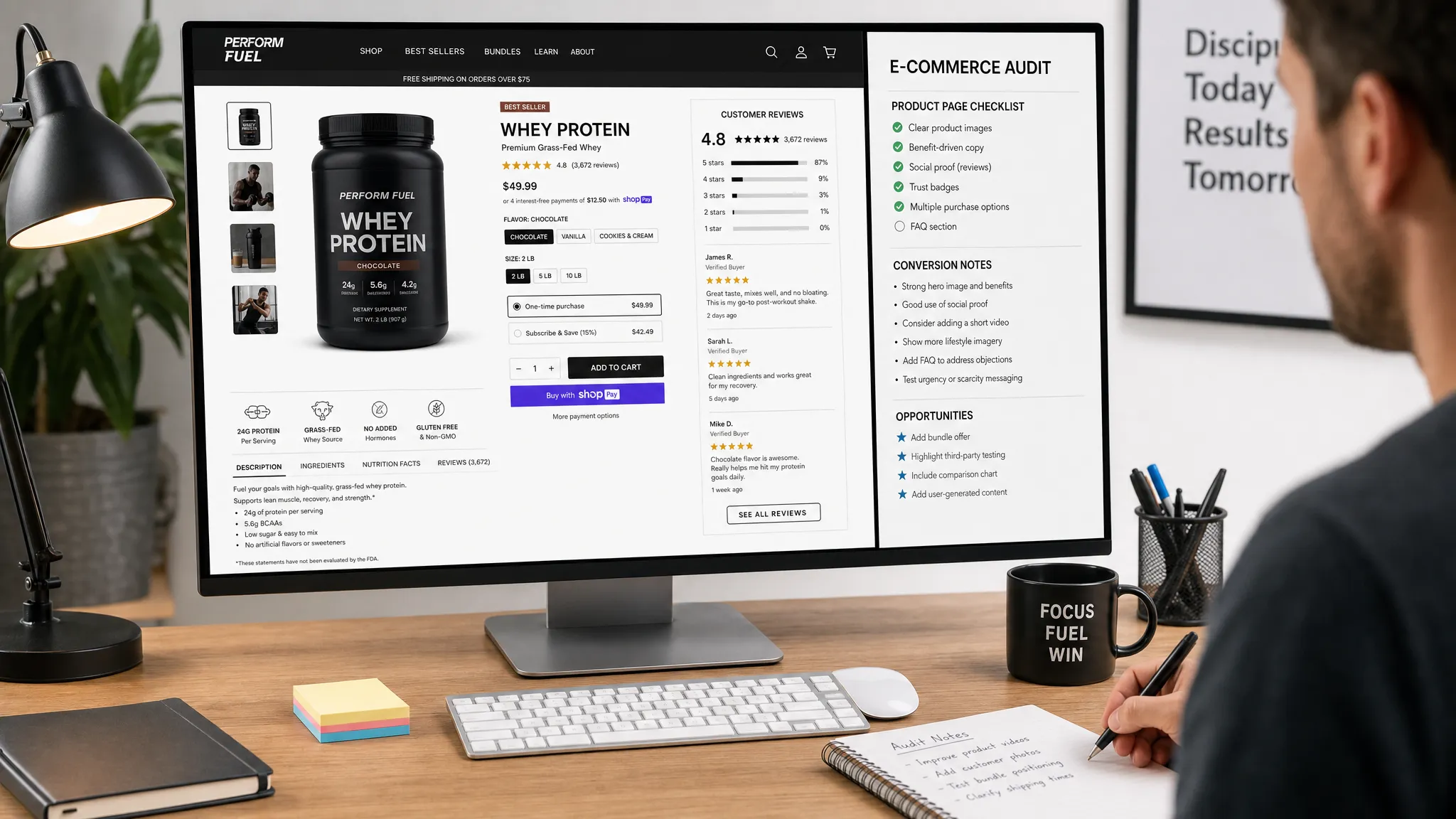
For ecommerce brands, the product detail page is often the most important conversion asset on the site. It should function like a strong salesperson: clarify the benefit, handle objections, prove credibility, make selection easy, and guide the next action.
A conversion rate optimization agency should assess whether each PDP answers the most important buying questions before they become reasons to leave. For fitness and wellness products, that may include sizing, ingredients, certifications, use cases, results timelines, taste, texture, compatibility, safety, durability, washing instructions, shipping, returns, and guarantees.
The PDP audit should look closely at the above-the-fold section. Shoppers should not have to scroll endlessly to understand what the product is, who it is for, why it is better, how much it costs, and what to do next. The product imagery should show context, scale, texture, usage, and key differentiators. If the product requires education, the page should sequence that education clearly instead of overwhelming visitors with dense blocks of copy.
Reviews deserve special attention. A page with 500 reviews can still underperform if the best proof is buried. The agency should inspect whether reviews are filterable, specific, recent, and aligned with the main objections. For example, a running short might need reviews that mention fit, chafing, pocket security, and race-day performance. A protein powder might need proof around taste, digestion, mixability, and routine use.
Audit navigation, collections, and product discovery
Not every visitor enters through a product page. Many shoppers begin at the homepage, a collection page, a quiz, a content article, or a search result. A CRO audit should inspect whether the site helps visitors find the right product quickly.
Navigation should reflect how customers shop, not just how the company organizes inventory. A sports apparel brand might need paths by sport, product type, weather condition, gender, fit, or training goal. A wellness brand might need paths by benefit, ingredient, routine, flavor, or subscription preference.
Collection pages should do more than display a grid. They should help shoppers compare options. That means useful filters, clear product cards, visible pricing, review signals, benefit-driven labels, and short explanations when categories are not self-explanatory. If customers must open eight tabs to understand the difference between products, the site is creating cognitive load.
Site search is another overlooked area. The agency should review top search queries, zero-result searches, misspellings, synonym handling, and whether search results prioritize the right products. High-intent shoppers often use search when they are close to buying. A poor search experience can quietly drain revenue.
Audit checkout friction and purchase confidence
Checkout is not the place to introduce doubt. By the time a shopper reaches checkout, the job is to keep the experience clear, fast, and trustworthy.
A CRO audit should inspect every step between cart and completed purchase. This includes cart design, shipping cost visibility, payment methods, discount code behavior, error messages, account creation requirements, upsells, subscriptions, taxes, delivery estimates, return policy access, and mobile usability.
The agency should pay close attention to surprise costs. Unexpected shipping fees, unclear delivery timing, or confusing subscription terms can cause abandonment even when the product is desirable. In categories where timing matters, such as race-day nutrition, gym equipment, event apparel, or recovery tools, delivery clarity can directly affect conversion.
Cart upsells should also be audited carefully. A smart bundle or add-on can raise AOV, but aggressive upsells can slow the purchase and create decision fatigue. The question is not “can we add an upsell?” It is “does this upsell make the purchase easier, more complete, or more valuable?”
Audit trust signals, proof, and risk reversal
Trust is a conversion lever, not a decorative element. In sports, fitness, and wellness, customers are often evaluating whether a product will actually work for their body, goals, routine, or performance standards.
A conversion rate optimization agency should examine how the brand proves its claims. This can include customer reviews, before-and-after content where appropriate, athlete or expert endorsements, certifications, clinical references, user-generated content, guarantees, press mentions, founder credibility, manufacturing transparency, and clear policies.
The key is relevance. Generic trust badges are weaker than proof tied to the exact hesitation a buyer has. If shoppers worry about taste, show taste-specific reviews. If they worry about durability, show long-term use. If they worry about fit, show body types, sizing guidance, and exchange reassurance. If they worry about ingredients, make the label, sourcing, and compliance information easy to find.
A trust audit should also look for overclaiming. Performance and wellness brands must be especially careful with language. Inflated promises can reduce credibility and create compliance risk. Strong CRO does not mean making bigger claims. It means making believable, specific, well-supported claims easier to understand.
Audit mobile experience and speed where revenue actually happens
For many D2C brands, mobile traffic dominates. Yet founders and teams often review the site on desktop because it is easier to analyze. That creates a dangerous blind spot.
A mobile CRO audit should inspect thumb-friendly navigation, sticky CTAs, image loading, product variant selection, form fields, payment options, popups, review readability, and checkout flow. It should also evaluate whether key information appears in the right order on smaller screens.
Speed should be reviewed through a revenue lens. The agency should identify which templates and user journeys are slow, not just report a generic performance score. The homepage, collection pages, PDPs, landing pages, cart, and checkout can each create different issues.
Common mobile conversion problems include oversized media, intrusive popups, slow-loading reviews, hidden size guides, difficult variant selectors, discount code confusion, and checkout fields that are painful to complete on a phone.
A faster site is not automatically a higher-converting site, but a slow and frustrating mobile experience almost always limits scale.
Audit creative and content as part of the funnel
CRO is not only a website discipline. The expectations created before the visit shape how users behave after they arrive.
A conversion rate optimization agency should review the creative ecosystem feeding the site. That includes paid social ads, influencer whitelisting, UGC, email campaigns, organic content, advertorials, SEO pages, and retargeting assets. If creative is promising one thing and the site is saying another, conversion suffers.
This is especially important for brands spending on Meta, TikTok, YouTube Shorts, or creator campaigns. Shoppers may arrive with a very specific story in mind: a trainer recommended the product, an athlete demonstrated it, a customer showed a transformation, or an ad framed it as a solution to one problem. The landing experience should continue that story.
If an agency only audits page design and ignores the traffic source, it may miss the real issue. Sometimes the page is fine, but the creative is attracting the wrong buyer. Other times the creative is strong, but the site fails to reinforce the hook that got the click.
For emerging brands, this overlap between acquisition, conversion, and positioning is often where the biggest gains come from. It is also why a narrow CRO project can underperform if broader D2C fundamentals are weak, a theme OPTYO covers in its breakdown of what a direct-to-consumer marketing agency should fix.
Audit email and post-click recovery flows
Not every visitor will buy on the first session. A CRO audit should include the recovery systems that bring shoppers back.
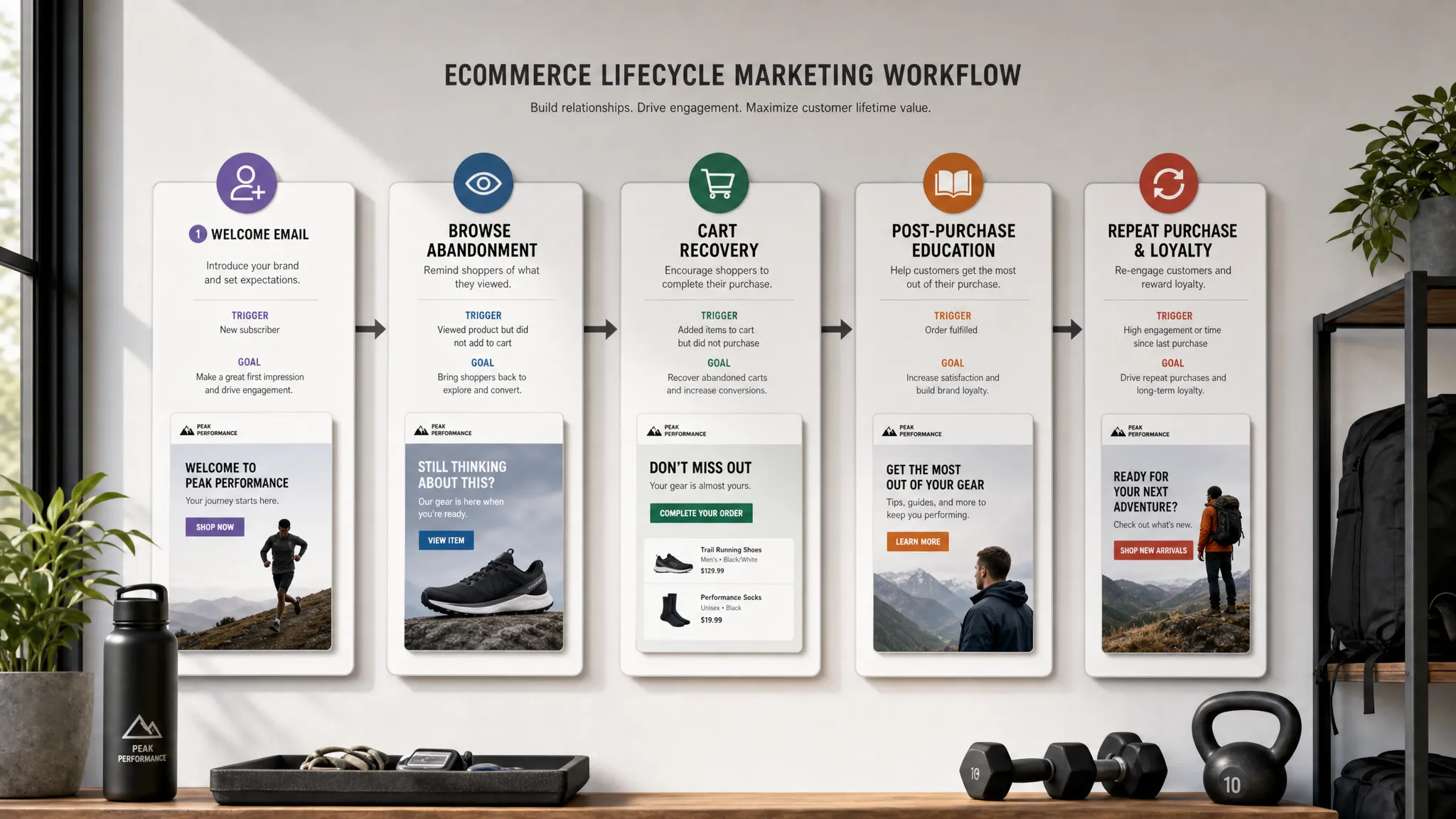
Email and SMS flows can rescue revenue from high-intent users who need more time, more proof, or a better-timed offer. The agency should review welcome flows, browse abandonment, cart abandonment, checkout abandonment, post-purchase education, replenishment, winback, and subscription retention where applicable.
The audit should check whether these flows are segmented by behavior and product interest. A shopper who viewed a high-ticket equipment item needs different messaging than someone who abandoned a low-cost accessory. A returning customer needs different proof than a first-time visitor. A subscriber needs support around habit formation, not just another discount.
The goal is not to blast more messages. The goal is to use email and SMS to answer the questions that prevented conversion in the first place.
Audit pricing, bundles, subscriptions, and perceived value
Price objections are not always about being too expensive. Often they are about unclear value.
A conversion rate optimization agency should review how pricing is framed across the site. Are shoppers comparing the product to cheaper alternatives without understanding the difference? Are bundles easy to understand? Is the subscription value clear? Are savings communicated honestly and simply? Does the page explain cost per serving, cost per use, or durability when those details matter?
For consumables, bundle and subscription audits can be especially valuable. A first-time buyer may not want to commit to a large quantity until taste, fit, or effectiveness is proven. A returning buyer may appreciate savings, convenience, and replenishment timing. The offer should reflect those different levels of confidence.
For premium products, the audit should assess whether the site builds enough value before showing the price. Premium positioning requires proof, differentiation, and confidence. If the price appears before the value is understood, shoppers may bounce before the brand has made its case.
Audit experimentation maturity and test prioritization
A CRO audit should not end with a long list of opinions. It should become a prioritized testing roadmap.
The agency should separate issues into categories: tracking fixes, quick wins, usability improvements, messaging tests, offer tests, landing page tests, checkout improvements, and larger strategic projects. Not every recommendation needs an A/B test. Some problems, such as broken mobile layout or missing shipping information, can be fixed directly. Other ideas should be tested because they involve tradeoffs.
Prioritization should consider impact, confidence, effort, traffic volume, and business risk. A high-impact PDP test may be worth more than five minor homepage tweaks. A checkout simplification may be urgent if abandonment is severe. A new bundle strategy may need careful measurement because it can affect margin and customer quality.
The agency should also be honest about sample size. If the site does not have enough traffic for reliable A/B testing on every page, the CRO plan may need to combine qualitative research, usability review, analytics, customer surveys, heatmaps, and focused before-and-after measurement.
What the final CRO audit should include
At the end of the audit, an ecommerce founder should not receive a vague deck full of screenshots and generic suggestions. The deliverable should be specific enough to guide execution.
A strong CRO audit should include:
- A summary of the biggest revenue leaks and why they matter.
- A data review showing where users drop off by segment, source, device, and funnel stage.
- A page-by-page assessment of landing pages, PDPs, collection pages, cart, and checkout.
- Clear recommendations tied to business goals, not just design preferences.
- A prioritized testing roadmap with expected impact and implementation effort.
- Measurement guidance so results are judged by revenue quality, not vanity metrics.
The best audits also explain the logic behind each recommendation. Founders should understand why a change is being proposed, what customer friction it addresses, and how success will be measured.
Red flags when hiring a conversion rate optimization agency
Some agencies sell CRO as a collection of quick hacks. That is rarely what scaling brands need.
Be cautious if an agency promises a guaranteed conversion lift before reviewing your analytics, insists on redesigning the site before identifying the bottleneck, focuses only on colors and buttons, ignores traffic quality, or recommends discounts as the default solution. Those are signs that the agency may be optimizing the surface rather than the system.
You should also be wary of agencies that cannot explain how CRO connects to paid media, creative, email, and brand strategy. For ecommerce brands, conversion is not isolated. It is the result of what customers see, believe, understand, and experience from first impression to repeat purchase.
A useful conversion rate optimization agency should help you make better growth decisions, not just run isolated experiments.
Frequently Asked Questions
What does a conversion rate optimization agency do? A conversion rate optimization agency analyzes the customer journey to identify why visitors are not taking desired actions, then recommends and tests improvements across messaging, design, UX, offers, checkout, analytics, and retention flows.
What should be included in a CRO audit? A CRO audit should include analytics validation, traffic segmentation, landing page review, product page analysis, checkout friction review, trust signal assessment, mobile usability, offer evaluation, and a prioritized testing roadmap.
How long does a CRO audit take? The timeline depends on site complexity, traffic volume, analytics quality, and the number of templates or funnels being reviewed. A focused audit can be relatively quick, while a full-funnel ecommerce audit usually requires deeper analysis across acquisition, conversion, and retention.
Is CRO only for brands with high traffic? No. High traffic helps with statistically significant A/B testing, but lower-traffic brands can still benefit from CRO through analytics review, customer research, usability fixes, clearer messaging, and better offer structure.
Should CRO come before paid media scaling? Often, yes. If the site has major conversion leaks, increasing ad spend can simply amplify inefficiency. The strongest growth plans improve acquisition and conversion together.
Turn your CRO audit into a growth system
A strong audit should show you exactly where revenue is leaking and what to fix first. But the real value comes from execution: better creative, clearer landing pages, stronger offers, cleaner tracking, and testing that improves profitable growth over time.
OPTYO helps sports, fitness, wellness, D2C, and CPG brands connect performance marketing with conversion strategy, creative, ecommerce development, email, SEO, and growth consulting. If your traffic is growing but your site is not converting the way it should, connect with OPTYO to identify the highest-impact opportunities in your funnel.