.png)


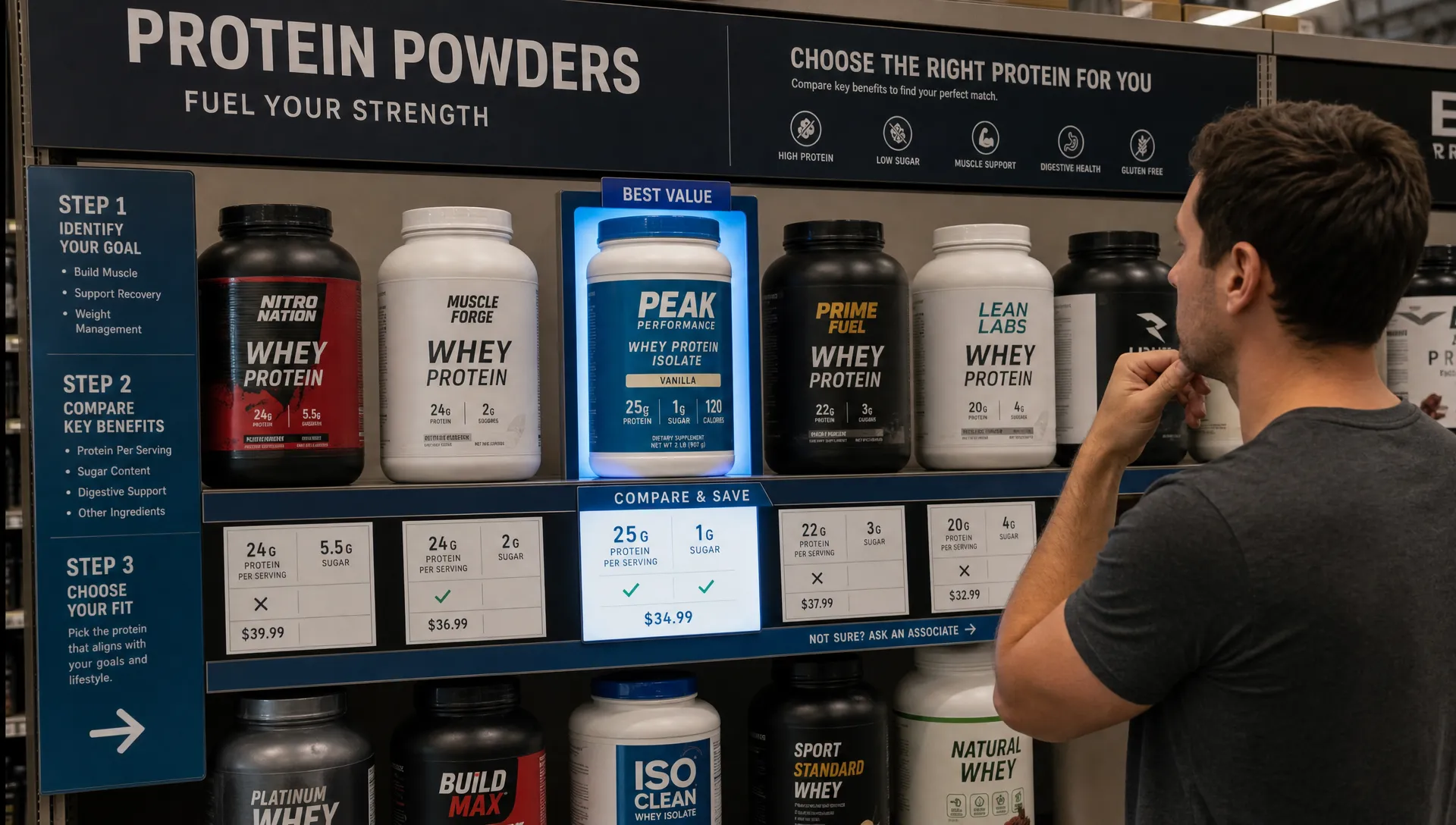

In a crowded ecommerce market, customers rarely choose the brand with the most features. They choose the brand they understand fastest, trust most, and remember when the buying moment arrives. That is what market position is really about.
A branded agency helps define and strengthen that position. Not just by making a brand look better, but by making it easier to buy, easier to believe, and easier to recommend. For sports, fitness, wellness, D2C, and CPG founders, this matters because the category is noisy. A supplement brand is not just competing with other supplements. It is competing with creator-led products, retail shelves, subscription apps, Amazon search results, social ads, and customer skepticism.
The right market position gives every part of the business a clearer job. Your ads know what to say. Your product pages know what to prove. Your packaging knows what to signal. Your email flows know what customer identity to reinforce. Your media buying has a sharper angle to test.
That is where a branded agency can create measurable leverage.
Market position is not just a tagline
Market position is the place your brand occupies in the mind of a specific customer, compared with the alternatives they could choose instead. It answers practical questions like:
- Who is this brand really for?
- What problem does it solve better than the rest?
- Why should I believe it?
- What does choosing this brand say about me?
- Why should I pay this price now?
A tagline can express a position, but it does not create one by itself. A position is built through repeated proof across product, messaging, creative, offer structure, customer experience, and distribution.
For example, a recovery drink for competitive athletes should not sound like a general wellness beverage. A premium running apparel brand should not merchandise itself like a discount basics line. A high-protein snack built for busy parents should not use the same messaging as a product aimed at gym-first consumers tracking macros.
The product may be excellent, but if the brand position is vague, buyers have to work too hard to understand why it matters.
Why growing brands lose position
Many ecommerce brands start with a clear founder insight. The early audience gets it. The first creative concepts work. The initial product-market fit feels obvious.
Then growth introduces complexity.
New channels get added. New products launch. Wholesale enters the picture. Paid social creative expands. Influencer briefs multiply. Email, SEO, Amazon, landing pages, retail decks, and packaging all evolve at different speeds. Before long, the brand is saying five slightly different things to five different audiences.
That drift creates expensive problems. Paid media becomes harder to scale because hooks are inconsistent. Conversion rates stall because the site does not reinforce the promise from the ad. Product launches underperform because the value proposition is unclear. Repeat purchase suffers because customers bought a product, not a brand idea they want to return to.
A branded agency helps prevent that drift by turning positioning into a usable operating system, not a one-time strategy deck.
What a branded agency actually changes
A strong branded agency connects brand thinking with performance outcomes. It does not treat positioning as a separate exercise from growth. Instead, it asks how the brand should win in the market, then translates that answer into creative, conversion, retention, and channel decisions.
It clarifies the customer you are built to win
Most weak positioning begins with an audience that is too broad. “Health-conscious consumers” is not enough. “Active adults” is not enough. Even “athletes” may be too vague for a brand trying to scale efficiently.
A branded agency helps narrow the target without shrinking the opportunity. The goal is to identify the highest-value customer segment where the brand can become unusually relevant.
For a fitness brand, that may be strength athletes who want evidence-backed performance without bodybuilding clichés. For a wellness brand, it may be women in their 30s and 40s who want practical recovery support without clinical coldness. For a sports accessory brand, it may be youth sports parents who care about durability, safety, and repeat use.
This clarity changes the entire go-to-market system. When the audience is sharper, customer research improves, creative briefs become more focused, and performance data becomes easier to interpret.
Before the creative system is built, a brand strategy agency defines the strategic foundation that guides decisions like audience, differentiation, proof, and messaging hierarchy.
It defines what you should be known for
A brand cannot be known for everything. If your homepage claims quality, innovation, community, sustainability, affordability, performance, and convenience all at once, customers will usually remember none of it.
A branded agency helps identify the primary idea the market should associate with your brand. That idea must sit at the intersection of customer demand, competitive white space, and business advantage.
In sports, fitness, and wellness, strong positions often come from one of several angles:
- Performance credibility, such as tested, athlete-informed, or competition-ready products
- Lifestyle identity, such as products for a specific training culture or aspirational community
- Convenience and adherence, such as making healthy habits easier to repeat
- Premium quality, such as superior materials, formulation, design, or service
- Trust and transparency, such as clean sourcing, clinical support, or simple education
The strongest position is not always the loudest claim. It is the one your brand can prove consistently.
It turns differentiation into proof
Many founders can explain why their product is different on a sales call, but the website and ads fail to make that difference obvious. A branded agency closes that gap.
The agency looks for proof points that make the position credible. These may include formulation details, athlete testing, customer reviews, founder expertise, material quality, third-party validation, before-and-after use cases, or product design choices.
The difference between a claim and a position is proof. “Built for serious training” is a claim. Showing the design decisions, athlete use cases, durability tests, and customer outcomes that support that idea is positioning.
This matters because modern customers compare quickly. They scan ads, product pages, comments, reviews, and competitor sites before committing. If your proof is hidden, scattered, or generic, the brand loses momentum at the exact moment a buyer is trying to justify the purchase.
A branded agency organizes that proof so every touchpoint supports the same market perception.

It aligns creative with the position
Creative is often where positioning either becomes real or falls apart. If the brand strategy says premium performance but the ads look cheap, the market believes the ad. If the strategy says approachable wellness but the copy sounds clinical and intimidating, the market feels the mismatch.
A branded agency helps create a creative system that communicates the position instantly. This includes visual direction, copy style, content pillars, offer framing, landing page messaging, and ad angles.
For ecommerce brands, this is especially important because paid creative does more than generate clicks. It teaches the market how to categorize the brand.
A brand that runs constant discount-led creative may win short-term purchases but train customers to see it as a deal brand. A brand that only shows product features may struggle to build emotional preference. A brand that leans too heavily on lifestyle may fail to give skeptical buyers enough proof.
The agency’s job is to balance attention, clarity, and credibility.
For a deeper sports-specific lens, OPTYO has also covered how marketing and sports brands win with better positioning, especially when brand clarity and performance marketing need to work together.
It improves conversion by reducing confusion
Market position has a direct impact on conversion rate. When buyers understand who the product is for, why it is different, and why the price makes sense, they need less convincing.
A branded agency can review the full customer journey and identify where the position weakens. Common issues include unclear hero sections, product pages that lead with features instead of outcomes, weak comparison framing, inconsistent claims between ads and landing pages, and missing trust signals.
This is where brand and conversion rate optimization overlap. Strong positioning can guide:
- Homepage messaging that communicates the main value proposition quickly
- Product page sections that prioritize the right benefits and proof points
- Bundles and subscriptions that match the customer’s buying motivation
- Email flows that reinforce the reason customers chose the brand
- Upsells that feel aligned with the brand promise instead of random
For example, if a wellness brand is positioned around daily consistency, the ecommerce experience should make subscriptions, routines, and habit-building easy to understand. If a sports equipment brand is positioned around premium durability, the site should show materials, testing, warranty details, and customer use cases prominently.
Positioning is not decoration. It is a conversion tool.
It helps pricing feel justified
Price is not just a number. It is a signal. Customers use price to infer quality, seriousness, audience, and category expectations.
A branded agency helps make sure the market position supports the pricing strategy. If a product is premium, the brand experience must feel premium before the customer reaches checkout. If a product is value-oriented, the messaging must make the economic benefit easy to understand without making the brand feel low quality.
This is especially important for D2C and CPG brands facing rising acquisition costs. Discounts can create short-term lift, but if discounting becomes the primary reason to buy, it weakens long-term positioning.
A better approach is to build perceived value. That may come from clearer education, stronger proof, better bundles, superior creative, thoughtful packaging, stronger retention programs, or more specific audience positioning.
Premium brands across categories show this clearly. Even outside sports and wellness, a company like Lumina’s luxury vacation rentals positions around private homes, premium amenities, curated destinations, and service rather than competing like a generic lodging option. The lesson applies broadly: when the experience and message support the promise, the price becomes easier to understand.
It creates consistency across channels
Customers do not experience your brand in one place. They may see a Meta ad, search your brand, read reviews, visit the website, abandon cart, receive an email, watch a creator video, and then buy from a retargeting ad two weeks later.
If each touchpoint tells a different story, the brand feels unstable. A branded agency helps create consistency without making everything repetitive.
The aim is not to use the same sentence everywhere. The aim is to make every channel reinforce the same market position in a format that fits the medium.
Paid social might dramatize the pain point. SEO might educate the buyer. Email might reinforce identity and routine. Product pages might prove the claim. Packaging might confirm the quality. Influencer content might show the product in real use.
When those pieces are aligned, the brand becomes easier to remember and harder to compare on price alone.
It supports product launches and offer expansion
Market position becomes even more important when a brand launches new products. Without a clear position, every new offer can pull the brand in a different direction.
A branded agency helps decide whether a new product strengthens the position or dilutes it. It also helps frame the launch so customers understand why the new offer belongs in the brand world.
For example, a recovery-focused wellness brand might launch sleep support, hydration, or mobility tools if they reinforce the core promise. But if the brand suddenly launches unrelated lifestyle accessories with no strategic bridge, customers may become confused.
Strong positioning gives product expansion a logic customers can follow. It also gives the marketing team a clearer launch narrative, which can improve creative testing, email segmentation, landing page structure, and retention campaigns.
If you are preparing for a new offer, it can help to understand how a product marketing agency helps new offers launch with clearer messaging, creative, and channel strategy.
It gives performance marketing better inputs
Performance marketing is only as strong as the inputs behind it. If the positioning is unclear, the media team is forced to test random hooks, broad claims, and disconnected creative concepts.
A branded agency gives performance marketing stronger raw material. Instead of testing isolated slogans, the team can test structured hypotheses based on audience, pain point, outcome, proof, and offer.
Useful positioning-driven metrics include:
- Which audience segment has the strongest conversion rate and repeat purchase behavior
- Which benefit angle creates the highest quality traffic, not just the cheapest click
- Which proof points improve add-to-cart and checkout completion
- Which creative themes increase branded search and direct traffic over time
- Which customer language appears most often in reviews, surveys, and support tickets
This is how positioning becomes measurable. The brand does not have to choose between strategy and performance. The strategy gives performance marketing a clearer map.
Signs your market position needs help
Not every brand needs a full rebrand. Many need a sharper position and a better system for expressing it. You may need a branded agency if:
- Customers like the product but struggle to explain why it is different
- Your ads generate traffic but the site does not convert efficiently
- Competitors with similar products feel more memorable
- Your team debates messaging every time a new campaign launches
- New products make the brand feel scattered instead of stronger
- You rely too heavily on discounts to create urgency
- Your creative looks polished but does not communicate a clear reason to buy
These are not just brand problems. They are growth problems.
What to look for in a branded agency
The best partner should understand both market perception and business performance. Beautiful creative is useful only if it supports the right position. Data is useful only if it helps clarify what the market values.
For ecommerce founders, especially in sports, fitness, and wellness, look for an agency that can connect:
- Customer research and competitive analysis
- Brand strategy and messaging
- Creative asset production
- Paid social and acquisition strategy
- Ecommerce development and conversion rate optimization
- Email marketing and retention
- KPI reporting and growth consulting
That combination matters because market position does not live in a brand book. It lives in the daily interactions between your brand and your customers.
Frequently Asked Questions
What is a branded agency? A branded agency is a partner that helps shape how a company is perceived in the market, then translates that position into messaging, creative, ecommerce experiences, campaigns, and growth strategy.
How does a branded agency improve market position? It clarifies the target customer, defines differentiation, organizes proof points, aligns creative, improves conversion messaging, and makes the brand more consistent across channels.
Is market positioning only important for premium brands? No. Every brand has a position, whether intentional or not. Value brands, performance brands, lifestyle brands, and premium brands all need a clear reason customers should choose them.
Can better positioning lower customer acquisition costs? It can. Clearer positioning often improves ad relevance, conversion rates, repeat purchase, and customer referrals, which can make paid growth more efficient over time.
When should an ecommerce brand hire a branded agency? Consider hiring one when growth is slowing, messaging feels inconsistent, launches are underperforming, competitors feel more distinct, or your brand depends too heavily on discounts to drive sales.
Build a position your market can remember
A strong market position does not happen by accident. It is built through focused strategy, consistent creative, sharper ecommerce execution, and a clear understanding of what customers need to believe before they buy.
For sports, fitness, and wellness entrepreneurs, the opportunity is not just to look more polished. It is to become easier to choose.
If your brand is ready to clarify its position and turn that clarity into stronger marketing, creative, and ecommerce performance, OPTYO can help you connect brand strategy with growth execution.