.png)


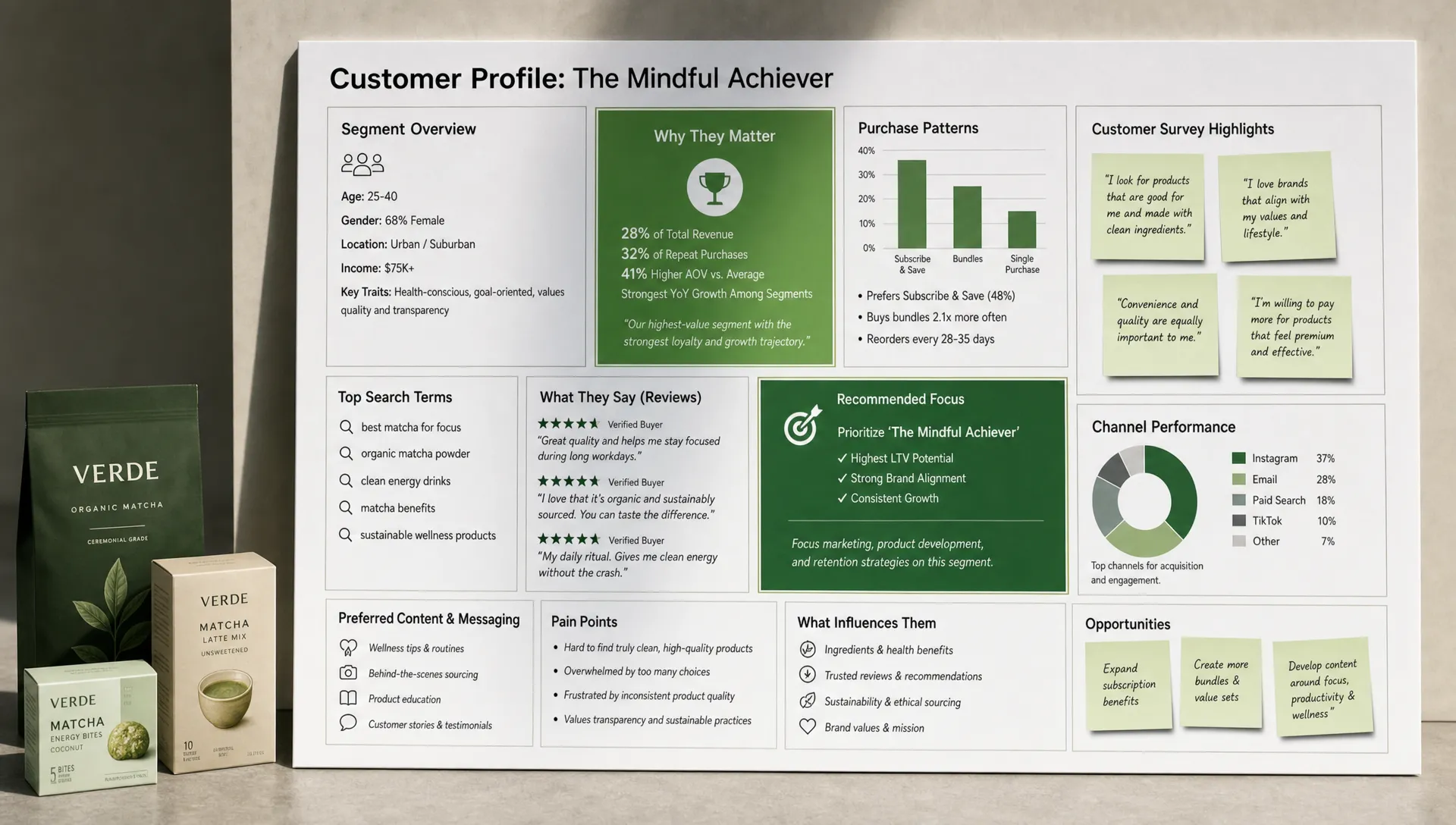

Most ecommerce brands think they know their customer. They have a persona slide with an age range, a few interests, a lifestyle label, and maybe a stock photo. The problem is that personas built from assumptions rarely survive contact with real acquisition costs.
If you want to scale a sports, fitness, wellness, or consumer product brand, you need to identify your target customer with real data. Not the broadest group that could buy. Not the audience Meta lets you select. Not the customer you wish you had. The customer who buys, repeats, leaves strong reviews, responds to your best creative, and can be reached profitably.
That distinction matters because customer clarity affects almost every growth lever: positioning, paid social creative, landing pages, email segmentation, product bundles, SEO content, influencer partnerships, and even inventory decisions. When you know who your strongest customer is, marketing stops being a guessing game and becomes a repeatable testing system.
Target customer vs. target market: the difference that changes your strategy
Your target market is the broader group your brand serves. Your target customer is the specific buyer profile most likely to create profitable growth.
For example, a recovery supplement brand might define its target market as active adults who train regularly. That is useful, but still too broad for paid acquisition. The target customer might be a 35 to 50-year-old recreational endurance athlete who trains before work, struggles with soreness, values clean ingredients, and is willing to pay more for a product that helps them stay consistent.
That level of specificity gives your team better answers to practical questions:
- What pain should the hero section of the landing page address first?
- Which proof points belong in the ad creative?
- Which objections need to be answered before checkout?
- Which products should be bundled together?
- Which customer segments deserve retention campaigns?
If you still need the strategic foundation, OPTYO has a separate guide on how to define your target market for faster growth. This article goes one layer deeper, focusing on how to use real data to identify the customer worth prioritizing.
Start with the customers who already bought
The cleanest place to begin is not with audience research. It is with purchase behavior.
Open your ecommerce platform, CRM, analytics tool, or order history and look for patterns among people who have already paid you. Real customers reveal more than hypothetical prospects because their behavior includes commitment. They saw the price, evaluated the offer, made the purchase, and either came back or did not.
Start by segmenting customers around business outcomes, not demographics. Age, gender, location, and interests can be helpful later, but they are secondary to customer value.
Look for customers with:
- Higher average order value
- Strong gross margin after discounts and shipping
- Repeat purchases or subscription behavior
- Low return rates
- Low support burden
- High review quality
- High referral likelihood
- Fast time from first visit to purchase
- Strong response to email or SMS campaigns
This exercise often reveals uncomfortable truths. The largest audience is not always the most valuable. The customer who buys during a flash sale may not be as valuable as the smaller segment that buys at full price, returns less, and comes back every 60 days.
For D2C brands, especially in competitive categories like fitness equipment, apparel, supplements, hydration, recovery, and wellness products, your best target customer is usually the segment where demand, margin, retention, and message clarity overlap.
Segment by use case, not just identity
A common mistake is describing customers only by who they are. Better targeting comes from understanding what situation they are in.
For example, “women 25 to 40 who care about fitness” is too vague. Compare that with “new mothers returning to strength training at home who need low-impact equipment, short workouts, and reassurance that they can rebuild safely.” The second description immediately suggests messaging, creative, product education, and content topics.
Use case segmentation is especially powerful for sports and wellness brands because people buy around goals and constraints. A customer may purchase the same product for different reasons:
- A busy executive buys a recovery tool to stay mobile after travel.
- A CrossFit athlete buys it to improve training consistency.
- A physical therapy patient buys it to support a rehab routine.
- A coach buys it for clients or a studio.
Same product, different customer context. If you treat those buyers as one audience, your message becomes generic. If you separate them by use case, your marketing becomes more relevant.
The goal is not to create dozens of personas. The goal is to identify which use cases produce the strongest economics and clearest message-market fit.
Pull signal from acquisition data
Your ad accounts, analytics, and landing pages contain clues about who your target customer really is. The key is to look beyond surface-level metrics.
A low cost per click does not automatically mean a strong audience. A high click-through rate does not matter if the visitors do not buy. A cheap lead is not valuable if it never converts.
Instead, look at the full path from impression to purchase. In paid social, compare creative angles by downstream performance. Which hooks drive profitable purchases, not just engagement? Which videos attract customers who buy higher-margin products? Which testimonials reduce friction? Which problem statements create better conversion rates?
In search, analyze the queries that lead to purchases. Branded searches show existing demand, but non-branded queries often reveal buyer intent. A phrase like “best knee sleeves for heavy squats” tells you more than “fitness accessories.” It shows the buyer’s activity, goal, and buying criteria.
In email, compare segments based on engagement and revenue. Which product education emails lead to second purchases? Which post-purchase flows generate reviews? Which customers respond to performance claims versus lifestyle storytelling?
This is where performance marketing becomes more than media buying. The data tells you which customer segments are economically viable. OPTYO’s guide to performance marketing for ecommerce profitability explains why profitable growth depends on connecting targeting, creative, conversion rate, and unit economics.
Use surveys to understand the “why” behind the purchase
Behavioral data tells you what happened. Surveys help explain why it happened.
The best time to survey customers is shortly after purchase, while motivation is still fresh. Keep the survey short and focused. You are not trying to collect every possible opinion. You are trying to understand the buying trigger, the decision criteria, and the objections they had to overcome.
Ask questions like:
- What was happening in your life or routine that made you look for this product?
- What problem were you trying to solve?
- What alternatives did you consider before buying?
- What nearly stopped you from purchasing?
- What mattered most when choosing between options?
- Where did you first hear about us?
- What words would you use to describe this product to a friend?
The last question is especially valuable. Customers often describe your value proposition more clearly than your marketing team does. They use real language, not brand language. If multiple customers repeat the same phrase, that phrase may belong in your ads, landing pages, product descriptions, and email subject lines.
Avoid leading questions. “Did you buy because our product is high quality?” will produce weak data. “What made you choose us over another option?” is far more useful.
Mine qualitative data from reviews, support, and social comments
Some of the best target customer data is already sitting in places teams ignore. Customer reviews, support tickets, live chat transcripts, social comments, post-purchase emails, and user-generated content can reveal the exact language customers use when they explain their pain, goals, and doubts.
Look for repeated patterns:
- Words customers use to describe the problem
- Emotional triggers behind the purchase
- Complaints about competitor products
- Features customers mention without being prompted
- Unexpected use cases
- Reasons for hesitation
- Outcomes customers celebrate after purchase
This qualitative layer is what turns data into messaging. A dashboard might show that a customer segment converts well. Customer language tells you what to say to more people like them.
You can see this principle clearly outside ecommerce too. A niche service brand like Stories by DJ does not speak to everyone planning a wedding. Its positioning centers on intimate Mediterranean elopements, cinematic storytelling, and couples who want an experience that feels personal rather than conventional. Ecommerce brands can apply the same logic: the sharper the customer context, the easier it is to make the right buyer feel understood.

Build a target customer scorecard
Once you have purchase data, acquisition data, surveys, and qualitative insights, organize the findings into a scorecard. This helps you avoid choosing a target customer based only on the loudest opinion in the room.
Score each potential customer segment across six criteria:
- Value: Does this segment generate strong average order value, margin, repeat purchase behavior, or lifetime value?
- Urgency: Does the customer have a real problem or goal that motivates action now?
- Reachability: Can you reach this segment through paid social, search, influencers, partnerships, email, SEO, or retail channels?
- Message clarity: Can you explain the value proposition in language that immediately resonates?
- Competitive advantage: Do you have a believable reason this customer should choose you instead of a cheaper or better-known alternative?
- Scalability: Is the segment large enough to support growth once your initial campaigns work?
This approach keeps your team honest. A segment may love your product but be too hard to reach. Another may be easy to reach but too discount-driven. Another may produce high order value but require a level of education that makes acquisition expensive.
The strongest target customer is not always the easiest to describe. It is the segment where your brand can win repeatedly and profitably.
Validate your target customer with controlled tests
Your target customer hypothesis is not finished until you test it in market.
Start with small, controlled experiments. You do not need to rebuild your entire brand or spend aggressively before you have signal. Test one variable at a time when possible, such as audience angle, offer framing, landing page headline, product bundle, or creative hook.
For example, a fitness apparel brand might test three customer angles:
- Strength athletes who need durable training gear
- Busy professionals who want versatile athleisure
- New gym-goers who want confidence and comfort
Each angle should have its own creative, landing page copy, and proof points. If you send all three audiences to the same generic page, you will not know whether the segment failed or the message failed.
Validation should include both marketing metrics and business metrics. A test is not successful just because it gets attention. It should show signs of profitable demand.
Track:
- Conversion rate
- Cost per acquisition
- Average order value
- Gross margin after discounts
- Return rate
- Email opt-in rate
- Add-to-cart rate
- Repeat purchase behavior
- Post-purchase survey responses
This is where many brands misread early results. If one segment produces cheaper purchases but requires heavy discounts, while another segment costs more to acquire but has stronger retention and higher order value, the second segment may be the better target customer.
Turn customer data into sharper creative
Once you know your target customer, your creative strategy should become more specific.
Instead of creating ads that say “premium fitness gear for everyone,” you can create ads that speak directly to the customer’s trigger. For a runner dealing with recurring soreness, the message might focus on recovery and consistency. For a strength athlete, it might focus on durability and performance. For a busy parent, it might focus on convenience and time.
Customer data should influence:
- Hooks in paid social videos
- Before-and-after storytelling
- Testimonials selected for ads
- Product page headlines
- FAQ sections on landing pages
- Email welcome flows
- SEO content topics
- Influencer briefs
This is why broad audience targeting alone is not enough. In modern paid social, creative often does much of the targeting. Platforms can find people, but your creative tells the platform which people are responding. If your creative is generic, the algorithm receives weak signal.
For a deeper look at this acquisition loop, OPTYO’s article on how a paid social agency improves customer acquisition breaks down how audience strategy, creative testing, offers, landing pages, and tracking work together.
Common mistakes when identifying your target customer
Even data-driven teams can get this wrong. The most common issue is confusing volume with value. A segment that produces the most orders during a promotion may not be the segment that builds the business.
Another mistake is relying too heavily on platform-reported data. Ad platforms are useful, but attribution is imperfect. Compare platform data with ecommerce revenue, post-purchase surveys, first-party analytics, and customer behavior over time.
Brands also get trapped by founder bias. Entrepreneurs often build for people like themselves, which can be a strength early on. But as the brand grows, customer data may reveal that the best buyer is different from the original assumption.
Finally, many teams stop at demographics. Demographics can help with media planning, but they rarely explain motivation. “Men 30 to 45” is not a strategy. “Competitive recreational cyclists training for longer weekend rides who need better hydration without stomach discomfort” is much closer to a useful target customer.
How often should you revisit your target customer?
Your target customer is not a one-time decision. It should be reviewed as your product line, pricing, channels, and brand awareness evolve.
Early-stage brands should revisit customer data monthly because small changes can reveal important patterns. More established brands can review quarterly, with deeper analysis before major launches, seasonal campaigns, or new channel expansion.
You should also revisit your target customer when:
- Customer acquisition costs rise without a clear explanation
- Conversion rates drop across key landing pages
- A new product attracts a different buyer than expected
- A customer segment starts repeating at a higher rate
- Reviews reveal an unexpected use case
- Paid creative fatigue appears faster than usual
- Retail, wholesale, or marketplace channels change the buyer mix
The goal is not to constantly change direction. The goal is to keep your strategy grounded in current evidence.
From target customer insight to growth strategy
Identifying your target customer with real data is not just a research exercise. It should change how your brand operates.
Your best customer insight should influence product positioning, campaign strategy, landing page structure, offer design, retention flows, and content planning. If the insight stays in a slide deck, it has not done its job.
For ecommerce entrepreneurs, the practical takeaway is simple: stop asking “Who could buy this?” and start asking “Which customer can we serve, reach, convert, and retain profitably?”
That question creates a stronger foundation for scale.
Frequently Asked Questions
What is a target customer? A target customer is the specific type of buyer your brand is best positioned to attract, convert, and retain profitably. It is more specific than a broad target market and should be based on real behavior, not assumptions.
What data should I use to identify my target customer? Start with purchase history, average order value, repeat purchase rate, margin, return rate, acquisition data, search queries, email engagement, customer surveys, reviews, and support conversations.
How is a target customer different from a buyer persona? A buyer persona is often a fictional profile used for planning. A target customer should be validated with real data, including buying behavior, profitability, motivations, objections, and channel performance.
Can a brand have more than one target customer? Yes, but most growing ecommerce brands should prioritize one primary target customer first. Secondary segments can be tested later, especially if they require different messaging, offers, or channels.
How do I know if I picked the wrong target customer? Warning signs include high acquisition costs, low conversion rates, weak repeat purchases, heavy discount dependence, poor reviews, unclear messaging, and ad creative that gets engagement but does not generate profitable sales.
Build growth around the customer who actually converts
The brands that scale are rarely the ones with the broadest audience. They are the ones with the clearest customer insight, the strongest economics, and the discipline to test before they scale.
If you are building a sports, fitness, wellness, D2C, or CPG brand, OPTYO can help connect customer data to performance marketing, creative strategy, ecommerce optimization, and growth consulting. Visit OPTYO to explore how a data-driven growth partner can help you identify the customers worth scaling around.