.png)



Revenue scaling in ecommerce rarely fails because a brand “just needs more traffic.” It usually stalls because the growth system is out of balance. Ads are spending faster than creative can refresh. Product pages are getting clicks but not enough purchases. Email flows exist, but they are not increasing repeat orders. Reporting shows platform ROAS, but not whether the business is actually becoming more profitable.
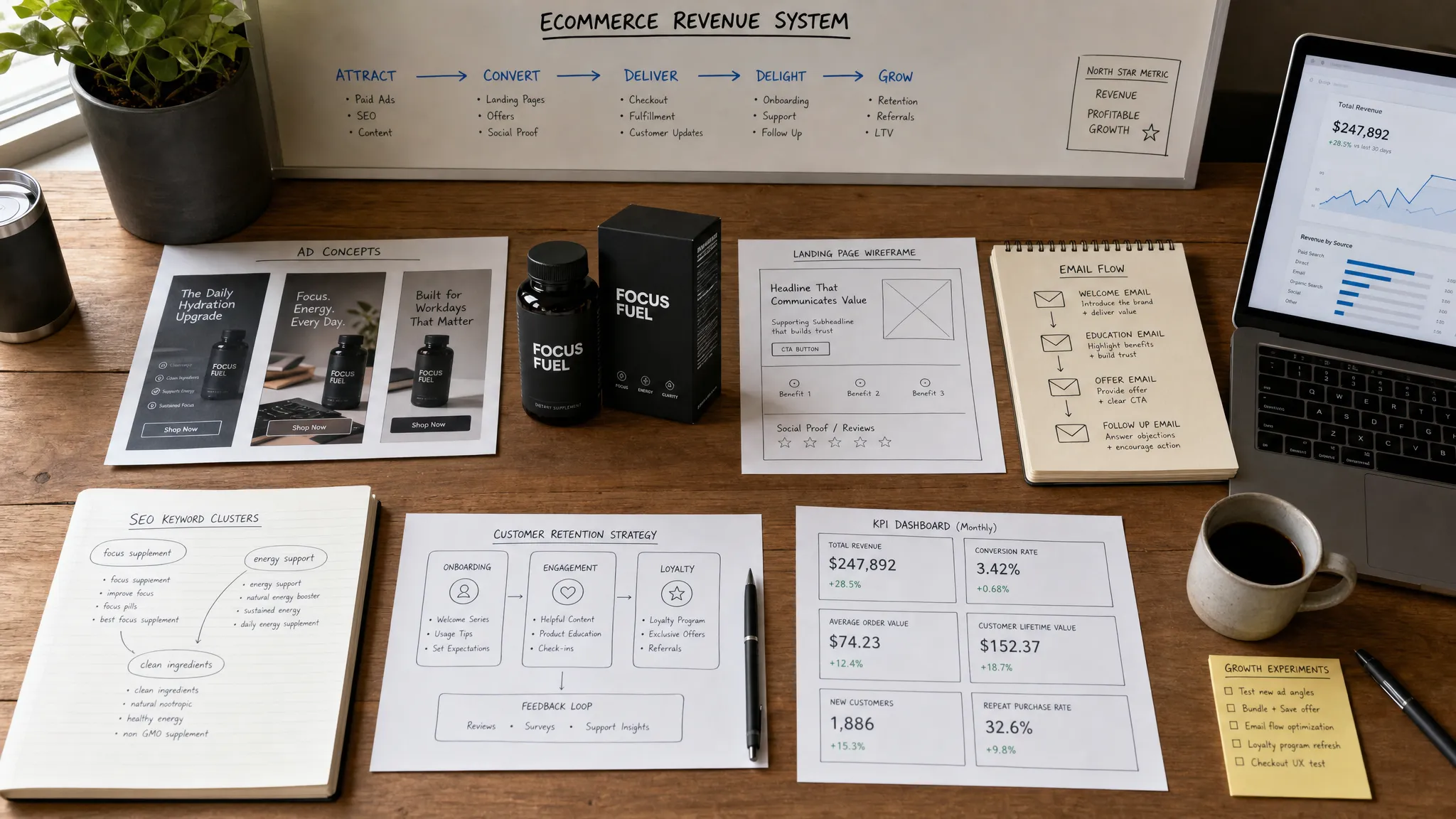
That is where an ecommerce marketing agency can create leverage. The right partner does not simply manage campaigns. It connects paid acquisition, creative strategy, conversion rate optimization, email marketing, SEO, and KPI reporting so every part of the funnel works toward revenue growth.
For sports, fitness, and wellness brands, this matters even more. Customers need to trust the product, understand the performance benefit, believe the brand story, and feel confident enough to buy. Scaling revenue means building that confidence at every touchpoint.
Why ecommerce revenue becomes harder to scale
Early ecommerce growth often comes from founder energy, product novelty, organic community, and a few ad campaigns that hit. That stage is exciting, but it can hide weaknesses in the business model.
As spend increases, those weaknesses become expensive. A landing page that converted well with warm audiences may underperform with cold traffic. A creative angle that worked for months may fatigue. A discount that lifted first purchases may train customers to wait for sales. A high ROAS campaign may still be unprofitable if shipping, returns, cost of goods, and agency or platform fees are not included.
Most brands hit a ceiling when they scale one lever without improving the others. More ad spend without better conversion increases customer acquisition cost. Better traffic without retention creates a leaky bucket. Strong creative without clear reporting makes it hard to know what to repeat.
An ecommerce marketing agency helps by turning growth into a system instead of a series of disconnected tactics.
What an ecommerce marketing agency actually does
A strong ecommerce agency focuses on revenue, not just activity. That means it should understand how every channel and asset contributes to business outcomes.
At a practical level, an agency may support:
- Paid social advertising for demand generation and retargeting
- Paid search and shopping campaigns for high-intent buyers
- Conversion rate optimization across product pages, landing pages, carts, and checkout
- Email marketing to increase first purchase, repeat purchase, and customer lifetime value
- Creative asset production for ads, organic content, landing pages, and lifecycle campaigns
- Search engine optimization to build compounding non-paid traffic
- KPI reporting to connect marketing performance to revenue, margin, and customer behavior
- Brand strategy consulting to sharpen positioning, messaging, and offers
The value is not just having people execute these tasks. It is having a team that understands how the tasks interact. For example, if paid ads are sending traffic to a weak offer, the answer is not always a new campaign structure. It may be a better landing page, stronger product education, clearer pricing, or a lifecycle campaign that warms prospects before the sale.
Start with the revenue math before increasing spend
Scaling begins with knowing what the business can afford. If a brand does not understand its economics, it can mistake revenue growth for profitable growth.
Before an agency scales campaigns, it should clarify metrics like average order value, gross margin, contribution margin, customer acquisition cost, blended ROAS, marketing efficiency ratio, repeat purchase rate, and customer lifetime value. These numbers help define how aggressively a brand can spend and where the best growth opportunities live.
For example, a performance apparel brand with strong margins and repeat purchases may be able to tolerate a higher first-order CAC than a single-purchase equipment brand. A supplement company with predictable replenishment can scale differently than a seasonal fitness accessory brand. A premium product may need more education and proof before purchase, while a low-consideration item may scale through offer testing and creative volume.
This is one reason revenue strategy should come before media buying. The right ecommerce marketing agency will ask questions about margin, inventory, fulfillment, returns, and repeat purchase behavior because those factors shape the entire growth plan.
Improve paid acquisition with better creative and clearer channel roles
Paid media is often the most visible part of ecommerce scaling. It is also one of the easiest places to waste money if the strategy is built only around platform tactics.
Meta, TikTok, Google, YouTube, and other channels do not all play the same role. Paid social is often strongest at creating demand, testing angles, and introducing products to new audiences. Paid search and shopping campaigns are usually better at capturing existing intent from customers who are already comparing options or looking for a specific product type.
An agency can help define those roles, then build campaigns around them. That includes structuring budgets, testing audiences, improving landing paths, and setting realistic performance expectations by channel.
Creative is the biggest unlock in many accounts. Strong creative testing answers questions like:
- What problem does the customer feel most urgently?
- Which product benefit is most compelling?
- What proof points build trust fastest?
- Which objections stop customers from buying?
- Which hooks attract qualified buyers instead of low-intent clicks?
For sports and wellness brands, creative needs to do more than look polished. It has to show the product in use, communicate the benefit clearly, and stay credible. Performance claims, transformation messaging, and health-related promises should be handled carefully. Trust is a growth asset.
Convert more traffic into buyers with CRO
If paid media brings people to the store, conversion rate optimization determines how much of that demand becomes revenue.
CRO is not just button color testing. It is the process of understanding why customers hesitate and improving the buying experience. For ecommerce brands, that often means refining product pages, collection pages, landing pages, cart flow, mobile experience, checkout, offers, and trust signals.
According to Baymard Institute research on cart abandonment, ecommerce cart abandonment remains a major revenue leak across online stores. The exact causes vary, but common issues include unexpected costs, forced account creation, slow checkout flows, unclear delivery information, and weak trust signals.
Product detail pages deserve special attention. They must answer customer questions before the customer leaves to search elsewhere. For categories where authenticity, scarcity, and fit are major buying barriers, such as a specialty sneaker retailer like BigBoiSneakers, strong product pages need clear visuals, detailed sizing guidance, trust-building information, shipping expectations, and easy navigation between brands or price points.
The same logic applies to fitness and wellness ecommerce. A gym equipment brand needs to address durability, space requirements, assembly, warranty, and use cases. A nutrition brand needs to explain ingredients, taste, usage, certifications, and replenishment cadence. An apparel brand needs fit guidance, material details, movement-focused imagery, and return clarity.
CRO compounds paid media performance. If conversion rate improves, the same traffic produces more revenue. That can lower effective CAC, increase ROAS, and create more room to scale spend.
Use email marketing to increase customer lifetime value
Many ecommerce brands focus too heavily on first purchases. Revenue scales more efficiently when the brand also increases repeat purchase, cross-sell, and long-term customer value.
Email marketing is one of the most important channels for that work. It allows brands to turn visitors, leads, and customers into a more valuable audience over time. A strong email program should not be limited to newsletters or discount blasts. It should include lifecycle flows that match the customer journey.
Core flows often include welcome series, abandoned cart, browse abandonment, post-purchase education, product review requests, replenishment reminders, cross-sell campaigns, winback sequences, and VIP or loyalty messaging.
For sports, fitness, and wellness brands, education is especially powerful. A customer who buys a recovery tool may need guidance on how to use it. A customer who purchases supplements may need timing instructions, routine ideas, or replenishment reminders. A customer who buys training apparel may respond well to styling, performance care tips, or sport-specific product recommendations.
Retention also improves paid acquisition. When lifetime value rises, the business can often afford to acquire customers more aggressively while staying profitable.
Build SEO assets that reduce dependency on paid media
Paid media can scale quickly, but it stops the moment spend stops. SEO works differently. It takes longer to build, but it can create compounding traffic and revenue over time.
An ecommerce marketing agency can use SEO to capture demand across the full funnel. That includes category pages for commercial intent, product pages for specific buying intent, comparison content for evaluation, and educational content for customers still learning about the problem.
For example, a home gym brand might target searches around compact strength equipment, garage gym setups, or equipment comparisons. A wellness brand might build content around routines, ingredients, benefits, or use cases. A sports accessory brand might capture demand around sport-specific gear guides.
SEO also supports paid marketing. Search data can reveal customer language that improves ad hooks. High-performing content can be repurposed into email and creative concepts. Organic product and category pages can become stronger landing pages for paid campaigns.
If you want a deeper breakdown of organic growth, OPTYO has also covered how a search engine optimization agency grows D2C brands.
Strengthen brand strategy so growth does not depend on discounts
Performance marketing works best when the brand is already meaningful to the customer. Without clear positioning, ecommerce brands often rely too much on discounts, broad claims, or generic product features.
Brand strategy helps define why a customer should choose your product over the alternatives. That includes the target market, category positioning, emotional promise, proof points, pricing logic, visual identity, messaging hierarchy, and offer strategy.
For a fitness product, the brand may need to own a specific training philosophy or audience segment. For a wellness product, credibility and trust may matter more than hype. For a sports brand, community and identity can be just as important as product specs.
The best ecommerce marketing agencies do not separate brand and performance. They use brand strategy to improve campaign angles, creative briefs, landing page copy, product education, and email messaging. That makes performance marketing more efficient because customers understand the value faster.
For founders still refining their audience, it is worth revisiting how to define your target market for faster growth before scaling budget.
Turn reporting into decisions, not dashboards
Reporting is only useful if it changes what the team does next. A good ecommerce agency should not bury founders in disconnected platform screenshots. It should explain what is happening, why it matters, and what decisions should follow.
Useful reporting connects platform metrics to business metrics. That means looking beyond in-platform ROAS and understanding blended performance across the entire store.
Important metrics often include:
- Total revenue and revenue by channel
- New customer revenue versus returning customer revenue
- CAC and cost per purchase
- Blended ROAS and marketing efficiency ratio
- Conversion rate and average order value
- Email revenue and flow performance
- Repeat purchase rate and customer lifetime value
- Creative testing results and fatigue signals
- Landing page and product page performance
This level of reporting helps founders see whether growth is healthy. If revenue is rising but contribution margin is shrinking, the strategy needs adjustment. If paid social is struggling but branded search is rising, the agency should investigate whether awareness is improving. If email revenue is flat despite traffic growth, lifecycle strategy may need attention.
OPTYO’s work with MX Select is one example of how data-driven advertising, landing page optimization, email automation, and multi-channel budget testing can support revenue growth. The MX Select case study highlights how a strategic approach helped build a premium fitness equipment brand past $1M in revenue.
What a 90-day agency scaling plan can look like
Every brand needs a custom plan, but the first 90 days with an ecommerce marketing agency should usually focus on diagnosis, controlled testing, and early scaling.
Days 1 to 30: audit and strategy
The first month should clarify the growth model. That includes reviewing account structure, tracking, creative performance, website conversion, email flows, SEO foundations, customer segments, offer strategy, and key financial metrics.
The agency should identify the biggest constraints. Is the main issue traffic quality, conversion rate, creative fatigue, low AOV, weak retention, poor tracking, unclear positioning, or a margin problem? The answer determines the plan.
Days 31 to 60: launch priority tests
The second month should focus on high-impact tests. That might include new creative angles, landing page variants, product page improvements, email flow updates, Google Shopping optimization, or offer testing.
At this stage, the goal is not random experimentation. It is structured learning. Each test should answer a specific question about the customer, offer, channel, or buying experience.
Days 61 to 90: scale what works and fix what blocks growth
By the third month, the agency should have enough signal to shift budget, refine creative production, improve retention, and prioritize CRO or SEO work. The goal is to scale the strongest opportunities while continuing to remove bottlenecks.
This is also when communication rhythm matters. Founders should understand what has been learned, what is being scaled, what is being paused, and what the next growth constraint is.
How to choose the right ecommerce marketing agency
Not every agency is built for every ecommerce brand. Some are media-buying shops. Some focus on creative production. Some specialize in SEO, email, or CRO. The right partner depends on the brand’s stage, category, goals, and internal team.
Before hiring an agency, founders should ask:
- Do they understand ecommerce unit economics?
- Can they connect paid media with CRO, creative, email, and SEO?
- Do they have experience with brands in your category or business model?
- How do they measure success beyond platform ROAS?
- What is their creative testing process?
- How do they communicate insights and decisions?
- Can they support both strategy and execution?
For sports, fitness, and wellness brands, category understanding is especially valuable. The agency should understand seasonality, product education, community influence, credibility, and the difference between impulse purchases and considered purchases.
OPTYO is built around that intersection of performance marketing and brand acceleration. For D2C and CPG companies in sports, fitness, and wellness, the opportunity is not just to drive more clicks. It is to build a growth system that can keep improving as the brand scales.
Frequently Asked Questions
When should an ecommerce brand hire a marketing agency? An ecommerce brand should consider hiring an agency when it has product-market validation, enough margin to support customer acquisition, reliable fulfillment, and a clear need for more strategic execution across paid media, CRO, email, SEO, or creative.
Can an ecommerce marketing agency guarantee revenue growth? No agency should guarantee specific revenue results because performance depends on product demand, pricing, margin, website experience, inventory, competition, and market conditions. A strong agency should provide a clear strategy, testing roadmap, reporting process, and performance targets.
What is the difference between an ecommerce agency and a general marketing agency? An ecommerce agency focuses on online revenue drivers like paid acquisition, product pages, checkout, conversion rate, retention, average order value, and customer lifetime value. A general agency may focus more broadly on awareness, branding, or communications.
How long does it take to see results from an ecommerce marketing agency? Paid media and CRO tests can often produce signals within weeks, while SEO and retention improvements may take longer to compound. Most brands should evaluate early progress over the first 60 to 90 days, then assess broader growth trends over several months.
What should founders prepare before working with an agency? Founders should prepare access to ad accounts, analytics, ecommerce platforms, email platforms, creative assets, product margin data, customer insights, historical performance, inventory information, and business goals.
Ready to build a revenue system that scales?
Scaling ecommerce revenue is not about chasing one perfect campaign. It is about improving the entire system: acquisition, creative, conversion, retention, SEO, reporting, and brand strategy.
If you are building a sports, fitness, or wellness brand and want a partner that understands both performance marketing and brand growth, connect with OPTYO. The right strategy can turn scattered marketing activity into a repeatable engine for revenue growth.