.png)




Most ecommerce brands spend heavily to win the first order. The real profit often appears later, when that first-time buyer comes back for a refill, buys the next product in the routine, joins a seasonal drop, or recommends the brand to a training partner.
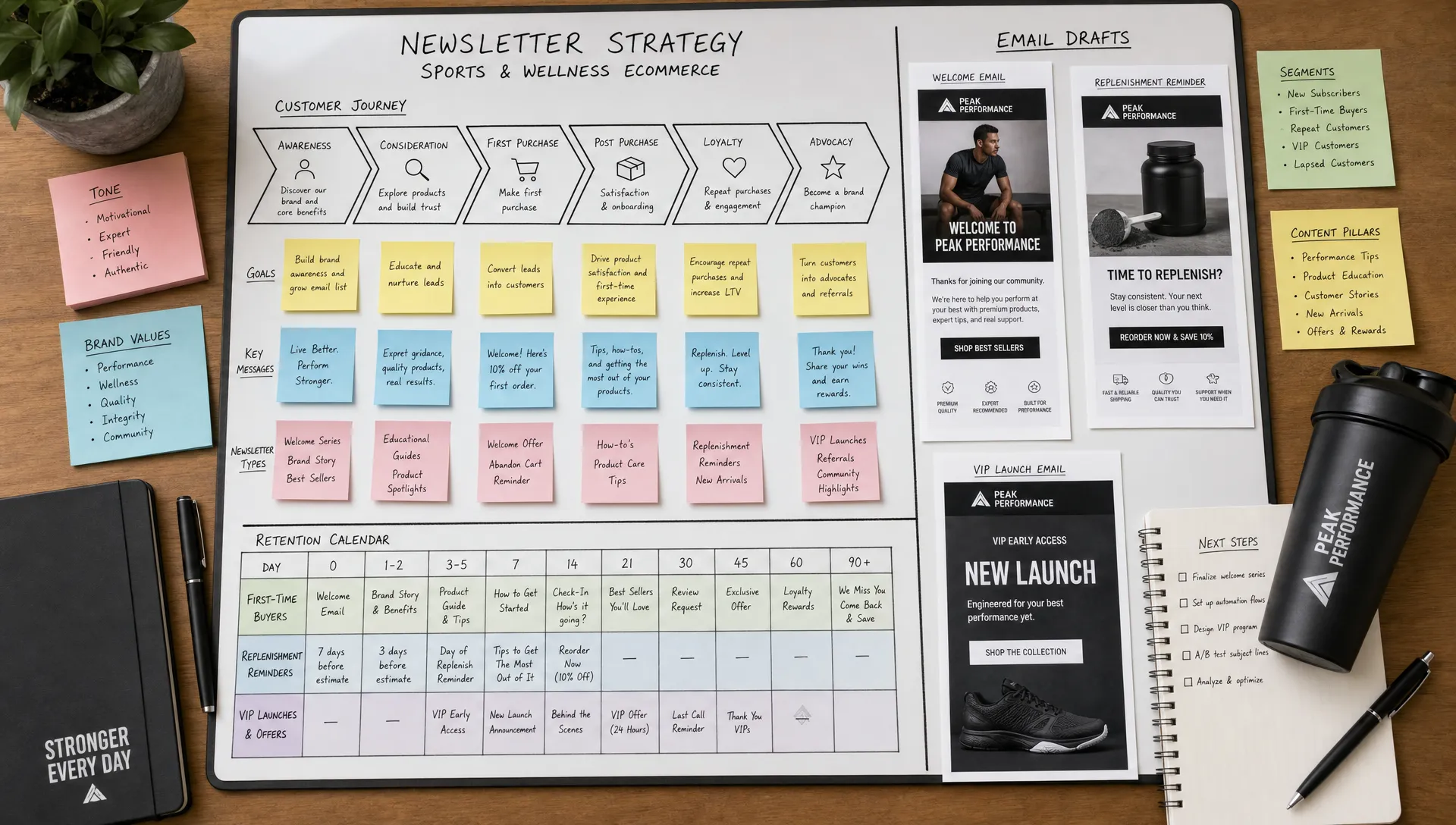
That is where a newsletter marketing agency can create outsized leverage. Not by sending more promotional emails, but by building a repeatable retention system that keeps customers engaged between purchases and gives them relevant reasons to buy again.
For sports, fitness, and wellness brands, this matters even more. Customers are not just buying a product. They are trying to perform better, recover faster, stay consistent, feel healthier, or belong to a community. A strong newsletter program connects your products to those ongoing goals, which makes repeat revenue feel natural instead of forced.
Repeat revenue is built after the first purchase
A first purchase proves that someone trusted your promise once. Repeat revenue proves that your brand stayed useful.
That difference changes how your marketing should work. A paid ad might win attention for a moment, but a newsletter gives your brand a direct channel to educate, motivate, launch, remind, and retain. For D2C and CPG brands, this direct relationship is one of the most valuable assets in the business because it reduces reliance on constant acquisition spend.
A newsletter marketing agency helps turn that relationship into a revenue engine by answering practical questions:
- What should new subscribers receive before they buy?
- What should first-time buyers learn after their order arrives?
- When should customers be nudged toward replenishment, accessories, bundles, or a second category?
- Which customers should get education, which should get an offer, and which should not be discounted at all?
- How do we measure loyalty without overvaluing one-time campaign spikes?
The goal is not just more email revenue this week. The goal is more repeatable revenue over the next 90, 180, and 365 days.
Customer stage   | Main goal                                  | Newsletter agency focus                                      | Useful metric
New subscriber   | Build trust before purchase                | Welcome content, education, social proof, offer testing      | Signup-to-first-purchase rate
First-time buyer | Create confidence and product usage        | Post-purchase education, routine-building, support content   | Second-purchase rate
Active customer  | Increase frequency and average order value | Cross-sell, bundles, replenishment, loyalty moments          | Revenue per recipient
At-risk customer | Prevent churn                              | Winback content, replenishment reminders, preference updates | Reactivation rate
VIP customer | Deepen loyalty | Early access, community, referral prompts, exclusive drops | Purchase frequency and LTV Many founders think of newsletters as a creative task: write copy, design a template, send it on Thursday. That is only a small part of the job.
A strong newsletter marketing agency connects strategy, analytics, creative, segmentation, deliverability, merchandising, and testing. The agency should understand how email supports the full customer journey, not just how to make a campaign look polished.
For an emerging ecommerce brand, this often includes:
- Building a retention calendar tied to product demand, seasonality, and inventory
- Creating campaign concepts that balance education, community, and sales
- Segmenting audiences by behavior rather than blasting the full list
- Improving sign-up forms, landing pages, and lead capture offers
- Writing automated flows for welcome, post-purchase, replenishment, cross-sell, and winback moments
- Testing subject lines, offers, creative angles, send times, and product merchandising
- Reporting on repeat purchase rate, customer lifetime value, and email-attributed revenue
This is also why newsletter strategy should not live in isolation. It works best when connected to acquisition, CRO, creative, and brand positioning. OPTYO discusses that broader growth connection in its guide on how an ecommerce marketing agency can scale revenue, where retention is one piece of a larger performance system.
Start with better first-party data
A newsletter program can only be as relevant as the data behind it. If every subscriber looks the same in your platform, your emails will feel generic.
A newsletter marketing agency helps collect and use first-party and zero-party data in a way that improves personalization without making the experience feel invasive. For sports, fitness, and wellness brands, useful data might include training goals, product category interest, dietary preferences, preferred sport, purchase frequency, size, flavor preference, or routine stage.
The key is to ask for information when it benefits the customer. A running apparel brand might ask subscribers whether they train for road, trail, or race day. A supplements brand might ask whether the customer is focused on recovery, energy, muscle gain, or daily wellness. A fitness equipment brand might ask whether the buyer is building a home gym, upgrading accessories, or looking for programming.
That information helps the newsletter feel less like a broadcast and more like a coach, guide, or helpful teammate.
Segment by behavior, not just demographics
Age, gender, and location can be useful, but they rarely explain why someone buys again. Behavioral segmentation is more powerful because it reflects intent.
A customer who bought protein powder 28 days ago is in a different mindset than someone who browsed a shaker bottle but never purchased. A subscriber who clicks every product launch is not the same as a discount-only buyer. A VIP customer who buys every season should not receive the same message as a first-time buyer who has not opened an email in 60 days.
A newsletter marketing agency typically looks for segments such as:
- Recent buyers who need onboarding and usage education
- Customers approaching a likely replenishment window
- Category buyers who are ready for a complementary product
- High-engagement subscribers who have not purchased yet
- Discount-sensitive buyers who only act during promotions
- VIPs who deserve early access and community-led messaging
- Lapsed customers who need a relevant reason to return
This is where repeat revenue starts to compound. Instead of sending one message to everyone, the brand sends the right message to the right customer based on what they have already shown through behavior.
Turn newsletters into lifecycle programs
Campaign newsletters are important, but lifecycle messaging is where repeat revenue becomes more predictable. Campaigns respond to the calendar. Lifecycle flows respond to customer behavior.
A strong agency will usually build both. The campaign calendar might include product drops, seasonal routines, athlete stories, training content, and promotions. Lifecycle flows run in the background, triggered by signups, purchases, browsing behavior, replenishment timing, and inactivity.
Lifecycle program    | Revenue role                                | Example for a sports, fitness, or wellness brand
Welcome series       | Converts subscribers into first-time buyers | Introduce the brand promise, bestsellers, proof, and first-purchase incentive
Post-purchase series | Reduces regret and builds product usage     | Share setup tips, training routines, recipes, recovery guidance, or care instructions
Replenishment flow   | Brings customers back at the right time     | Remind customers when supplements, snacks, hydration, or consumables may be running low
Cross-sell flow      | Expands category adoption                   | Recommend socks after running shoes, a shaker after protein, or recovery tools after training gear
Winback flow         | Reactivates lapsed buyers                   | Use new product updates, personalized recommendations, or a limited offer to restart engagement
VIP flow | Increases loyalty and advocacy | Offer early access, exclusive bundles, referral prompts, or community-driven content Protect deliverability before chasing more sends
Revenue from newsletters depends on getting into the inbox. If messages land in spam, promotions tabs that customers ignore, or never arrive at all, even the best creative cannot perform.
A newsletter marketing agency should pay close attention to list health, consent, engagement, spam complaints, bounce rates, authentication, and sending cadence. This is especially important as inbox providers continue to raise expectations around sender behavior and subscriber engagement.
More email is not always better. Sending too frequently to unengaged subscribers can damage sender reputation and reduce performance across the entire list. A smarter approach is to segment engaged audiences, suppress inactive contacts when needed, and create re-engagement paths before removing subscribers who no longer respond.
If deliverability is already hurting performance, it may be worth reviewing how an email deliverability agency protects revenue before scaling newsletter volume.
Create content customers actually want to keep receiving
Repeat revenue does not come from discounts alone. If every email says buy now, customers learn to ignore your brand until they need a coupon.
Sports, fitness, and wellness brands have an advantage here because they can create newsletter content that fits naturally into a customer’s lifestyle. The best newsletters help customers use the product, understand the category, and feel connected to the outcome they care about.
Good newsletter content might include training tips, recovery checklists, product education, founder notes, athlete stories, nutrition guidance, customer transformations, seasonal routines, new drop previews, and community highlights. The commercial message still matters, but it is wrapped in genuine value.
For brands that sell apps, connected devices, coaching platforms, or AI-enabled wellness tools, retention also depends on product adoption. If customers do not trust or understand the experience, they will not keep using it. Product teams can use resources like the AI Product Adoption Deck to diagnose where adoption breaks, then turn those insights into onboarding emails, trust-building content, and re-engagement campaigns.
Use offers without training customers to wait for discounts
Discounts can drive short-term sales, but overusing them can weaken margin and brand perception. A newsletter marketing agency helps brands choose the right incentive for the right moment.
A first-time subscriber might need a welcome offer. A replenishment customer may not need a discount at all, just a timely reminder and easy reorder path. A VIP customer might respond better to early access than 15% off. A lapsed customer may need a stronger reason to return, but that reason could be a new product, improved formulation, limited bundle, or personalized recommendation.
Offer strategy should consider margin, inventory, customer value, and brand positioning. A premium wellness brand should not sound like a clearance outlet. A performance apparel brand should not discount every drop if scarcity and innovation are part of the appeal.
A useful framework is to match the offer to the customer’s intent:
Customer intent                | Better approach                                            | Why it works
High intent, recent engagement | Product education or early access                          | Avoids unnecessary discounting
Needs refill or replacement    | Replenishment reminder or bundle                           | Solves a practical timing problem
Browsed but did not buy        | Objection handling and social proof                        | Addresses friction before offering a deal
Lapsed customer                | Newness, personalized recommendation, or winback incentive | Creates a fresh reason to return
VIP buyer | Exclusivity, access, referral, or community | Rewards loyalty without reducing perceived valueMeasure repeat revenue with the right KPIs
Email platforms make it easy to focus on open rates and campaign revenue. Those numbers matter, but they do not tell the full retention story.
A newsletter marketing agency should measure performance in a way that reflects customer quality, not just campaign activity. A campaign that produces a quick sales spike but increases unsubscribes, discount dependence, or low-margin orders may not be a true win.
Stronger retention reporting includes:
- Repeat purchase rate by cohort
- Second-purchase conversion rate
- Purchase frequency over time
- Revenue per recipient
- Margin-aware revenue where possible
- Flow revenue versus campaign revenue
- Active subscriber percentage
- Unsubscribe and spam complaint rate
- Customer lifetime value by segment
- Time between first and second purchase
The most important question is simple: are customers buying again because your brand is becoming more useful to them, or because you are pushing harder?
That distinction matters. A healthy newsletter program should improve customer understanding, not just email volume.
Connect newsletter strategy to the full growth plan
Newsletter marketing is most effective when it is connected to the rest of the business. If paid social is testing new hooks, the newsletter can validate those messages with existing customers. If CRO shows shoppers hesitate on product comparison, newsletter content can address that objection. If SEO is bringing in educational traffic, email can convert those readers into subscribers and buyers.
This is why a newsletter marketing agency should work closely with performance marketing, creative, ecommerce, and brand strategy. Retention is not a separate department. It is the continuation of every promise made before the sale.
For entrepreneurs, the risk is treating email as an afterthought after ads, product development, and operations. But once acquisition costs rise, retention becomes the difference between a brand that constantly needs new buyers and a brand that compounds customer value.
If you are refining that larger system, it can help to connect retention to a smarter growth strategy so your newsletter program supports positioning, funnel design, measurement, and long-term revenue goals.
When should you hire a newsletter marketing agency?
A founder can usually manage simple email campaigns in the earliest stage. But as the list grows, the opportunity cost of a basic newsletter program increases.
It may be time to bring in a newsletter marketing agency if your brand has a growing subscriber list but low repeat purchase rate, strong first-order sales but weak second-order conversion, inconsistent email revenue, too many generic blasts, poor segmentation, weak post-purchase education, or a promotion calendar that relies too heavily on discounts.
It is also a smart move when your product requires education. Supplements, performance gear, wellness products, fitness equipment, and training-related products often need more explanation than a single product page can provide. A newsletter gives you room to build belief over time.
The right agency should not only ask what you want to send next. It should ask what your customers need to believe, understand, feel, and do before they buy again.
Frequently Asked Questions
What does a newsletter marketing agency do? A newsletter marketing agency builds and manages email newsletter strategies that improve engagement, conversion, and repeat revenue. This can include segmentation, content planning, campaign creation, lifecycle flows, testing, reporting, and coordination with broader ecommerce growth efforts.
How does newsletter marketing increase repeat revenue? Newsletter marketing increases repeat revenue by keeping customers engaged after the first purchase. It can educate buyers, remind them to reorder, introduce complementary products, promote relevant launches, reactivate lapsed customers, and reward loyal customers with access or exclusive offers.
Is newsletter marketing different from email marketing? Newsletter marketing is a focused part of email marketing. Email marketing includes automated flows, transactional messages, promotional campaigns, and retention programs. Newsletter marketing usually emphasizes recurring editorial or promotional communication that keeps subscribers engaged over time.
How often should an ecommerce brand send newsletters? The right frequency depends on audience engagement, product category, content quality, and purchase cycle. Many brands benefit from a consistent weekly or biweekly cadence, but high-frequency sending should be reserved for engaged segments and moments when the brand has something genuinely valuable to share.
What should sports and wellness brands include in newsletters? Sports and wellness brands can include training tips, recovery guidance, product education, customer stories, athlete insights, seasonal routines, replenishment reminders, product drops, and community content. The best mix combines usefulness with clear buying opportunities.
Turn your newsletter into a repeat revenue channel
A newsletter should not be a last-minute promotion tool. For ecommerce brands, especially in sports, fitness, and wellness, it can become one of the most reliable ways to grow repeat revenue, increase customer lifetime value, and strengthen brand loyalty.
OPTYO helps D2C and CPG brands connect performance marketing, creative, ecommerce development, CRO, email marketing, SEO, reporting, and growth strategy into one clearer path to scale. If your newsletter program needs to become more strategic, more measurable, and more connected to revenue, start with OPTYO.