.png)


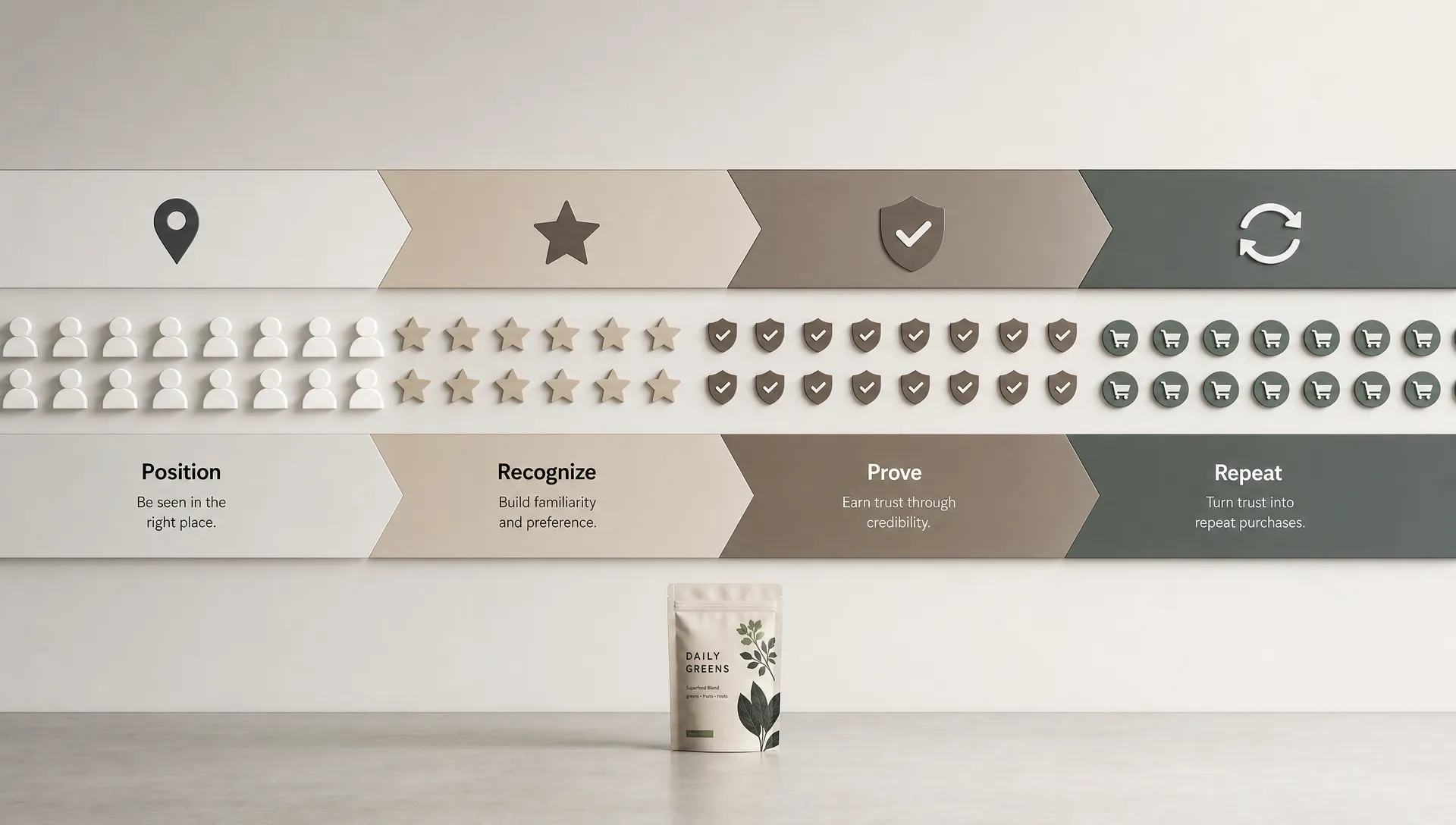

A customer rarely remembers a brand because it had the cleanest logo or the cleverest tagline. They remember it because the brand became linked to a specific need, feeling, outcome, or moment in their life.
For ecommerce founders in sports, fitness, and wellness, that distinction matters. Your customers are not just buying shoes, supplements, equipment, apparel, or recovery tools. They are buying progress, confidence, identity, discipline, belonging, and proof that their goals are possible.
That is what a strong brand strategy does. It makes your brand easier to recognize, easier to trust, and easier to choose when customers are ready to buy. It connects what you sell with why people care, then turns that connection into repeatable creative, messaging, offers, and customer experiences.
What a memorable brand strategy really does
A memorable brand strategy is not a mood board. It is not a one-time positioning workshop that gets buried in a folder. It is a practical operating system for how your company earns attention and preference.
At its best, strategy answers four questions with extreme clarity:
- Who are we for?
- What problem or desire do we own?
- Why should customers believe us?
- How will people recognize us again and again?
The goal is not to make every person love your brand. The goal is to make the right customers instantly understand why your brand belongs in their life.
This is especially important in ecommerce because customers are moving fast. They see your ad for two seconds, scan your product page, compare you to alternatives, read a few reviews, and decide whether your promise feels believable. If your brand is vague, the customer does the work. If your strategy is sharp, the brand does the work for them.
Start with one clear customer and one clear job
The fastest way to become forgettable is to aim at everyone.
Many early-stage brands describe their audience in broad terms like “active people,” “busy professionals,” or “anyone who wants to be healthier.” Those groups are too large to create a memorable message. A runner training for their first marathon, a former athlete rebuilding consistency, and a parent trying to squeeze in 30-minute workouts may all buy fitness products, but they respond to different motivations.
A stronger brand strategy starts with a more specific customer context. Instead of asking, “Who could buy this?” ask, “When does the customer need us most?”
For a sports nutrition brand, that moment might be the frustration of crashing halfway through a long training session. For a recovery brand, it might be the morning after a hard workout when soreness threatens consistency. For a wellness CPG brand, it might be the daily routine where customers want a healthier option without feeling restricted.
Specificity gives you language. Language gives you memory.
If you need to sharpen this foundation, OPTYO’s guide on how sports brands win with better positioning breaks down why clear market position makes creative, paid media, and ecommerce execution easier to scale.
Build around a memorable strategic idea
A brand strategy customers remember usually has one central idea. Not ten values. Not a paragraph of internal language. One idea that can be repeated across ads, product pages, packaging, email, creator briefs, and customer support.
That idea should sit at the intersection of three things: what your customer wants, what your product can credibly deliver, and what competitors are not already owning.
For example, a generic fitness apparel brand might say, “Premium workout clothes for active lifestyles.” That is clear, but not memorable. A sharper idea might be, “Training gear for athletes who refuse to coast.” Now the brand has a worldview. It knows who it is talking to. It can build creative around effort, consistency, and identity.
A supplement brand might move from “clean ingredients for better performance” to “fuel for athletes who train before the world wakes up.” The second version creates a scene in the customer’s mind. It suggests a lifestyle, a ritual, and a specific emotional state.
The test is simple: could your strategic idea inspire a campaign, a product page headline, an email subject line, and a founder story without sounding forced? If not, it may still be too generic.
Make the promise easy to repeat
Customers do not memorize brand decks. They remember simple associations.
Your brand promise should be short enough to repeat and specific enough to matter. It does not have to be a public tagline, but your internal team should be able to say it without hesitation.
A strong promise usually includes an audience, an outcome, and a reason to believe. For example, “We help strength athletes recover faster with science-backed mobility tools” is more useful than “We help people feel their best.” It gives your marketing team direction. It gives your creative team tension. It gives customers something concrete to evaluate.
The promise should also avoid overclaiming. Wellness, fitness, and nutrition brands often operate in categories where trust is fragile. Customers are skeptical of miracle language, exaggerated transformation claims, and vague “clinically inspired” messaging. Credibility compounds when your brand makes clear claims, supports them with proof, and stays consistent.
For categories with regulatory or health-related considerations, memorable branding should never come at the expense of responsible claims. Teams managing complex policy, documentation, or review processes can benefit from AI compliance workflows that help keep growth moving without letting compliance become an afterthought.
Create distinctive assets customers can recognize
A brand becomes easier to remember when it uses consistent signals. These signals can include color, typography, photography style, packaging structure, sonic cues, product naming, slogans, recurring characters, founder presence, or a recognizable content format.
The key is distinctiveness, not decoration.
If your brand looks like every other minimalist wellness company, you may appear polished but still disappear in the feed. If your performance creative changes style every week, paid media may generate short-term tests but fail to build long-term recognition. If your packaging, website, and ads all feel like different companies, memory gets diluted.
Distinctive assets work when they are repeated with discipline. A customer should be able to see your ad without the logo and still have a sense that it belongs to you.
For ecommerce brands, the most useful assets are often the ones that can travel across channels:
- A repeatable product benefit phrase
- A recognizable visual treatment for before-and-after or product demonstration content
- A consistent founder or expert voice
- A signature color or packaging element
- A recurring ritual customers can associate with your product
These assets do not replace performance marketing. They make performance marketing more efficient because every impression has a chance to build recognition, not just capture a click.

Turn proof into part of the brand
A memorable brand is not only recognized. It is believed.
In sports, fitness, and wellness, proof is part of the product experience. Customers want to know whether the product works, whether people like them use it, and whether the brand understands their goals. Your strategy should define what type of proof matters most.
For some brands, proof is technical: ingredient quality, third-party testing, durability, engineering, or expert validation. For others, proof is social: customer stories, community participation, athlete adoption, reviews, transformations, or repeat purchase behavior. For many ecommerce brands, it is a combination.
The mistake is treating proof as something that only belongs at the bottom of a product page. Proof should shape your ads, landing pages, emails, packaging, and retention flows.
A recovery product can lead with the emotional pain of missing training days, then support the promise with customer quotes and usage education. A functional beverage can turn ingredient transparency into a brand asset, not just a compliance requirement. A fitness equipment brand can use durability tests as creative, not just product information.
If you want brand strategy to support revenue, connect proof to conversion. OPTYO’s article on how brand strategy and marketing drive better conversion explains how positioning, proof, and offer clarity reduce friction in the buying journey.
Build a messaging system, not a slogan collection
Memorable brands do not rely on one line to do all the work. They create a messaging system that adapts to different customer stages while staying anchored in the same strategy.
At the awareness stage, your message should create recognition and relevance. The customer should quickly think, “This is for someone like me.”
At the consideration stage, your message should explain why your product is different, why the promise is believable, and how it compares to alternatives.
At the purchase stage, your message should remove risk. That may include reviews, guarantees, shipping clarity, bundles, product education, or use-case guidance.
At the retention stage, your message should reinforce identity. Customers should feel smarter, stronger, more consistent, or more connected because they bought from you.
This is where many ecommerce brands underuse brand strategy. They build a strong acquisition message, then send generic post-purchase emails. Or they create a premium website, then run ads that feel disconnected from the brand. A messaging system keeps every touchpoint aligned.
Connect brand memory to product experience
Customers remember what a brand says, but they remember even more strongly what the brand helps them do.
If your brand promises discipline, the customer experience should make consistency easier. If your brand promises simplicity, the buying process should not feel complicated. If your brand promises premium performance, the packaging, instructions, and support experience should all feel high quality.
This is where strategy becomes operational. A brand promise may influence product bundles, subscription timing, onboarding emails, educational content, loyalty programs, or community design.
For example, a wellness brand built around “daily momentum” could create a 30-day customer onboarding sequence that helps buyers build the habit. A training gear brand built around “no wasted reps” could include workout education, care instructions, and performance tips that reinforce the brand idea after purchase.
When the experience matches the message, customers do not just remember the brand. They trust it.
Use performance data without letting it flatten the brand
Performance marketing is essential, but it can make brands generic if every decision is based only on the last click or the latest winning hook.
A discount ad might drive purchases this week while training customers to wait for promotions. A fear-based hook might improve click-through rate while weakening trust. A trend-driven creative style might lower CPMs temporarily while making your brand indistinguishable from competitors.
The answer is not to ignore performance data. The answer is to interpret it through the brand strategy.
Track metrics that show both short-term response and long-term memory:
- Branded search volume
- Direct traffic quality
- Returning customer rate
- Email and SMS revenue from repeat buyers
- Creative performance by message theme
- Review language and customer sentiment
- Repeat purchase timing
- New customer acquisition cost by audience and offer
If customers start using your own phrases in reviews, mentioning your brand by name in social comments, or searching for you directly, your strategy is starting to live in the market.
Common reasons brand strategies fail
Most weak strategies do not fail because the team lacks taste. They fail because the strategy is too broad, too internal, or too disconnected from execution.
Watch for these issues:
- The target customer is described demographically, but not emotionally or behaviorally.
- The brand promise sounds good, but could apply to dozens of competitors.
- The creative direction changes so often that customers cannot form memory.
- The website says one thing, while ads emphasize something else.
- Proof is buried instead of being built into the brand story.
- The team treats branding as separate from paid media, CRO, email, and product experience.
A memorable brand strategy is not what your team says in a workshop. It is what customers consistently notice, understand, believe, and repeat.
A practical 30-day brand strategy sprint
If your brand feels scattered, you do not need to rebuild everything at once. Start with a focused sprint.
- Audit your customer language by reviewing reviews, support tickets, social comments, survey responses, and sales calls.
- Identify the highest-value customer moment where your product solves a real problem or supports a meaningful aspiration.
- Write one clear positioning statement that defines the audience, problem, promise, and proof.
- Choose three to five distinctive assets you can repeat across ads, website, email, and packaging.
- Rewrite your top landing page and top three ad concepts around the same strategic idea.
- Build proof into the first screen of your product page, not only near the bottom.
- Track performance by message theme so you learn which parts of the strategy create both clicks and customers.
This process will not solve every brand challenge, but it will reveal whether your business has a memory problem, a message problem, a proof problem, or an execution problem.
Frequently Asked Questions
What is a brand strategy? A brand strategy is the plan that defines who your brand serves, what position it owns, what promise it makes, why customers should believe it, and how that idea shows up across marketing, product, and customer experience.
How do you make a brand more memorable? Make the brand specific, consistent, and easy to recognize. Focus on one clear customer, one central idea, repeatable distinctive assets, credible proof, and a customer experience that reinforces the promise after purchase.
Is brand strategy only for large companies? No. Early-stage ecommerce brands often need brand strategy even more because they have limited attention and budget. A clear strategy helps small teams make better decisions about creative, offers, website messaging, and retention.
How is brand strategy different from marketing strategy? Brand strategy defines the meaning, position, promise, and recognition system of the brand. Marketing strategy defines how that brand reaches customers, creates demand, converts traffic, and grows revenue across channels.
How often should a brand strategy change? The core strategy should stay stable long enough to build memory, but execution can evolve as customer insight, product mix, and market conditions change. If you change the strategy every quarter, customers may never learn what to remember.
Build a brand customers recognize and choose
A memorable brand is built through focus and repetition. It knows exactly who it is for. It owns a meaningful customer moment. It uses distinctive assets with discipline. It proves its promise at every stage of the buying journey. Most importantly, it turns strategy into execution.
For sports, fitness, and wellness ecommerce brands, that combination can be the difference between buying attention and building demand.
If your brand has strong products but scattered messaging, inconsistent creative, or acquisition channels that are getting harder to scale, it may be time to tighten the strategy behind the growth. To connect brand positioning, performance marketing, ecommerce experience, and creative execution, you can work with OPTYO to build a growth system customers remember.