.png)



Pay per click advertising is not expensive because clicks cost money. It becomes expensive when a brand buys the wrong clicks, sends them to the wrong experience, or measures the wrong outcome.
For ecommerce founders, especially in sports, fitness, and wellness, this distinction matters. A campaign can show strong traffic, attractive click-through rates, and even decent revenue while still draining cash after product costs, shipping, returns, discounts, and customer service are included. Profit is not won inside the ad platform alone. It is won across the full system: offer, audience, creative, landing page, conversion rate, retention, and measurement.
The most damaging PPC mistakes are rarely dramatic. They are small decisions that compound every day: optimizing for the wrong conversion event, chasing cheap clicks, scaling before margins are clear, or trusting ROAS without understanding whether the sale was actually profitable.
Here are the pay per click advertising mistakes that hurt profit, and how ecommerce brands can fix them before wasted spend becomes a growth ceiling.
Mistake 1: Optimizing for Revenue Instead of Contribution Profit
Revenue is not the same as profit. This is the mistake that makes PPC look better in dashboards than it feels in the bank account.
A campaign that spends $5,000 and generates $15,000 in sales may look healthy at a 3x ROAS. But if gross margin is 45 percent, discounts are heavy, shipping is subsidized, and returns are common, that campaign may have little or no contribution profit. For a sportswear, supplement, or recovery product brand, product-level margin can vary widely across SKUs. Treating every sale as equally valuable is a fast way to scale the wrong products.
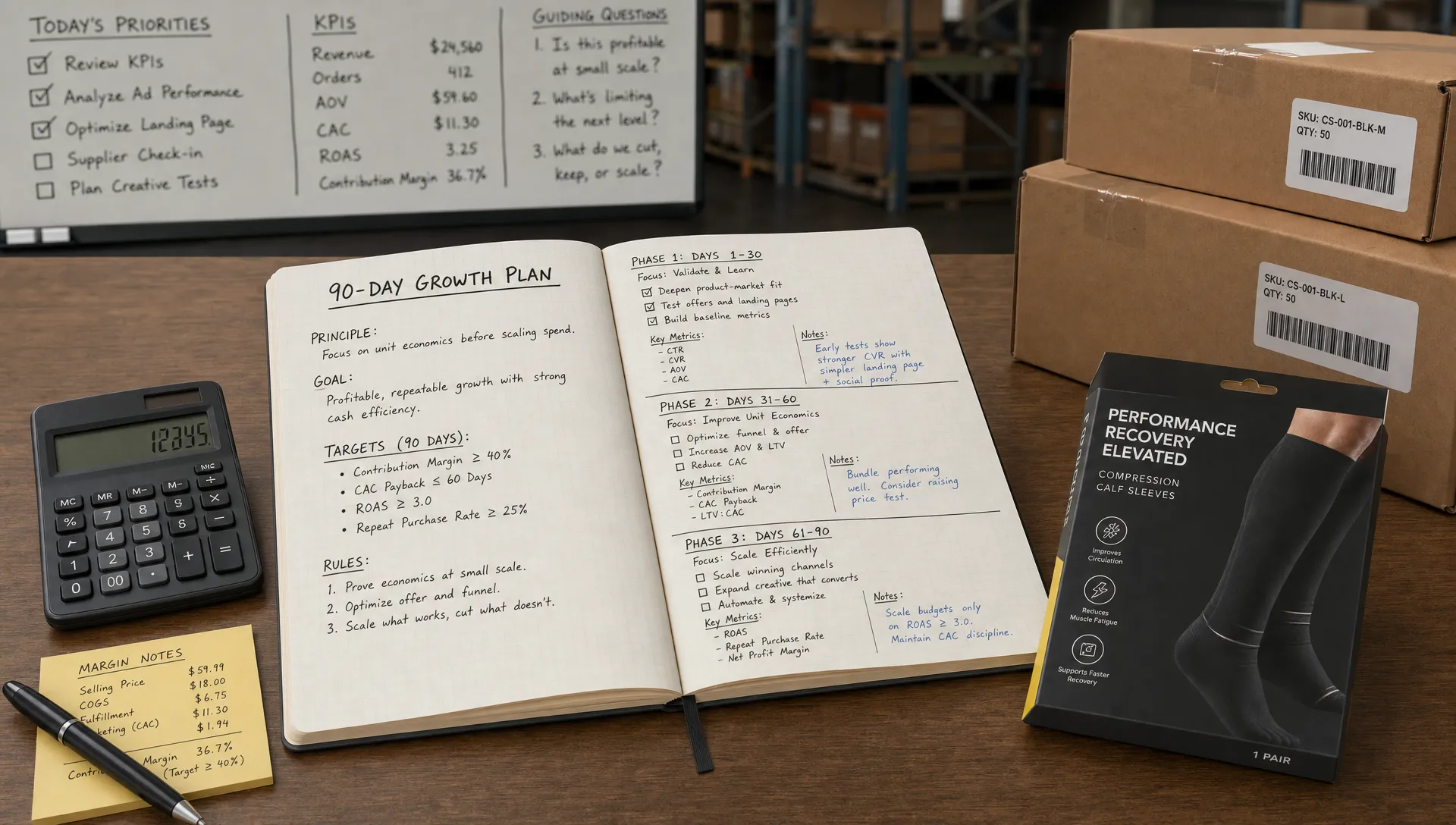
Before increasing budget, calculate the break-even CAC for each key product or bundle. This should include cost of goods sold, payment processing, fulfillment, shipping, returns, discounting, and any platform or agency fees. Then compare that number with actual acquisition cost by campaign and product.
If you do not know your break-even CPA, you are not really optimizing PPC. You are guessing with a more expensive interface.
A more profitable approach is to separate campaigns by economic reality. Push higher-margin bundles, starter kits, subscriptions, or products with strong repeat purchase behavior more aggressively than low-margin single-item orders. OPTYO breaks down this broader mindset in its guide to performance marketing for ecommerce profitability, where paid acquisition is treated as part of the full profit equation rather than a standalone media-buying exercise.
Mistake 2: Treating Every Searcher as Equally Ready to Buy
Not every click has the same intent. Someone searching for best electrolyte powder for marathon training is in a different mindset than someone searching for what causes muscle cramps. Both users may be relevant, but they should not receive the same bid, message, or landing page.
High-intent searches usually deserve stronger bids and more direct product pages. Research-stage searches may need education, comparison content, quizzes, email capture, or retargeting before they convert profitably. When brands pay purchase-level prices for awareness-level clicks, profit gets squeezed.
Intent also changes by category. The same logic applies outside ecommerce: a person searching for a holistic dentist in Tulsa expects a focused local service experience, while a shopper comparing recovery boots or protein bars may need product proof, reviews, usage guidance, and shipping clarity before buying.
For ecommerce PPC, the fix is to map keywords and audiences to the buyer journey. Bottom-funnel traffic should see frictionless purchase paths. Middle-funnel traffic should see proof, education, comparisons, and strong reasons to trust the brand. Top-funnel traffic should usually be measured with a longer view, because forcing it into immediate ROAS goals can cause platforms to cut off valuable demand creation.
Mistake 3: Letting Tracking Tell a Half-True Story
Bad tracking does not just make reporting messy. It changes how platforms learn.
If your campaigns optimize toward the wrong event, such as page views instead of purchases, add-to-cart instead of profitable purchases, or all purchases instead of new customer purchases, the algorithm will find more of what you asked for. That may not be what the business needs.
Tracking issues often appear in subtle ways. A purchase pixel fires twice. Subscription purchases are counted the same as one-time discounted orders. Returning customers from email are credited to paid search. Google Ads, Meta, Shopify, and analytics platforms all report different numbers, and the team chooses whichever version makes performance look best.
The solution is not to obsess over perfect attribution. Perfect attribution does not exist. The solution is to create a consistent measurement framework that is useful for decisions.
At minimum, ecommerce brands should align ad platform data with backend sales, new customer counts, refund data, and blended performance metrics. For brands with longer consideration cycles, post-purchase surveys and first-party customer data can also help clarify which channels create demand and which channels harvest it.
When tracking is weak, profitable campaigns can get cut and unprofitable campaigns can receive more budget. That is one of the fastest ways PPC turns from growth engine into margin leak.
Mistake 4: Scaling Before the Offer and Landing Page Are Ready
More budget does not fix a weak offer. It only exposes the weakness faster.
Many founders assume that if a campaign is not converting, the problem is targeting. Sometimes it is. But often the bigger issue is what happens after the click. The product page does not answer objections. The value proposition is generic. The mobile experience is slow. Shipping costs appear too late. Reviews are thin. The subscription offer feels risky. The page asks for the sale before the shopper understands why this brand is different.
This is especially costly in competitive fitness and wellness markets, where shoppers compare ingredients, materials, certifications, durability, flavor, sizing, recovery benefits, and brand credibility before purchasing. If the landing page does not reduce uncertainty, the ad has to work too hard.
Before increasing spend, audit the conversion path. Look at page speed, above-the-fold clarity, product imagery, social proof, guarantee language, bundle logic, checkout friction, and email capture. Small conversion rate improvements can change the entire economics of PPC. A campaign that is unprofitable at a 1.5 percent conversion rate may become scalable at 2.5 percent without lowering CPC at all.
This is why a strong agency should not only ask how to spend more. It should also ask what needs to be fixed before scaling ads.
Mistake 5: Using Automation Without Guardrails
Automation is not the enemy. Blind automation is.
Modern PPC platforms rely heavily on machine learning, broad match, dynamic creative, automated bidding, and audience expansion. These tools can improve performance when the inputs are clean. They can also burn budget quickly when conversion tracking, product feeds, audience signals, and campaign structure are weak.
For example, a broad match campaign may find valuable long-tail queries, but it may also spend on searches that have little purchase intent. A Performance Max campaign may generate sales, but if it over-indexes on branded demand or remarketing, it can inflate ROAS without creating much incremental growth. A paid social campaign may find cheap conversions from existing customers while new customer acquisition remains too expensive.
Guardrails matter. Review search terms, exclude poor-fit queries, segment branded and non-branded demand, monitor new versus returning customers, and make sure automated campaigns are optimizing toward events that reflect business value.
The goal is not manual control for its own sake. The goal is to give automation better instructions. OPTYO explains this system-level approach in its article on how a pay per click agency lowers wasted spend, including the role of intent, negative keywords, tracking, landing pages, and economics.
Mistake 6: Chasing Cheap Clicks Instead of Qualified Demand
Low CPC feels efficient, but cheap traffic can be expensive if it does not convert or retain.
This often happens when brands optimize for surface-level metrics: click-through rate, cost per click, impressions, or traffic volume. Those numbers matter, but only when connected to business outcomes. A campaign can drive thousands of inexpensive clicks from curiosity-driven audiences and still produce poor purchase quality.
For a D2C fitness brand, a low-cost click from someone who likes workout memes is not the same as a higher-cost click from someone actively searching for a knee sleeve, hydration mix, or strength program. The first may be useful for awareness if measured correctly. The second is closer to revenue.
Creative can cause the same issue. Overly broad hooks such as this changed my life or everyone needs this may attract attention without qualifying the buyer. Better creative filters the audience by making the product promise, use case, and customer fit clear. That may reduce click volume, but it can improve conversion rate and profit.

Mistake 7: Confusing ROAS With Incremental Growth
ROAS is useful, but it can lie by omission.
Branded search campaigns often show excellent ROAS because people already know the brand. Retargeting campaigns can also look strong because they reach shoppers who were already close to buying. These campaigns may be worth running, but they should not be treated the same as campaigns that create new demand.
The profit problem appears when a brand averages everything together. Blended ROAS looks stable, so the team scales budget. But most of the reported return may be coming from branded, returning, or remarketing audiences, while prospecting campaigns are losing money.
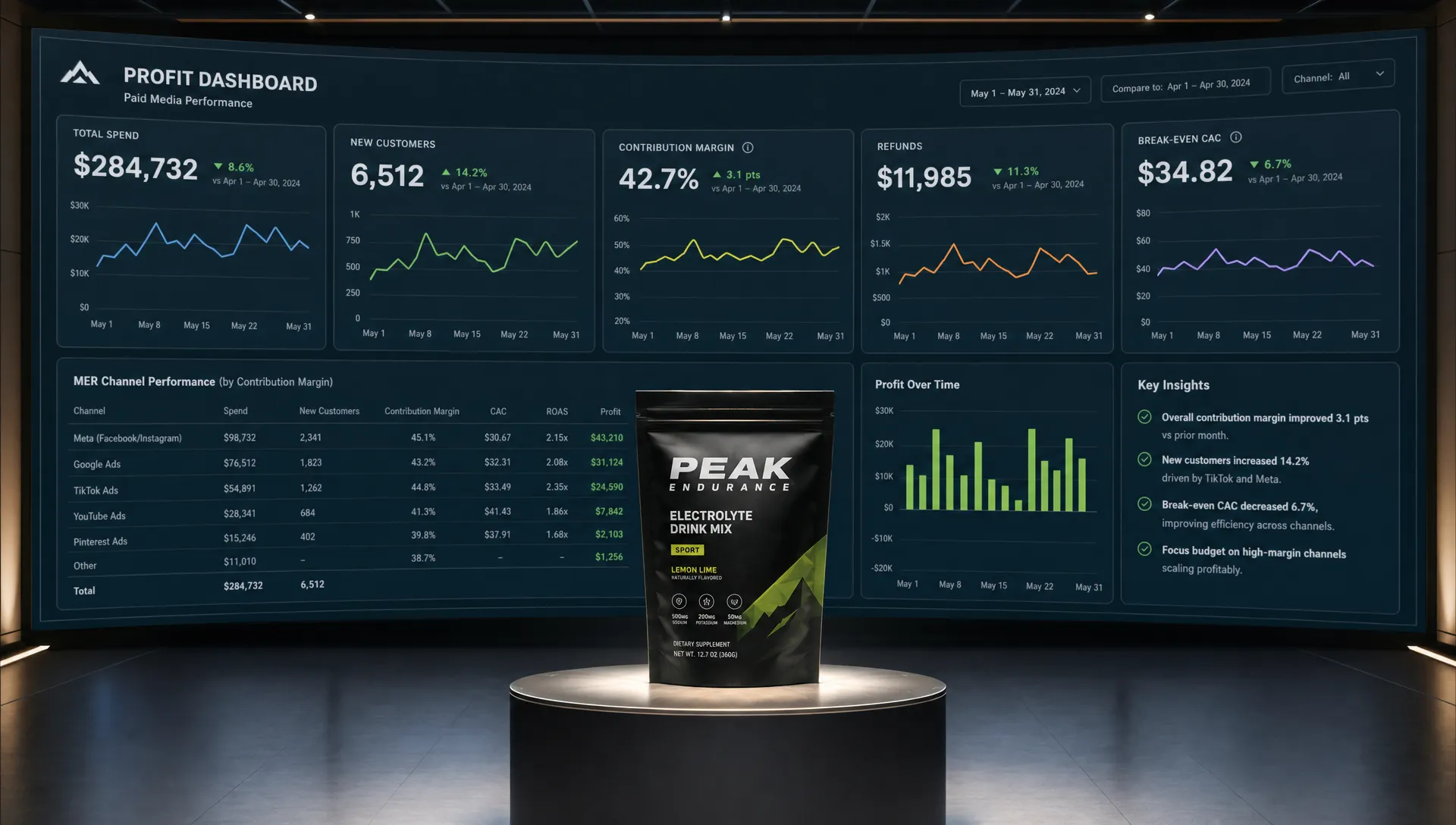
To avoid this, separate demand capture from demand creation. Track branded and non-branded search separately. Watch new customer CAC. Compare platform ROAS with MER, which is total revenue divided by total ad spend. Look at contribution margin, not just gross revenue.
Incrementality does not have to be complicated at first. Even simple holdout tests, geo tests, or budget pacing comparisons can reveal whether paid media is creating new profitable demand or taking credit for sales that would have happened anyway.
Mistake 8: Ignoring Retention After the First Purchase
A first purchase is not the finish line. In many sports, fitness, and wellness categories, profit depends on repeat purchase.
Supplements, functional foods, apparel, recovery tools, coaching programs, and wellness products often have very different payback windows. If you judge every campaign only on first-order ROAS, you may underinvest in channels that acquire high-quality customers. But if you assume lifetime value without proof, you may overspend and wait for repeat purchases that never arrive.
The right approach is to connect PPC with retention. Email marketing, post-purchase education, replenishment reminders, loyalty offers, referral programs, and community building can all improve the value of each acquired customer. Paid media should not be isolated from these systems.
For example, if a hydration brand knows customers typically reorder every 30 days, the post-purchase flow should reinforce usage habits, collect feedback, and make the second purchase easy. If an apparel brand has strong cross-sell potential, the first purchase should trigger personalized recommendations based on sport, fit, or training style.
PPC becomes more profitable when the business has a plan for what happens after the first order.
Mistake 9: Making Decisions Too Quickly, or Waiting Too Long
PPC requires disciplined decision-making. Many brands fail on one of two extremes.
Some teams change campaigns daily because early results look unstable. They pause ads before learning has enough data, reset bid strategies too often, and never allow a test to reach a useful conclusion. Other teams do the opposite. They let weak campaigns run for weeks because they hope performance will improve, even though the same problems keep showing up.
A better process defines the test before launch. Know what you are testing, what success means, how much budget is required, and when the decision will be made. A creative test, keyword test, landing page test, and offer test may all need different timelines and success metrics.
This does not mean ignoring early warning signs. If tracking is broken, the landing page is down, spend is going to irrelevant queries, or CPMs spike far beyond normal ranges, intervene quickly. But if the campaign is simply moving through normal learning volatility, give it enough data to be judged fairly.
The most profitable PPC teams are neither reactive nor passive. They operate with a testing cadence.
Mistake 10: Running Ads Before Positioning Is Sharp
Paid media amplifies positioning. It cannot replace it.
If your brand promise sounds like every competitor, your PPC campaigns will fight on price, discounts, and aggressive claims. That is a difficult place to protect margin. In crowded fitness and wellness categories, strong positioning helps shoppers quickly understand who the product is for, why it is different, and why it is worth paying for.
Weak positioning shows up in ads as vague benefits, interchangeable headlines, and creative that could belong to any brand. Strong positioning shows up as specificity: built for endurance athletes training in heat, protein snacks for parents who lift before work, recovery gear for runners managing high-mileage weeks, or clean-label hydration for teams and clubs.
Specificity may narrow the audience, but it often improves profit because it attracts buyers with clearer need and higher intent. PPC does not need to reach everyone. It needs to reach the right people with a message that makes the next step obvious.
A Simple PPC Profit Audit for Ecommerce Brands
If your ad account is spending but profit is not improving, start with a short audit before changing budgets. The goal is to identify whether the issue is traffic quality, economics, conversion, measurement, or retention.
Use these questions as a practical starting point:
- Do we know the break-even CAC for each main product, bundle, and subscription offer?
- Are campaigns separated by intent, such as branded, non-branded, shopping, prospecting, and remarketing?
- Are we tracking new customers, returning customers, refunds, and contribution margin?
- Are automated campaigns guided by clean conversion events and strong exclusions?
- Does the landing page answer the objections created by the ad?
- Are we measuring creative by purchase quality, not just click-through rate?
- Do retention flows increase the value of customers acquired through PPC?
- Are we making test decisions based on enough data and a clear hypothesis?
- Can we explain which campaigns create incremental demand and which capture existing demand?
If the answer to several of these questions is unclear, the problem may not be the ad platform. It may be the growth system surrounding it.
How to Fix PPC Without Killing Momentum
Improving PPC profitability does not always require a full rebuild. Often, the best move is to stabilize the foundation while keeping useful campaigns running.
Start by protecting what is already working. Identify campaigns that consistently acquire customers within an acceptable payback window. Then isolate the waste. Look for irrelevant queries, poor landing page match, low-margin products receiving too much spend, over-crediting of branded traffic, and campaigns optimized to shallow events.
Next, prioritize fixes by financial impact. If tracking is broken, fix that first because every decision depends on it. If conversion rate is weak across all paid traffic, focus on landing pages and offers. If CPCs are rising but conversion quality is strong, improve creative and audience segmentation. If first-order economics are tight but repeat purchase is strong, improve retention measurement and payback modeling.
The key is to avoid random optimization. Profit does not improve because a team makes more changes. It improves because the right constraints are removed in the right order.
Frequently Asked Questions
What is the biggest pay per click advertising mistake ecommerce brands make? The biggest mistake is optimizing for revenue or ROAS without understanding contribution profit. A campaign can generate sales and still lose money after product costs, shipping, discounts, returns, and fees are included.
How do I know if my PPC campaigns are profitable? Start with break-even CAC, then compare it with actual new customer acquisition cost and contribution margin. Also review blended metrics such as MER, refund rates, repeat purchase behavior, and product-level margin.
Is a high ROAS always good? No. High ROAS can be misleading if it comes mainly from branded search, remarketing, returning customers, or low-margin products. ROAS should be evaluated alongside incrementality, new customer growth, and profit.
Should I use broad match and automated bidding? Yes, but only with guardrails. Automation works best when tracking is clean, negative keywords are maintained, conversion events are meaningful, and campaigns are monitored for traffic quality and incremental value.
How often should PPC campaigns be optimized? Campaigns should be monitored frequently, but major decisions should follow a defined testing cadence. Change campaigns quickly when tracking or spend quality is broken, but avoid resetting tests before enough data is collected.
Turn PPC From Spend Into Scalable Profit
The brands that win with PPC are not simply better at buying clicks. They are better at connecting paid media to economics, offer strategy, conversion rate, creative, retention, and measurement.
For sports, fitness, and wellness ecommerce brands, this is where OPTYO focuses: performance marketing, creative, ecommerce development, conversion rate optimization, email marketing, SEO, KPI reporting, and growth consulting working together as one profit system.
If your campaigns are generating activity but not enough profit, the next step is not always more budget. It is a sharper diagnosis of where profit is leaking, and a plan to fix it before you scale.